What Is Media Monitoring? A Practical 2026 Guide
What it covers, what it actually costs, and how teams set it up in 2026 — with real numbers and real practitioner quotes.
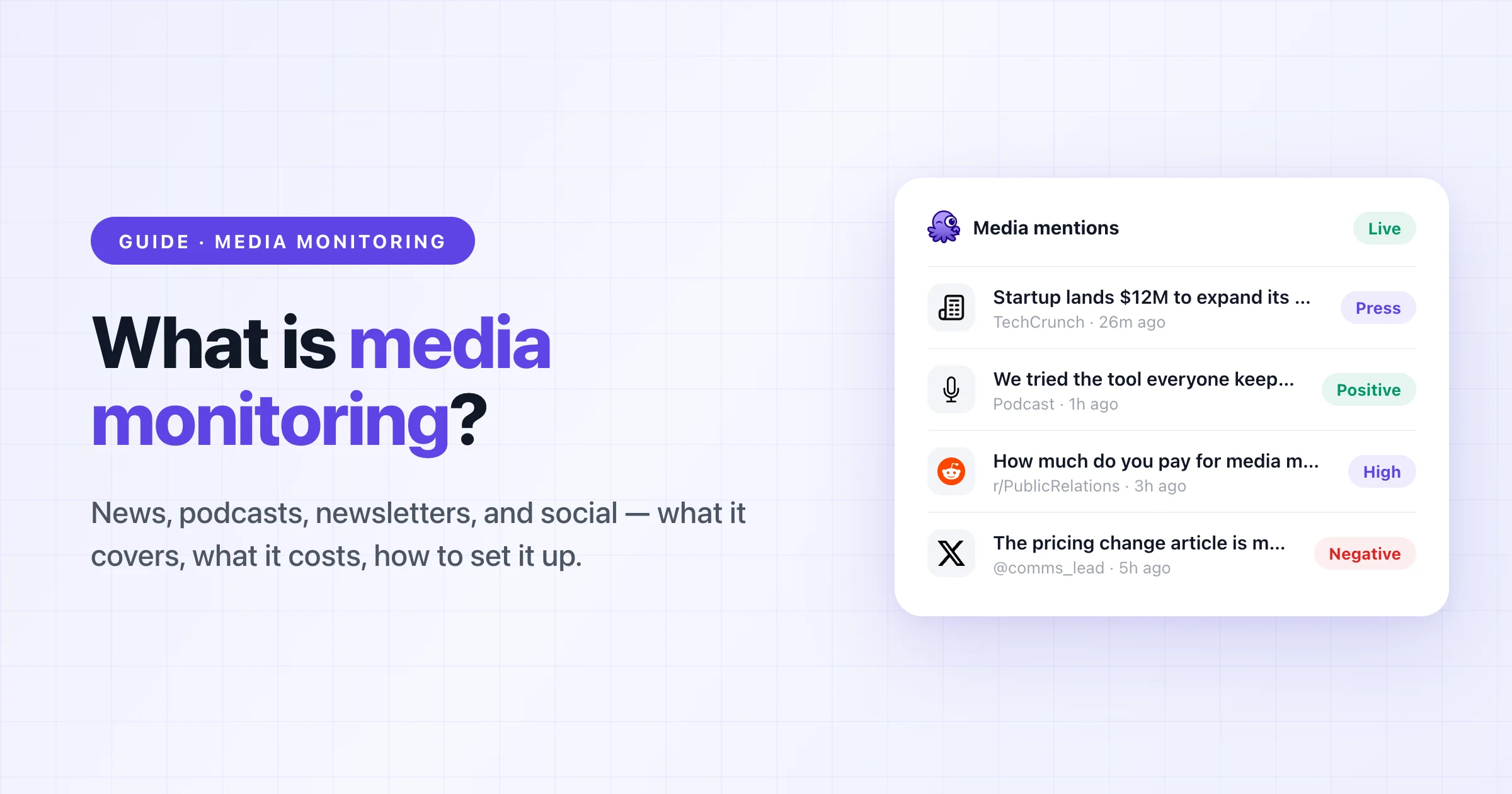
Media monitoring is the practice of automatically tracking mentions of your brand, products, competitors, or industry keywords across published media — news articles, blogs, podcasts, newsletters, and social platforms — so that relevant coverage reaches your team shortly after it appears. The point is speed and completeness: knowing about the article, review, or thread while you can still respond, amplify, or correct it.
That definition sounds simple, and the collecting part is. What makes media monitoring interesting in 2026 is everything around it: what counts as "media" now, how AI changed the filtering, what these tools really cost (the list prices are hard to find, so we collected real contract numbers below), and what teams actually do with the mentions once they have them.
We build Octolens, a monitoring tool, so we're a vendor in this category — I'll point out where our product fits and where a different category of tool is the better choice.
"Media" used to mean newspapers, magazines, TV, and radio. Today the coverage that moves opinion about a company is spread across many more places, and a monitoring setup has to decide which of them to watch:
| Media type | What it includes | Why it matters |
|---|---|---|
| News & press | Online publications, trade press, regional outlets, press releases | Coverage that ranks in search and gets cited by AI assistants for years |
| Blogs & newsletters | Industry blogs, Substacks, curated newsletters | Where niche audiences actually read about tools and companies |
| Podcasts & video | Podcast episodes, YouTube reviews and tutorials | High-trust, high-influence mentions that most tools still miss |
| Social & communities | Reddit, X, LinkedIn, Hacker News, forums | Where buying questions get asked and reputations form in public |
| Broadcast & print | TV, radio, physical newspapers | Still relevant for consumer brands and crisis work; needs enterprise tooling |
Most teams don't need all five. A B2B software company lives in the first four rows. A consumer brand doing crisis-prone work is the main case where broadcast and print clipping still earn their cost.
One thing that changed in the last few years: the lines between these types blur quickly. A journalist publishes an article, someone posts it on Hacker News, the comment thread develops its own opinion of your product, and a newsletter quotes the thread two days later. Monitoring only the article means seeing a third of the story.
These terms overlap a lot, and vendors use them loosely. The practical differences:
- Media monitoring is the umbrella term, with a historical lean toward news, press, and broadcast. When a PR team says "media monitoring," they usually mean tracking earned coverage.
- Social listening focuses on conversations — social platforms and communities — and on analyzing them for trends and sentiment, beyond your own brand name.
- Brand monitoring is scoped by subject rather than by channel: tracking mentions of your brand and products, wherever they appear, so someone can respond.
- Media intelligence is what the enterprise suites call the analytics layer on top: dashboards, narrative analysis, reporting for leadership.
For example, when a customer asks us whether they need social listening or media monitoring, the honest answer is usually that the distinction matters less than coverage: they need one feed that includes the trade article and the Reddit thread about it, because the two together are the actual story.
Measuring PR and amplifying coverage. The classic use case. A publication writes about you; the value of that article depends heavily on what you do in the first day — sharing it, thanking the author, getting it in front of customers. Teams that learn about coverage from a weekly report consistently miss that window.
Catching problems early. Negative coverage compounds. An article about a billing issue gets syndicated, quoted, and discussed, and each hop makes it harder to correct the record. The teams that handle this well hear about the story within the hour. As an example from our own customers: Vercel routes mentions into more than 20 team-specific Slack channels, so the team that owns a problem sees the conversation about it directly.
Competitive intelligence. Tracking competitor names surfaces their launches, their coverage, and — often most useful — articles and threads where people compare them to you. That feeds positioning, sales enablement, and roadmap discussions with real outside language instead of internal assumptions.
Feeding AI workflows. This one is newer. Once mentions are structured data with relevance and sentiment scores, they stop being something only humans read. Customers pipe mentions through webhooks into ticketing systems, CRMs, and AI agents that classify, summarize, and draft responses. An agent can already see your code, docs, and tickets; monitoring gives it ears for what's being said outside the company.
Media monitoring is genuinely old. Clipping bureaus have existed since the 1800s, and the workflow barely changed for a century: humans read publications, cut out relevant articles, and mailed them to clients.
"In the 19th century, industrial magnates and politicians would pay for 'press cuttings' or clipping services that summarized the news of the day for them. Even today, wealthy individuals will pay secretaries and assistants to do the same."
The modern pipeline automates each step of that. What happens is:
- You define keywords — your brand, products, competitors, executives, and a few industry terms. This is the step most worth doing carefully: too broad and you drown, too narrow and you miss the conversations you wanted.
- The tool collects mentions from its source network continuously. Coverage breadth is the real differentiator between tools here, and it's worth testing with your own keywords rather than trusting the sources page.
- AI filters and scores each mention for relevance and sentiment. This is the part that changed most in the last few years. Keyword matching alone made monitoring unusable for common-word brand names; LLM-based filtering made it workable, because the model can tell whether a post about "Notion" means the product or the concept.
- Mentions get delivered — to a dashboard if you want one, but more usefully into Slack, email, a webhook, or an API, where your team and your automations already are.
Two honest caveats about the AI step. Sentiment analysis has been oversold for a long time — practitioners were reporting roughly 60% accuracy from the pre-LLM generation of tools:
"We've found most automated sentiment analysis to be subpar (at best, 60% accurate). The problem with just looking at words is that there is no context of the whole Tweet."
LLMs improved this a lot, especially with company context to score against, but sentiment on sarcastic or mixed posts is still judgment, and no vendor should tell you otherwise. And coverage gaps are real even at the top of the market:
"We have moved tools several times in the last few years and have used pretty much all of the big guys. They are all rubbish — we're with the global leader at the moment (no names) and we regularly find coverage that they've missed."
If you read practitioner discussions, one theme comes up again and again — collecting mentions is solved, and the work has moved to deciding what matters:
"Monitoring itself is easier than ever; making sense of it is what's gotten harder. … Signal ≠ volume anymore. Mentions are cheap. Context isn't. One niche journalist, creator, or analyst can move sentiment more than 200 generic pickups."
That matches what we see with customers. The setups that survive are the ones where every alert has an owner and a possible action. A feed someone has to remember to check gets abandoned in week three. A filtered stream in the Slack channel of the team that can act on it keeps working, because the cost of consuming it is near zero.
The practical implication: the useful measure of a monitoring setup is how many mentions led to an action, for example a reply, an escalation, a share, or a ticket. Raw mention counts mostly measure how broad your keywords are.
This is the least transparent part of the market. The enterprise suites don't publish prices, and buyers notice:
"Currently considering whether to renew our media monitoring contract and the lack of price transparency only serves the interest of these companies. … I'll go first: About $13k a year." — DiscoFriesPls on r/PublicRelations
"It costs whatever the sales rep wants to make it cost. Best thing to do is negotiate at the end of a quarter." — Comfortable_Big_3571, same thread
Combining self-reported contracts from that thread with procurement data, the market has three price bands:
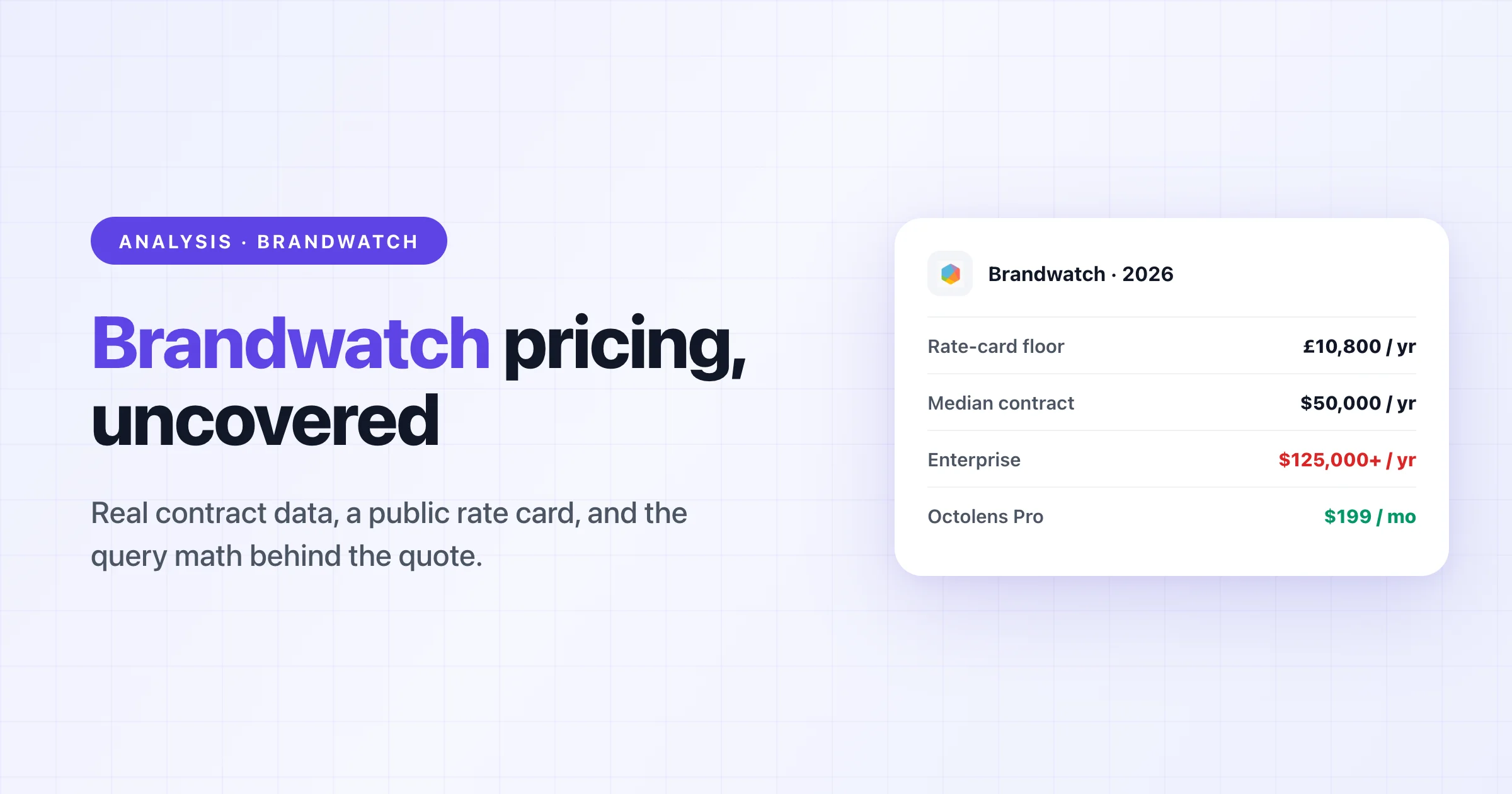
Enterprise suites — roughly $10,000 to $130,000+ per year. Meltwater's contracts run a median of $25,800/year in Vendr's data across 126 purchases; Brandwatch's Vendr median is around $50,000/year; Cision is custom-quoted, with Reddit buyers reporting $13k–$23k. Self-reported contracts in that thread scatter widely for similar usage, and almost everyone who shares a number also shares a negotiation story:
"I've tried Cision, Meltwater, and Muckrack. Year-long contracts with each … They initially quoted me $12,500-ish per year for 3 seats, I got them down to $10k … I had to sign an NDA to get out of a contract with one of the other two mentioned, because what they promised vs. what was delivered was...off by a mile."
What you get for that money: broadcast and print clipping, journalist contact databases, press-release distribution, and account management. If you need those, this band is the only place to get them.
Self-serve monitoring tools — roughly $50 to $600 per month. Tools like Brand24 (from $199/month billed annually), Mention, and Octolens ($199/month) cover online media — news, blogs, podcasts, newsletters, and social platforms — with monthly billing and no sales call. We compared the segment in detail in our social media monitoring tools roundup. This band is where most product-led and B2B software companies land, because their coverage lives online and they don't need a journalist database.
Free — Google Alerts and Talkwalker Alerts. Genuinely fine for a low-stakes brand name, with known gaps: delayed digests, patchy coverage of smaller outlets, no social platforms to speak of, no filtering. The common failure mode is assuming free alerts catch everything. They don't, and usually a customer is the one who tells you what you missed.
For a deeper breakdown of the enterprise band, including a public rate card, see our Meltwater pricing analysis.
Whether a report is useful depends on whether it changes decisions. The metrics that tend to:
- Mention volume against your own baseline. Absolute numbers mean little; a 3x spike against your normal week means something happened worth understanding.
- Sentiment ratio over time. The trend matters more than the score, and the why matters more than the trend. "Negative share doubled after the pricing change article" gives you something to act on, while a standalone score like "sentiment is 71 today" usually doesn't.
- Share of voice against two or three named competitors, on a consistent keyword set.
- Response time on actionable mentions — the metric that most directly reflects whether monitoring is working as an operational system.
- Recurring themes inside negative and confused mentions, which is roadmap and docs input, essentially for free.
The format matters as much as the metrics. A monthly PDF assembled by hand is the modern version of the mailed clippings envelope, and it has the same problem: by the time anyone reads it, the stories in it are over. If the underlying data is accessible — through an API or exports — the report can be a live view or an automated weekly summary instead, and the human time goes into interpretation.
- Write down the actions first. Who responds to a negative article? Who shares positive coverage, and where? Who sees competitor launches? If a mention type has no owner and no action, don't alert on it.
- Start with a narrow keyword set. Your brand, product names, common misspellings, and your two most-compared competitors. Add industry terms later, once relevance filtering is tuned — going too broad on day one buries the signal and burns your patience.
- Route mentions where the owners already work. Slack channels per team beat one shared inbox. As an example, Tally runs mentions into the tools they already use daily and keeps response time under five minutes without anyone watching a dashboard.
- Tune for two weeks, then trust it. Mark irrelevant mentions, add negative keywords, adjust thresholds. The goal is a feed where most alerts deserve a look.
- Connect the data to your systems once the basics work — webhooks into ticketing for bug reports, API pulls for reporting, or an agent that drafts a daily brief of the five mentions worth responding to.
The honest cases against buying anything: your brand gets a handful of mentions a month and Google Alerts plus a weekly manual search covers it. Or you're pre-launch and there is no coverage to monitor yet — spend the time earning mentions instead of tracking them. Or your coverage is genuinely broadcast-first, in which case the enterprise suites are the right category and a tool like ours isn't.
The case for a tool is volume and stakes: enough mentions that manual checking fails, or few enough hours that the checking never happens, or coverage that moves fast enough that finding out late costs real money.
If your coverage lives online — press, blogs, podcasts, newsletters, communities — that's the segment we built Octolens for: one feed across 150,000+ news sources and every major social platform, AI-filtered, delivered into Slack or your own systems via API, webhooks, and MCP. And if you need clipping for TV segments or a database of journalist contacts, take the enterprise-suite band seriously despite the pricing games; that's what it's for.