Brandwatch Pricing in 2026: What It Actually Costs (Real Contract Data)
Brandwatch won't publish prices, so we did the digging: real contract data from 40 tracked purchases, Brandwatch's own public government rate card, and the contract details worth checking before you sign.
Try to find a price on brandwatch.com. There's a plans page, it lists three products, and there isn't a single number on it — every path ends at "schedule your free demo."
The people who went through that funnel describe the result pretty consistently. One agency marketer on Reddit shared their actual bill while shopping for a cheaper option: "Currently we pay about $10,000/year for Brandwatch … We have two user seats … though I'm really the only one who uses the tool." The first reply: "$10k/year for 2 users that's for social media? Are you serious?" And that was one of the small contracts.
The numbers are out there, though. Vendr tracks real Brandwatch contracts from real buyers, and — the best source we found — Brandwatch filed an actual rate card with the UK government's public procurement marketplace. This post pulls it all together: what Brandwatch really costs in 2026, how the query-based pricing model works, what's hidden in the add-ons, and how to decide whether it's worth it.
(Disclosure up front: we build Octolens, a social listening tool that competes with Brandwatch for part of this market. We'll be explicit about where we're a good alternative and where we're not — Brandwatch does things we don't.)
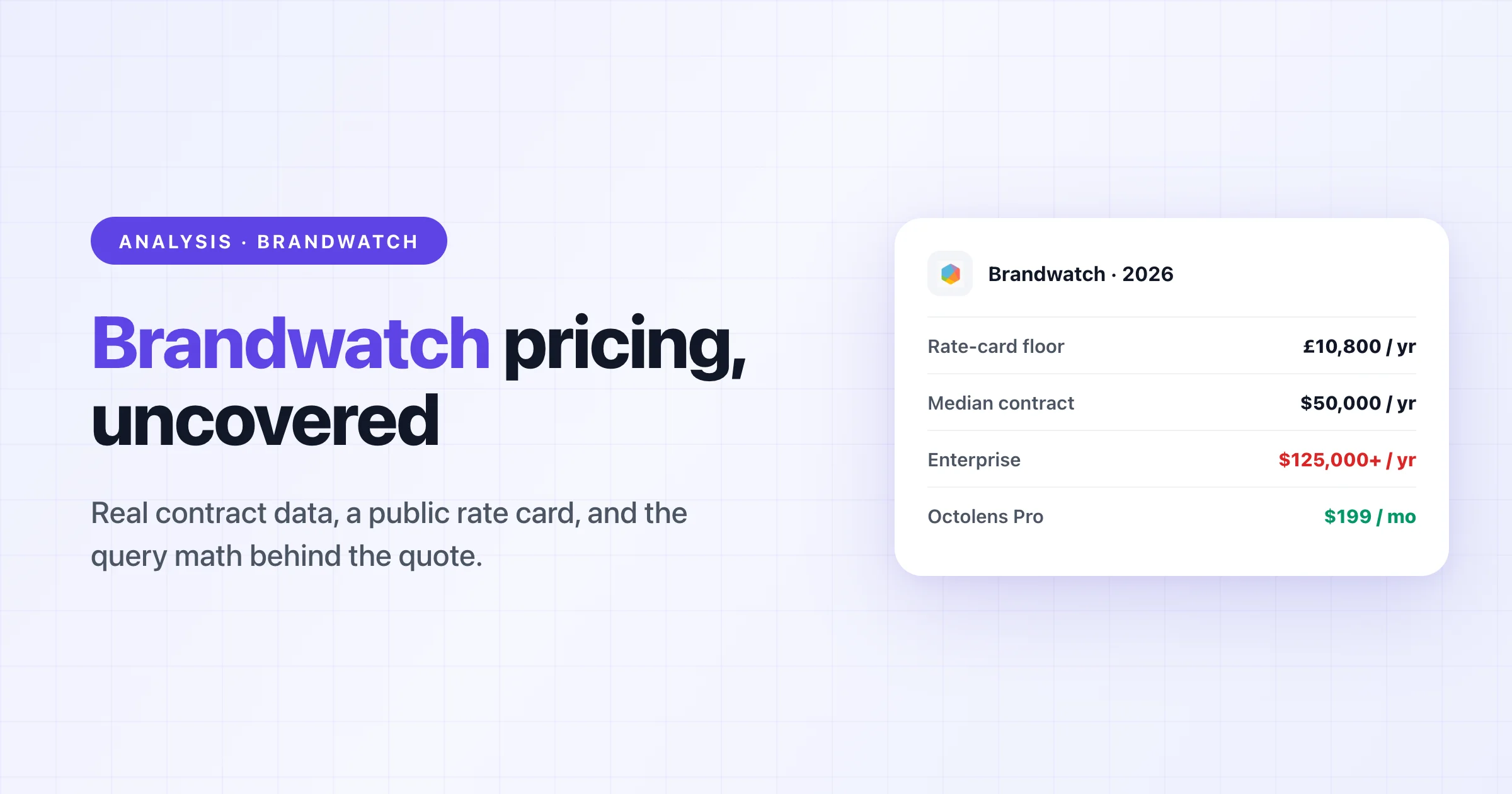
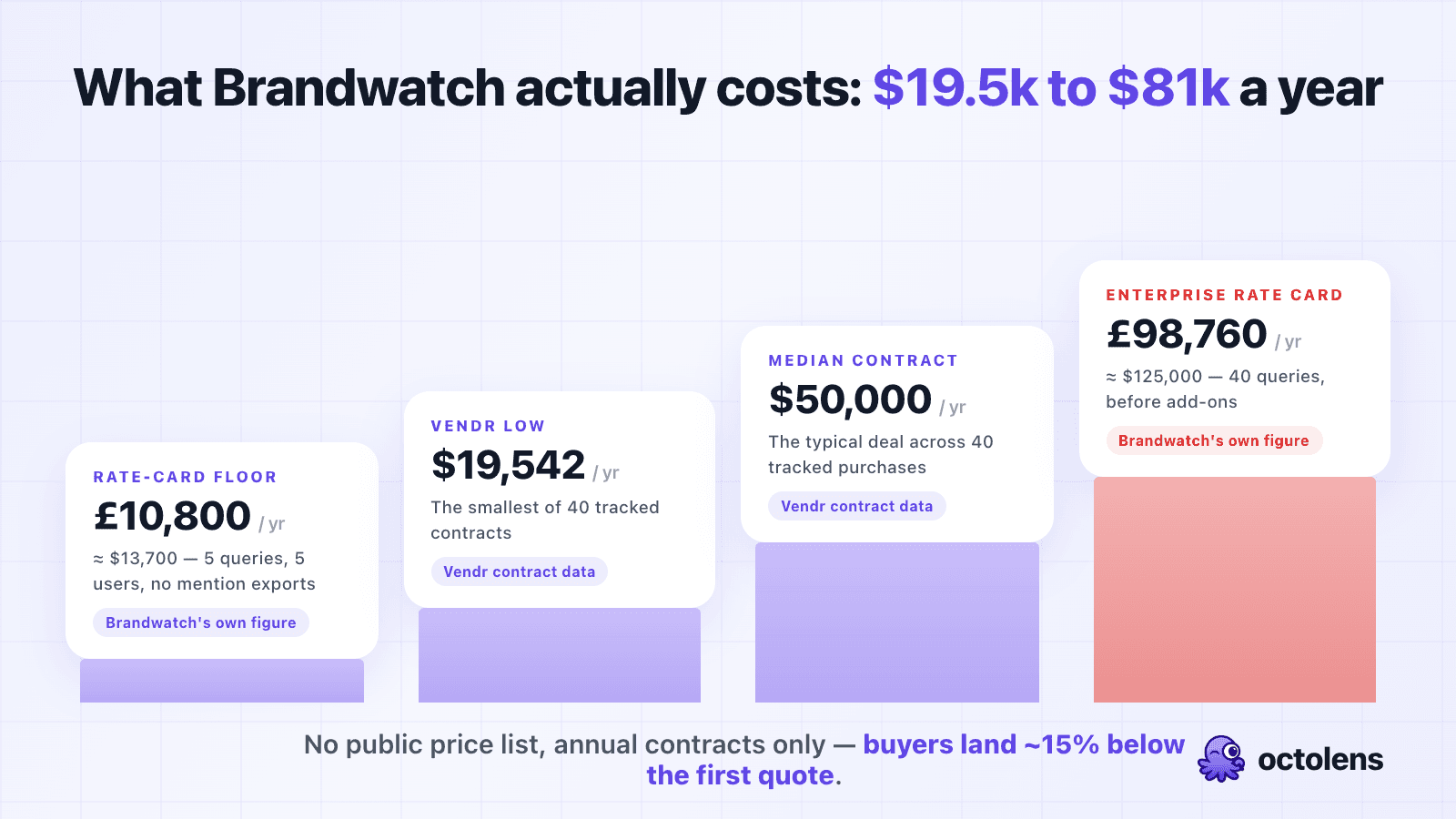
Short answer: the median Brandwatch contract is $50,000 per year, and real contracts range from about $19,500 to $81,200.
Here's the same question answered from four independent sources:
| Source | What it says |
|---|---|
| Brandwatch's own plans page | No prices published — custom quotes only, behind a demo call |
| Vendr (40 tracked purchases, updated Feb 2026) | Median contract $50,000/yr, range $19,542–$81,200 |
| Brandwatch's public UK government rate card | Consumer Intelligence from £10,800/yr (about $13,700), Social Media Management from £13,800/yr (about $17,500) |
| User reports on Reddit | $10,000/yr for a 2-seat agency setup (an older, small contract — below today's Vendr floor) |
The gap between the rate-card floor and the Vendr median is the important part. The £10,800 entry package exists, but it comes with limits most buyers outgrow in the sales call itself — 5 saved queries, 1 year of data, no mention exports. By the time a typical insights team has scoped what it actually needs, the quote lands near $50,000. That's also why independent researchers keep arriving at the same number: a 9-vendor pricing study posted to Reddit in September 2026 notes that Brandwatch attaches "a dollar figure only through a demo, a buyer's own contract, or a tracked-purchase marketplace like Vendr" — and cites the same $50,000 median.
For how this compares across the category: Meltwater's median contract is $25,800/year, Sprout Social prices per seat with an unpriced listening add-on, and the full landscape from $29/month upwards is in our social listening tools guide.
Brandwatch sells three products, each quoted separately. Understanding which one you're actually being quoted for matters, because they overlap just enough to be confusing.
This is the deep social listening product (the app itself is called Consumer Research). It comes in Pro, Premium, and Enterprise packages, and pricing runs on one of two models:
- Query model — you pay for the number of saved searches you can have running at once
- Mentions model — you pay for the volume of results collected per month (Premium and Enterprise only)
The package tier decides your limits: Pro gets up to 5 users, 1 year of historical data, and no mention exports at all. Premium gets 20 users, 2 years of data, and exports up to 10k mentions per day. Enterprise raises that to 50 users and 100k per day. Basic API access is included in all three, but the rate limits are real — lifting them is a paid add-on (more below).
The publishing, engagement, and monitoring suite (the old Falcon.io product, for anyone who remembers the acquisition). Standard is £13,800/year with 3 users and a single Listen query, Pro is £22,200 with 3 queries, Premium is £39,000 with 5. Extra Listen queries are £540/year each.
There's also a Listen Standalone option at £7,200/year (~$9,100) with 3 users and 3 searches — the closest thing Brandwatch sells to an entry-level listening product, and notably not something the sales process tends to lead with.
Influencer discovery and campaign management (Influence), at £27,000/year standalone or £8,100 for the discover-only version. Separate product, separate quote; API access for it is another £5,400/year.
From the rate card's own structure, your price moves with:
- Query count — each concurrent saved search costs roughly £1,400–£1,740/year at the margin
- Mention volume — on the mentions model, each additional 1M monthly mentions is £15,600–£22,800/year
- Package tier — Pro vs. Premium vs. Enterprise decides seats, data history, and export rights
- Historical data — access beyond the rolling window is a separate paid add-on
- Channels — extra Facebook/Instagram and Twitter/X channel packs are priced separately
- Contract length — Vendr's data shows 15–25% discounts for 2–3 year commitments
To sell to the UK government, Brandwatch filed a 17-page pricing document on the G-Cloud 14 procurement marketplace. It's public, anyone can read it, and it's the only place Brandwatch itself puts numbers next to its products. (Prices are GBP and from the May 2024 filing — treat them as the shape of the pricing, and expect your commercial quote to differ.)
The Consumer Intelligence query ladder, per year:
| Queries | Pro | Premium | Enterprise |
|---|---|---|---|
| 5 | £10,800 | £21,000 | n/a |
| 10 | £16,200 | £30,600 | £37,200 |
| 20 | £27,900 | £48,360 | £58,860 |
| 40 | n/a | £88,200 | £98,760 |
That top-right cell is worth converting: £98,760 is about $125,000/year — before add-ons. And the ladder keeps going: past 40 queries, each additional one is £1,440–£1,740/year.
Then the add-ons, each priced separately:
| Add-on | Price |
|---|---|
| Historical data access (Premium/Enterprise only) | £2,880–£10,650/yr depending on queries |
| Image Insights (logo detection in photos) | £14,440/yr |
| Logo Recognition (add your own logos) | £4,608 per logo per yr |
| Vizia Reporting (live report screens) | £7,680/yr |
| Additional Twitter/X channels (50) | £9,600/yr |
| Premium print data (Dow Jones + NYT) | £6,360–£20,400/yr by tier |
| API+ (rate limit increase) | £4,880/yr |
| Onboarding (Basic) | £3,000 one-off, or £2,625/yr recurring |
| Analyst reports (Bronze/Silver/Gold) | £7,500–£22,500 one-off each |
| Expert hours | £200/hr |
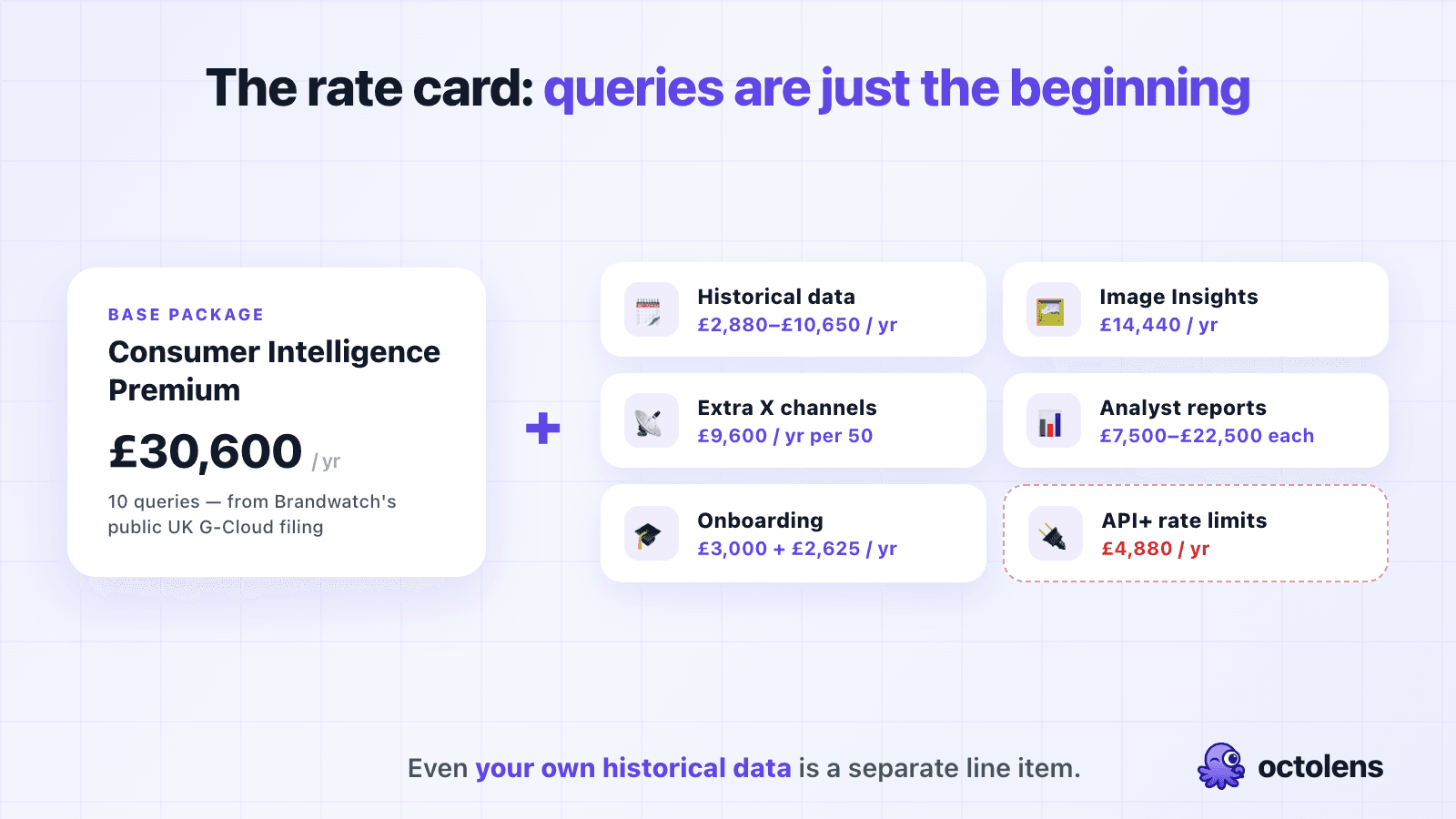
Three things jump out:
Your own historical data is an add-on. The base packages include a 1–2 year rolling window. Going further back — the archive depth that's supposed to be Brandwatch's headline strength — costs up to £10,650/year extra, and isn't available on Pro at all. The September 2026 pricing study mentioned above flags the same issue from the buyer side: get "the historical-data window in writing before signing" — Brandwatch is "the one vendor here with no retention figure published anywhere in its public documentation."
Onboarding can be a subscription. £3,000 one-off is normal for enterprise software. The £2,625/year recurring onboarding package — renewable training hours, forever — is a line item we haven't seen anywhere else in this category.
API access is included, but throughput is paid. Every Consumer Intelligence tier lists "Basic API," and then the rate card prices the rate-limit increase at £4,880/year. So programmatic access to your own mentions technically exists on every package; using it at production volume is another negotiation.
Reading the rate card next to Vendr's buyer data, the contract number is the start, not the total. Budget for:
- Onboarding: £3,000–£6,000 (Basic or Advanced), unless you take the recurring version.
- Historical data, if you need to look back further than your package's rolling window — and most research use cases do.
- Query creep. Queries are the unit of everything. Each brand, competitor, campaign, and topic is a query, and every one past your allowance is ~£1,500/year. Teams that start with 5 rarely stay at 5.
- Export ceilings. On Pro you cannot export mentions at all; on Premium you're capped at 10k/day. If your workflow involves getting data out of Brandwatch, the tier decides whether that's possible.
- Reports and services. The analyst-report tiers run £7,500–£22,500 per report, and anything custom is £200/hour.
One more structural cost: there is no monthly option and no self-serve trial. Every figure above is committed annually before you've used the product outside a demo. That's the part the smaller buyers consistently regret — as one user put it on X: "I tried it with brandwatch and realised it's only good for mega corps and those guys all have big enterprise gigs for listening."
Three realistic scenarios, assembled from the rate card and the Vendr data:
Scenario 1: A small team that wants listening, not a research department. The honest fit inside Brandwatch's catalog is Listen Standalone (£7,200/yr, 3 users, 3 searches) or Consumer Intelligence Pro with 5 queries (£10,800/yr, no exports). All-in with basic onboarding you're at roughly $13,000–$18,000 for year one — right where the Reddit agency's $10k legacy deal sits, and right where the seat waste starts. Two seats, one actual user is a pattern the sales process doesn't discourage.
Scenario 2: A mid-market consumer-insights team. Consumer Intelligence Premium with 10 queries (£30,600), historical data for those queries (£4,180), and basic onboarding (£3,000). That's £37,780 — about $48,000 for year one, which is Vendr's $50,000 median almost exactly. The rate card and the contract data land in the same place, which makes both easier to trust.
Scenario 3: An enterprise insights org. Enterprise at 40 queries (£98,760), Image Insights (£14,440), Vizia reporting (£7,680), advanced onboarding (£6,000). Over £126,000 — call it $160,000/year — and that's before extra channel packs, print data, or a single analyst report. This is the buyer Brandwatch is actually built for, and at this level you're negotiating a platform relationship, not a price list.
If Brandwatch is the right tool for your job, don't pay the first number. The dynamics are documented in Vendr's negotiation data:
- The first quote moves ~15%. Vendr's tracked buyers land an average of 15.29% below the initial Brandwatch quote. Treat the first number as an opening position, because that's what it is.
- Bring a Meltwater quote. The two get cross-shopped constantly (we've written up the direct comparison), and a real competing number moves the price more than anything you can say. Meltwater's median is half of Brandwatch's, which makes it a useful anchor even if you never intended to buy it.
- Trade contract length carefully. 2–3 year commitments earn 15–25% off. Real money — but weigh it against being locked into a tool you couldn't trial, from a vendor whose parent company went through a debt restructuring in 2025–2026.
- Get the data window in writing. Rolling data, query save history, and archive access are all tier-dependent and none of it is in Brandwatch's public documentation. Put the retention numbers in the order form.
- Size queries and exports at signing. Mid-term additions price at list. If you'll want 15 queries and daily exports by Q3, negotiate them now, not in Q3.
Honest answer: for the right buyer, yes — and the right buyer is narrower than the marketing suggests.
Where Brandwatch genuinely earns its price: consumer-insights research at scale. Consumer Research's archives, audience segmentation, and analytics genuinely go deeper than mid-market tools — as one practitioner put it in a recent thread, "Brandwatch is solid if you need deep archives and analyst-style reports, but the sales process is rough for small teams." It has an official Reddit data partnership, coverage across 100M+ sources, and reporting built for insights analysts presenting to executives. A consumer brand running always-on category research across markets is making a reasonable $50,000 purchase.
Concretely, Brandwatch is the right buy when:
- You're an insights or research team at a consumer brand — the segmentation and archive tooling is the actual product, and it's good
- You need image and logo detection — the Image Insights add-on tracks brand appearances in photos, which almost nothing mid-market does
- Procurement expects an enterprise vendor — annual contracts, security reviews, a dedicated CSM on the Enterprise tier
Where the price stops making sense: when the job is knowing what people say about your product and acting on it. Then you're paying $50,000/year for capped seats, capped exports, add-on historical data, and add-on API throughput — for mentions your team reads in a dashboard. The same buyer frustration shows up in how people describe the product experience: one thread asking for opinions on Brandwatch opens with the observation that these platforms "look very dated and I am surprised there's not much clean, light, helpful software for monitoring brands …"
That's the actual dividing line. Brandwatch sells research infrastructure for insights departments. If what you need is the mentions themselves — in Slack, in your CRM, in your AI agents, while the thread is still alive — you're buying the wrong shape of product, at ten times the price of the right one.
How the market prices out in 2026:
| Tool | Entry price | Typical annual cost | Billing | API access | Best for |
|---|---|---|---|---|---|
| Brandwatch | Custom (~£10,800/yr rate-card floor) | $50,000 median ($19.5k–$81k) | Annual only | All tiers, throughput paid | Consumer insights at scale |
| Meltwater | ~$10,000/yr | $25,800 median | Annual only | Enterprise tier only | PR teams needing premium news |
| Talkwalker (Lumen, via Hootsuite Enterprise) | Custom | ~$13,300 (thin sample) | Annual only | Custom | Legacy Talkwalker workflows |
| Brand24 | $249/mo ($199 annual) | $2,388–$4,788 | Monthly or annual | Higher tiers | SMB keyword tracking |
| Octolens | $199/mo ($159 annual) | $1,908–$7,188 | Monthly or annual | Every plan | Product-led and technical brands |
(Brandwatch, Meltwater, and Talkwalker figures are Vendr tracked-contract data; the Talkwalker sample is thin since it now ships inside Hootsuite Enterprise. Head-to-head write-ups: Brandwatch vs Meltwater, Brandwatch vs Sprout Social, Brand24 vs Brandwatch, and the three-way legacy comparison.)
Look elsewhere if:
- Your customers talk on Reddit, Hacker News, GitHub, and podcasts — Brandwatch's Reddit partnership feeds its research archive; it doesn't get a developer thread into your team's Slack while a reply still matters
- You want data in your tools, not another dashboard — with Brandwatch, export rights and API throughput are tier decisions; with API-first tools they're the default
- You can't commit $50,000 annually before trying the product — no trial, no monthly billing, and a quote that depends on a sales conversation is a lot of risk for a tool you haven't used
- You're the agency paying $10k for seats nobody uses — the Reddit thread that opened this post is the pattern, and it has better answers now
Price only means something next to the job you're hiring for. Brandwatch Enterprise and Octolens Pro aren't the same product with different price tags: one is research infrastructure for an insights department, the other is a data layer for what people say about you online — coverage of the platforms your customers actually use (Reddit, Hacker News, X, LinkedIn, YouTube, podcasts, newsletters, GitHub), AI relevance scoring so only signal gets through, and delivery straight into Slack, email, or webhooks, a REST API, and MCP for AI agents on every plan. Vercel, PostHog, Cursor, and Lovable all set this up without ever talking to a sales team.
If Brandwatch's shape isn't your shape, we keep an updated comparison of Brandwatch alternatives — including where each one (ours included) falls short.
- Brandwatch publishes no prices — the plans page lists three products and routes everything to a demo call
- The median real contract is $50,000/year across 40 purchases tracked by Vendr (updated Feb 2026), ranging from $19,542 to $81,200
- Brandwatch's own public UK rate card starts at £10,800/year for 5 queries and 5 users, climbs to £98,760/year at 40 Enterprise queries, and prices historical data, image recognition, and API throughput as separate add-ons
- Queries are the pricing unit — every saved search past your allowance is ~£1,500/year, and mid-term additions price at list
- There's no free trial, no free plan, and no monthly billing — and buyers land ~15% below the first quote on average, so negotiate
- Worth it for consumer-insights teams doing deep research at scale; hard to justify for teams that mainly need mentions delivered into their own tools
The real question behind "how much does Brandwatch cost" is what you're buying: a research department's infrastructure, or the mentions themselves.
If it's the mentions you're after, you don't need a sales call to see them: try Octolens free for 7 days — sign up, add your keywords, and your mentions are in Slack the same afternoon, with API, webhooks, and MCP included on every plan, billed monthly if you want.