Meltwater Pricing in 2026: What It Actually Costs (Real Contract Data)
Meltwater won't publish prices, so we did the digging: real contract data, a public government rate card, user-reported costs, and the contract terms that catch teams off guard.
Try to find a price on meltwater.com. There's a pricing page, but no prices — just a form that routes you to a sales call.
That's not an accident. Meltwater sells six-figure enterprise contracts, and opaque pricing is part of the playbook: the quote depends on what the rep thinks your budget is.
But the numbers are out there. Meltwater has started publishing "indicative ranges" on its own blog, procurement platforms like Vendr and SpendHound track real contract data, and — the best source we found — Meltwater filed an actual rate card with the UK government's public procurement marketplace.
This post pulls all of it together: what Meltwater really costs in 2026, what's hidden in the contract, and how to decide whether it's worth it.
(Disclosure up front: we build Octolens, a social listening tool that competes with Meltwater for part of this market. We'll be explicit about where we're a good alternative and where we're not — Meltwater does things we don't.)
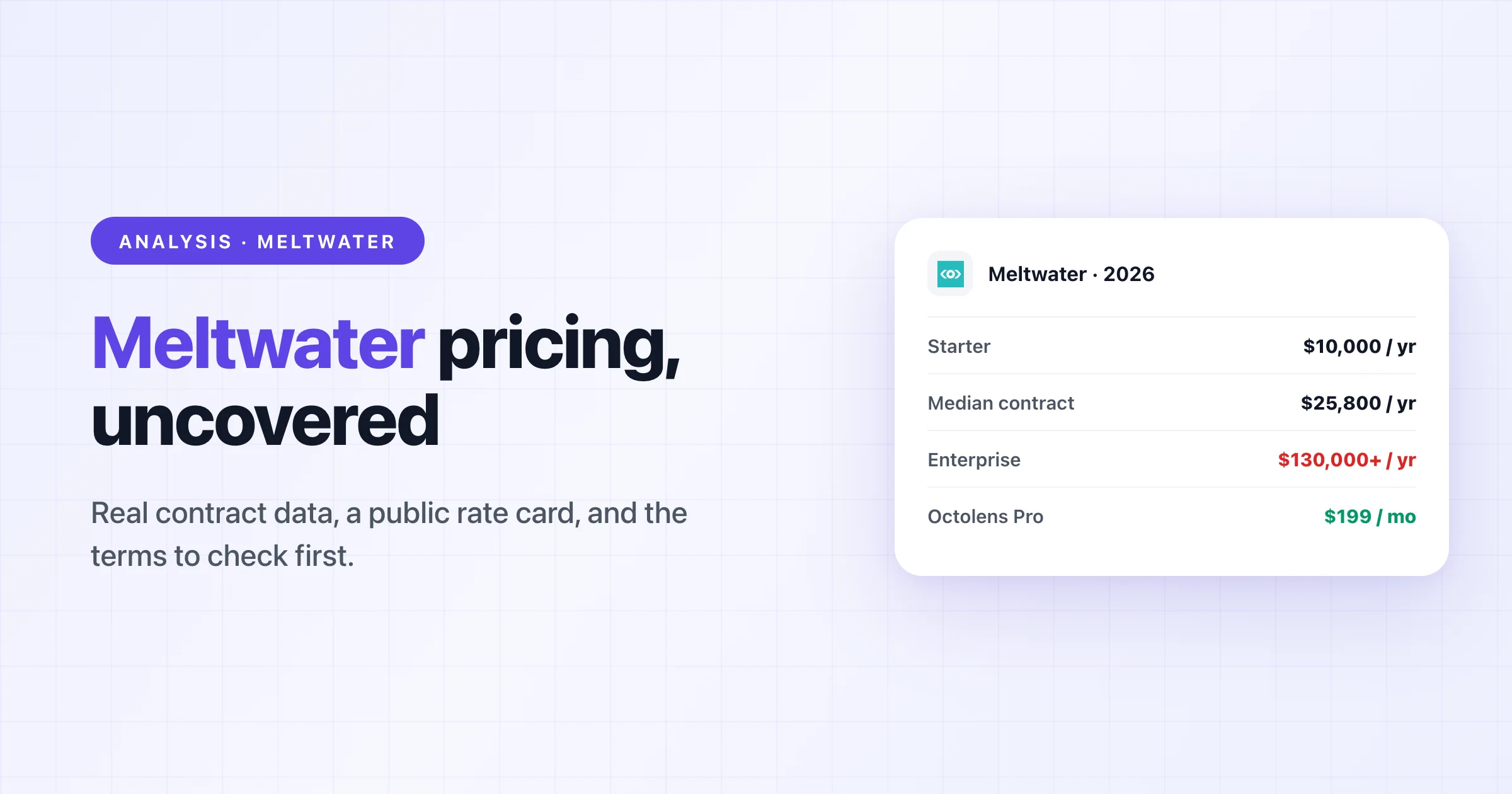
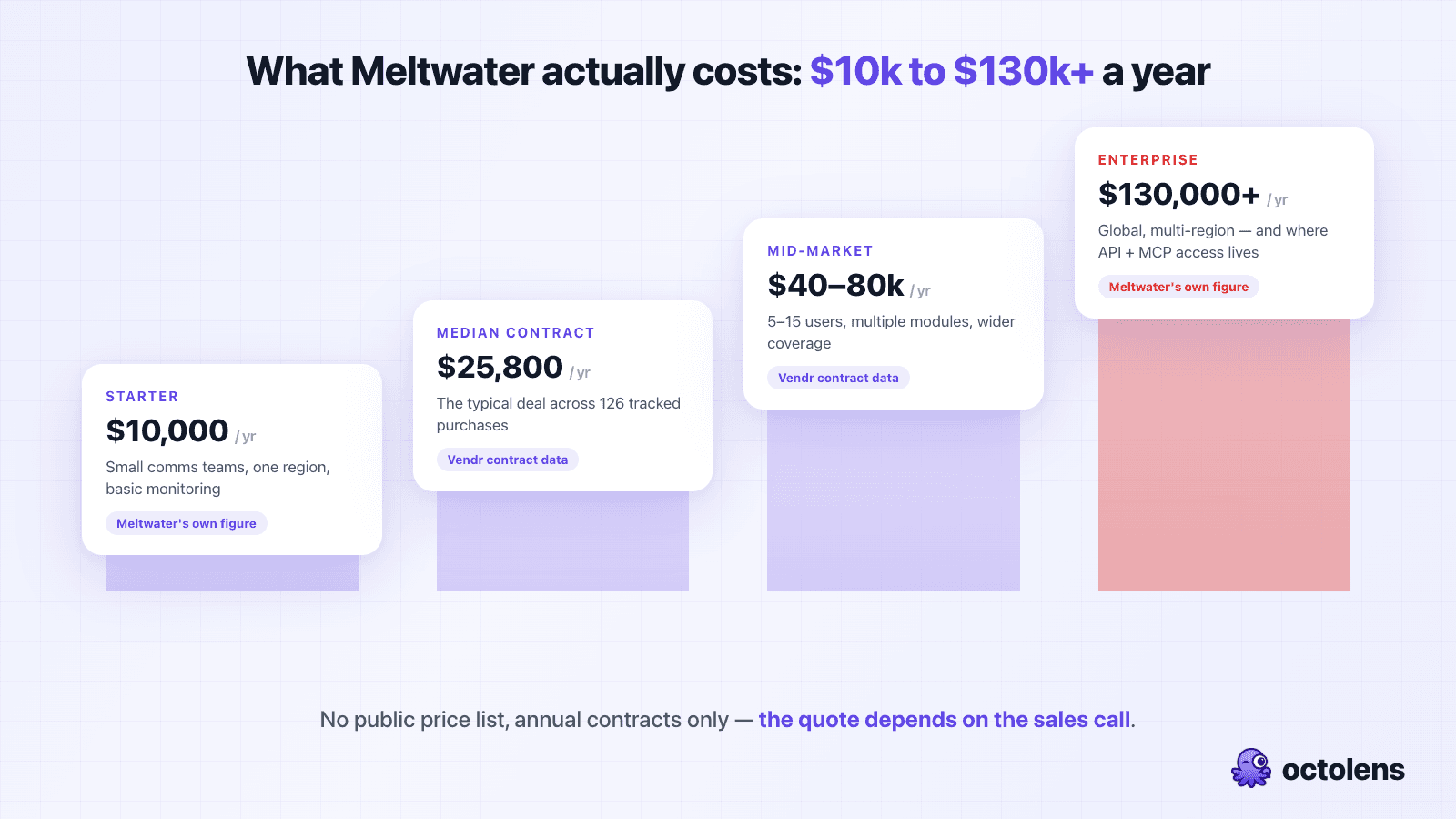
Short answer: plan for $10,000 to $57,000 per year for most teams, and $100,000+ for global enterprise deployments.
Here's the same question answered from four independent sources:
| Source | What it says |
|---|---|
| Meltwater's own blog | Starter from $10,000/yr, Pro from $25,000/yr, Enterprise from $130,000/yr |
| Vendr (126 real purchases) | Median contract $25,800/yr, range $5,375–$56,993 |
| SpendHound (160 customers) | SMB average $13,275/yr, enterprise average $65,020/yr |
| User reports on Reddit | $6,900/yr (monitoring only) up to $100,000 (enterprise reporting) |
The sources agree with each other, which is a good sign the numbers are real. The floor for a bare-bones single-region setup is around $6,000–$10,000 per year. The typical contract is mid-twenties. And once you add users, regions, and modules, six figures arrives fast.
For context on how the market segments: enterprise platforms like Meltwater, Brandwatch, and Sprinklr typically start at $800–1,000/month, while mid-range tools run $159–$599/month. We've broken down the whole landscape in our guide to the best social listening tools.
Meltwater doesn't have fixed plans in the way a self-serve SaaS product does — every contract is scoped individually. But their published tiers give you the shape of it:
Built for small comms teams. Includes basic media monitoring, social listening, AI summaries, and access to the media relations database. Typically limited to a single region.
At this tier you're paying roughly $833/month for what mid-market tools deliver for $200–$600/month — the premium is for Meltwater's news coverage and the PR toolset, not for more social listening.
The tier most mid-sized teams land on, and it matches Vendr's $25,800 median almost exactly. Adds cross-channel monitoring, competitive benchmarking, expanded AI features, and wider geographic coverage.
Global, multi-region, multi-language deployments with governance workflows and influencer marketing. This is also the tier where API and MCP access lives — if you want your mention data flowing into your own systems or AI agents, Meltwater gates that behind the six-figure tier.
That last point matters more than it looks. In 2026, mention data you can't pipe into your own stack — your Slack, your CRM, your agents — is data trapped in a dashboard. It's the single biggest philosophical difference between Meltwater and API-first tools, and we've written about why we think data access shouldn't be an enterprise upsell.
Per Meltwater's own cost-driver list, your price moves with:
- Modules — media monitoring, social listening, media contacts/outreach, consumer insights, influencer marketing are all priced separately
- Users — per-seat licensing, and seats aren't cheap (more on this below)
- Geography and languages — single-region vs. global coverage is a major multiplier
- Search volume — contracts specify how many saved searches you get, not just seats
- Contract length — multi-year deals earn 10–20% discounts, per Vendr's negotiation data
Here's the most concrete pricing data available anywhere: to sell to the UK government, Meltwater had to file a pricing document on the G-Cloud 14 public procurement marketplace. It's public. Anyone can read it.
The core platform (GBP, per year):
| Configuration | Price |
|---|---|
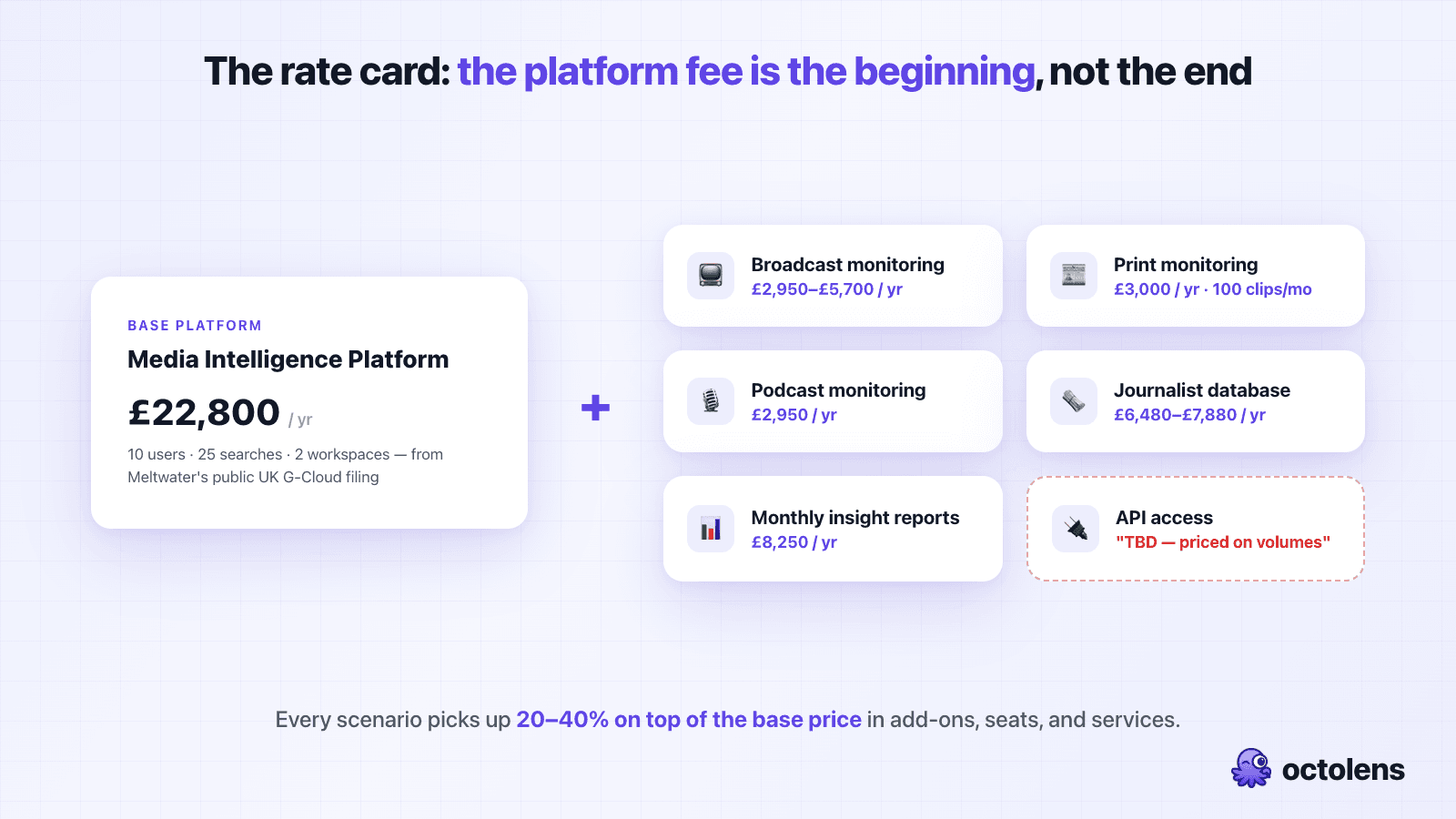
| Media Intelligence Platform — 10 users, 25 searches, 2 workspaces | £22,800/yr (~$29,000) |
| Media Intelligence Platform — 15 users, 50 searches, 2 workspaces | £32,700/yr (~$41,500) |
Note the structure: you're capped on users and searches. Going from 10 to 15 users and 25 to 50 saved searches costs an extra £9,900 a year — that's the per-seat economics in action.
Then the add-ons, each priced separately:
| Add-on | Price |
|---|---|
| UK broadcast (radio/TV) monitoring | £2,950/yr |
| Global broadcast monitoring | £5,700/yr |
| UK print monitoring (100 clips/month) | £3,000/yr |
| Podcast monitoring | £2,950/yr |
| Journalist database + press distribution (UK) | £6,480/yr |
| Journalist database + press distribution (global) | £7,880/yr |
| Newswire distribution | £500–£2,500 per release |
| AI-driven insight reports (monthly) | £8,250/yr |
| Branded newsletter (up to 1,000 recipients) | £3,250/yr |
Two things jump out:
Podcast monitoring is a ~$3,700/year add-on. Podcasts are where a lot of high-intent product conversations happen now, and Meltwater treats them as premium extras. (For comparison: Octolens includes podcast, news, and newsletter coverage on its Scale plan at $599/month — alongside Reddit, Hacker News, and GitHub on every plan.)
The API has no listed price at all. On Meltwater's own rate card, the Export API, Streaming API, and Display API are all marked "TBD — priced on volumes." Even in a public government filing, programmatic access to your own mention data is a custom negotiation.
The contract number isn't the whole number. From Vendr's buyer data and user reports, budget for:
- Onboarding and training: $2,000–$10,000. Implementation isn't free, and Meltwater's platform is complex enough that training is genuinely necessary.
- Renewal increases: 3–7% per year. Built-in price escalation is standard in Meltwater contracts. Your $25,000 year-one contract is a $28,000+ contract by year three before you've added anything.
- Overage charges. Contracts specify usage limits; exceeding them triggers overage fees.
- Mid-contract upgrades at list price. Negotiating leverage exists at renewal time. Add a module mid-term and you'll pay at or above list — Vendr's data shows upgrades are where discounts go to die.
- Professional services. Custom reporting and integrations are billable. The analyst-curated report tiers on the G-Cloud rate card are literally priced "TBD."
One more structural cost: there is no monthly option. Every dollar above is committed annually, up front. If the tool doesn't work out in month three, you own it for nine more months.
Abstract ranges are only so useful, so here are three realistic scenarios assembled from the rate card and contract data above:
Scenario 1: A 3-person comms team at a Series B startup. Media monitoring plus social listening, one region, no print or broadcast. You're at the Starter tier: expect a first quote around $12,000–$15,000/year, negotiable toward $10,000. Add onboarding (~$2,000–$3,000) and you're at roughly $13,000–$17,000 all-in for year one — about $1,100–$1,400/month. This is the buyer profile where the mid-market alternatives make the strongest case, because at this scope you're using maybe a third of what you're paying for.
Scenario 2: A 10-person PR team at a mid-market company. Media Intelligence Platform with 10 seats and 25 searches (the G-Cloud configuration: $29,000), plus the journalist database ($8,000), plus quarterly insight reports (~$5,600). That's roughly $42,000–$45,000/year — squarely inside Vendr's mid-market band of $40,000–$80,000. If this team also wants broadcast and podcast coverage, add another $8,000–$11,000.
Scenario 3: A global enterprise comms org. Multi-region, multi-language, 15+ seats, influencer marketing, API integration into an internal data warehouse. This is the $100,000–$150,000+ band, consistent with Meltwater's own "from $130,000" Enterprise figure. At this level the line items stop mattering — you're negotiating a platform relationship, and everything is custom.
The pattern across all three: the platform fee is the beginning, not the end. Every scenario picks up 20–40% on top of the base price in add-ons, seats, and services.
If Meltwater is the right tool for your job, don't pay list. The negotiation dynamics are well documented in Vendr's buyer data, and the average buyer saves about 15%:
- Start 90–120 days before your decision deadline. Meltwater's reps work quarterly quotas like every enterprise sales team. Time pressure is your leverage, not theirs — but only if you're not the one in a hurry.
- Bring competing quotes. Cision and Brandwatch quotes move Meltwater's price more than anything else you can say. Get real numbers from at least one direct competitor before your pricing call.
- Bundle modules at signing, not mid-term. Vendr's data is blunt about this: mid-contract upgrades price at or above list. If you think you'll want the journalist database in six months, negotiate it now.
- Trade contract length for price — carefully. Multi-year commitments earn 10–20% discounts. That's real money, but weigh it against being locked into a tool you haven't used yet, with an auto-renewal clause on top.
- Cap the renewal escalator in writing. The 3–7% annual increase is negotiable at signing and nearly impossible to fight later. Get a cap (or a fixed renewal price) into the order form itself, not a side email.
This is the part current customers complain about most, and it deserves its own section.
Meltwater contracts auto-renew for a full year unless you cancel at least 60 days before the term ends. That's confirmed in Meltwater's own help center. Miss the window by a day and you're contractually committed to another year at the (escalated) renewal price.
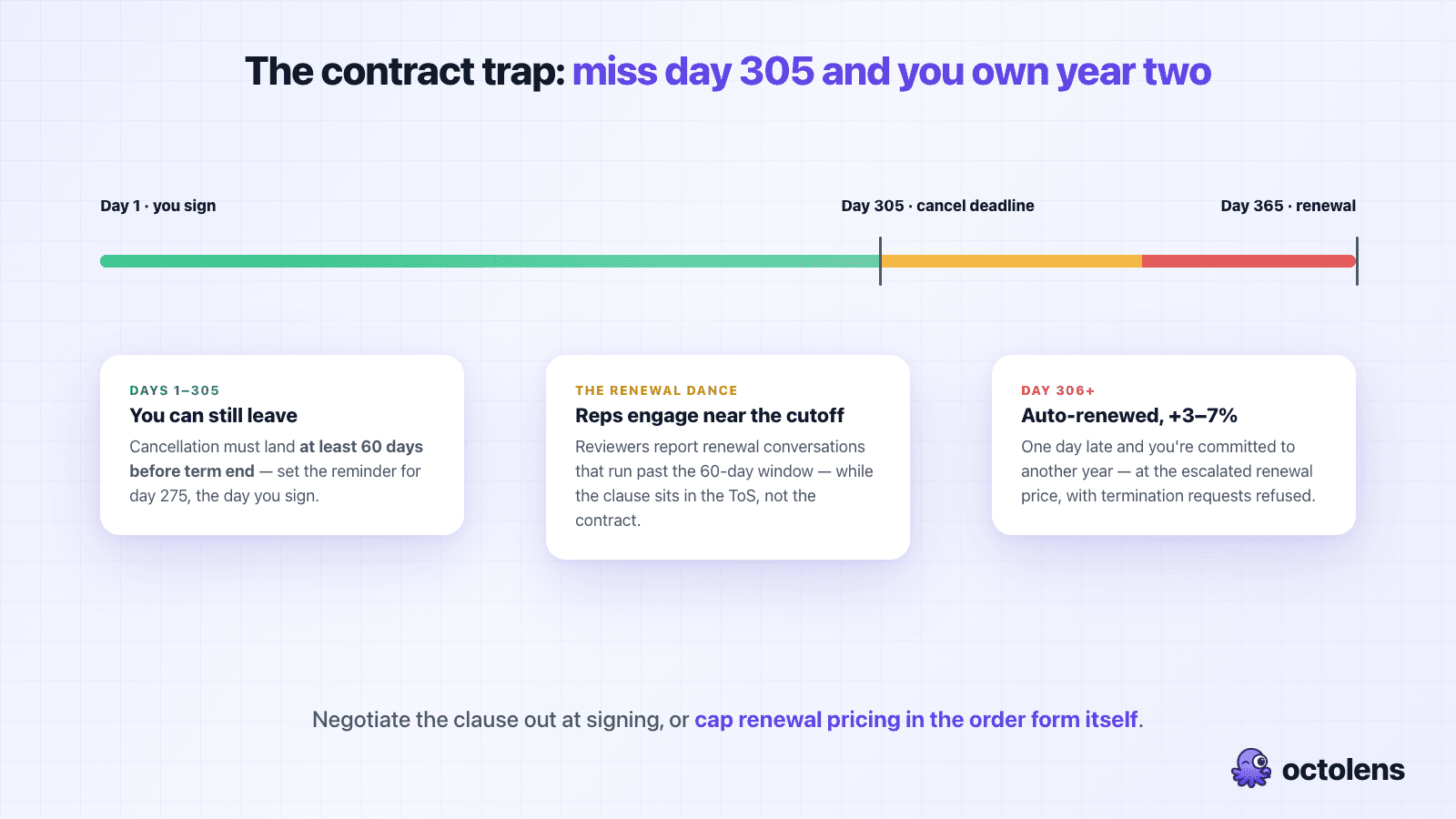
Review sites are full of this exact story. Two representative TrustRadius review titles: "Beware of Hidden Contract Terms like Auto-renewal Clauses and Built-in Price Increases" and "Meltwater deceptive auto-renewal policy and truly awful customer service." Reviewers describe the same pattern: the auto-renewal clause lives in the terms of service referenced by the contract rather than the contract itself, sales reps engage in renewal conversations that run past the 60-day cutoff, and once the window closes, termination requests are refused. One Canadian customer reported their billing being switched from CAD to USD at renewal — an effective 25%+ price increase on top of the escalator.
Meltwater's G2 rating is 4.1/5 across roughly 2,900 reviews, and the pattern in the reviews is consistent: people generally like the data. The complaints cluster around the buying experience — pricing opacity, aggressive renewal and upsell tactics, and contracts that are hard to exit.
If you do sign with Meltwater, three practical defenses:
- Calendar the cancellation deadline the day you sign. Set the reminder for 90 days before term end, not 60.
- Negotiate the auto-renewal clause out, or at minimum get renewal pricing capped in writing. Vendr's data says buyers who engage 90–120 days early with competing quotes in hand save ~15%.
- Get every limit in writing — seats, searches, clip volumes, overage rates — before signing, not after.
Honest answer: it depends entirely on which job you're hiring it for.
Where Meltwater genuinely earns its price: premium news coverage. Meltwater licenses paywalled content from Bloomberg, Dow Jones/Factiva, and similar outlets — coverage that cheaper tools legally cannot index — and pairs it with print and broadcast tracking. A Fortune 500 comms department spending $65,000/year on it is making a reasonable purchase.
Concretely, Meltwater is the right buy when:
- You're a PR/comms team at a large organization — the journalist database (450,000+ contacts), press distribution, and coverage reporting are the actual product, and they're good
- You report coverage to executives — the analyst-curated reports and branded dashboards exist for exactly this
- Procurement is a feature, not a bug — your org expects annual contracts, security reviews, and a key account manager
Where the price stops making sense: everything downstream of "PR coverage tracking." As we said in our brand monitoring tools comparison, Meltwater is a PR tool first and a brand monitoring tool second. If what you actually need is to know when someone mentions your product on Reddit, Hacker News, or a podcast — and to get that mention into Slack or your CRM while the thread is still alive — you're paying five figures for a dashboard your team will rarely open, with the API that would fix that gated at $130,000/year.
There's a version of this that's been true for a decade: a five-figure contract, two licensed seats, and everyone else in the company queuing behind them for data. That model is exactly what modern tooling is unwinding.
How the market actually prices out in 2026:
| Tool | Entry price | Typical annual cost | Billing | API access | Best for |
|---|---|---|---|---|---|
| Meltwater | ~$10,000/yr | $13,000–$65,000 | Annual only | Enterprise tier only | PR teams needing premium news |
| Brandwatch | Custom | ~$50,000 (Vendr median) | Annual only | Enterprise tiers | Consumer insights at scale |
| Cision | Custom | $9,600 SMB / $75,000 ent. | Annual only | Limited | Press release distribution + PR |
| Octolens | $199/mo ($159 annual) | $1,908–$7,188 | Monthly or annual | Every plan | Product-led and technical brands |
(Brandwatch's ~$50k median is from Vendr contract data; Cision figures are SpendHound customer averages. Full breakdowns of each tool are in our social listening tools guide.)
The three legacy platforms get cross-shopped constantly, so here's the direct comparison using the same contract-data sources:
- Meltwater vs. Cision: Nearly identical pricing profiles — SpendHound puts Cision at $9,565/year for SMBs (slightly cheaper than Meltwater's $13,275) but $74,923 for enterprises (more expensive than Meltwater's $65,020). The real difference is emphasis: Cision leads with press release distribution (PR Newswire is theirs), Meltwater leads with monitoring and analytics. Teams that primarily push news out lean Cision; teams that primarily track coverage lean Meltwater.
- Meltwater vs. Brandwatch: Brandwatch is the more expensive platform — Vendr's median Brandwatch contract runs about $50,000/year against Meltwater's $25,800. You're paying for deeper consumer-insights tooling: bigger historical archives, more sophisticated audience segmentation, dashboards built for insights analysts rather than PR managers. If your buyer is a comms director, Meltwater; if it's a consumer-insights team, Brandwatch — at twice the median price.
- All three share the same commercial model: annual-only contracts, custom quotes behind sales calls, API access reserved for the top tiers, and per-seat economics that make broad internal access expensive. Whichever you pick, the negotiation advice above applies unchanged.
Look elsewhere if:
- Your customers talk on Reddit, Hacker News, GitHub, and podcasts — Meltwater's center of gravity is news and mainstream social; developer-community coverage is not what you're paying the premium for
- You want data in your tools, not another dashboard — if mentions should land in Slack, your CRM, or your AI agents, you need API and webhook access that doesn't cost $130,000/year
- You can't commit five figures annually — the annual-only, auto-renewing contract structure is a real risk for a tool you haven't been able to trial
- You're a startup or mid-market product team — you'd be paying for a journalist database and print monitoring you'll never use
Because in the end, the comparison worth doing isn't really price — it's price per job. Meltwater's Starter tier at $10,000/year and Octolens Pro at $1,908/year (annual) aren't the same product with different price tags. One is a PR suite with premium news licensing. The other is a data layer that watches 15+ platforms — Reddit, Hacker News, X, LinkedIn, YouTube, podcasts, newsletters, GitHub — filters the noise with AI, and delivers mentions wherever your team works: Slack, email, webhooks, a REST API, or MCP for AI agents, on every plan including the cheapest one.
That's why teams like Vercel, PostHog, Cursor, and Lovable run their community listening this way — mentions route to the right Slack channel or straight into their own tools, and nobody's queuing behind two licensed seats.
If that sounds more like your job to be done, we keep an updated comparison of Meltwater alternatives — including where each one (ours included) falls short.
- Meltwater pricing starts around $10,000/year (their own published Starter figure) and runs to $130,000+ for enterprise
- The median real contract is $25,800/year across 126 purchases tracked by Vendr; SMBs average $13,275, enterprises $65,020
- Meltwater's public UK government rate card shows £22,800/year for 10 users and 25 searches — with broadcast, print, and podcast monitoring all as paid add-ons, and API pricing listed as "TBD"
- There's no free trial, no free plan, and no monthly billing — contracts are annual with a 60-day auto-renewal cancellation window and built-in 3–7% yearly increases
- Worth it for enterprise PR teams that need premium news and journalist outreach; hard to justify for product-led teams that need community mentions flowing into their own tools
- API access on every plan is the structural difference — with Meltwater it's an enterprise negotiation; with tools like Octolens it's included at $199/month
The real question isn't "how much does Meltwater cost?" — it's whether you're buying a PR suite or a data layer.
If it's the data layer you're after, you don't need a sales call to find out what your mentions look like: try Octolens free for 7 days and they're flowing into Slack, your CRM, and your agents this week — API, webhooks, and MCP on every plan, no annual contract.