How Vercel Listens to Developers at Scale
Learn how teams across Vercel use Octolens to capture user feedback, detect incidents early, and build a thriving developer community.
Vercel is the home of Next.js and powers high-performance apps for everyone from solo builders to the Fortune 500.
Company info (October 2025):
- Size: ~650 employees
- Funding: $563M raised
- Headquarters: San Francisco
I sat down with three people at Vercel to understand how they use Octolens. Brian Emerick is a Technical Program Manager who helped roll out Octolens across 20+ teams. Rhys Sullivan is a Software Engineer on the Domains team, and Anthony Shew leads community for Turborepo. All three have built Octolens into how they work day-to-day.
Vercel's products get talked about everywhere. Reddit, X, Hacker News, GitHub, community forums — thousands of mentions every day.
Before Octolens, keeping up was a real problem. Brian explains: "We wanted our Product Managers (PMs) plugged into social conversations.
But for many, especially those coming from engineering, it wasn't a natural muscle.
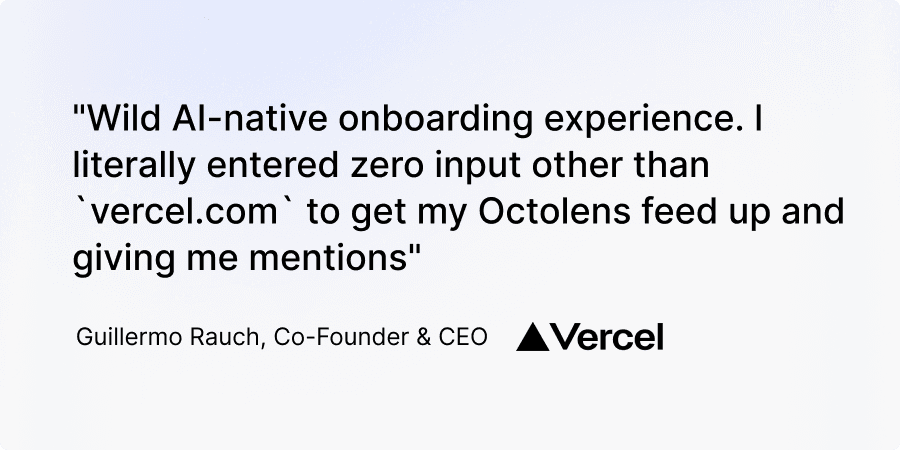
They aren't the ones to spend hours a week on X or Reddit, filtering through noise." This matters because community engagement is baked into Vercel's culture. Guillermo Rauch, their CEO, is constantly responding on socials. He wanted that same mindset across the whole company.
X and Reddit move fast. Vercel needed every team hearing what the community was saying — not just leadership or the engineers who happened to be chronically online.
- Critical feedback and issues risked being missed. A Reddit bug report or valuable feedback on X could go unseen until it snowballed.
- Coverage was uneven. Some teams stayed close to chatter, others had no visibility.
- Manual searching was slow. Team members without a social media habit couldn't realistically keep up.
Guillermo found Octolens on X. They piloted it on a few keywords.
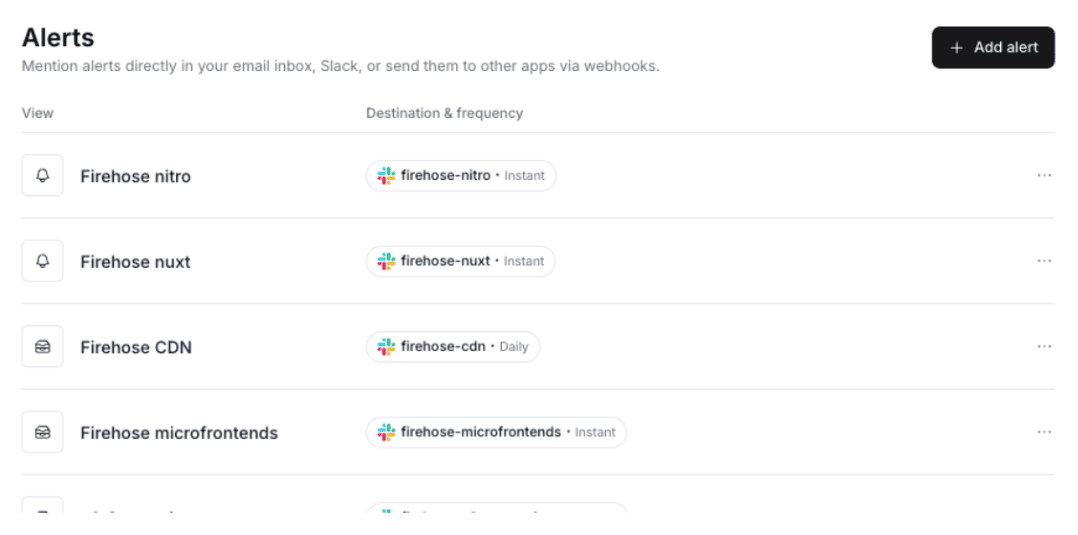
It spread fast. Today, 20+ Vercel teams — Domains, Turborepo, CI/CD, Pricing, and more — each have a dedicated "firehose" Slack channel powered by Octolens.
Relevant mentions stream in automatically, filtered by AI and Boolean logic to cut out the noise.
The Domains team has their own firehose. When something comes in, they jump on it.
Here's a good example from Rhys: "A user was accidentally charged for a domain and posted about it on Reddit.
I saw it within minutes, replied, fixed their account, and let them know it was handled.
That quick response mattered and the fix went out to all users." Without Octolens, this either gets missed entirely or Rhys burns hours each week manually searching X and Reddit. "I don't want to spend my workday scrolling X.
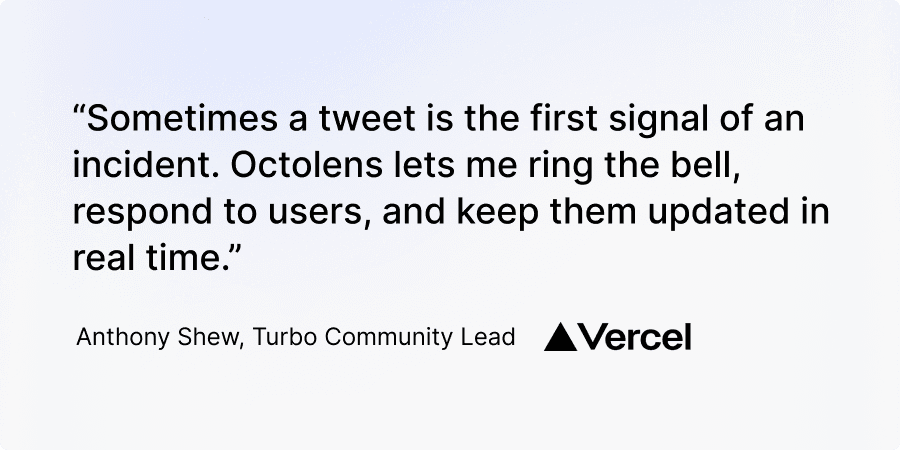
Octolens pipes the important stuff into Slack so I can focus on building and still stay on top of what developers are saying." Anthony Shew on Turborepo uses it differently — more as an early-warning system for incidents. "Sometimes a tweet is the first signal of an incident. Octolens lets me ring the bell, respond to users, and keep them updated in real time."
He also tags posts to track issues over time. When a fix ships, he goes back to the original reporters and lets them know. That kind of follow-through builds real trust.
It's not just about catching bugs and putting out fires.
Teams also pick up on the good stuff — praise, wins, organic love from the community that would otherwise go unnoticed.
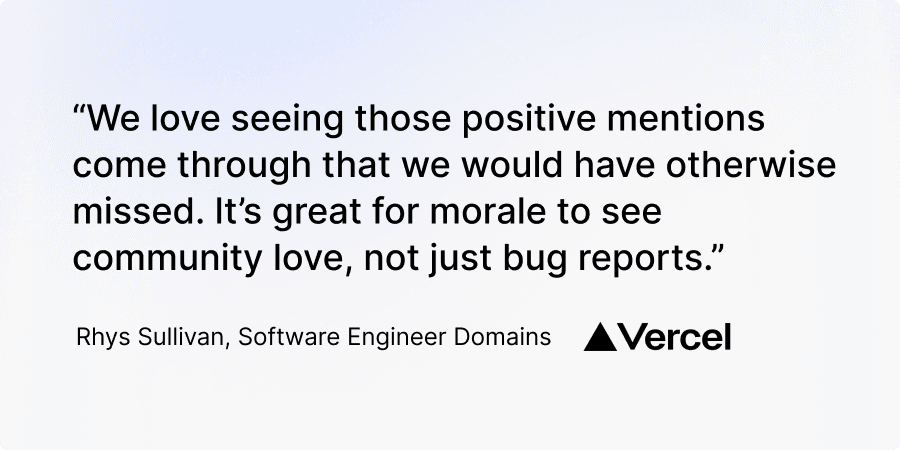
Rhys: "We love seeing those positive mentions come through that we would have otherwise missed.
It's great for morale to see community love, not just bug reports."
And sometimes you find things you'd never expect. Anthony: "Octolens flagged an entire college lecture about Turborepo.
I would have never known someone was teaching Turborepo in class.
Discovering things like that is incredible."
Faster bug detection, real-time incident response, and the occasional morale boost — that's why engineers at Vercel actually use Octolens every day.
Here's how Vercel runs it in practice:
- Firehoses by product– Each major product area gets its own Slack channel fed by Octolens.
- Filter out noise– On top of Octolens's AI noise detection, teams add negative keywords and excluded authors to keep streams relevant.
- Triage in real time – Engineers and PMs check alerts throughout the day, responding or escalating.
- Incorporate feedback & celebrate wins – Feedback shapes roadmap decisions. Positive mentions get shared for team morale.
- Trend analysis – Weekly summaries and combining other feedback sources with social mentions help zoom out and see patterns beyond day-to-day posts.
Brian on what changed for PMs: "Before Octolens, PMs could spend hours just searching across platforms.
Now they spend that time consuming and acting on filtered feedback.
It's twice as efficient." But it goes beyond saving time. Vercel treats community sentiment as one of three equal inputs to their roadmap:
- Direct customer interviews
- Data analytics
- Community conversations surfaced by Octolens
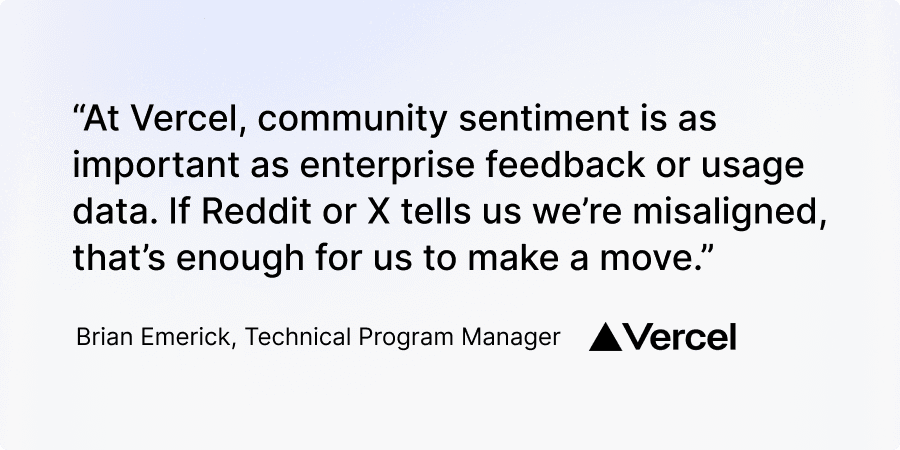
Brian: "At Vercel, community sentiment is as important as enterprise feedback or usage data.
If Reddit or X tells us we're misaligned, that's enough for us to make a move." That's the key shift. Social conversations aren't just noise to monitor — they're a real input to product decisions.
Across 20+ teams, the impact compounds:
- Faster response to incidents including security-related issues.
- Real-time visibility across all product areas, not just leadership.
- Efficiency gains for PMs who now act instead of search (estimated 50% time savings).
- Morale boost for engineers from seeing candid community love.
- Unexpected discoveries like college lectures shaping strategy.
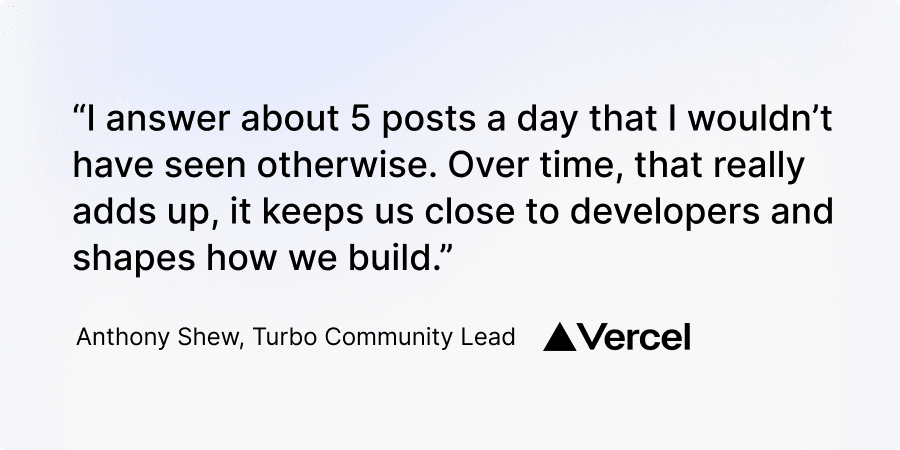
Anthony put a number on it: "I answer about 5 posts a day that I wouldn't have seen otherwise.
Over time, that really adds up, it keeps us close to developers and shapes how we build."
Octolens monitors your brand mentions across 15+ platforms in real time. AI filters the noise so you only see what matters.
Start for free or book a demo to see how it works for your team.