Table of contents
- First, a disclosure
- What is social media monitoring?
- Monitoring vs. social listening: which one do you need?
- How we evaluated these tools
- Quick comparison: the best social media monitoring software at a glance
- Our tool: Octolens
- 1. Hootsuite
- 2. Sprout Social
- 3. Brand24
- 4. Mention
- 5. Awario
- 6. BrandMentions
- 7. Mentionlytics
- 8. Agorapulse
- 9. Keyhole
- 10. Brandwatch
- 11. Google Alerts
- Free social media monitoring tools: what actually works
- Which monitoring tool should you pick?
First, a disclosure
I'm the co-founder of Octolens, and Octolens is one of the twelve tools below. I'm not going to pretend to be neutral about it, so Octolens has its own labeled section outside the numbered ranking, and the ranked list only covers tools we don't make. I also hold us to the same standard as everyone else: real G2 ratings, actual prices instead of "contact sales" hand-waving, honest cons for our own product, and quotes from real users. You should be able to disagree with my ranking using the data on this page.
Here's the problem monitoring solves, in the words of an agency owner on Reddit last week:
"I keep missing people asking for recommendations or solutions across Reddit, X, and Facebook groups. I usually only find these conversations after they've already moved on, so I miss the chance to respond while they're still actively looking." — r/SocialMediaMarketing
That's the whole game: speed. A mention you see within minutes is an opportunity. The same mention three days later is a missed one.
What is social media monitoring?
Social media monitoring is the practice of tracking mentions of your brand, product, competitors, or keywords across social platforms in real time, so you can respond while the conversation is still live. It's the social slice of the broader media monitoring umbrella, which also covers news, podcasts, and newsletters. A social media monitoring tool automates this: it scans platforms like Twitter/X, Reddit, LinkedIn, and YouTube around the clock, filters out the noise, and sends an alert to your email, Slack, or API the moment something relevant appears.
The hard part about this is not collecting mentions, but filtering out the ones that are relevant for you. As one user put it when recommending tools in that same thread:
"Manually searching Reddit, X, and Facebook groups gets old really fast. I've tested a few tools and honestly the biggest challenge isn't finding mentions... it's filtering out all the noise." — r/SocialMediaMarketing
A tool that sends you 500 alerts a day, of which 480 are irrelevant, trains you to ignore alerts. The best tools in 2026 use AI filtering so that when your phone buzzes, it matters.
Monitoring vs. social listening: which one do you need?
These terms get used interchangeably, but they're different jobs:
- Social media monitoring is operational. Track mentions in real time, get alerted, respond. It answers "what are people saying about us right now, and where do I need to show up?"
- Social listening is strategic. Analyze sentiment, trends, and share of voice over weeks and months. It answers "why are people saying this, and what should we do about it?"
Monitoring is about speed-to-response. Listening is about depth of analysis. If you need the analysis side — sentiment trends, competitive benchmarking, audience research — we compared 21 platforms in our social listening tools guide, and if the sentiment layer itself is what you're evaluating, we ranked the best AI sentiment analysis tools across social, feedback, and call platforms separately. This article focuses on the monitoring job: catching every relevant mention fast, with as little noise as possible.
For most teams, the honest answer is you need monitoring first. You can't analyze conversations you never saw.
How we evaluated these tools
I tested each tool against five criteria that matter for monitoring specifically:
- Alert speed — How fast does a mention go from posted to in-your-inbox? Real-time, hourly, or daily makes a real difference.
- Where it looks — A monitor is only as good as its coverage. Does it see Reddit threads, forums, and niche platforms, or just Twitter and Facebook?
- Noise filtering — Does AI separate signal from noise, or does it dump every keyword match on you?
- Where alerts land — Email only? Slack? Webhooks and API so mentions flow into your own systems?
- Pricing honesty — Is the price published on the website, or hidden behind a demo call?
G2 ratings below were pulled in May 2026; review counts are rounded. Pricing was re-checked against every vendor's own pricing page in August 2026 — several tools changed their plans since this article first went up, and the details below reflect the current state.
Quick comparison: the best social media monitoring software at a glance
If you're here because you searched for free options, that's a real category and we cover it properly — jump to free social media monitoring tools below. For everyone else, here are all twelve tools side by side.
| Tool | Best for | G2 (May 2026) | From | Free option | API |
|---|---|---|---|---|---|
| Octolens (our tool, not ranked) | Real-time monitoring piped into your stack | 5/5 (6) | $159/mo | 7-day trial | Yes (all plans) |
| Hootsuite | Monitoring inside a publishing workflow | 4.3/5 (~6,700) | $99/user/mo | 14-day trial | Limited |
| Sprout Social | Marketing teams managing major social channels | 4.4/5 (~6,400) | $199/user/mo | 30-day trial | Yes (higher tiers) |
| Brand24 | Affordable real-time alerts for small teams | 4.6/5 (337) | $249/mo | 14-day trial | $149/mo add-on |
| Mention | Set-and-forget mention alerts | 4.3/5 (~450) | Custom (Company plan) | Free trial | Paid add-on |
| Awario | Surgical Boolean alerts at the lowest price | 3.9/5 (~50) | €49/mo (€29 annual) | 7-day trial | Enterprise only |
| BrandMentions | Real-time tracking accuracy | 4.9/5 (~236) | $79/mo (annual) | 7-day trial | Enterprise only |
| Mentionlytics | Tracking mentions across languages on a budget | 4.9/5 (~100) | $49/mo | 14-day trial | From $299 plan |
| Agorapulse | SMB social inbox + basic monitoring | 4.5/5 (~955) | $99/user/mo | 30-day trial | No |
| Keyhole | Hashtag and campaign tracking | 4.3/5 (~100) | Custom | Trial available | Yes |
| Brandwatch | Enterprise-scale coverage | 4.2/5 (~1,700) | Custom (~$50k/yr median) | Demo only | Yes (enterprise) |
| Google Alerts | Free web monitoring (no social) | N/A | Free | Always free | No |
Our tool: Octolens
We make Octolens, so it sits outside the ranking. The numbered list below starts with the tools we don't make.
Best for: Mentions delivered wherever your team already works | G2: 5/5 (6 reviews, May 2026)
Yes, I'm biased. I built this. But the monitoring use case is exactly why.
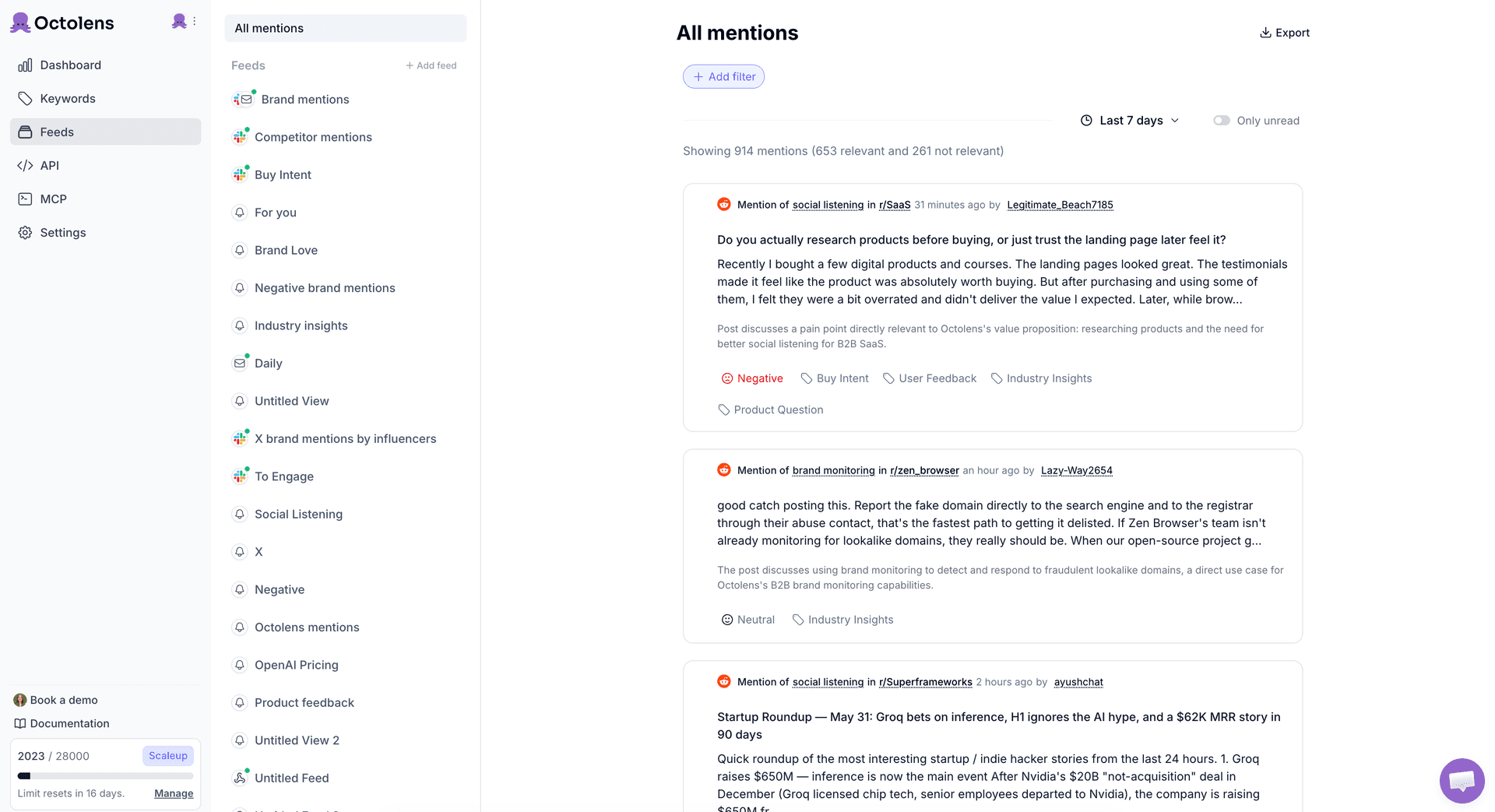
Octolens runs keyword monitoring everywhere people talk — the mainstream networks plus the corners most monitoring tools are blind to: Hacker News, GitHub, Stack Overflow, podcasts, and newsletters — plus news and press coverage across 150,000+ outlets. Before anything reaches you, the AI scores it for relevance. That's the difference between an alert channel your team actually reads and one they mute after week two.
The part that sets it apart for monitoring: every plan includes the REST API, webhooks, and MCP. A new mention can post to Slack, open a Linear issue, update your CRM, or trigger an AI agent — without you touching a dashboard. Vercel runs 20+ internal teams on it; Lovable, Supabase, Render, and Modal monitor this way too. And you're live fast: the onboarding AI reads your website and proposes the keywords worth tracking, so setup is a couple of minutes, not an afternoon.
| Detail | Info |
|---|---|
| Price | Pro from $159/mo billed annually ($199 monthly); Scale from $499/mo |
| Coverage | X, LinkedIn, Reddit, Bluesky, GitHub, Hacker News, Stack Overflow, YouTube, TikTok, DEV.to, podcasts, newsletters, news/blogs |
| Alerts | Hourly refresh (Pro), real-time (Scale) — Slack, email, webhooks |
| API | REST API, webhooks, and MCP at every tier |
| Free trial | 7 days |
Pros:
- AI relevance filtering means alerts stay readable — built for common-word brands and high mention volume
- Widest coverage of developer and B2B platforms (HN, GitHub, Stack Overflow, podcasts, newsletters)
- API, webhooks, and MCP on every plan — mentions flow into Slack, Linear, CRMs, or agents
- Unlimited seats on every plan, so the whole team can triage mentions
Cons:
- Doesn't watch Instagram or Facebook — built for B2B, not consumer brands
- Won't schedule or publish posts — it's monitoring and intelligence, full stop
- Newer product: enterprise checkboxes like SSO and audit logs aren't there yet
Website: octolens.com
1. Hootsuite
Best for: Teams that want monitoring inside their publishing workflow | G2: 4.3/5 (~6,700 reviews, May 2026)
Hootsuite's monitoring runs on Talkwalker technology (Hootsuite acquired them), which means serious coverage under the hood: 150+ million sources in 187 languages. If your team already schedules and publishes through Hootsuite, adding monitoring streams keeps everything in one place.
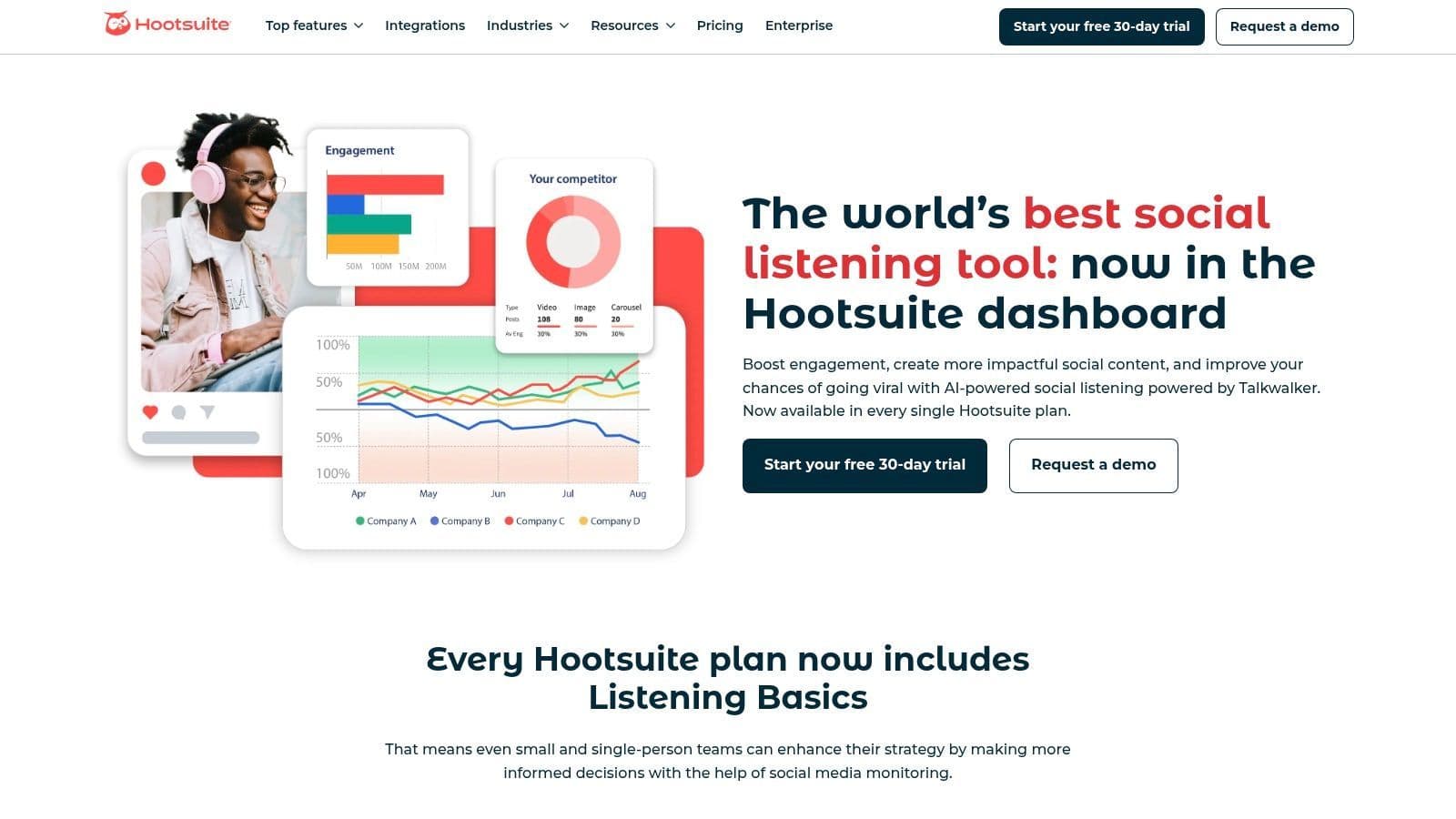
The streams model is genuinely good for watching specific keywords, hashtags, and accounts across your connected social channels. Since mid-2026 basic brand and competitor monitoring is included in the base plans, which is an improvement — but the advanced listening that reaches beyond your connected channels still sits on the Enterprise tier, which means a sales conversation. If you're comparing options in this bracket, we put together a full Hootsuite alternatives comparison.
| Detail | Info |
|---|---|
| Price | $99 (Standard), $199 (Professional), $399 (Advanced) per user/mo; advanced listening on Enterprise via sales |
| Coverage | Major social networks; the Talkwalker engine extends reach to 150M+ sources on higher tiers |
| Alerts | In-app streams, email; real-time on connected channels |
| API | Limited |
| Free trial | 14 days |
Pros:
- Monitoring streams sit next to publishing and engagement — one tool for the social team
- Basic brand and competitor monitoring now included in base plans
- Talkwalker engine brings deep coverage and 187-language support when you add listening
- Mature product with a huge integration ecosystem
Cons:
- Real listening depth still requires the Enterprise tier — separate pricing, sales call required
- Per-user pricing gets expensive for teams
- Coverage leans mainstream social — weak on Reddit, forums, and developer platforms
- Limited API access; trial shortened to 14 days
Website: hootsuite.com
2. Sprout Social
Best for: Marketing teams monitoring major social channels alongside publishing | G2: 4.4/5 (~6,400 reviews, May 2026)
Sprout Social's Smart Inbox is one of the best monitoring workflows in the category — every message, mention, and comment across your connected profiles lands in a single queue your team can triage, assign, and answer. For brands whose audience lives on Twitter/X, Instagram, Facebook, and LinkedIn, the respond-fast loop is excellent.
If you're weighing Sprout against cheaper or more listening-focused options, see our full comparison of the best Sprout Social alternatives.
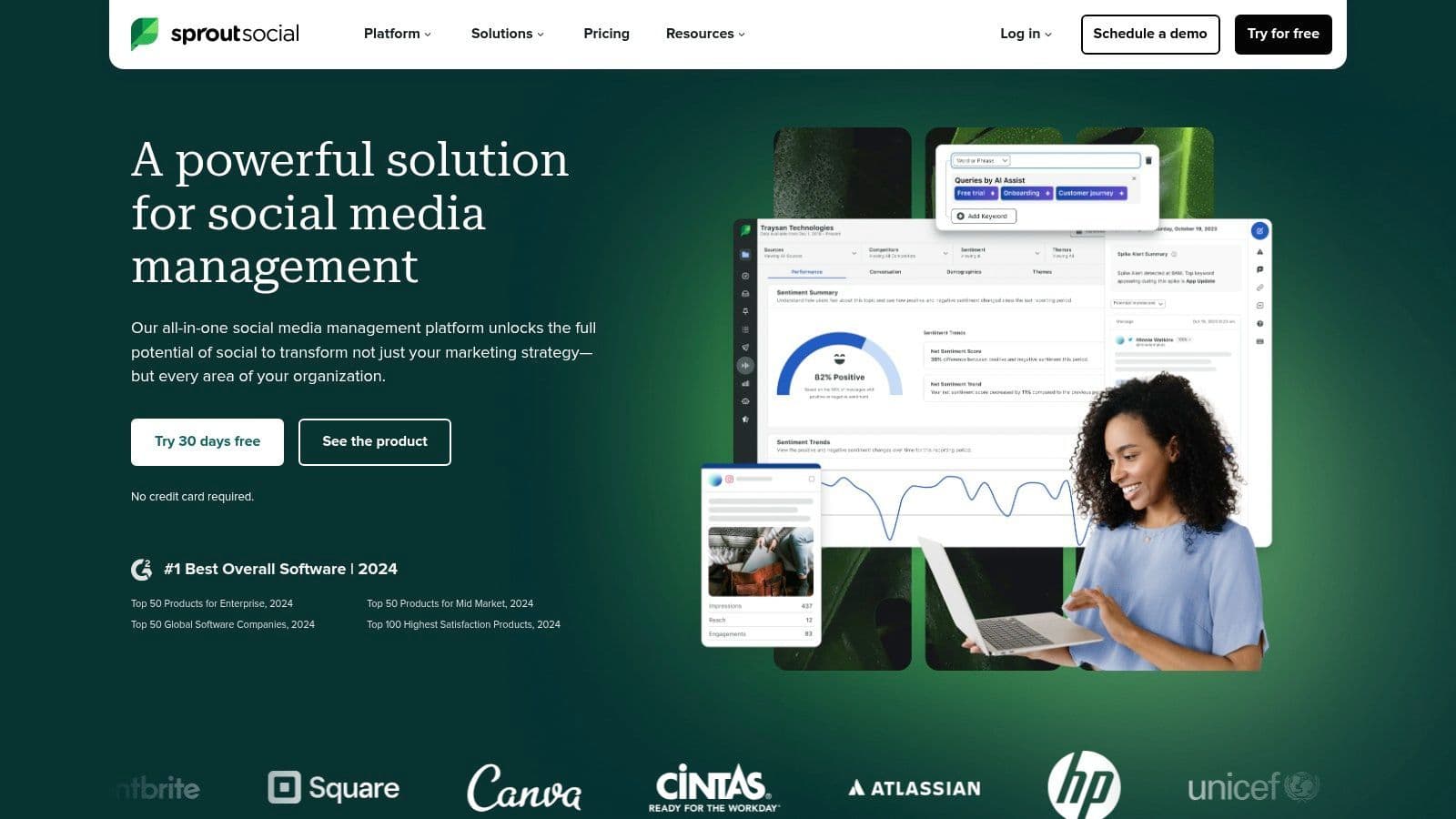
The limitation is where Sprout looks. Brand keyword monitoring beyond your own profiles is part of the premium listening add-on, and the data sources lean heavily toward mainstream networks. No meaningful Reddit coverage, nothing from Hacker News or GitHub. If conversations about you happen off the big networks, Sprout won't see them.
| Detail | Info |
|---|---|
| Price | $79 (Essentials), $199 (Standard), $299 (Professional), $399 (Advanced) per seat/mo; premium listening is an add-on on Standard and up |
| Coverage | The big networks: X, Facebook, Instagram, LinkedIn, Pinterest, TikTok |
| Alerts | Smart Inbox, email, mobile push |
| API | Yes, on higher tiers |
| Free trial | 30 days |
Pros:
- Smart Inbox is a best-in-class triage-and-respond workflow
- Clean interface, strong team collaboration (assignments, approvals)
- Solid reporting on response times — useful if support runs through social
- 30-day free trial, and the new $79 Essentials tier lowers the entry price
Cons:
- Keyword monitoring beyond owned profiles requires the premium listening add-on
- Three Professional seats put you around $900/mo before the listening add-on
- Blind to Reddit, forums, and every developer platform
- Built for B2C social teams, not technical audiences
Website: sproutsocial.com
3. Brand24
Best for: Small teams that need affordable real-time alerts | G2: 4.6/5 (337 reviews, May 2026)
Brand24 (now part of Adobe, via Adobe's 2026 acquisition of Semrush) is the strongest budget-to-midrange monitoring option for most marketing teams. It tracks social media, news, blogs, forums, and podcasts, with a Storm Alerts feature that notifies you when mention volume suddenly spikes — exactly what you want when something starts going wrong (or right) about your brand.
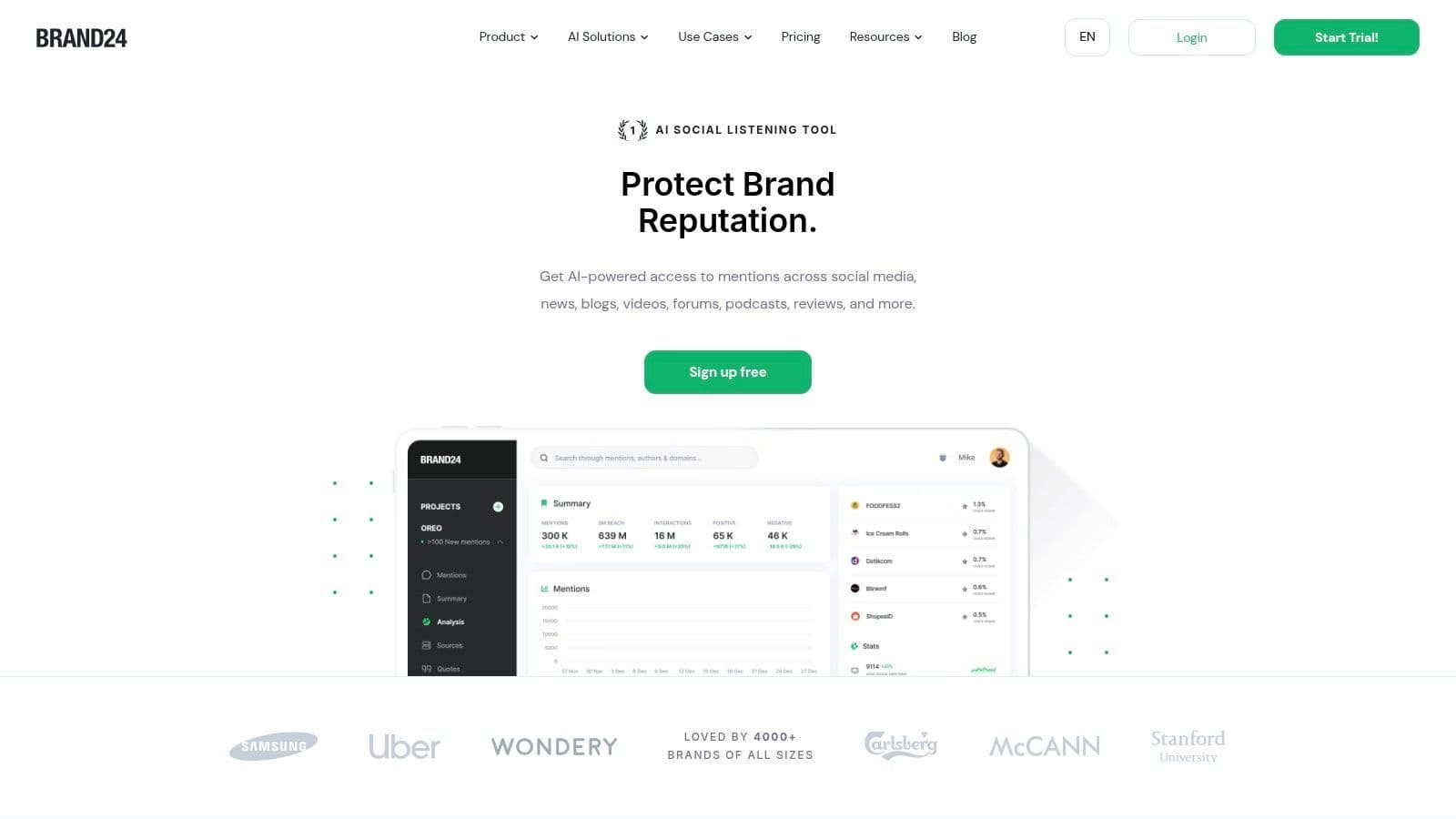
Influence scoring helps you prioritize which mentions deserve a response first, and the interface doesn't need a training session. The trade-offs: mention quotas tighten as you grow, and coverage of developer platforms is thin.
| Detail | Info |
|---|---|
| Price | $249/mo (Individual), $349 (Team), $499 (Pro), $699 (Business); roughly 20% less on annual billing |
| Coverage | Social channels plus news, blogs, forums, podcasts, and review sites |
| Alerts | Real-time in-app, email, Slack; Storm Alerts for volume spikes |
| API | $149/mo add-on on Pro and Business; included on Enterprise |
| Free trial | 14 days |
Pros:
- Storm Alerts catch sudden mention spikes — early warning for PR moments
- Influencer Score ranks mentions by author reach, so you answer the big ones first
- Easy setup and a clean interface
- 14-day free trial, no sales call
Cons:
- Mention limits get restrictive as volume grows — upgrades sneak up on you
- Skips developer platforms entirely (Hacker News, GitHub, Stack Overflow)
- API costs an extra $149/mo even on the $499 Pro plan
- Analytics are lighter than enterprise tools
See our Brand24 alternatives comparison, or our full hands-on Brand24 review from a real trial run.
Website: brand24.com
4. Mention
Best for: Set-and-forget mention alerts for small teams | G2: 4.3/5 (~450 reviews, May 2026)
Mention (now owned by Agorapulse) does exactly what the name says: it tracks mentions across social media, news, blogs, and forums and tells you about them. Setup is fast, the alert configuration is flexible (daily digests, real-time pings, or both), and the mobile app means you can triage mentions from anywhere.
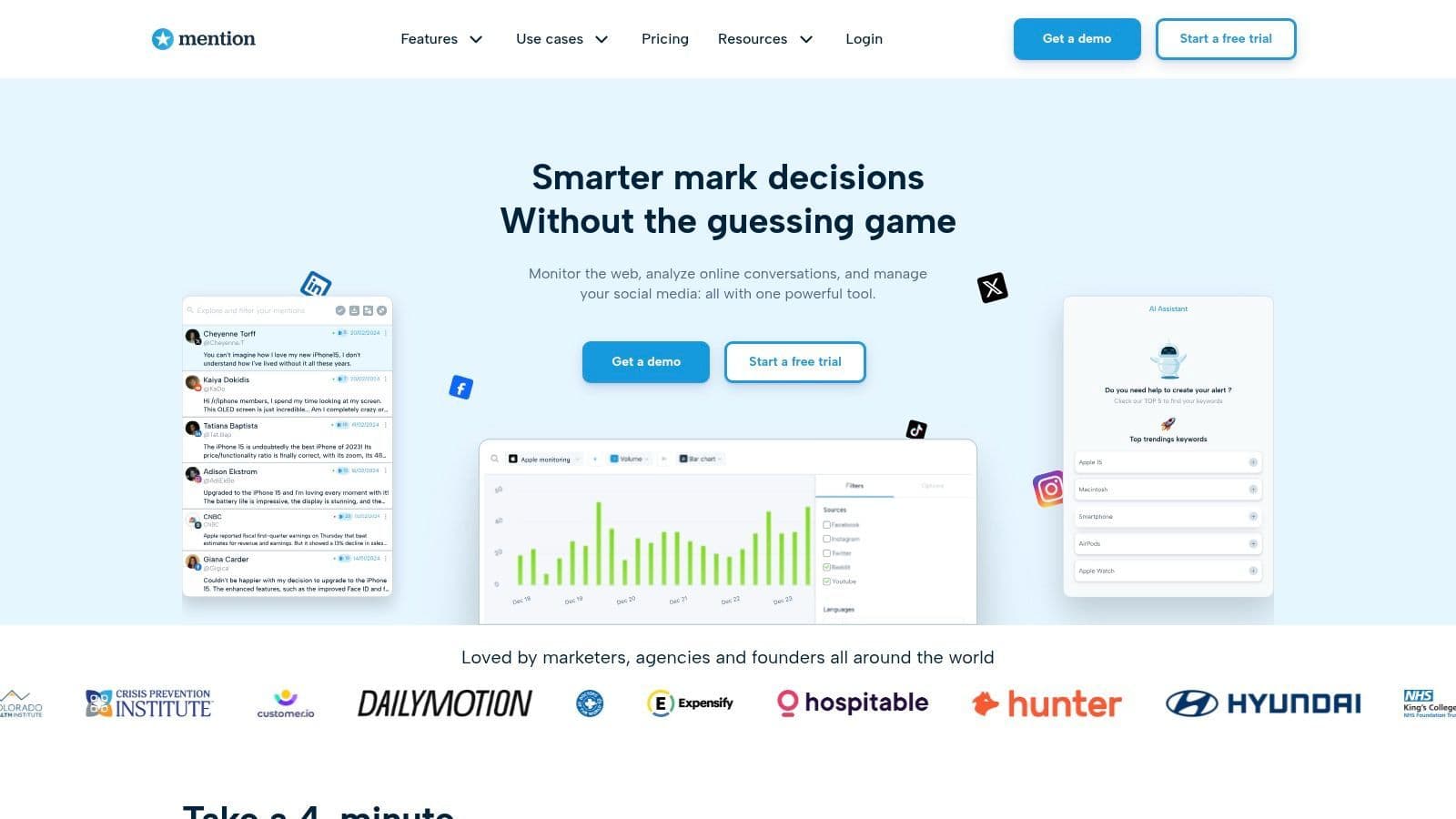
The honest caveat from my own competitor testing: coverage has gaps. Mentions that other tools caught sometimes never showed up in Mention. For low-stakes monitoring that's tolerable; if catching every conversation matters to your pipeline, it's a real cost.
One more thing that changed in 2026: Mention no longer publishes prices. There's now a single "Company" plan with custom pricing, and API access and historical data are paid add-ons. The old $599/month tier no longer exists. A free trial is back as of August 2026, so at least you can test coverage before talking to sales.
| Detail | Info |
|---|---|
| Price | Custom ("Company" plan; pricing revealed via trial or demo) |
| Coverage | Mainstream social plus news, blogs, and forums |
| Alerts | Real-time and digest emails, in-app, mobile push |
| API | Paid add-on |
| Free trial | Yes |
Pros:
- Keywords to live alerts in minutes
- Flexible alerting: real-time pings or daily digests per keyword
- Mobile app makes triage from your phone painless
- Free trial available again, without a demo call first
Cons:
- Misses things — side-by-side tests surfaced conversations Mention never caught
- No published pricing anymore, so budgeting means a sales conversation
- API is a paid add-on on top of the custom plan price
- Doesn't reach developer platforms, and the roadmap under Agorapulse is an open question
See our Mention alternative comparison.
Website: mention.com
5. Awario
Best for: Noise-free alerts via hand-tuned Boolean queries | G2: 3.9/5 (~50 reviews, May 2026)
Awario is the cheapest serious monitoring tool on this list, and its Boolean search is the best in its price class. If your brand name is a common word — or you only care about mentions that include specific qualifiers — Awario lets you build queries precise enough to keep the feed clean without AI filtering.
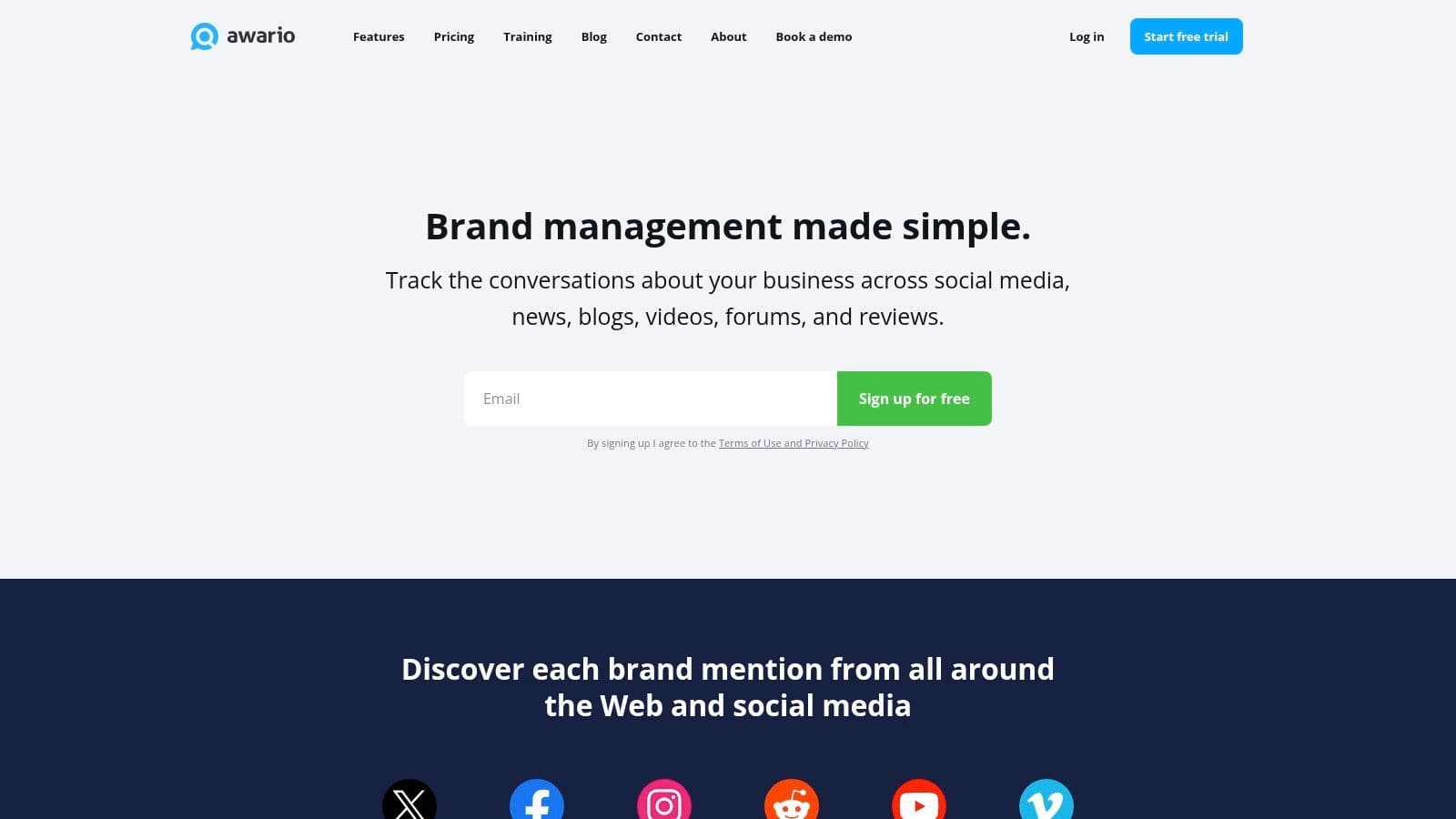
The Leads module is a clever monitoring twist: it watches for people asking for recommendations in your category, which turns brand monitoring into pipeline. At €49/month — or €29/month if you commit annually (Awario now prices in euros) — it's the cheapest serious option here; just know that unless you're on Enterprise, the data goes no further than the dashboard.
| Detail | Info |
|---|---|
| Price | €49/mo (Starter), €149 (Pro), €399 (Enterprise); €29/€89/€249 on annual billing |
| Coverage | Social networks plus news, blogs, forums, and review sites |
| Alerts | Email digests and in-app, near real-time |
| API | Enterprise plan only |
| Free trial | 7 days |
Pros:
- Boolean queries give you surgical control over what triggers an alert
- Leads module surfaces buying-intent conversations
- Cheapest credible monitoring option — €29/mo on annual billing
- White-label reports for agencies
Cons:
- API only on the €399 Enterprise plan, and no webhooks anywhere
- The UI looks and feels dated next to 2026-era tools
- Thin historical data
- Boolean precision requires manual tuning that AI tools do automatically
Weighing it seriously? We wrote a longer Awario alternative comparison.
Website: awario.com
6. BrandMentions
Best for: Real-time tracking accuracy at a fair price | G2: 4.9/5 (~236 reviews, May 2026)
BrandMentions holds one of the highest G2 ratings in the category, and the reviews consistently praise the same thing: when something gets posted, it shows up fast. For a tool whose entire job is "tell me the moment someone mentions me," that's the metric that counts.
Coverage spans the social networks alongside news, blogs, forums, and review portals, with sentiment and emotion tagged on each mention. The analytics are serviceable rather than deep — this is a monitoring tool, not an intelligence platform — but at under $100/month that's the right trade. Tier differences are mostly about history depth and refresh speed: daily updates on the entry plan, real-time on the higher ones.
| Detail | Info |
|---|---|
| Price | From $79/mo on annual billing (~$99 on shorter billing cycles) |
| Coverage | Web-wide: social, news, blogs, forums, and review portals |
| Alerts | Real-time email and in-app on higher tiers; daily updates on the entry plan |
| API | Enterprise plan only |
| Free trial | 7 days |
Pros:
- Real-time tracking accuracy is the most-praised feature in reviews
- Tops the category on G2 at 4.9/5
- Strong sentiment and emotion tagging on mentions
- Fair pricing from $79/mo
Cons:
- API only on Enterprise, so mentions can't leave the platform on the plans most teams buy
- Entry plan refreshes daily, not in real time — the headline feature costs more
- Analytics won't sustain serious competitive research
- Small vendor with a thin integration ecosystem
Website: brandmentions.com
7. Mentionlytics
Best for: Catching mentions in every language your customers speak | G2: 4.9/5 (~100 reviews, May 2026)
Mentionlytics covers social media, news, blogs, and forums with strong multi-language support — if your mentions come in Spanish, German, and Greek as well as English, it handles that better than most tools in its price range. The Social Intelligence Advisor (SIA) turns raw mention data into plain-language suggestions about what to act on.
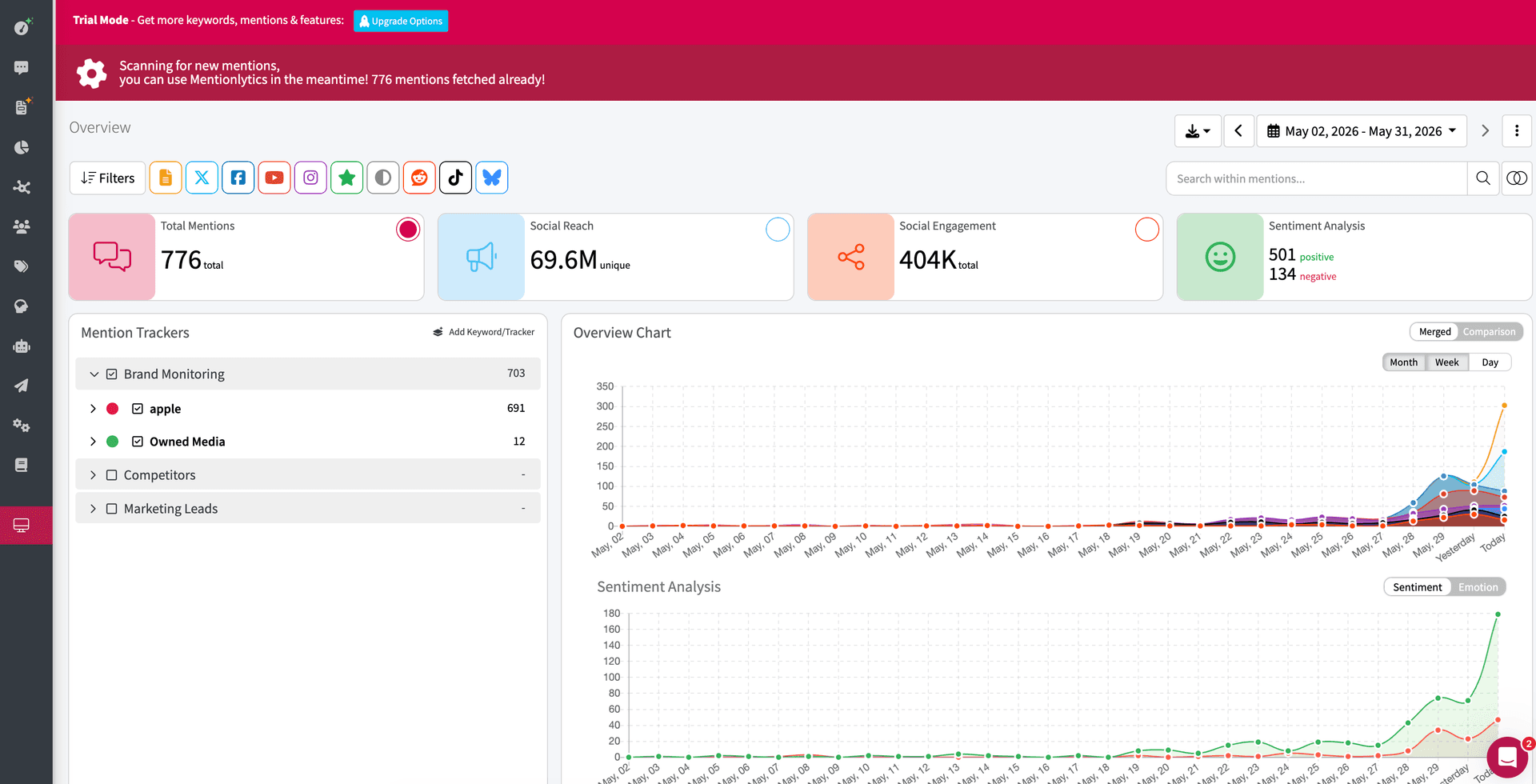
At $49/month entry pricing (billed yearly) it undercuts most of the list while keeping a 4.9/5 G2 rating. The constraint is the ceiling: the API starts at the $299 Advanced plan, integrations are fewer, and coverage depth trails the bigger platforms.
| Detail | Info |
|---|---|
| Price | $49/mo (Basic), $169 (Essential), $299 (Advanced), billed yearly; plans continue up to Enterprise |
| Coverage | Social channels, news sites, blogs, and forums |
| Alerts | Email, in-app; mention spikes flagged by SIA |
| API | Advanced plan ($299/mo) and up |
| Free trial | 14 days |
Pros:
- Strong multi-language mention tracking for the price
- SIA turns mentions into plain-language recommended actions
- Accessible pricing from $49/mo
- 4.9/5 on G2
Cons:
- API locked to the $299 Advanced plan and above
- Fewer integrations than larger platforms
- Coverage depth trails enterprise tools
- Only around 100 G2 reviews to date
Website: mentionlytics.com
8. Agorapulse
Best for: Small businesses that answer mentions from one inbox | G2: 4.5/5 (~955 reviews, May 2026)
Agorapulse is a social media management tool first — publishing, scheduling, unified inbox — with keyword monitoring layered in. For a small business, that combination is practical: the same inbox where you answer comments also surfaces brand mentions and competitor keywords, so responding is one click instead of a context switch.
The monitoring itself is basic compared to dedicated tools: major social platforms only, no forums, no developer platforms. But if your audience is on Facebook, Instagram, and LinkedIn and you want one affordable tool for the whole social workflow, it earns its spot.
| Detail | Info |
|---|---|
| Price | $99 per user/mo (Standard), $149 (Professional), $199 (Advanced); up to 20% off annually |
| Coverage | The six big networks: Facebook, Instagram, X, LinkedIn, TikTok, YouTube |
| Alerts | Unified inbox, email notifications |
| API | No |
| Free trial | 30 days |
Pros:
- Monitoring lands in the same inbox where you respond — fast reaction loop
- Clean interface, quick setup
- Good team features (assignments, saved replies)
- 30-day free trial
Cons:
- Monitoring limited to major social networks — no forums, Reddit depth, or dev platforms
- Per-user pricing grows with the team
- No API
- Listening depth well below dedicated tools
Website: agorapulse.com
9. Keyhole
Best for: Hashtag and campaign monitoring in real time | G2: 4.3/5 (~100 reviews, May 2026)
Keyhole (acquired by Muck Rack) is a specialist: real-time hashtag and campaign tracking. If you're running a launch, an event, or an influencer campaign and need a live read on hashtag reach, volume, and engagement, Keyhole does that job better than the general-purpose tools on this list.
It also handles account tracking and some keyword monitoring across X, Instagram, Facebook, YouTube, TikTok, and news. But it's campaign measurement first — if you need always-on brand monitoring across the open web, this isn't the primary tool.
| Detail | Info |
|---|---|
| Price | Custom — nothing published |
| Coverage | X, Instagram, Facebook, YouTube, TikTok, plus news sites |
| Alerts | Real-time dashboards, scheduled reports |
| API | Yes |
| Free trial | Available |
Pros:
- Live hashtag tracking is the best in the business
- Live event monitoring is genuinely useful mid-campaign
- Influencer identification built in
- API access included
Cons:
- Campaign-focused — not built for always-on keyword tracking
- No public pricing
- Doesn't look beyond the major networks
- Muck Rack acquisition may shift product direction
Website: keyhole.co
10. Brandwatch
Best for: Enterprise monitoring at maximum coverage | G2: 4.2/5 (~1,700 reviews, May 2026)
If budget isn't the constraint and coverage is, Brandwatch monitors more of the internet than anything else on this list — 100+ million sources with years of historical data. The Boolean query engine is the most powerful in the industry, and Signals (automated anomaly alerts) will flag unusual mention activity before a human would have noticed.
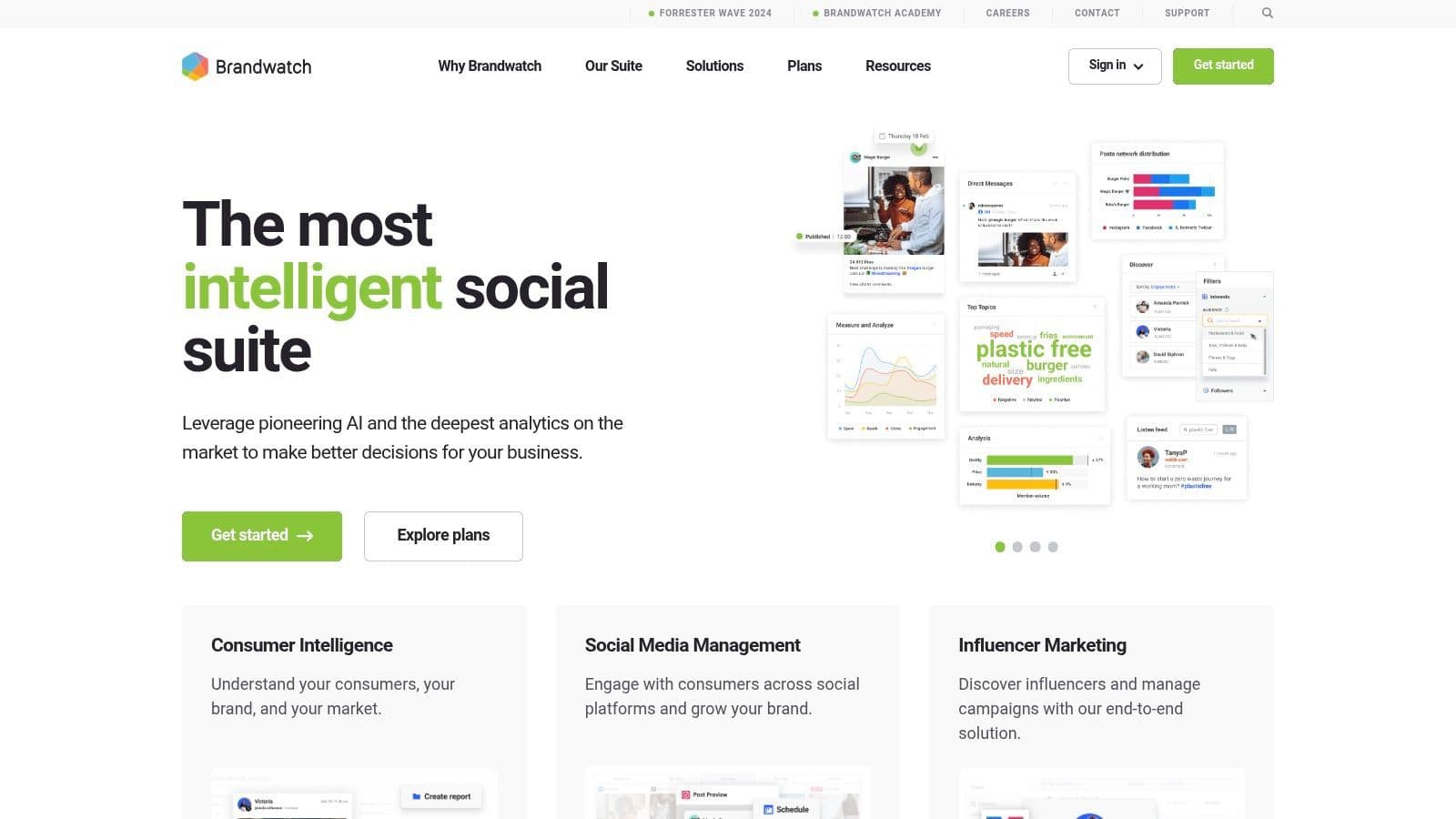
The reality check: this is enterprise software with enterprise onboarding. Pricing starts around $1,000/month and requires a sales cycle, the interface assumes a trained analyst, and most teams under 100 people will use a fraction of what they're paying for.
| Detail | Info |
|---|---|
| Price | Custom enterprise contracts — budget $1,000+/mo |
| Coverage | 100M+ sources spanning social, news, forums, and review sites, with deep archives |
| Alerts | Signals (AI anomaly detection), email, in-app |
| API | Yes, at enterprise tiers |
| Free trial | Demo only |
Pros:
- Broadest source coverage available — 100M+ sources, deep history
- Signals catches mention anomalies automatically
- Most powerful Boolean engine in the category
- Strong multi-language sentiment analysis
Cons:
- $1,000+/mo entry and a sales cycle before you see your own data
- Weeks-long onboarding; built for trained analysts
- Massive overkill below enterprise scale
- No self-serve anything
If it's on your shortlist, read our Brandwatch alternatives breakdown first.
Website: brandwatch.com
11. Google Alerts
Best for: Free web monitoring — as long as you know what it misses | G2: N/A
Google Alerts is free, takes 30 seconds to set up, and has no keyword limits. For monitoring news sites and blogs that Google indexes, it's a reasonable baseline that costs nothing.
It's also the most common source of false confidence in monitoring. Google Alerts covers zero social platforms — no Twitter/X, no Reddit, no LinkedIn, no YouTube — and mentions can take days to surface, if they surface at all. We've written about why Google Alerts misses so much and what a proper Google Alerts alternative looks like.
| Detail | Info |
|---|---|
| Price | Free |
| Coverage | Only web pages that land in Google's index |
| Alerts | Email (as-it-happens, daily, or weekly) |
| API | No |
| Free trial | N/A (always free) |
Pros:
- Free forever, with as many alerts as you want
- 30-second setup
- Decent for news sites and blogs
- Worth keeping as a backstop next to a paid tool
Cons:
- No social media coverage at all
- Days of lag — useless for responding while conversations are live
- High miss rate even on indexed content
- No filtering, no sentiment, no API
Website: google.com/alerts
Free social media monitoring tools: what actually works
"Free" is the most-searched qualifier in this category, so here's the honest version. A founder on X summed up why people look:
"Why it exists? Brand monitoring tools want $80/mo. Manually checking Reddit/HN/Google News is not a morning routine." — @just4rxxy
Your real free options:
| Free tool | What it covers | Speed | The catch |
|---|---|---|---|
| Google Alerts | Web pages in Google's index | Often days behind | Zero social platforms |
| Talkwalker Alerts | Google Alerts coverage + Twitter/X | Email digests | No Reddit, LinkedIn, or forums |
| F5Bot | Reddit, Hacker News, Lobsters | Near real-time | No filtering; every keyword match lands in email |
| Native saved searches (X, Reddit) | One platform each | Instant, but pull not push | You have to remember to check |
- Google Alerts — Web pages only, no social. Set it up anyway; it's free coverage of news and blogs.
- Talkwalker Alerts — A free Google Alerts alternative that adds Twitter/X mentions. Same email-digest model, slightly better coverage.
- F5Bot — Free emails when your keywords appear on Reddit, Hacker News, or Lobsters. For indie hackers, this is the best free tool on the list — it genuinely works. Browse Hacker News and you'll find people showing up in threads minutes after their name comes up, opening with things like "(came from f5bot) thanks for the post …" — that's swyx, who runs the Latent Space podcast, responding to a mention in April 2026. The limitation is just as visible: every raw keyword match lands in your inbox, unfiltered.
- Native platform search — Saved searches on X and Reddit work, but they're pull, not push: you have to remember to check.
- Free trials — Every paid tool above except Brandwatch offers 7-30 days free. Run two or three in parallel with the same keywords and compare what each catches; the differences will be obvious within a week.
One more free option from us: the share of voice calculator takes your brand plus up to three competitors and counts real mentions across 13+ platforms over the past week, so you can see how you compare before paying for anything.
The free stack (Google Alerts + Talkwalker Alerts + F5Bot) is a legitimate starting point for a solo founder. Its limits show up fast: no LinkedIn, no filtering, no sentiment, nothing pushed to Slack, and a lot of misses. When a missed conversation starts costing more than $50-100/month, that's your signal to upgrade — paid entry points are €29/mo (Awario annual) or $49/mo (Mentionlytics).
Which monitoring tool should you pick?
A decision framework, by situation:
You want mentions flowing into Slack, Linear, or your own systems in real time — Octolens. API, webhooks, and MCP on every plan, with AI filtering so alerts stay relevant. Built for B2B and technical audiences.
Your audience is on mainstream social and you also publish there — Sprout Social or Hootsuite. Monitoring inside the same tool your social team already uses.
You're budget-conscious but need real coverage — Brand24 for spike detection and influence scoring, Awario for Boolean precision at €49/mo (€29 on annual billing), or BrandMentions for raw real-time accuracy from $79/mo.
You're a small business that wants one tool for everything social — Agorapulse. Inbox, publishing, and basic monitoring in one place.
You're monitoring a campaign or hashtag, not a brand — Keyhole. Live campaign tracking is its specialty.
You're enterprise-scale with an analyst team — Brandwatch. Maximum coverage if you can absorb the price and onboarding.
You have zero budget — Google Alerts + Talkwalker Alerts + F5Bot, and the discipline to check saved searches.
One more thing worth doing regardless of which tool you pick: monitor your competitors' names alongside your own. Their unhappy customers ask for alternatives in public, and being the first helpful reply is the cheapest pipeline you'll ever generate. We wrote a full guide on competitor monitoring if you want the playbook, ranked the best competitor monitoring tools across every category from CI platforms to price trackers, and compared brand monitoring tools if your scope is reputation beyond social.
If your audience includes developers or technical buyers, check coverage before you commit to anything: most tools on this list don't watch Reddit properly, let alone Hacker News or GitHub. Start the free trials, set up the same keywords in two or three tools, and count what each one catches. Whichever one surfaces the most real conversations is your answer — and you'll know within days.