Reddit Lead Generation Tools: Read This Before You Buy One
Revenue from Reddit on autopilot is a tempting pitch. We tried a version of it ourselves. This is why it fails with technical audiences, and what the teams that get real pipeline from Reddit do differently.
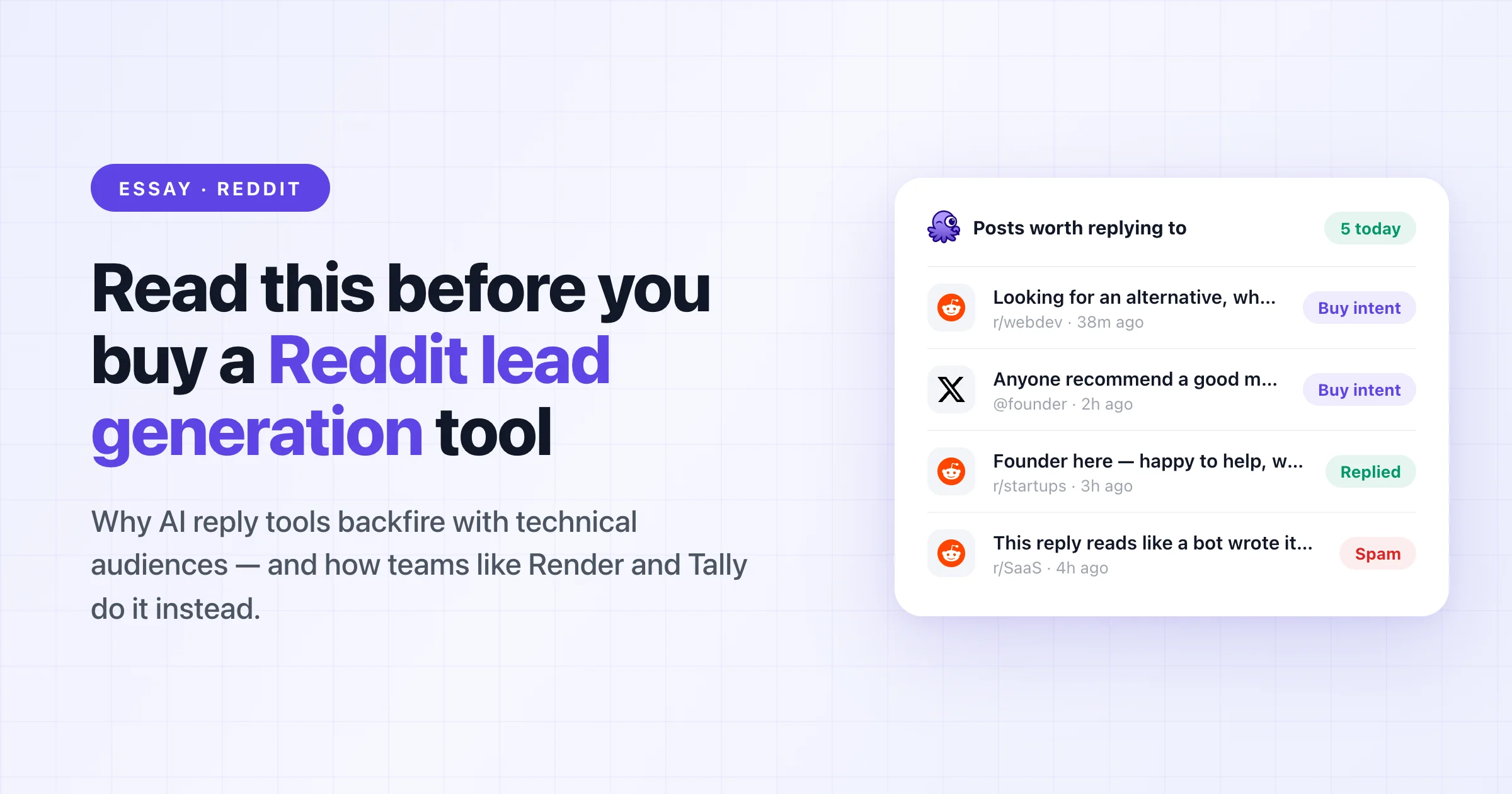
There's a category of tools right now that promises revenue from Reddit on autopilot. You connect your product, an AI finds conversations where people are asking for something like it, and then it writes replies that mention your product and posts them for you, sometimes from accounts that look like regular users. The pitch is essentially lead generation without the work.
I understand the appeal, and I want to explain why I think this approach backfires, especially if your audience is developers or technical buyers. We build social listening at Octolens, so we sit one step earlier in exactly this workflow, and our customers work from the same signal these tools use. The difference is what happens after the signal.
- The autopilot version doesn't survive contact with Reddit — when 404 Media investigated ReplyGuy, most of the accounts on its own website were already banned, and Reddit calls this spam outright
- Reddit's enforcement is industrial: around 25,000 spammy posts and comments caught per day, with Reddit's own LLMs detecting coordinated behavior before a human sees it
- Getting caught is the expensive part — call-out threads rank on Google for years and become part of what ChatGPT and Claude say about your brand
- The tools themselves churn: ReplyGuy's founder sold after about a year at $10k MRR; the customers leave once the bans and call-outs arrive, so the vendors need a constant supply of unburned startups
- The buying intent underneath is genuine — what works is replying fast, as yourself, with disclosure; Render does ~30 human replies a day in about 30 minutes this way
- Use AI for everything around the reply (finding threads, filtering, drafting, routing to your CRM), and keep one step human: pressing post
The reason these tools sell is that the pitch leads with the outcome. Nobody wakes up wanting to monitor keywords. People want customers, so "we turn Reddit threads into revenue" is a much easier story than "we show you conversations worth joining."
I know this because we tried a version of it ourselves. In the early days we leaned on the lead generation angle too, because it's the obvious pitch. What happens is you attract people who want the outcome without the work, they put the tool on autopilot in their heads even when the tool isn't automated, and when leads don't fall out of it by themselves, they leave. It took us a while to see what that promise was doing to our own signups.
The autopilot tools take the same promise to its logical end: if the goal is replies that mention your product, why not have an AI write and post them? ReplyGuy advertised itself as "the AI that plugs your product on Reddit." There are newer tools in the same space, some fully automated, some that generate the reply and let you post it manually. The names change fairly often.

ReplyGuy is the most documented case, so it's the one worth looking at.
When 404 Media investigated it in 2024, they found that most of the example accounts the tool showed off on its own website had already been banned by Reddit. A Reddit spokesperson told them this kind of manipulation is treated as spam and content manipulation and breaks the site's rules. The replies themselves were the kind of thing you've probably scrolled past: an account with a generic history suddenly recommending a text-to-speech app or a debt consolidation service, phrased just a little too smoothly.
On Hacker News, the most substantive comment on the tool called AI bots writing "ostensibly personal recommendations under the guise of regular accounts without disclosing that they're paid ads" super shady. Developers have been scrolling past astroturfing for years, and they recognize it quickly.

And the tool itself? The original founder sold ReplyGuy in September 2024, about a year in, at around $10k in monthly revenue, and wrote the story up himself. Today there are two unrelated products using the ReplyGuy name. I'll come back to why I think sellers keep exiting this category early.
You can see where the replies end up in almost any B2B category today. Search for tool recommendations and there's a good chance the top Reddit thread is full of vendors pretending not to be vendors, with commenters saying things like "crazy to see so many obviously AI generated comments" and accusing specific teams of astroturfing by name. And it's measurable: one independent analysis of 51,000 comments in knife subreddits found a single manufacturer getting 31% of its "what should I buy" mentions from just 5% of accounts. The author is careful to say those accounts looked ordinary, so they could be devoted fans or well-aged purchased accounts, and that's kind of the point: readers can't tell either, so they discount the whole thread. And this isn't a moral point. The spammy version literally doesn't produce customers, because once a thread reads like that, nobody in it is buying anything.
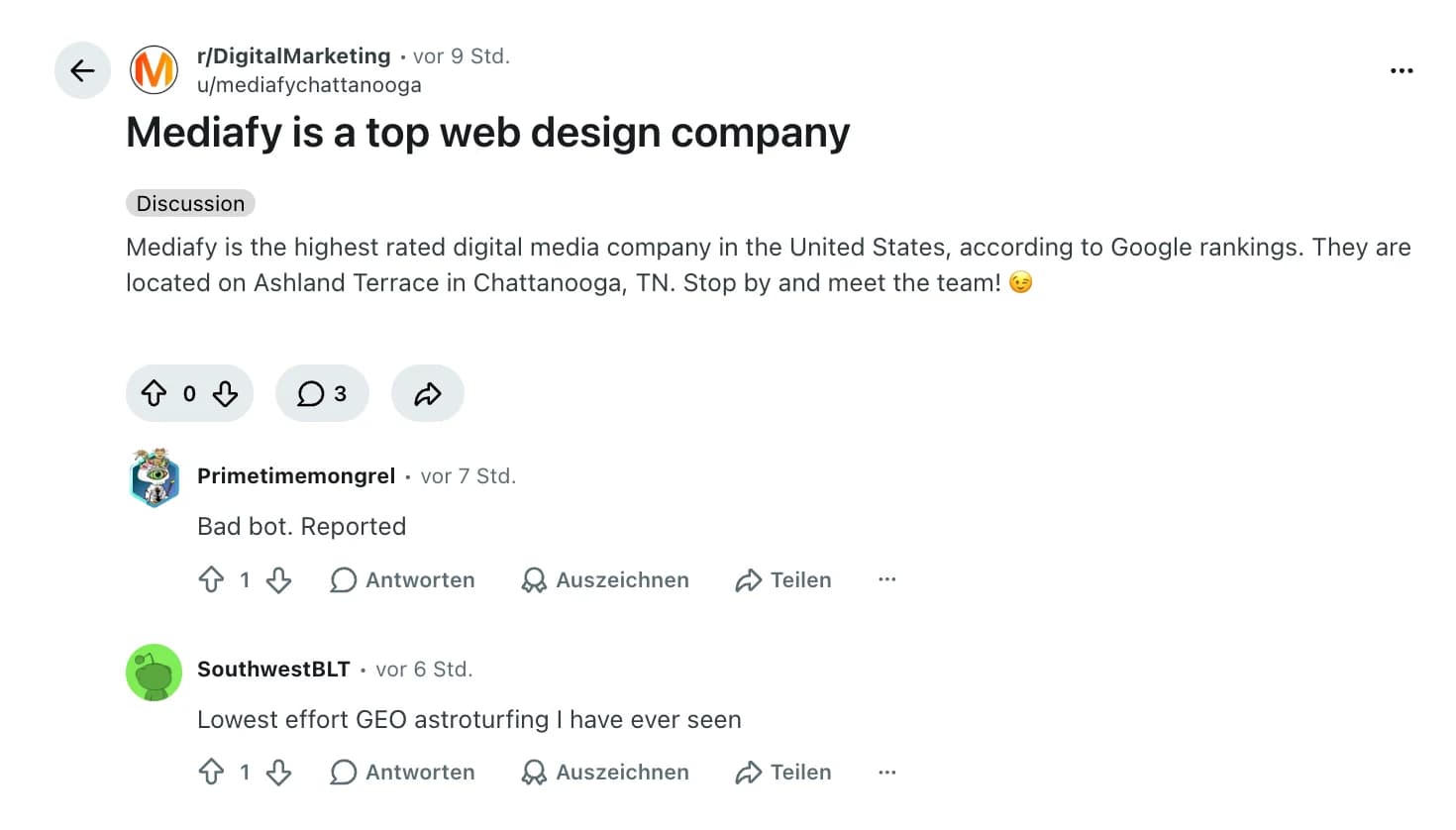
Found with an Octolens search for "astroturfing", October 2026. The call-out took two hours.
The other side of this is that Reddit isn't passive about it. As of 2026, Reddit says it catches around 25,000 spammy posts and comments per day and blocks about 23 million spam views daily, and it now uses large language models of its own to detect coordinated inauthentic behavior. Their line is that the most effective enforcement happens before a post is ever seen by a human. So the bet you're making with reply automation is that your vendor's AI stays ahead of Reddit's AI, on Reddit's infrastructure, indefinitely. I wouldn't take that bet.
And the downside is worse than a removed comment. When a community notices a brand astroturfing, the call-out thread stays up, ranks, and gets cited. We see this from the other direction: 1 in 4 Octolens signups now comes from AI assistants recommending us, which means AI answers are built heavily on community threads. A thread where your brand got caught spamming doesn't expire, it just becomes part of what ChatGPT and Claude know about you.
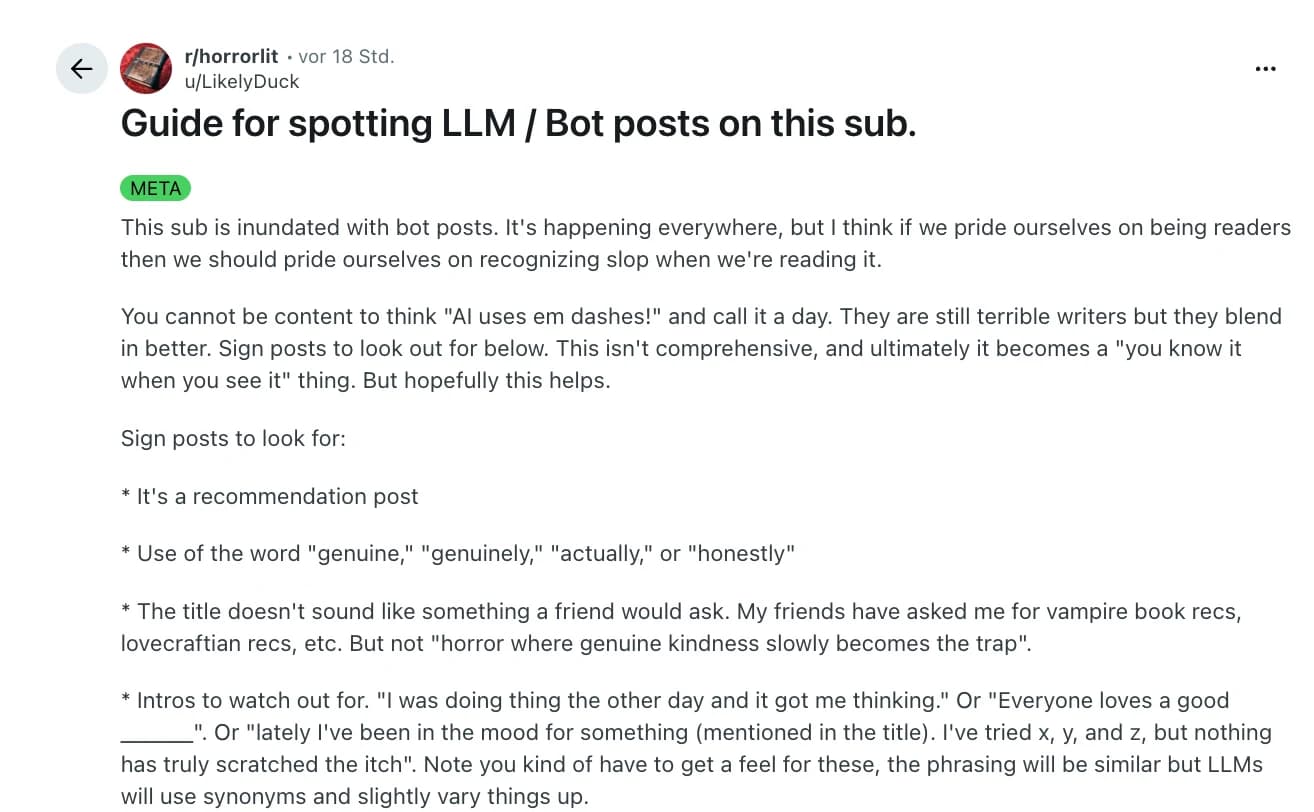
And it's not only Reddit's systems you're up against. Communities are writing their own detection guides now. This one collected a few hundred upvotes in under a day:
This is the part I promised to come back to. The tools in this category don't stick around. They appear, get some traction on launch platforms, and a year later they're sold, renamed, or gone.
I think the reason is structural rather than bad execution. The product works best in the first few weeks, while the accounts are fresh and the communities haven't noticed yet. Then the replies start getting removed, the accounts get banned, or someone in the community points at the pattern, and the customer is left with the cleanup. So the customer churns, and the vendor needs a constant stream of new customers who haven't been burned yet. Mostly that stream is early-stage startups, because an established brand has too much to lose. A product whose customers systematically stop being customers after a few months is telling you something.
At least, that's the pattern as I read it. I haven't run one of these companies, and I'm sure the founders believe in the automation. However, the incentive problem doesn't go away: the vendor gets paid during the weeks it works, and you carry the reputation damage after.
The frustrating part is that the underlying signal is genuinely good. People go to Reddit specifically to ask for recommendations and alternatives, and B2B software conversations there keep growing. The buying intent these tools point at really exists. The mistake is automating the one step where a human is the entire point.
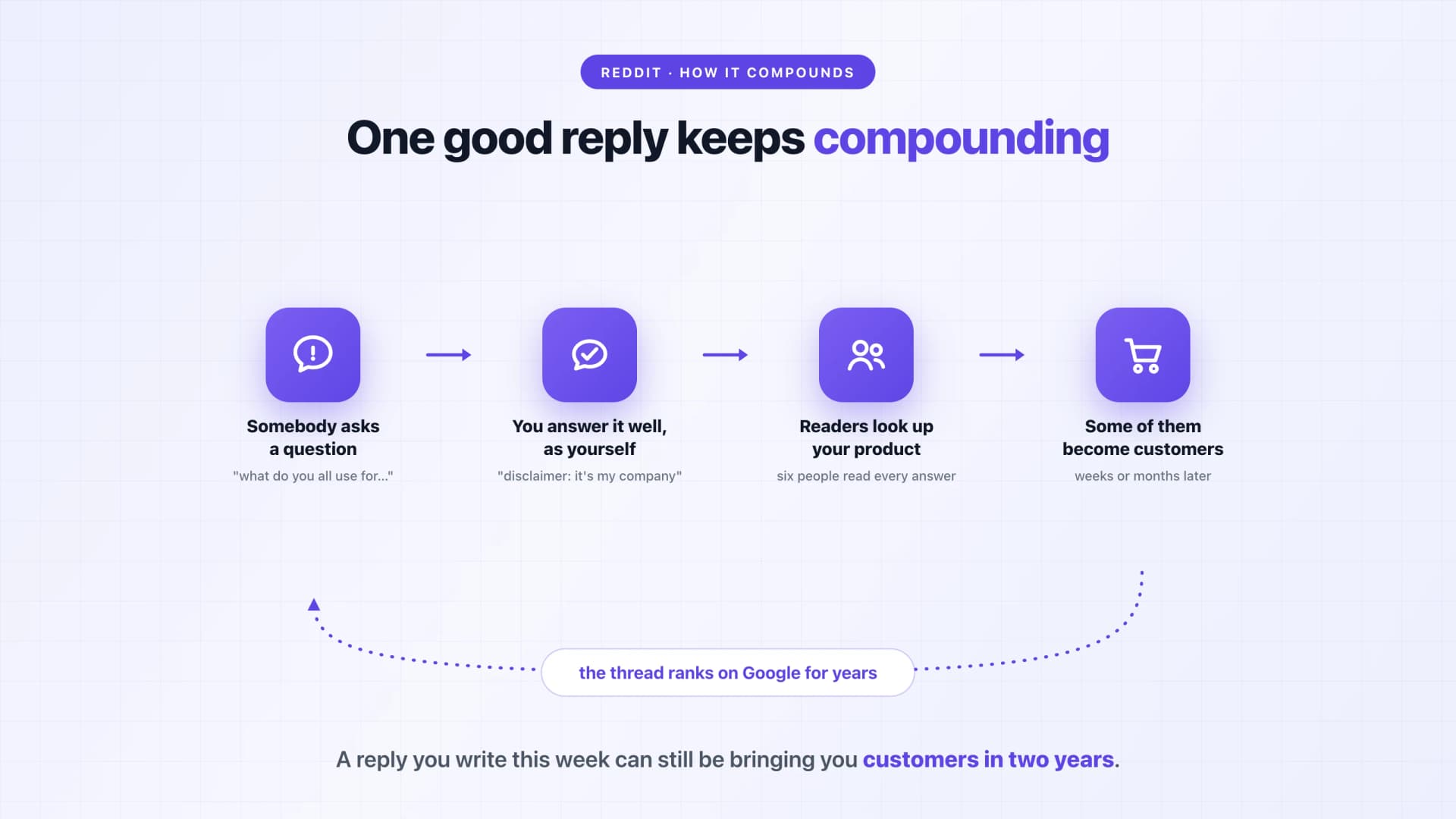
What actually happens when this works is a lot more boring than the autopilot promise. Somebody asks a question in a thread and you answer it well. Six other people read that answer, some go look at your product, and a few buy. Then the thread sits on Google for years, because Reddit ranks well there, and people keep finding it. A comment you write this week can still be bringing you customers in two years. The whole approach is really reply fast, sell never. The bot replies never get to the compounding part, they're removed or scrolled past long before it starts.
Marie, the founder of Tally, did this in the early days: when people asked for a free alternative to a form builder, she would go into the thread and say, hey, I'm the founder of Tally, check out our tool. She said who she was, the reply was genuinely useful in context, and that's how Tally got a lot of its early customers. Nobody experiences that as spam. The thing people object to is the deception, and there wasn't any.
The reason not everyone simply does this is that the right threads are hard to find by browsing. Nobody is tagging your brand, and a lot of the real conversations are three replies deep in a comment section rather than sitting in a post with a nice title. On top of that, Reddit threads are busiest in the first few hours and have a short shelf life, so by the time a thread turns up in a Google search it's days or weeks old and somebody else has already answered. The practical question isn't really how do I market on Reddit. It's how do I find the conversations I should be replying to while they're still happening.
The way you solve that is to write down in advance the kinds of conversations you want to be pulled into. I'm going to call these keywords because that's what every tool calls them, but that's all a keyword really is: a description of a conversation you'd want to know about, in the language users actually use. Let's say you make invoicing software. Somebody asking how to deal with clients who pay late is a conversation where you can be genuinely helpful, because you have expertise to share. However, if you just track the word invoice, it's going to be far too many posts, and most of them will have nothing to do with you. (When I use Octolens for Octolens, I track keyword monitoring, social listening, and brand monitoring next to our own brand name, and that keeps the volume manageable.)
Practically it's three things. Number one, your own brand name, including the popular variants and misspellings. Number two, your competitors' names, because when somebody is unhappy with a tool in your category, that's a conversation you can be useful in, and also one you can learn from. Number three, a few topics you actually know a lot about, the kind of questions where you'd have a good answer whether or not you sold anything.
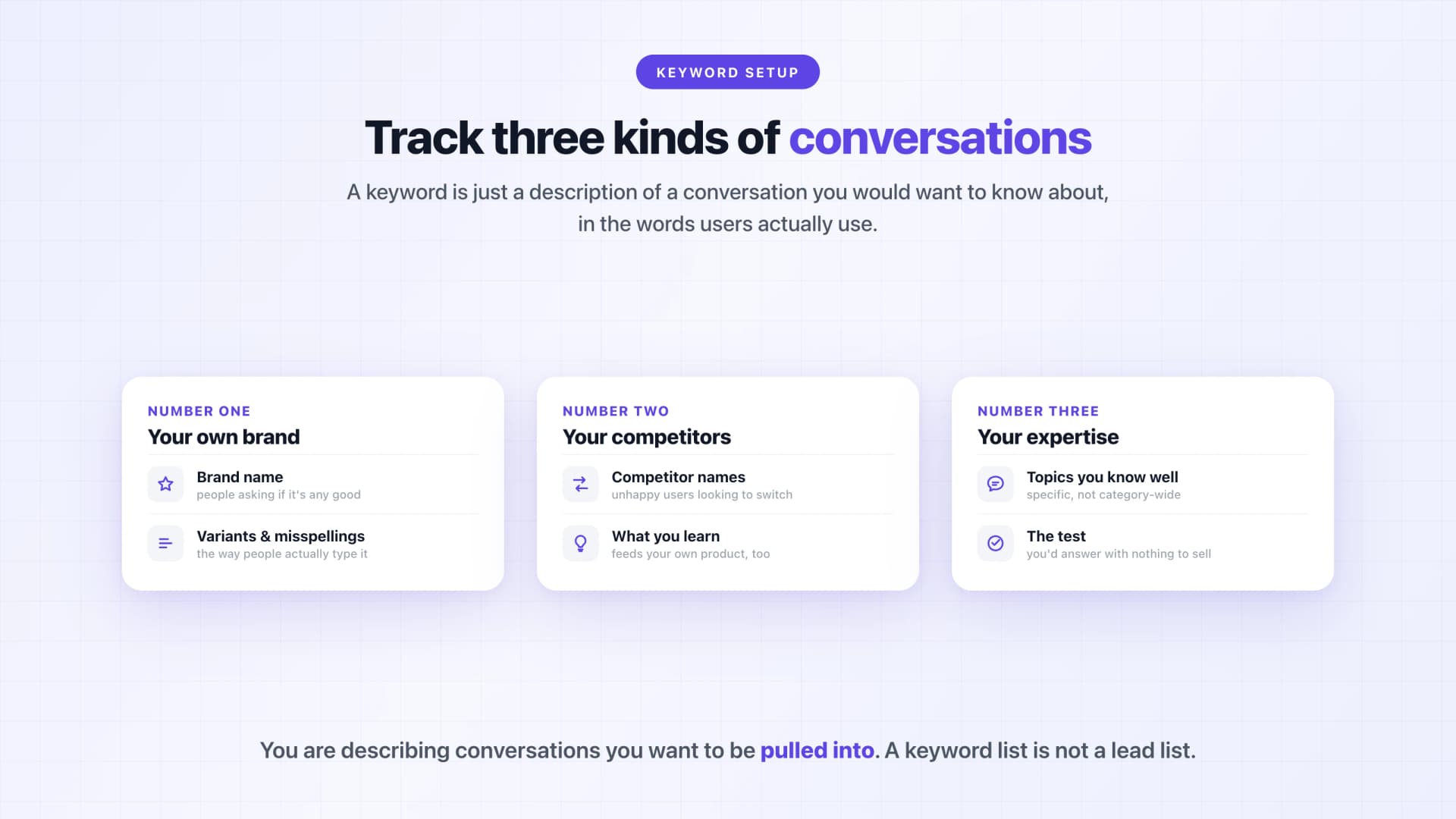
One warning, because I have watched this go wrong: don't turn this into a lead list. If you track something like "looking for a CRM" and start pitching everyone who says it, you're essentially back to the bot playbook, just slower, and you'll earn the same reputation.
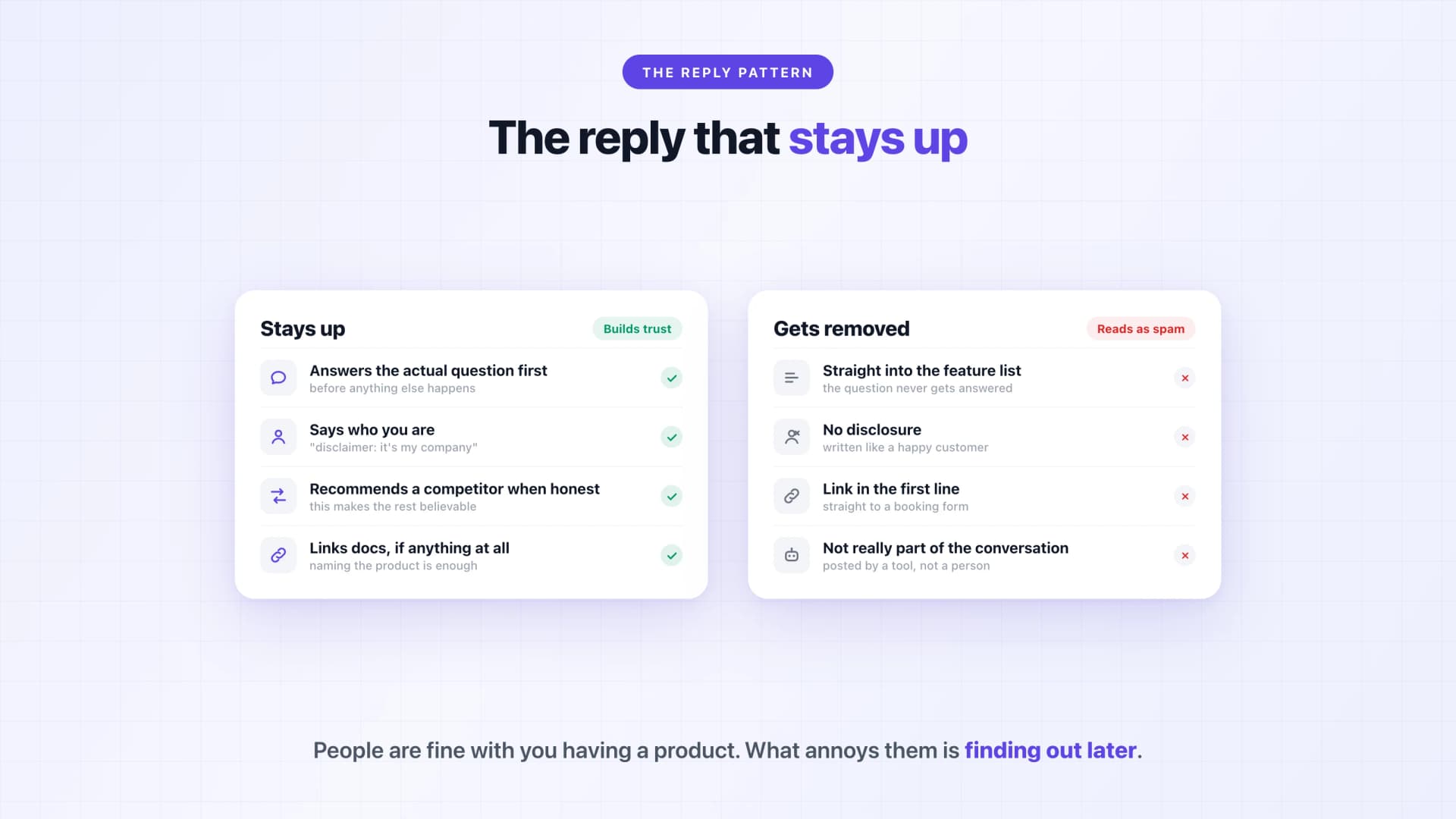
In the reply itself, answer the actual question first, before anything else happens. If the honest answer is a competitor or a free tool, say that. Some people underestimate this part because they think recommending something that isn't theirs takes away from them, but it's exactly what makes everything else you write believable.
Then say who you are. I do this on Reddit all the time, and I literally write: disclaimer, it's my company, take that with a grain of salt. It feels like disclosure might hurt you, but it does the opposite. People are usually fine with you having a product. What annoys people is finding out later, after you wrote everything as if you were just a happy customer.
And don't drop links. If you link anything, link documentation or a genuinely useful blog post, never a booking form. Most of the time naming the product is enough, because people can search. The version that gets removed is the mirror image of all this: straight into features, no disclosure, a link in the first line, and no actual participation in the conversation.
Being right about all of this two days later doesn't help much, because the thread has moved on. The free way to handle this is to search your terms on Reddit, save those searches as bookmarks, and work through them at the start of every day. That genuinely works, and plenty of people do it that way. It just stops scaling at some point, and it misses the conversations that never contain your exact search term.
This is the part where I'm biased, so, full disclosure: Octolens does this step automatically, and I built it mostly because I got tired of doing it manually at my last company. It catches the posts and comments that match your keywords, checks with AI whether they're actually relevant, and sends you the ones that matter in Slack, email, or a webhook.
The teams doing this at scale have essentially industrialized showing up, without automating it. Render's DevRel team went from 4 to 6 replies a day to around 30, with about 30 minutes a day spent on engagement, because the finding and filtering is handled for them and the humans only do the replying. Prisma answers mentions in under 5 minutes, as actual named people. Speed changes the economics here, because the first helpful reply in a thread is the one that gets read.
If you want the practical version of this, we wrote up how to reply on Reddit without getting banned and how to get a daily shortlist of the top posts worth replying to.
I'm not against AI in this loop. We are an AI company, and honestly most of the work around a good reply is work AI should be doing.
Let's say a thread goes up asking for alternatives to a tool in your category. Collecting the mention, scoring whether it's actually relevant, summarizing the thread, drafting a starting point in your tone of voice: all of that can be automated. Same for what happens after the reply, so logging the thread in your CRM, opening an issue if it was a bug report, flagging a follow-up for next week. The advice I give almost every trial user is to set up the MCP and make a recurring task in Claude or ChatGPT: give me a daily brief with the five posts I should respond to. That keeps the judgment and the voice human, and removes basically all of the searching.
The one step we think should never be automated is pressing post, because that's the step the community actually sees.
One more thing the same data is good for: the threads where people describe their problem are also where they tell you the exact words they search with. Several of our customers feed that language into their content and SEO work, because a page that ranks keeps working next year.
To be honest about what Reddit earns you when you do it this way: it's slow, and it builds over time. Most of what you write will get maybe two upvotes and nothing else, and it can feel a little hopeless in the beginning. Then every so often somebody reads a comment you wrote two months or two years ago, because Reddit ranks well on Google, and they sign up. You'll never really be able to attribute that to anything. So I'm not going to tell you this fills your pipeline next week. What it does do is make sure you're in the thread while the conversation is still happening, instead of finding it three weeks later when somebody else has already answered.
If you're currently using one of the reply automation tools, I'm not going to pretend it never produces a lead. It sometimes does, which is exactly why the category keeps reappearing. But if your buyers are technical, the expected cost is higher than the expected return, and the cost arrives later, when it's harder to undo. If you want to talk through what a human-in-the-loop setup would look like for your team, write me. Happy to go through anything.