Table of contents
- Your buyers ask ChatGPT before they ever see your website
- How ChatGPT decides which brands to recommend
- Step 1: Build your money-prompt matrix
- Step 2: Publish pages AI assistants actually pull from
- Step 3: Earn mentions where the models look
- Step 4: Measure it (and expect dark attribution)
- A realistic 90-day plan
Your buyers ask ChatGPT before they ever see your website
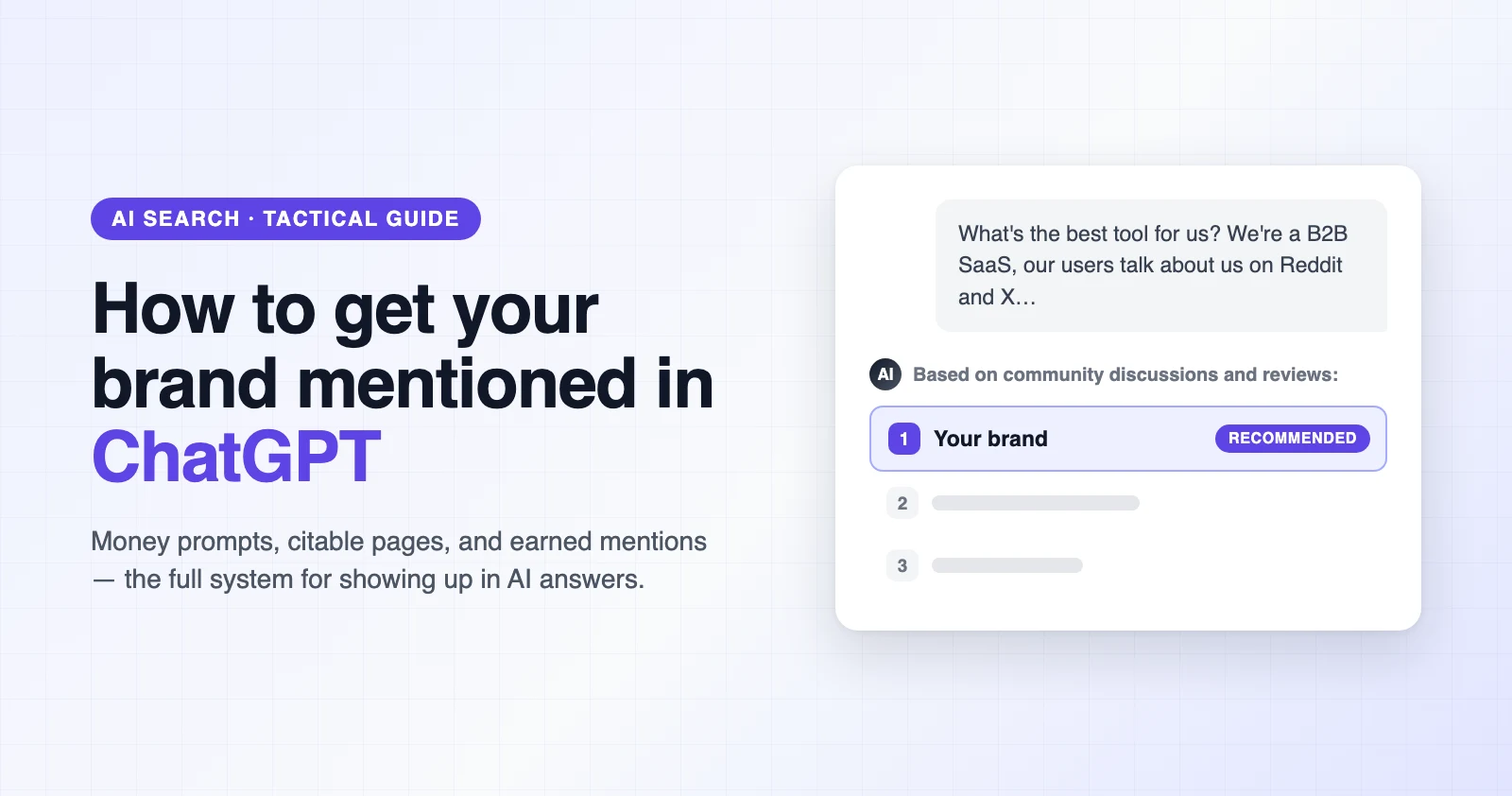
Here's how software gets evaluated now. A VP of engineering doesn't google "best social listening tools" and click through ten tabs. They open ChatGPT and type something like:
"We're a 40-person devtools company. Our users talk about us on Reddit, Hacker News, and X. We need a tool that catches those mentions, filters the noise, and pushes them to Slack. API access matters. Budget is around $200/month. What should we look at?"
Thirty seconds later they have a shortlist of three to five products. Either you're on it, or a competitor just got a warm lead you never knew existed.
The uncomfortable part: you can't buy your way onto that shortlist. There's no ad slot in the answer. The model recommends whoever the internet's evidence says is credible for that exact use case.
The good part: that evidence is something you can systematically build. The industry hasn't settled on a name for the practice - you'll see it called AEO (answer engine optimization), GEO (generative engine optimization), AI SEO, ChatGPT SEO, or just AI search optimization. Labels aside, the mechanics are consistent, and this guide is the full system: how AI assistants pick brands, how to find the prompts worth winning, what to publish on your own site, and how to earn the third-party mentions that models trust most. It works the same for ChatGPT, Perplexity, Gemini, Claude, and Google AI Overviews.
How ChatGPT decides which brands to recommend
People imagine LLM recommendations come from some frozen snapshot of the internet. That's only half the story, and it's the less important half for you.
Training data is the baseline. If your brand appeared consistently across the web for years, the model "knows" you. Big incumbents in mature categories (think CRM) are baked in this way, which is why prompts like "best CRM" are nearly impossible to move. Skip those.
Grounding is where the game is actually played. When someone asks a specific buying question - a use case, a budget, an integration, a comparison - the assistant usually runs a live web search and synthesizes an answer from what it retrieves. Ask ChatGPT a specific software question and expand the sources: you'll see it cite a handful of pages, and the same types keep showing up:
- Listicles and roundups - "the best X tools for Y" articles, both on vendor sites and independent blogs
- Community threads - Reddit above everything, plus Hacker News and niche forums
- Review platforms - G2, Capterra, and category-specific ones
- Vendor pages - comparison pages, docs, pricing pages
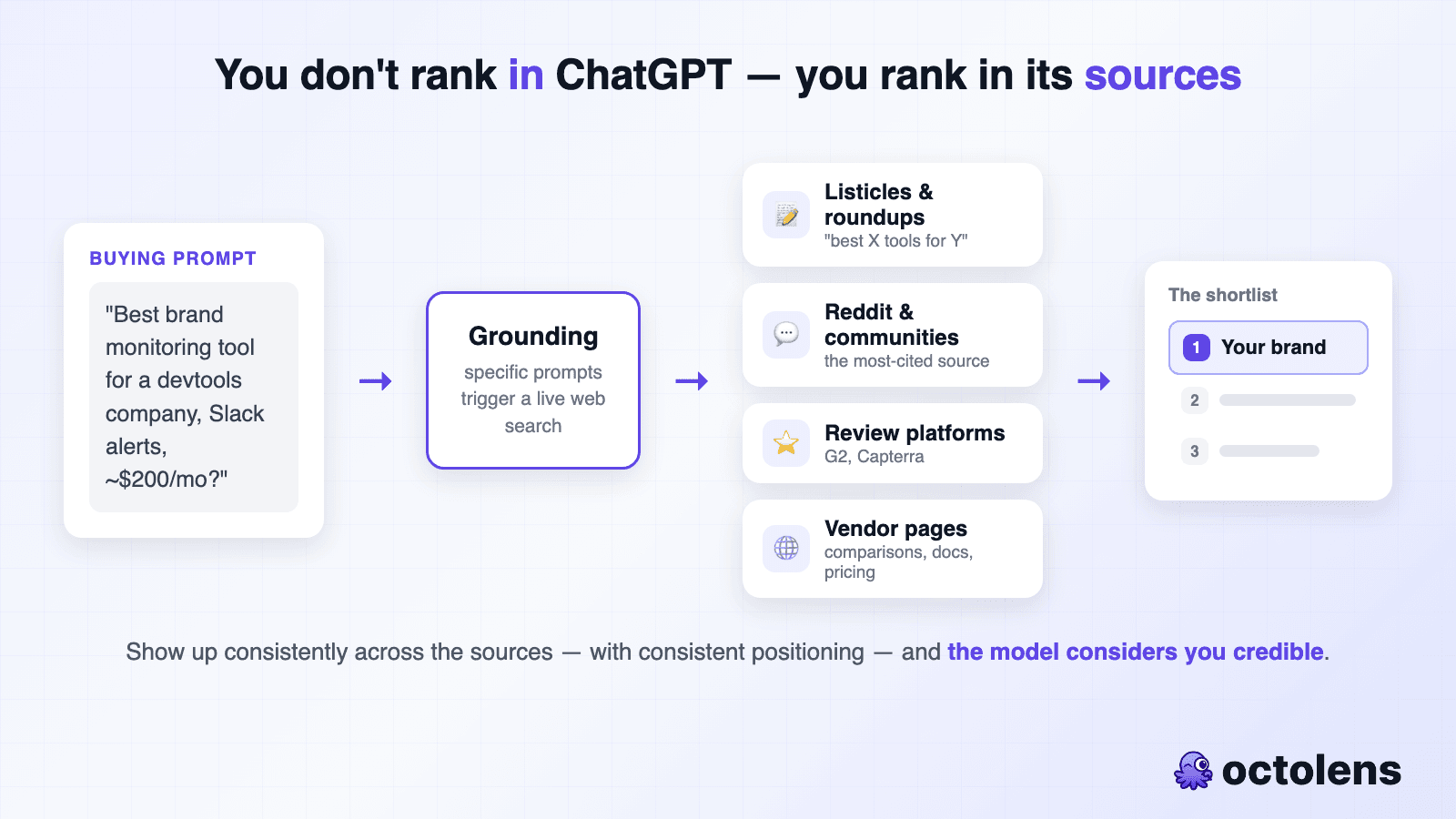
This is why the phrase "how to rank in ChatGPT" is a bit misleading. You don't rank in ChatGPT. You rank in the sources ChatGPT reads - and the way to show up in ChatGPT is to show up in enough of them, with consistent positioning, that the model considers you credible for the prompt.
Reddit deserves special emphasis. We monitor Reddit at scale for our customers - 522M+ Reddit mentions across 500K+ subreddits since July 2025 - and the pattern is unambiguous: candid community threads are the raw material AI answers are built from. A single "what do you all use for X?" thread where three people name your product can keep resurfacing in AI answers long after the thread went quiet.
So the system has two halves: pages you control (your site) and mentions you earn (everywhere else). Both start with knowing which prompts are worth winning.
Step 1: Build your money-prompt matrix
Most teams skip straight to writing content and produce generic top-of-funnel posts that AI assistants answer without recommending anyone. "What is social listening" gets a definition, not a shortlist. You want the prompts where the assistant names products - those are bottom-of-funnel, and they're triggered by specificity.
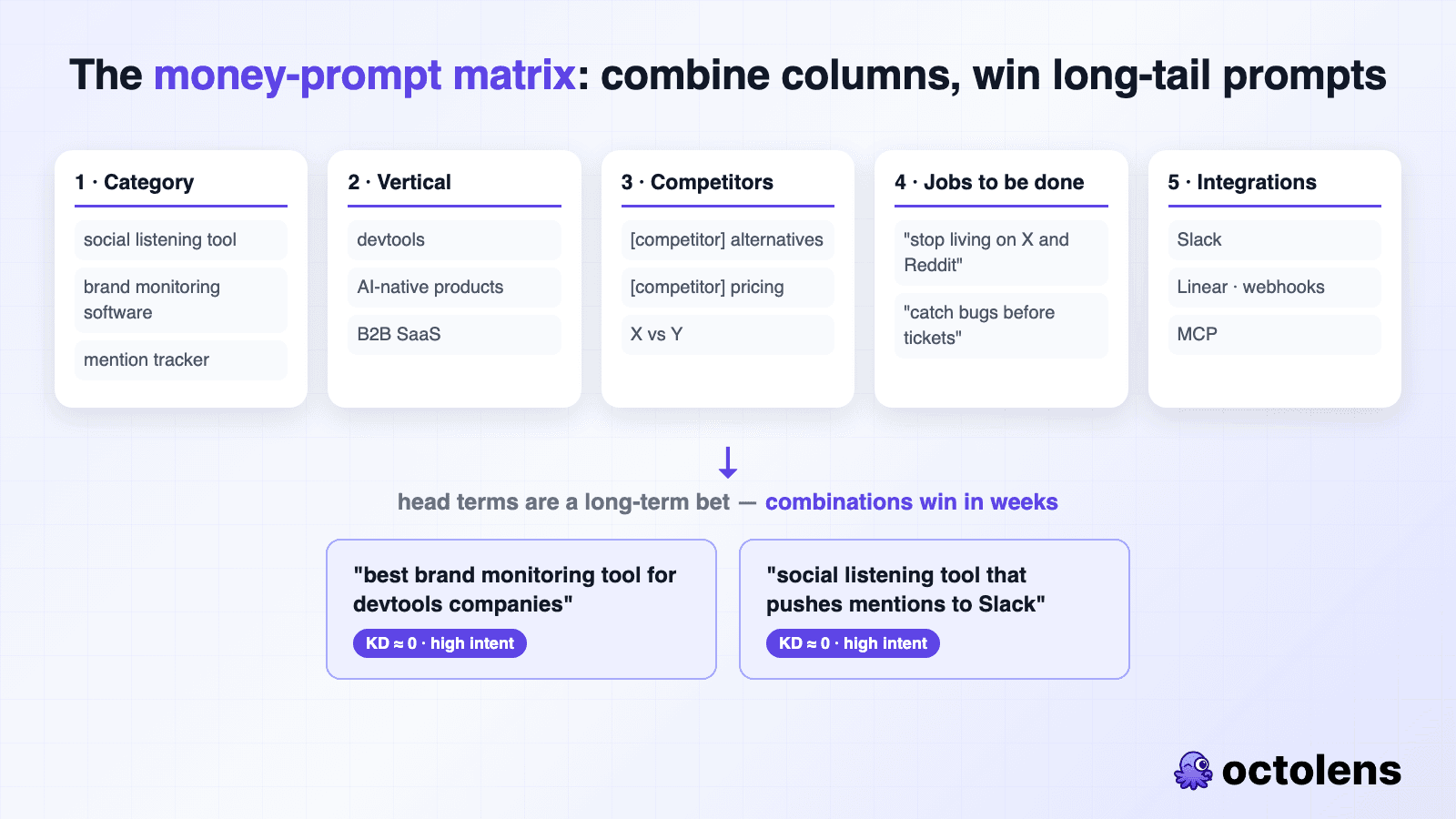
The fastest way to enumerate them is a simple matrix. Five columns:
| Column | What goes in it | Example (ours) |
|---|---|---|
| Category phrasings | Every way a buyer describes your product | social listening tool, brand monitoring software, mention tracker, social listening API |
| Verticals | Industries you demonstrably win | devtools, AI-native products, B2B SaaS |
| Competitors | Tools you get compared to or win deals from | the incumbents and the adjacent tools |
| Jobs to be done | The pain, phrased the way buyers phrase it | "stop living on X and Reddit all day", "catch bug reports before support tickets" |
| Integrations | The connections buyers search for | Slack, Linear, webhooks, MCP |
Your money prompts are combinations across columns: category + vertical ("best brand monitoring tool for devtools companies"), competitor + intent ("[competitor] alternatives", "[competitor] pricing"), job-to-be-done + category ("tool that alerts us when someone mentions us on Reddit"), integration + category ("social listening tool that pushes mentions to Slack").
Head terms alone are a long-term bet - established players have years of accumulated authority there. The combinations are where a smaller team wins fast, because difficulty drops to near zero while buying intent stays high.
Where the matrix content comes from (don't guess)
The matrix is only as good as its language. If column one contains phrases your marketing team invented and column four contains pains you assume people have, you'll target prompts nobody types.
Two sources fix this:
Your mentions. This is where social listening earns its place in an AI search program. Every day, people describe your product, your competitors, and their frustrations in public - on Reddit, X, Hacker News, LinkedIn - in their own words. That's your matrix, pre-written. We run Octolens on our own keywords and competitors, and the highest-value output isn't the alerts - it's the phrasing. When three separate Reddit threads describe the same pain in almost the same words, that phrasing goes in column four verbatim, because it's also exactly what those people will type into ChatGPT.
Your sales and support conversations. Call recordings and support threads tell you which competitors actually come up, why deals close, and what nearly kills them. Query them for: the words prospects use for your category, the tools they're switching from, and the objections that repeat.
An hour of mining real language beats a week of brainstorming. When your pages use the exact phrases buyers use, you match their prompts - and LLMs are literal enough that this matters.
Step 2: Publish pages AI assistants actually pull from
For every money prompt, check what gets cited before you write anything. Ask the prompt in ChatGPT and Perplexity, expand the sources, and note the page types. Google the equivalent keyword and note what ranks. Then build that type of page, better. For most SaaS buying prompts, the answer is a listicle or a comparison page - assistants love structured evaluations they can lift a shortlist from.
What consistently works in cited pages:
- A direct summary in the first 100 words. Assistants extract chunks, not whole articles. If the takeaway is buried in paragraph nine, the page gets skipped for one that answers immediately.
- Comparison tables. Structured data is the easiest thing for a model to lift accurately. Every listicle should open with one.
- Honest competitor coverage. Put yourself first with a straight face - state exactly who you're for and who you're not for - then review alternatives factually. Pages that read as fair get cited; pages that read as ads get skipped. Being explicit about your positioning also means the model repeats your framing when it mentions you.
- Real FAQs. Nobody asks an LLM one question. They ask follow-ups until they have a shortlist. Answer the follow-ups on the same page - the actual questions from your sales calls, not filler - and mark them up with FAQ schema.
- Freshness and specifics. A visible updated date, unique data points, real screenshots. Models weight recency and reward information that exists nowhere else. (This is also the argument for publishing original research - it makes you the citation instead of a paraphrase of one.)
Refresh before you write new. If a page of yours ranks on Google page one but never gets cited in AI answers, a structural refresh - summary up front, comparison table, FAQs, updated date, more depth per tool - is the fastest visibility win available. Assistants retrieve from search indexes, so pages already indexed and ranking start appearing in answers within weeks of a good update.
Technical table stakes, quickly: don't block AI crawlers in robots.txt or your CDN's bot protection (Cloudflare has blocked them by default), make sure money pages are indexed in Google and Bing (grounding retrieves from search indexes), keep pages fast, and consider an llms.txt. We ship llms.txt and llms-full.txt on this site - every post you're reading is machine-readable by design. Unless your site has thousands of pages, this is a day of work, not a quarter.
Or let Claude run this step for you. We packaged this exact page-building workflow as an open-source Claude skill: octolens/seo-page-builder. Drop it into Claude Code and it walks the same pipeline we use for every page on this site - keyword research, SERP analysis, mining real user quotes from Reddit and Hacker News, fact verification, then writing the page in the citable format above. It's the methodology from this guide, executable.
Step 3: Earn mentions where the models look
Everything so far happens on your site. It's necessary, and it's not sufficient - a model that only finds you on your own domain has one biased source. AI brand mentions are driven by corroboration: the brands that dominate AI answers are the ones mentioned consistently across sources they don't control. This off-page half is where most teams have nothing, and it's where social data stops being a nice-to-have and becomes the engine.
Reddit: the highest-leverage surface, and the easiest to get wrong
The math is simple: Reddit threads are among the most-cited sources in AI software answers, and recommendation threads stay retrievable for years. One authentic mention in the right thread outperforms most backlinks you could ever build.
The workflow that works:
- Monitor your money-prompt language, not just your brand name. Track your category terms, competitor names, and jobs-to-be-done phrasing across Reddit, Hacker News, and X. The threads you need - "what do you use for X?", "alternatives to [competitor]?" - almost never contain your brand name. That's the point: they're where your brand name should end up.
- Show up fast, as a member, not a marketer. Recommendation threads get most of their replies early - hours matter. When a relevant thread appears, respond with genuine help: answer the actual question, compare options honestly, disclose your affiliation, respect each subreddit's rules. One good answer that mentions your product beats ten promotional ones that get removed - and the removed ones damage the brand besides.
- Let happy customers speak. When someone asks for recommendations in your category and a customer answers, that's the most credible mention that exists - to humans and to models. You can't manufacture it, but you can make it easy: know which customers are active in communities, and make sure they hear about threads where their experience is relevant.
- Correct misinformation before it calcifies. Wrong claims about your product in old threads become "things people just know" - and then things AI assistants repeat. Metabase's developer advocate uses this exact workflow: catch wrong claims as they're posted, correct them in-thread, and future readers - human and machine - see the correction instead of the error.
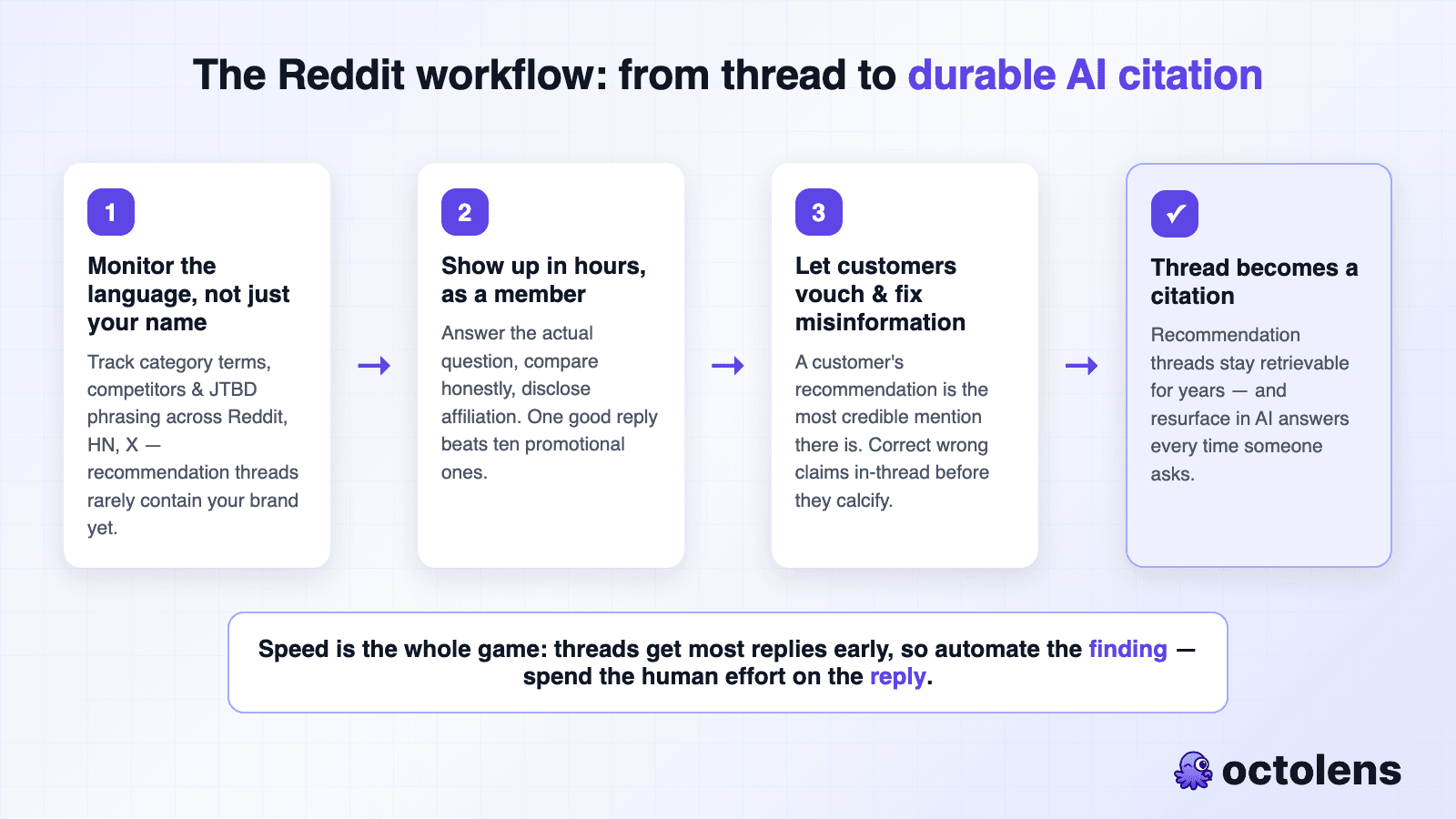
This only works as a minutes-level game. A recommendation thread found two weeks later by manual searching is a missed citation; the whole reason to automate the monitoring half is so the human effort goes into the reply, not the finding. That reality - AI answers being built from community threads - is a big part of why social signals became a GTM channel rather than a marketing curiosity.
Get into the listicles that get cited
When you check your money prompts (step 2), you'll notice the same independent articles cited repeatedly. Those pages are distribution infrastructure now - being in them means being in the answers built from them.
Make a list of every recurring cited page where you're absent. Then do targeted, personal outreach: find the author, and offer something real - a reciprocal placement in your own roundup, a podcast slot, data from your research they can cite. Ask for more than a link: a short writeup with your actual positioning, so every source describes you the same way. Consistency across sources is what lets a model state confidently who you're for.
Review sites and podcasts round out the footprint
G2 and Capterra profiles get cited for pricing and rating questions - keep yours current, with real reviews that mention your ICP. Podcast and YouTube appearances become transcripts, show notes, and episode pages: more surfaces where your brand and category co-occur. None of these individually moves the needle like Reddit does; together they build the corroboration models look for.
Watch your competitors' mentions too
Every public complaint about a competitor - pricing change, missing feature, bad support week - is a conversation where an alternative is welcome. Monitoring competitor mentions alongside your own turns their rough patches into your comparison-thread appearances. Those threads ("X vs Y", "leaving X, what else?") are precisely the ones assistants retrieve when someone asks for alternatives.
Step 4: Measure it (and expect dark attribution)
Full disclosure: Octolens monitors the conversations that feed AI answers - it doesn't track the AI answers themselves. That's a separate tool category, and we use one ourselves:
- AI visibility trackers like Peec (our pick) or Profound run your money prompts against ChatGPT, Perplexity, and Gemini daily and show which brands get recommended and which sources get cited. Start with 20-30 prompts from your matrix. The cited-sources report doubles as your outreach hit list for step 3.
- The leading indicator is source visibility. How often your brand comes up in the Reddit and community conversations LLMs draw from predicts answer visibility a few months out - it's the metric your social listening setup already measures, and it moves before the trackers do.
- A free-text "How did you hear about us?" field on signup is non-negotiable now. Most AI-influenced buyers never click through - they research inside the assistant, decide, then type your URL. Your analytics call it direct traffic; the buyer will happily tell you "ChatGPT recommended you" if you ask. Ask on sales calls too, and log it.
Expect LLM referral traffic to look small while its influence is large. Watch branded search and direct signups climb alongside your prompt visibility - that's the channel working.
A realistic 90-day plan
| Weeks | Focus |
|---|---|
| 1-2 | Build the money-prompt matrix from real mention and sales-call language. Set up monitoring for category terms, competitors, and JTBD phrases. Baseline 20-30 prompts in an AI visibility tracker. |
| 3-4 | Technical pass: crawler access, indexation, llms.txt. Refresh your 3-5 highest-intent existing pages into citable format. |
| 5-8 | Ship net-new comparison and alternatives pages for top matrix combinations, one or two per week. Start the community workflow: respond to every relevant recommendation thread within hours. |
| 9-12 | Outreach to the cited listicles you're missing from. Update review-site profiles. Re-run your prompt baseline, compare, and double down on what moved. |
Compounding is the point. Every citable page, every thread answer, every third-party placement stays retrievable - each month's work stacks on the last. And speed is the small-team advantage: shipping a competitor comparison page takes you a week and a bigger competitor a quarter of legal review. This is one of the few channels where being small is structurally in your favor.
It's already visible in the numbers where it's done well: at Render, developer perception and LLM recommendations now drive 50% of signups. Not a projection - a production number, built on exactly this loop: be present in the conversations, feed the sources, get recommended.
If you want to know where you stand before doing any of this, spend an hour asking ChatGPT and Perplexity your 20 most important buying prompts and noting who gets recommended and which sources get cited - that baseline is free, and the cited-sources list doubles as your first outreach hit list. And when you're ready to run the monitoring half of the system, Octolens tracks the conversations that decide your AI visibility - your brand, competitors, and category across Reddit, Hacker News, X, and the rest of the internet - try it free for 7 days.