How Metabase's Dev Advocate Saves 10 Hours a Week
With 47.3k+ GitHub stars and a community sprawling across Hacker News, Reddit, LinkedIn and X, Metabase needed a way to stop the daily five-tab bookmark juggle. Here's how their first DevRel hire built a real-time listening workflow with Octolens.
Metabase is an open-source business intelligence platform. You can use Metabase to ask questions about your data, or embed Metabase in your app to let your customers explore their data on their own.
- Size: ~110 employees
- Funding: $42.5M raised (Series B led by Insight Partners, with NEA and Expa)
- Headquarter: Remote
With 47.3k+ stars on GitHub and a community that spans Hacker News, Reddit, LinkedIn, X, and more, Metabase has the kind of popularity that other open-source companies dream about.
It's also the kind of popularity that's difficult to monitor by hand.
We talked with Matthew Hefferon, Metabase's first Developer Advocate about how Octolens fits into his daily routine, the misinformation he catches before it spreads, and what changed when "monitoring the community" stopped meaning "spending the first half of every day toggling between bookmarked searches."
"A big part of my job is listening and making sure people feel like there is a real human on the other side of Metabase." — Matthew Hefferon, Developer Advocate, Metabase
When Matthew joined Metabase as its first DevRel hire, his role was clear: support the community, jump in where he could help, and make sure people knew there was a real human on the other side. The hard part was the repetitive manual work:
"Before Octolens, I would go to Hacker News, Reddit, LinkedIn, X, search Metabase, and save those searches as bookmarks. I would spend the first half of my day manually monitoring and helping."
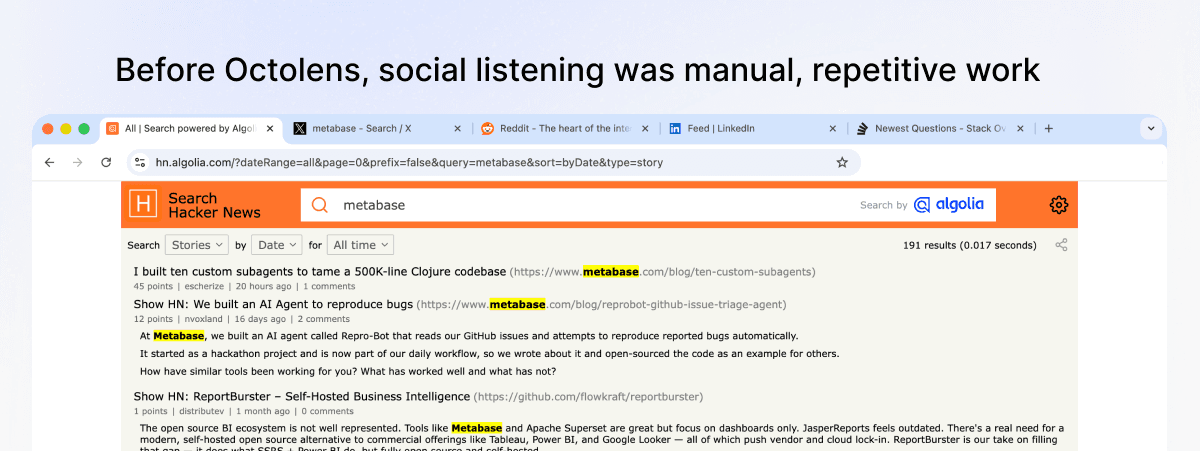
That workflow both ate into his time and left gaps. A Reddit thread may have already had the chance to run its course before it gets found.
"We have a large open-source community, and around 47.3k stars on GitHub, so conversations are happening all the time across a lot of places."
Finding a social listening tool was, in fact, one of the first projects Matthew was given when he was hired.
Matthew didn't need a general enterprise-grade listening platform. He needed something that covered the places Metabase users actually hang out and fit into his workflow.
"I wanted something that monitored the places our users actually hang out. I did not want to miss conversations because I was at the wrong party. Seeing Hacker News, Reddit, and GitHub was enough for me to try it."
That's the criterion most generic social listening tools fail — the rooms where developer-tool conversations actually happen — are not monitored. Octolens covers them by default, which is what got Matthew to sign up.
Matthew's morning routine is short.
"I pour a coffee, open Octolens, and start with brand monitoring. Then I go through all mentions and see where I can help."
What's notable is what doesn't happen in that routine: no five-tab juggling, no "did I miss anything overnight?", no manual triage of false-positive mentions.
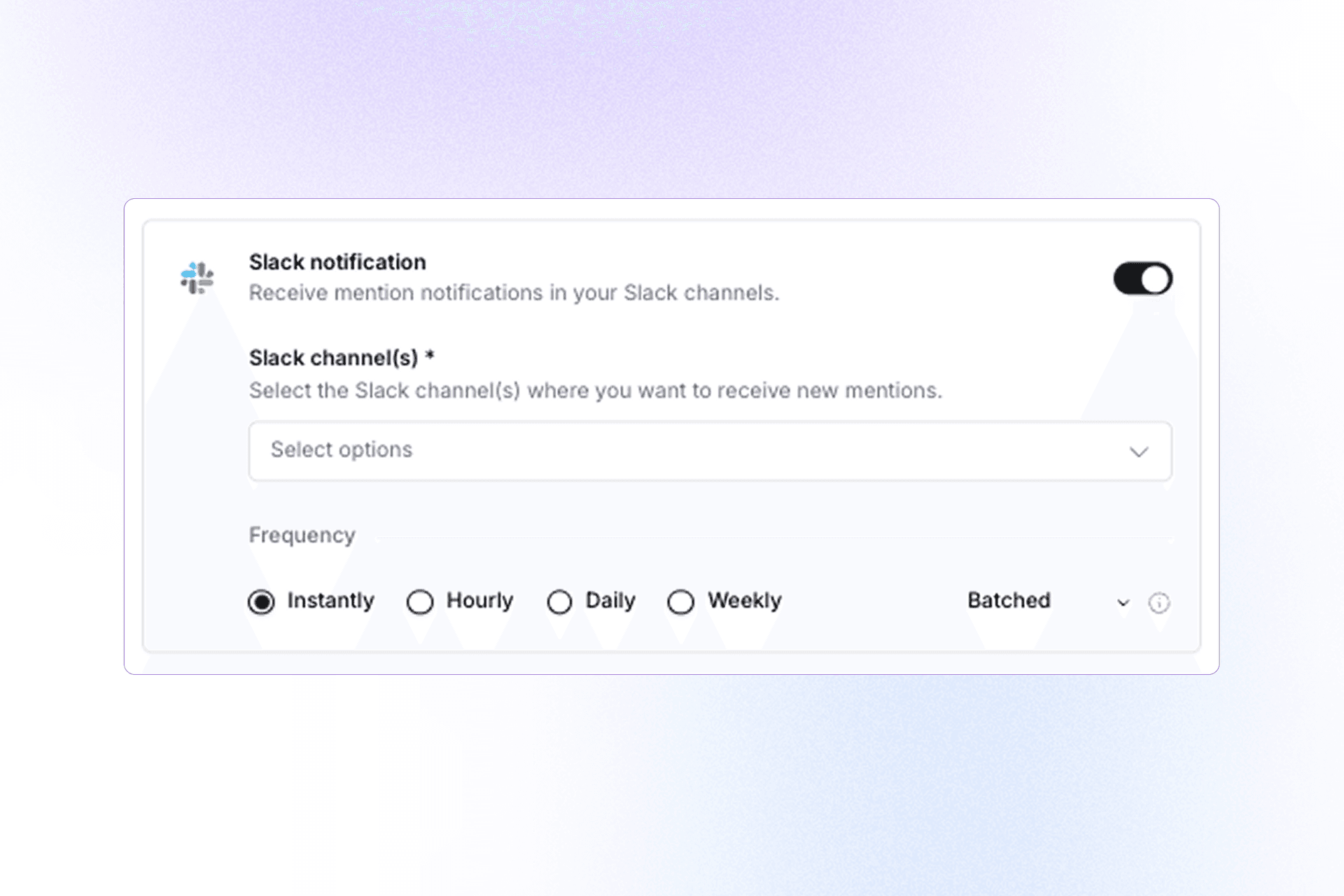
The second piece is broader than Matthew's own desk. Metabase pipes Octolens alerts into Slack, where the whole company can see Metabase mentions in real time and join conversations where it makes sense — engineers chiming in on technical threads, the product team flagging feature feedback, anyone catching a "have you tried Metabase?" recommendation in the wild.
"I have Slack alerts set up so everybody at the company can see Metabase mentions and be a part of those conversations."
He's also started using the Octolens MCP to layer AI on top of the firehose:
"I also started using the MCP to make sure I am not missing any important conversations."
Here is the exact MCP prompt Matthew uses to make sure he didn't miss anything important:
Run my morning Metabase mentions brief.

Review all mentions from the last 24 hours across all keywords (Metabase, business intelligence, embedded analytics, BI tools).

Start with a 2–3 sentence situation summary: what's the dominant story or theme today, and is the overall sentiment healthy, mixed, or concerning? Then surface only the posts worth acting on — skip anything generic, promotional, or low-signal.

For each one, give:
Platform + author
Category: Question / Pain Point / Comparison / Praise / Risk
One sentence on why it matters and a suggested action (reply, monitor, escalate, share internally)
The clearest test of a listening tool is what would have been missed without it. For Matthew, the recurring pattern is misinformation correction: Metabase-related wrong claims that, left alone, become "things people just know."
Two examples he's seen:
"You need to know SQL to use Metabase." Not true. Metabase ships with a no-code query builder so non-technical users can explore data without ever touching SQL. Every time this comment shows up in a thread, it can dissuade a marketer or ops person from trying Metabase.
"That is not true. You can use the query builder, so both technical and non-technical folks can use it. Octolens helps me catch those so I can jump in and clarify."
"Metabase only supports iframes for embedding." Also not true. Metabase has a full embedded analytics product with multiple integration paths.
These maybe aren't viral moments, but things like this can slowly build up around any open-source project with a long history. With AI answers sourcing Reddit and other UGC platforms heavily, this kind of misinformation can also impact the way your brand is represented there.
Catching them as they happen, in the threads where they happen, means future readers see the correction.
"Octolens saves me around 10 hours per week and completely changed how quickly I can respond. Going back to my bookmark method, I would check in the morning, around lunch, and again at the end of the day. There were hours in between where I could miss things. Now everything shows up in Slack or via MCP and I can respond in minutes."
Three checkpoints a day means an average mention sits unread for a few hours; a worst-case mention (posted right after the morning check) sits for most of a working day. With Slack alerts piping in continuously, that gap closes to single-digit minutes — which, for a comment thread on Reddit or Hacker News, is the difference between joining the conversation and reading the post-mortem.
For a DevRel function at a company with 47k stars, ten hours a week is the difference between "I'm spending the first half of my day monitoring" and "I'm shipping content, helping community contributors, and showing up where it counts."
The most interesting shift isn't the time saved — it's how Octolens has reshaped what Metabase does with what it hears.
It informs content. Metabase recently open-sourced its AI features and released an MCP server.
"I have seen questions about how to connect Metabase to Claude, which definitely influences the kind of content I create."
What developers ask in public helps determine what content Matthew creates next.
It informs the company. Every week, Matthew shares a Notion doc with the entire company that rolls up:
- Positive mentions
- Negative mentions
- Product feedback
- Feature requests
- Cool things the community is building
That doc closes the loop between "people are talking" and "the people building Metabase know about it." It helps inform the product roadmap discussions, customer-success talking points, marketing campaigns — all get richer when the source data is "what real users said this week" instead of "what we think they're feeling."
- Full platform coverage: Hacker News, Reddit, GitHub, X, and LinkedIn — the rooms where developer-tool conversations happen
- Misinformation correction: Catching false claims ("you need SQL to use Metabase," "embedding only works with iframes") before they perpetuate, including the Reddit and UGC threads AI answers now lean on
- Company-wide Slack visibility: Every Metabase mention piped into Slack so engineers, product, and marketing can jump into threads alongside DevRel
- Listening with the MCP: Layering the Octolens MCP on top of the firehose to answer any detailed question about mention data
- Response time in minutes: From three bookmark check-ins a day to mentions surfaced in real time — ~10 hours per week back, and replies in minutes instead of hours-to-days
- A weekly feedback loop to the whole company: A Notion digest of positive mentions, negative mentions, product feedback, feature requests, and cool community builds — feeding roadmap, content, and customer-success conversations
Octolens monitors your brand in real-time.
Receive AI-vetted alerts for keyword mentions and growth opportunities so you can act fast and stay ahead of your competition.
Get started for free or book a demo to see how Octolens can help you stay on top of the conversations that matter.