How to Track Social Signals Across the Internet (Not Just LinkedIn)
LinkedIn isn't the only place your buyers talk. Here's how GTM teams find buying intent across the full internet.
If you work in a go-to-market role, you've likely heard of the 95/5 rule: at any given time, roughly 95% of your total addressable market isn't in buying mode. But 5% is. They're actively evaluating, comparing tools, asking for recommendations, and making decisions.
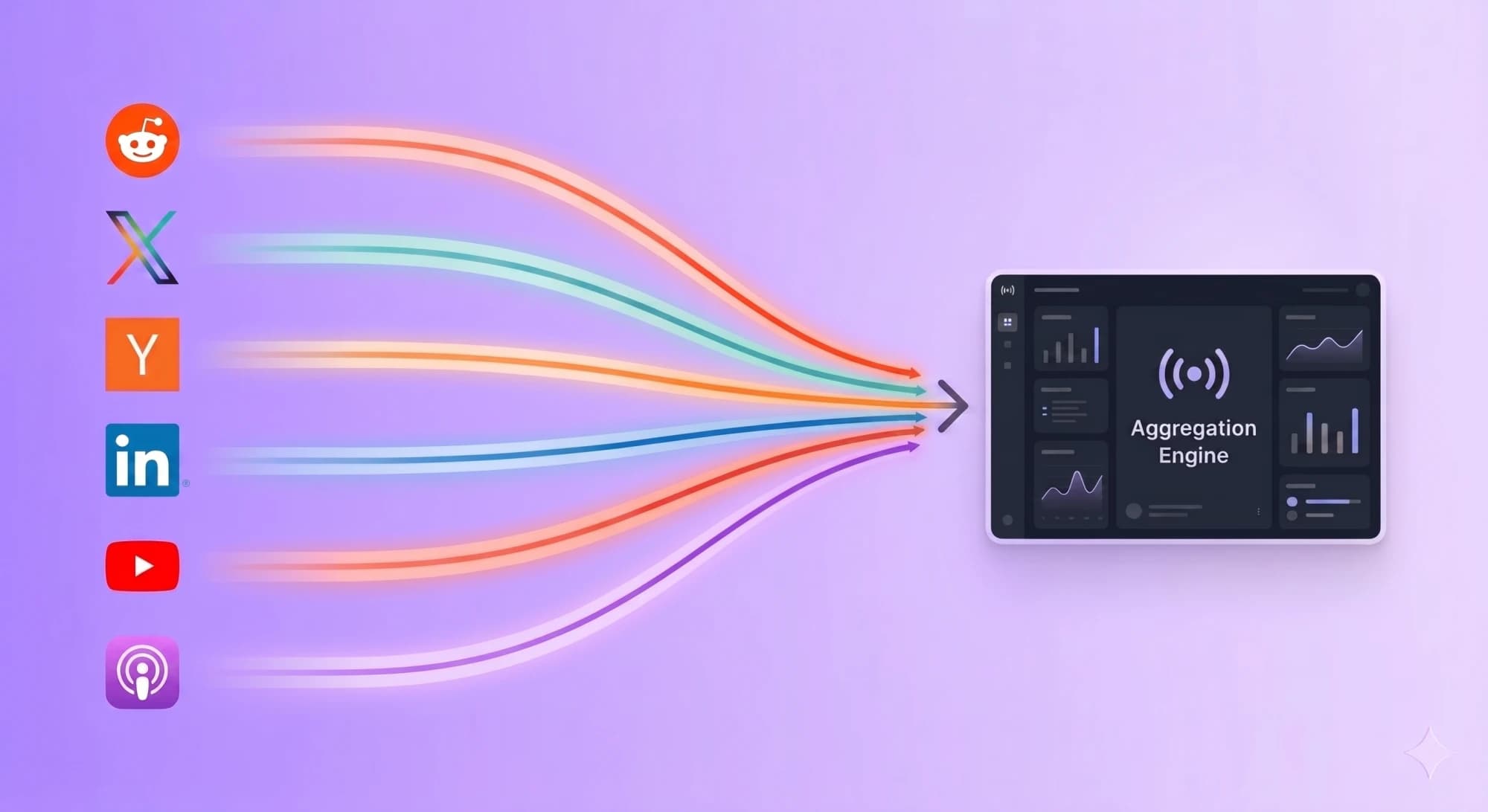
The problem isn't that these buyers are invisible. They're posting on Reddit asking for alternatives to your competitor. They're tweeting about the exact pain point your product solves. They're on Hacker News tearing apart a tool in your category. A podcast host just mentioned your space to 10,000 listeners.
These are all social signals - and they're how that 5% tells you they're ready. Most GTM teams miss them entirely because they're only watching LinkedIn.
If you're running go-to-market at a B2B company, tracking social signals is how you find the 5% while they're still in motion. But doing it well means going way beyond LinkedIn profile views and post engagement.
When most people talk about social signals, they mean one of two things: either engagement metrics that might influence SEO rankings (likes, shares, link clicks) or LinkedIn activity that sales teams use for outbound prospecting. Both definitions are too narrow for modern GTM.
In a GTM context, social signals are any public online action that indicates buying intent, a market shift, or a competitive vulnerability. They break down into three categories:
Buying intent signals: Someone is actively looking for a solution. They're asking for recommendations, comparing tools, requesting alternatives to a competitor, or describing a problem they need to solve. These are the highest-value signals because the buyer is already in motion.
Competitive signals: People are complaining about a competitor, discussing a pricing change, flagging a deprecated feature, or sharing why they switched away. These signals tell you when windows are opening and how to position against specific alternatives.
Market signals: Industry discussions, emerging trends, new category definitions, and thought leadership that shapes how buyers think about your space. These signals are less immediately actionable but critical for positioning and timing.
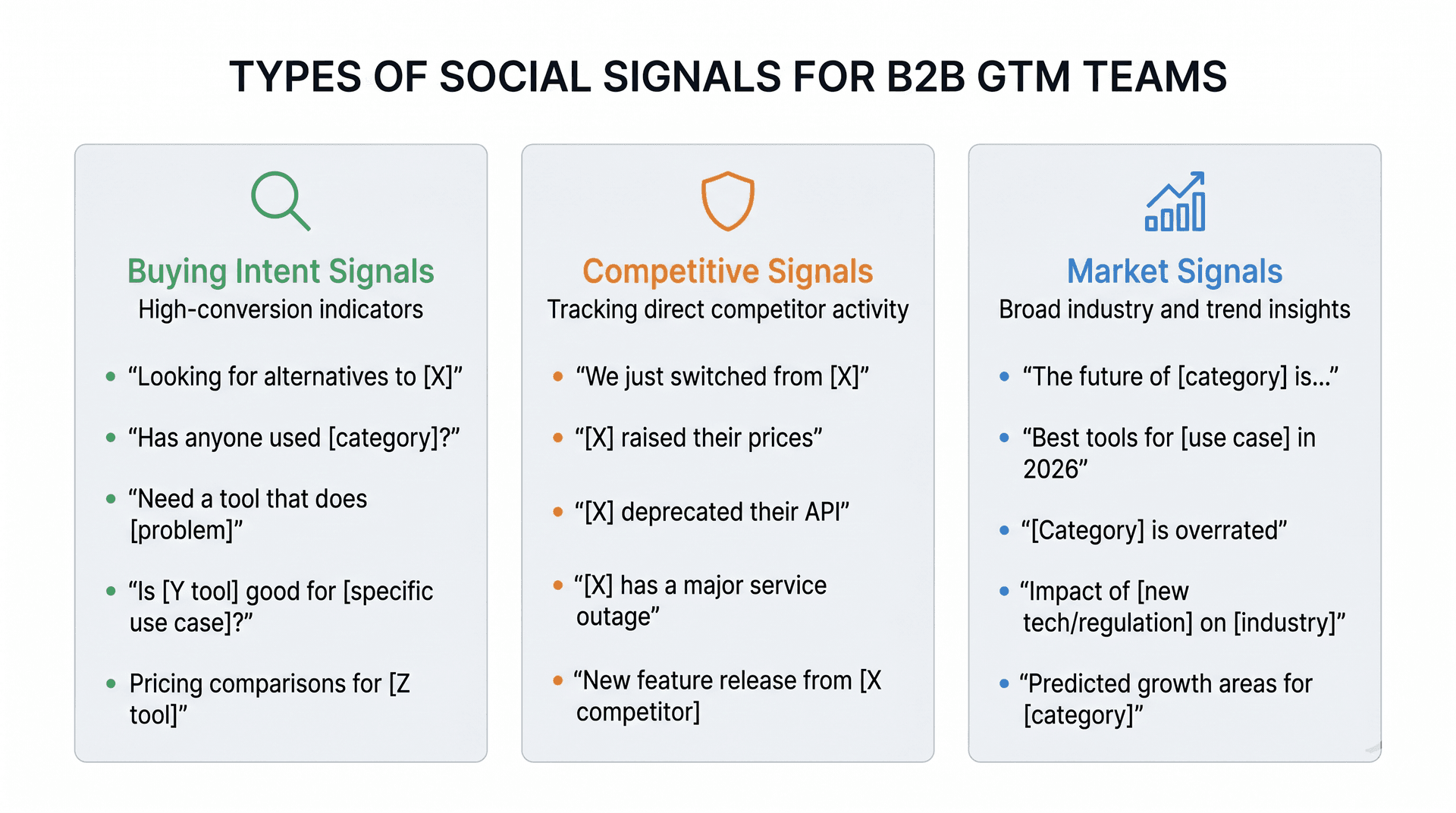
The key insight: these signals are scattered across the entire internet, not concentrated on any single platform. And the most candid, highest-intent signals often happen in the places you're least likely to be watching.
Most tools that promise to help you track social signals focus almost exclusively on LinkedIn. They'll tell you when a prospect views your profile, likes your post, comments on your content, or changes jobs. That's useful context, but it's a fraction of the picture.
LinkedIn is where people perform. It's where they post polished takes, congratulate each other on work anniversaries, and share thought leadership that's been reviewed by their marketing team. The conversations that reveal genuine buying intent - the unfiltered frustrations, the honest tool evaluations, the "help me choose between X and Y" threads - those happen somewhere else.
Reddit is where technical buyers are most candid. Subreddits like r/SaaS, r/startups, r/devops, and hundreds of niche communities are full of threads like "looking for alternatives to [competitor]" and "has anyone used [your category]?" People share honest experiences because they're anonymous or semi-anonymous. The signal-to-noise ratio for B2B intent is often better than LinkedIn. These threads are also the source material AI assistants pull from when buyers ask for recommendations - which makes them double leverage for AI search visibility.
Hacker News is where developer tool decisions get made. "Ask HN" and "Show HN" threads surface real evaluations from technical decision-makers. When someone posts "Ask HN: What do you use for [your category]?" that's a buying committee forming in public.
Twitter/X is where frustrations surface in real time. Someone hits a bug, gets frustrated with pricing, or discovers a limitation - they tweet about it before they open a support ticket. These are signals you can act on within minutes.
YouTube comments reveal adoption friction. When someone watches a tutorial about your competitor and asks "does this also work with [use case]?" in the comments, that's a signal most teams never see.
Podcasts and newsletters are where category narratives form. When a respected voice in your space mentions a competitor or defines a problem, that shapes how hundreds of potential buyers think about solutions. Tracking these mentions gives you early reads on market shifts.
If you're only watching LinkedIn, you're hearing the formal version of the conversation. The real one is happening everywhere else.
Not all social signals are created equal. Here are the five that consistently drive pipeline for GTM teams, along with where to find them and how to respond.
This is the highest-intent social signal you can track. Someone is actively evaluating, which means they've already decided their current solution isn't working. These posts show up most frequently on Reddit (r/SaaS, r/startups, category-specific subreddits), Quora, and Hacker News.
How to respond: Show up with a genuinely helpful answer. Share what makes your approach different without leading with a pitch. Link to a comparison page or documentation, not a demo booking link. Reddit communities in particular will punish anything that smells like self-promotion.
This is category-level interest. The buyer is earlier in their journey - they know they have a problem and are exploring whether a solution category exists. You'll find these on Reddit, Twitter, LinkedIn, and niche forums.
How to respond: Answer the category question first. Explain what the category does, what to look for, and what trade-offs matter. If your product is relevant, mention it as one option among several. This builds credibility and positions you as someone who understands the space, not just someone selling into it.
These signals are competitive intelligence gold. When someone shares why they left a competitor - on Twitter, LinkedIn, a blog post, or in a Reddit thread - you're getting unfiltered positioning data. What frustrated them? What did they switch to? What criteria mattered most?
How to respond: You don't need to respond publicly to every one of these. But you should be cataloging them. Over time, patterns emerge: maybe competitors lose customers over pricing, or lack of an API, or poor support. That's positioning ammunition for your website, sales decks, and outreach messaging.
When a competitor makes an unpopular move - raises prices, deprecates a feature, changes their API - the internet reacts fast. Twitter threads, Reddit rants, and Hacker News discussions pop up within hours. This is a timing window.
How to respond: Move quickly. If the competitor change creates a gap your product fills, create a comparison page or a migration guide. Engage in the discussions where it's appropriate. This isn't about being opportunistic - it's about being visible when buyers are actively reconsidering their options.
Sometimes the best signal isn't about any specific product at all. It's someone describing the exact problem you solve without knowing you exist. A developer on Stack Overflow asking how to do something manually that your product automates. A founder on Reddit describing a workflow that's clearly broken.
How to respond: This is where you can be most helpful. Answer the question or share your perspective on the problem. If your product is relevant, mention it briefly at the end. These interactions build genuine trust and create word-of-mouth over time.
Understanding which signals matter is the easy part. The hard part is building a system that reliably catches them across platforms, routes them to the right people, and makes it easy to respond. Here's how to do it step by step.
Most teams start and stop with their brand name. That's a mistake. You need to track:
- Your brand name (including common misspellings)
- Top 3-5 competitor names
- Category terms ("social listening tool", "brand monitoring", etc.)
- Pain-point phrases ("how to track mentions", "monitor brand reputation", etc.)
- Integration partners or adjacent tools your buyers also use
Start with 5-10 keywords. You can always expand, but starting too broad means drowning in noise before you learn what's valuable.
At minimum for B2B: Reddit, Twitter/X, LinkedIn, and Hacker News. If your buyers are technical, add GitHub, Stack Overflow, and dev-focused newsletters. If your space has active YouTube creators or podcasts, add those too.
The mistake most teams make is picking one or two platforms and assuming they're covered. Conversations hop between platforms constantly. A Reddit thread gets shared on Twitter, which gets discussed on a podcast, which gets posted to Hacker News. If you're only watching one platform, you're seeing one fragment of a multi-platform conversation.
This is where most social signal tracking efforts die. Everything goes into one Slack channel, the channel gets noisy, someone mutes it, and within two weeks nobody is looking at it.
Instead, create separate routes: buying intent signals go to the GTM team. Competitor mentions go to product marketing. Technical questions go to developer relations or support. Use filtered feeds with different destinations so the right people see the right signals.
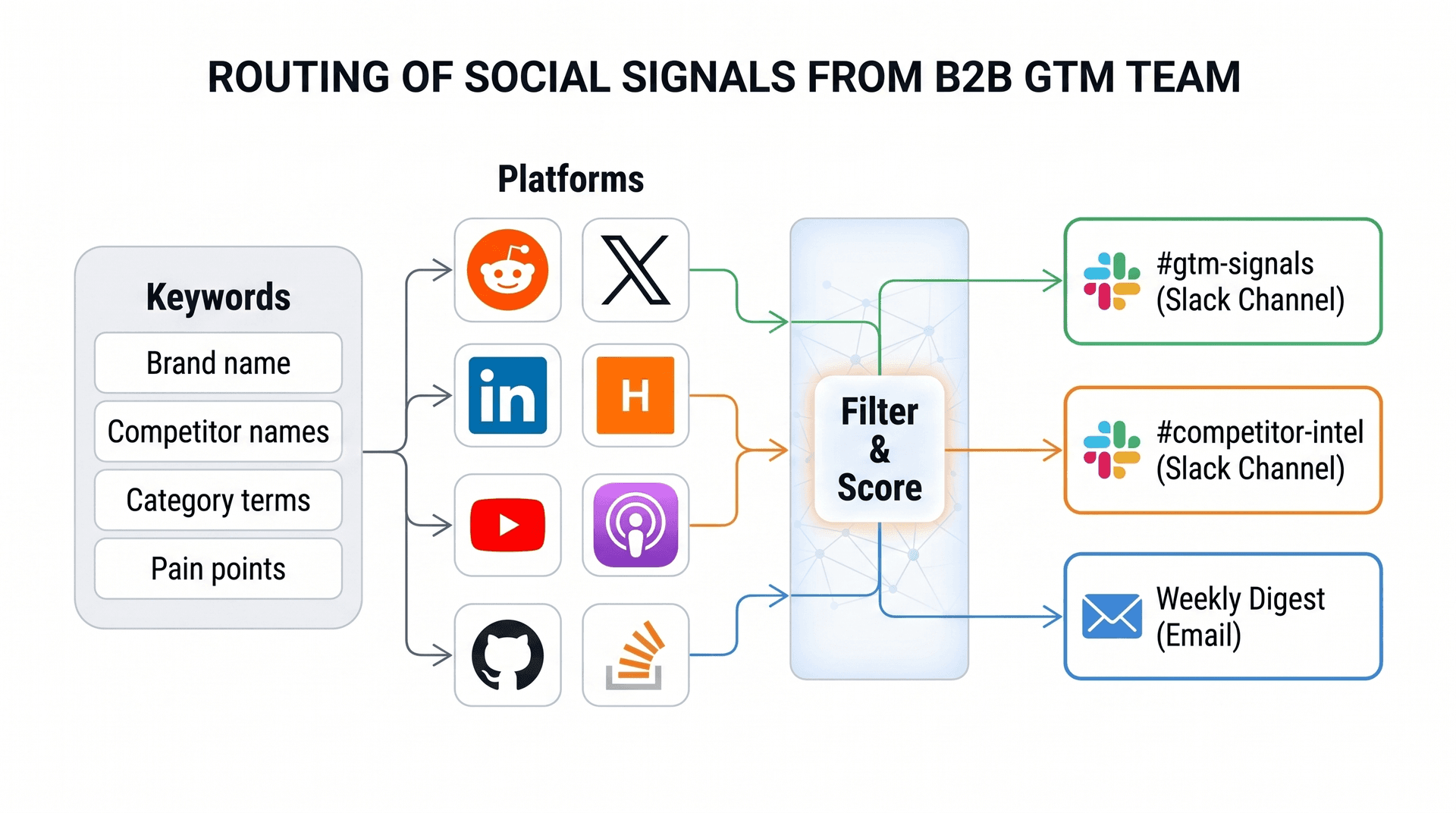
Not everything needs a real-time alert. High-intent signals - someone asking for alternatives, a competitor outage - should trigger immediately or hourly. Market signals and general category discussions can be a daily digest. Weekly summaries are too slow for almost everything.
Define how your team should respond to each signal type. What's the tone for Reddit versus Twitter versus LinkedIn? When should you comment publicly versus send a DM? What should you say when someone asks for alternatives - and what should you absolutely not say?
The playbook prevents two failure modes: nobody responding because nobody knows what to say, and someone responding badly because they improvised a sales pitch on Reddit.
If you're a GTM engineer or a technical founder, you'll eventually want social signals integrated into your stack - not just delivered as notifications.
An API-first approach lets you pull mentions programmatically, enrich them with data from your CRM, score them based on your own criteria, and route them automatically. Instead of reacting to each mention manually, you can build workflows that surface the highest-priority signals and suppress noise.
Webhooks give you real-time delivery without polling. When a new mention matches your criteria, it pushes to whatever system you want: Slack, a CRM, a custom scoring pipeline, or a queue that triggers outreach sequences.
The alternative is stitching together multiple platform APIs - Twitter's API, Reddit's API, YouTube's API - each with its own auth, rate limits, schema, and pricing. For most teams, this is not a good use of engineering time.
This is why we built Octolens as an API-first platform. One endpoint for mentions across 15+ platforms, with webhooks, Slack integration, and MCP support built in. Instead of managing a dozen API integrations, you get structured social signal data from everywhere - Reddit, Twitter, Hacker News, LinkedIn, YouTube, podcasts, newsletters, and more - through a single API.
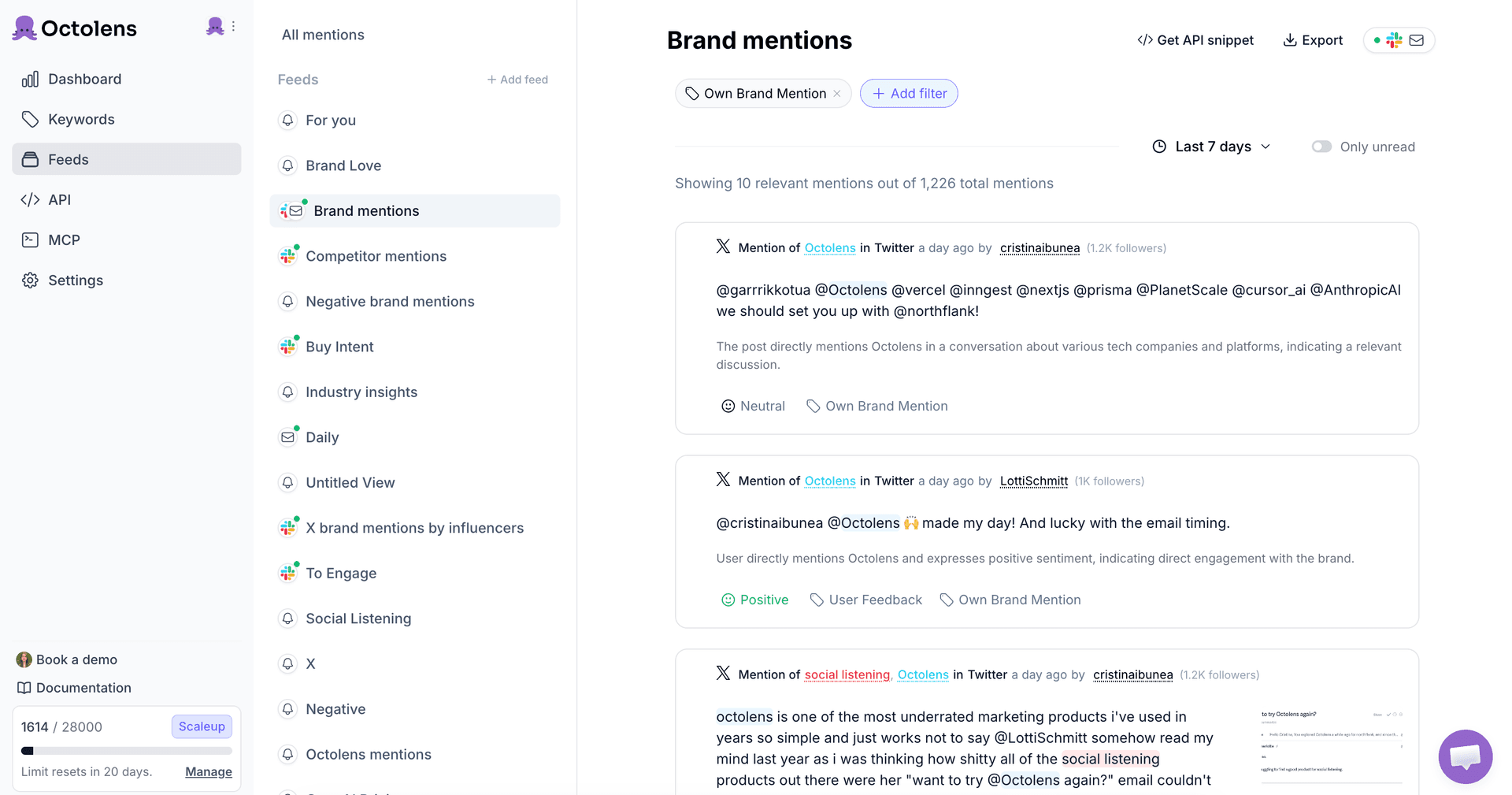
You don't need to build the whole system at once. Here's how to start tracking social signals this week and see results fast:
Day 1: Set up tracking for three keywords - your brand name and your top two competitors. Pick a tool that covers at least Reddit, Twitter, and LinkedIn (not just LinkedIn).
Day 2: Create a dedicated Slack channel for social signals. Not your general channel - a specific one that people know to check. Route your highest-intent signals there.
Week 1-2: Watch what comes in. You'll quickly learn which keywords produce valuable signals and which produce noise. Adjust your keywords and filters based on what you actually see.
Week 3+: Expand. Add category terms, pain-point phrases, and more platforms. Start building response playbooks based on the types of signals you see most often. Consider integrating via API if volume justifies it.
The goal isn't to track everything. It's to track the signals that actually lead to pipeline - and to be fast enough to act on them before your competitors do.
The best GTM teams don't wait for buyers to fill out a form. They show up in the conversations that are already happening - on Reddit, Hacker News, Twitter, YouTube, podcasts, and a dozen other places where buyers talk candidly about their problems and evaluate solutions.
Social signals are happening across the internet right now. The question is whether you're tracking them.
Octolens tracks mentions across 15+ platforms and routes them to Slack, email, webhooks, or your API. Try it free for 7 days.