Table of contents
- Render helps builders deploy and scale without managing infrastructure
- The Challenge: A Single-Stream Firehose Across Every Platform
- After Octolens: From 125 Untriaged Mentions to High-Signal Conversations
- The Broader Impact: Listening as Answer Engine Optimization (AEO)
- Key Takeaways: How Octolens Helps Render
- About Octolens
Render helps builders deploy and scale without managing infrastructure
Render is a unified cloud platform for building, deploying, and scaling apps and websites without the complexity of traditional cloud providers.
From vibe coders to teams shipping production workloads, builders choose Render to run apps without managing infrastructure.
Company info (June 2026)
- Size: ~140 employees
- Funding: $258M total raised, including a $100M Series C in February 2026 at a $1.5B valuation
- Headquarters: San Francisco, remote-first
For this story, we spoke with Hazal Mestci, Developer Relations Engineer at Render.
Hazal’s team owns in-person events and conferences, social listening, sponsorships and influencer partnerships, and increasingly the work of making sure LLMs recommend Render.
"Our team is a connector between marketing and technical work at Render, and a tool like Octolens is very important so that when we do the social listening part, we can actually have actionable tasks we take from the platform."
By using Octolens, Render achieved the following:
- The team responds to ~30 meaningful mentions every day, versus ~4–6 mentions a day with their previous social listening tool
- The team spends only 30 minutes a day on developer engagement instead of scrolling endlessly through platforms
- Developer perception and LLM recommendations now drive 50% of signups
The Challenge: A Single-Stream Firehose Across Every Platform
Render's growth model makes listening essential. With a self-serve motion, the team has to track what people are saying to build community, surface feature requests, and win developers over competitors before they commit elsewhere.
The problem was volume and noise. Before Octolens, Render used a social listening tool that was purely monitoring, with no context and no classification.
"As our presence grew, we found ourselves spending a lot of time manually triaging. I would wake up to 125+ mentions in each channel. That's just impossible to triage and respond to."
"Render" being a common word made it nearly impossible to track. The word collides with 3D rendering, game design, video rendering, and, more recently, a crypto project also called Render.
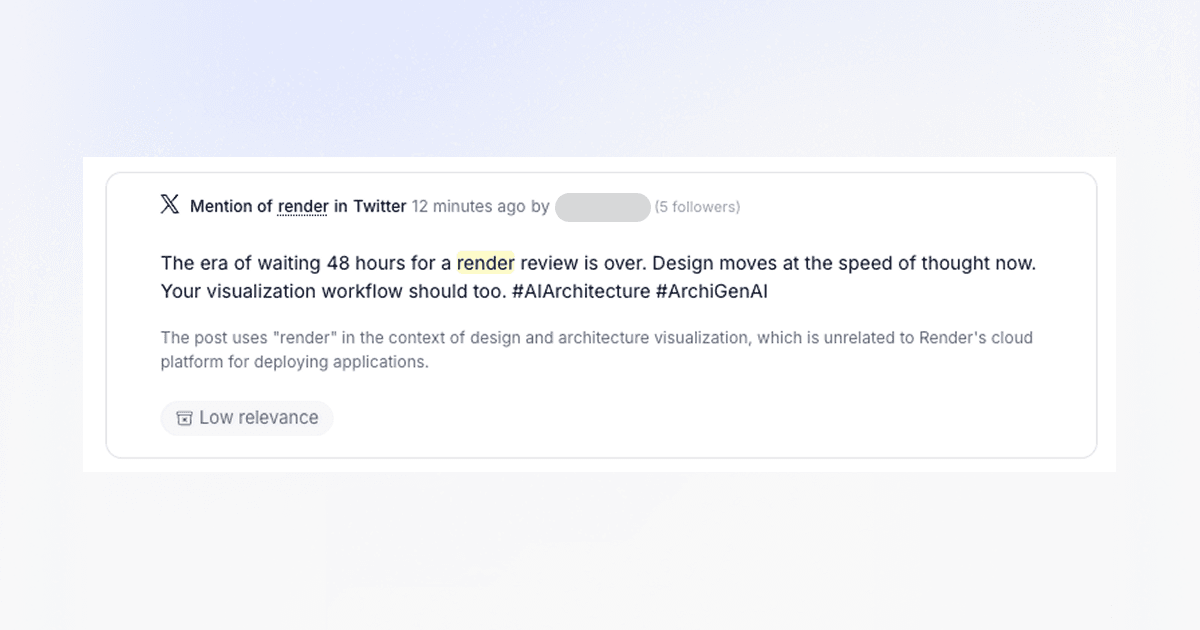
An example of a low-relevance mention filtered out by Octolens.
Hazal had also tried another tool at a previous company and hit the same wall: 250 emails a week to wade through, and brand keywords that pulled in everything from Antarctica to geography.
"You'd get the semantic alerts to filter some things out, but you wouldn't be able to make the content actually align with your criteria of what you're monitoring."
After Octolens: From 125 Untriaged Mentions to High-Signal Conversations
Then Render found Octolens.
"We tried a few different social listening tools and loved Octolens."
The immediate change was noise reduction. Octolens' AI relevance scoring filters out rendering, crypto, and game-design chatter automatically. In Render's workspace, a large share of raw mentions get filtered as irrelevant before they ever reach a human.
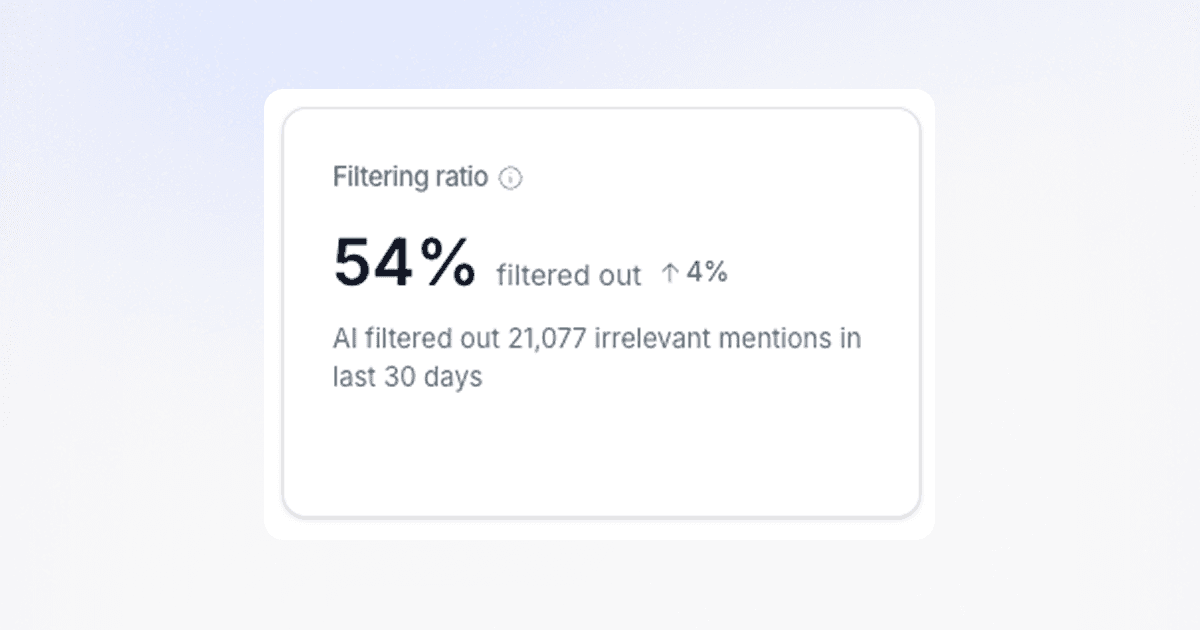
The filtering ratio across all keywords Render tracks in Octolens.
On top of that, the team set up dedicated feeds for each social platform that matters to them, plus podcasts, newsletters, and blogs.
The Workflow: API-Routed Mentions and a Daily Listening Slot
Every inbound mention is classified for urgency and routed by the Social Listening API to the right Slack channel, so the right person sees it without anyone manually triaging. Each person manages their Slack channel and responds to developers. Alerts include the mention, timestamp, author, an AI summary, and tags for brand mention versus promotional post, plus sentiment.
The team has a 30-minute social listening slot at 1 p.m. every day on the shared calendar. In that window, Hazal gets through around 30 responses.
"With my previous tool I'd maybe get through four to six a day. Now it's quadruple the amount of people I can actually respond to."
Sentiment also drives prioritization. Positive mentions ("we love Render") are nice but low urgency; negative mentions get answered first. The team also added competitor keywords covering the other deployment and infrastructure platforms developers compare against Render, and engages selectively: never piling on when a competitor gets criticized, but stepping in when someone is actively looking for a capability a competitor lacks.
"If someone says a competitor is bad for performance, I don't want to jump in and say, 'Yes, you should use Render.' That just leaves a bad taste. But if someone's asking, 'This tool doesn't have this feature; I'm looking for a tool that does,' I'll say, 'Render has this. Here's how you use it.'"
Real Moments Where Listening Paid Off
A pricing change. When Render adjusted pricing, social listening let the team find developers actively re-evaluating, then step in—sometimes with credits, sometimes by helping them restructure their infrastructure to pay less.
"With any pricing change, some people are happy and some aren't. It helped to find the folks evaluating pricing so we could give them credits, or go through their setup so they pay less by arranging things slightly differently."
A competitor's migration window. When a major incumbent platform moved into maintenance mode—no new features, just upkeep—a wave of teams started looking to migrate. That window is unforgiving: nobody migrates twice.
"If we miss the moment when people want to migrate, they go to a competitor instead, and no one migrates twice. Understanding that market sentiment immediately is extremely crucial."
The Broader Impact: Listening as Answer Engine Optimization (AEO)
Roughly 50% of Render's signups are now created by AI agents, not humans. A developer asks ChatGPT or Codex, "I built this app. Where should I host it?" The model suggests Render, and the agent creates the account and ships the deploy, YAML file and all, often without the developer ever visiting Render's marketing site. (For the full playbook behind this dynamic, see our guide on how to get your brand mentioned in ChatGPT.)
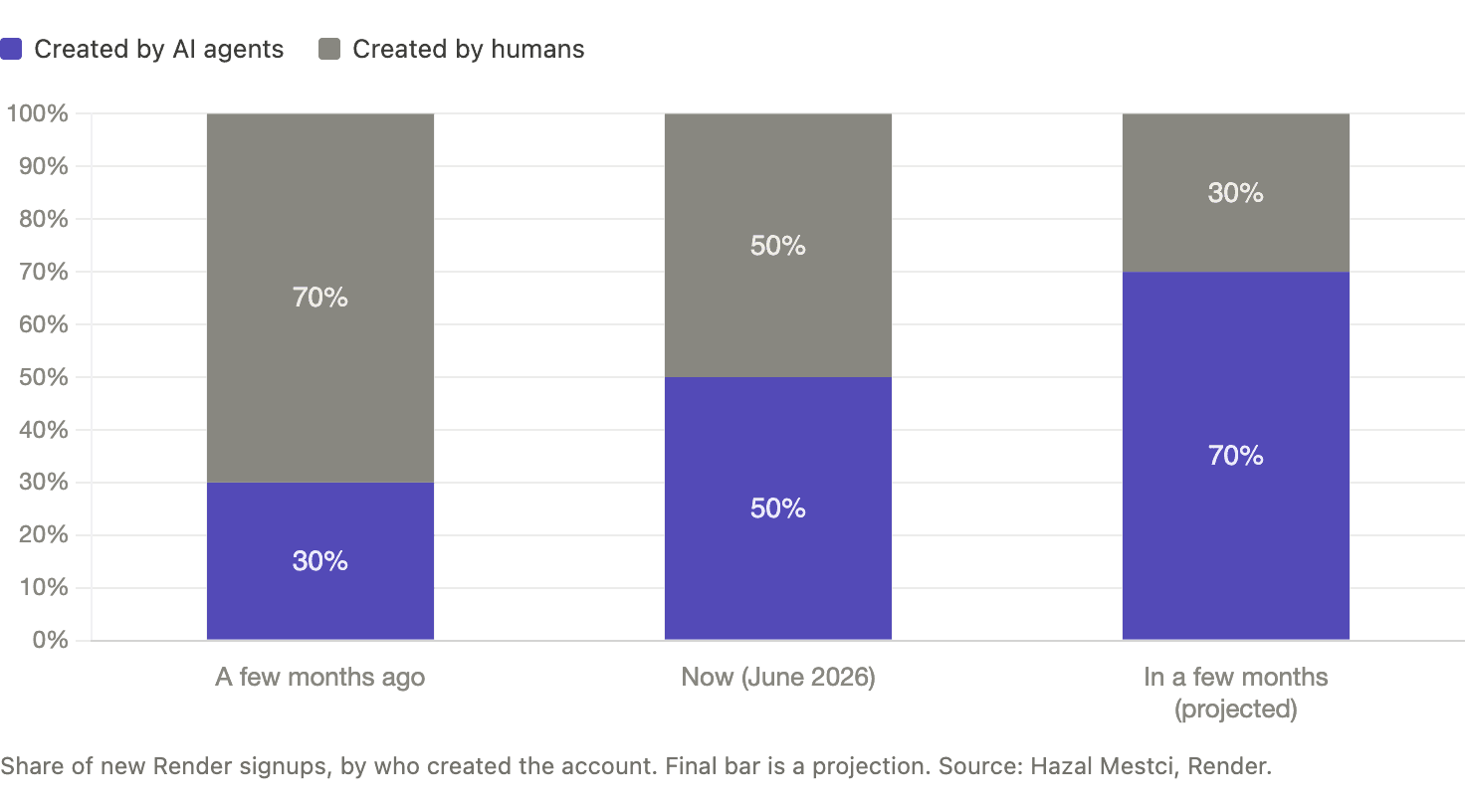
"A few months ago it was 70% humans searching and creating accounts, 30% agentic. Now it's 50/50. I think in a few months it'll be 70% agentic. The AI itself creates the account and hosts everything."
That shift makes social sentiment a growth input. When the DevRel team engages in a thread, responds to praise, clarifies a differentiator, and answers a comparison question, they are doing two things at once: helping a developer and adding useful public context that AI tools may surface when recommending a platform.
"It's valuable in two ways: I'm hearing from developers and helping them directly, while also creating useful public context that contributes to how AI tools talk about Render."
That's why comparison and "alternatives to X" threads matter most: engaging them shapes human and model perception at once.
Catching Documentation and Education Gaps
Octolens also helps surface when developers describe a problem Render already solves without knowing the feature exists.
"Someone will say, 'I'm trying to run a workflow and I want a durable agent, but I don't know how to do this.' We have a feature called Workflows that does exactly that; they're just not aware of it. That tells me our docs aren't findable enough, or we haven't promoted the feature well."
These are the moments LLMs can't yet cover: a feature shipped a week ago is hard for a model to pick up and recommend. Catching these threads manually helps a developer right now, and it's how Render seeds awareness of new features until the models catch up.
Going Deeper: What's Next with the API and MCP
With the API already routing every mention into the right Slack channel, Render is extending Octolens further into its stack.
Two more API-driven workflows are on the roadmap:
- Mentions → HubSpot leads. Render repeatedly sees buy-intent posts: "We're hosting X on another platform, we've had four outages this month, what should we move to?" The plan is to detect buy intent and create leads in HubSpot automatically, gated only on onboarding the sales team first.
- Mentions → Notion. As Render moves to Notion, feature-request mentions will flow into a product-feedback database so the team can prioritize what the community is actually asking for.
On top of the API, Hazal is beginning to use the Octolens MCP to browse and filter mentions and pull analytics conversationally, as the next layer over the firehose.
Key Takeaways: How Octolens Helps Render
- Common-word filtering: AI relevance scoring separates Render the cloud platform from common uses of the word
- All sources from one API: Reddit, Hacker News, GitHub, LinkedIn, and X, plus podcasts, newsletters, and blogs, organized into four owned listening channels
- Real developer engagement: From ~4–6 mentions a day with the previous tool to responding to ~30 mentions in a focused 30-minute daily window
- AEO as a growth lever: Engaging high-signal threads shapes both developer perception and the LLM recommendations now driving 50% of signups
- API-powered routing: Inbound mentions classified for urgency and routed to the right Slack channel, with HubSpot lead-generation and Notion feature-request pipelines next
- MCP for analytics: A conversational layer on top of the firehose for analytics and missed-mention briefs
About Octolens
Octolens monitors your brand in real time. Receive AI-vetted alerts for keyword mentions and growth opportunities so you can act fast and stay ahead of your competition. With the Octolens API and MCP server, you can pipe live social data straight into your own stack: Slack, your CRM, your product database, or your AI agents.
Get started for free or book a demo to see how Octolens can help you stay on top of the conversations that matter.