
Brandwatch vs Sprout Social: Which Should You Pick in 2026?
The #1 Google result for this question is a Reddit thread where the asker chose Brandwatch for its listening — then came back months later to report bugs. These two wear the same label but are different species: a consumer-intelligence platform on custom contracts vs a per-seat management suite whose listening is a separately quoted add-on. Here's the comparison with verified 2026 numbers.

Charlotte Schmitt
Co-Founder at Octolens · Last updated August 2026
TL;DR
Brandwatch and Sprout Social overlap far less than their marketing suggests. Brandwatch is a Cision-owned consumer-intelligence platform — 100M+ sources, an official Reddit data partnership, research-grade dashboards — sold on custom contracts with a median around $50,000/year per Vendr. Sprout Social is a social-media-management suite — publishing, shared inbox, engagement, reporting — sold per seat at $199–$399/seat/month on annual billing ($249–$499 monthly), with a 30-day self-serve trial. The catch: Sprout's social listening, the part that actually competes with Brandwatch, is an individual add-on to the Standard plan and up, has no published price, and is commonly reported around $999/month.
So the honest framing isn't which tool is better — it's which job you're hiring for. If the job is deep listening and consumer research, Brandwatch is the stronger product and Sprout's add-on won't close the gap. If the job is running your social channels day to day, Sprout is the more usable suite and Brandwatch's management tooling is the afterthought. Either way, real listening ends in a sales conversation about a five-figure annual number — and if what you actually want is the mention data in your own tools, neither is built primarily for that.
Brandwatch vs Sprout Social at a glance
Brandwatch
Custom (⌀ $50k/yr)
Sprout Social
$199–$399/seat/mo + listening add-on
Pricing & contracts
Custom only; Vendr median $50k/yr (≈$19.5k–$81k)
$199–$399/seat/mo annual ($249–$499 monthly); listening add-on quoted separately
Listening & analytics depth
Core product: consumer research, custom dashboards, historical archives
Add-on to a management suite; reactive monitoring focus
Publishing & engagement
Monitoring-first; management tooling is the afterthought
Core product: publishing, shared inbox, approvals, reporting
Source coverage
100M+ sources incl. official Reddit data partnership
Strong on connected networks; thinner beyond them
Setup & evaluation
Sales demo, onboarding, boolean training
30-day self-serve trial, no credit card
API & data access
Enterprise API, negotiated per contract
Sprout API included on Advanced ($399/seat annual)
marks who has the edge on each dimension — reasoning in the section below.
What real users say about Brandwatch and Sprout Social
The top-ranking result for this exact comparison is a Reddit thread, not a vendor page — and the practitioners in it are more candid than any feature table. Every card links to the original post:

Every quote above is reproduced word-for-word from a public post; ellipses shorten longer passages and square brackets note small editorial substitutions. Every card links to the original source. The opinions are the authors' own.
The two tools in detail
Brandwatch
Custom (⌀ $50k/yr)Cision-owned enterprise consumer intelligence: 100M+ sources, an official Reddit data partnership, deep historical archives, and custom dashboards — sold through sales teams on custom contracts.
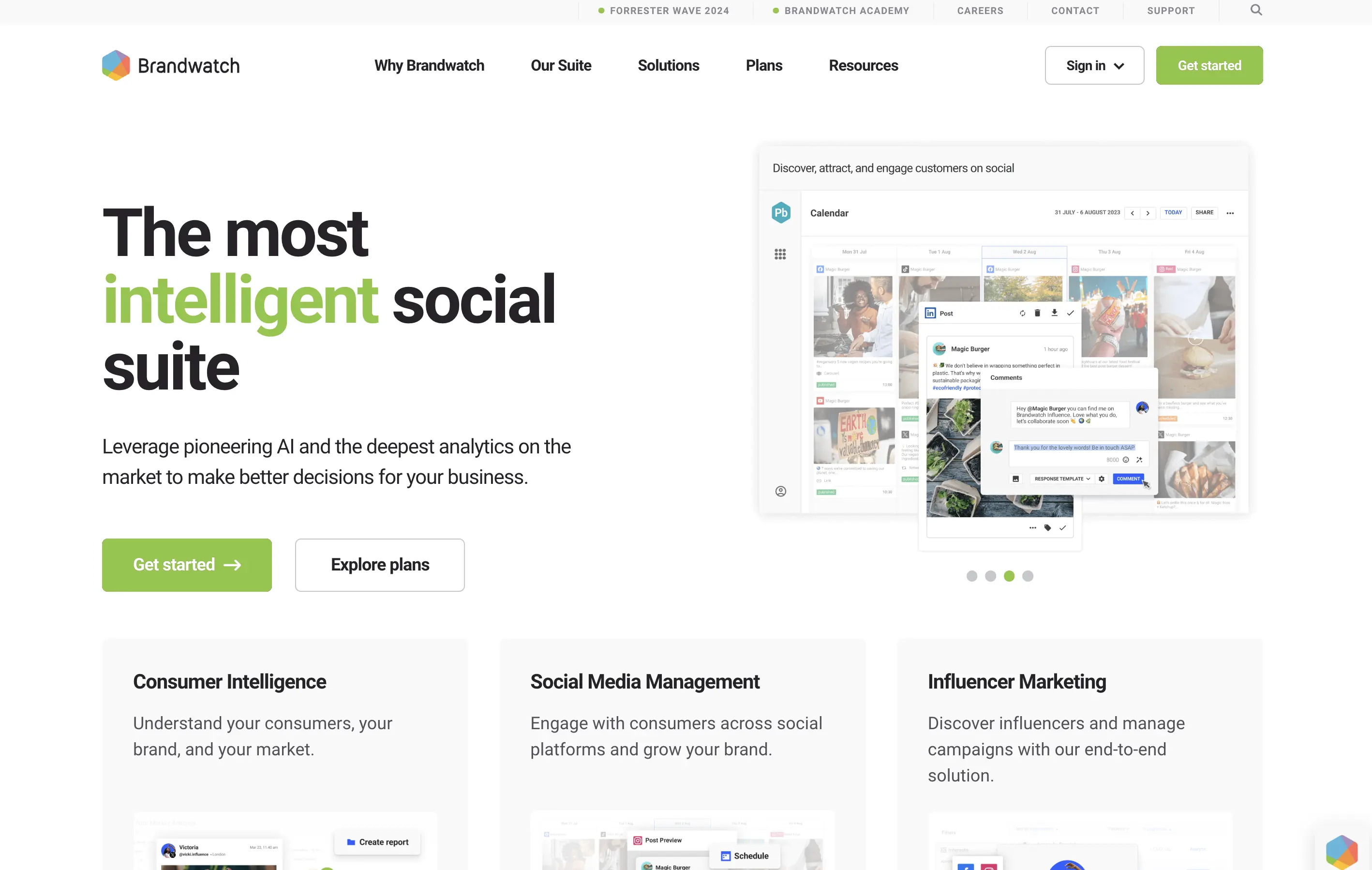
No public price list — every deal is a custom contract behind a sales demo. Vendr's marketplace data (verified August 2026) puts the median at about $50,000/year across 40 recorded purchases, ranging from roughly $19.5k to $81k, with multi-year commitments commonly discounted 15–25%. Larger multi-suite deployments exceed six figures annually.
Pros
- The strongest social listening in this pairing — practitioners call it “hands down a better all around tool,” with data quality and custom dashboards Sprout doesn't match
- Enterprise-grade source coverage: 100M+ sources, deep historical archives, and an official Reddit data partnership
- No cap on connected accounts, unlimited custom dashboards, and custom metrics on every tile
Cons
- Enterprise-only pricing: a sales cycle before you see a number, annual lock-in, and a $50k/year median contract
- Boolean query structure takes real ramp-up time, and costs compound as your team requests more coverage
- Users report bugs, noisy alerts, and sentiment accuracy issues; its management/publishing tooling trails Sprout's in polish
Best for: Organizations hiring for deep listening and consumer research, with dedicated analysts and procurement built for annual contracts.
Key differentiator: Research-grade listening depth no management suite matches — historical archives, consumer research panels, and the official Reddit data partnership.
Sprout Social
$199–$399/seat/mo + listening add-onPer-seat social-media-management suite: publishing, shared inbox, engagement, and reporting with a 30-day self-serve trial — listening sold separately as a sales-quoted add-on.
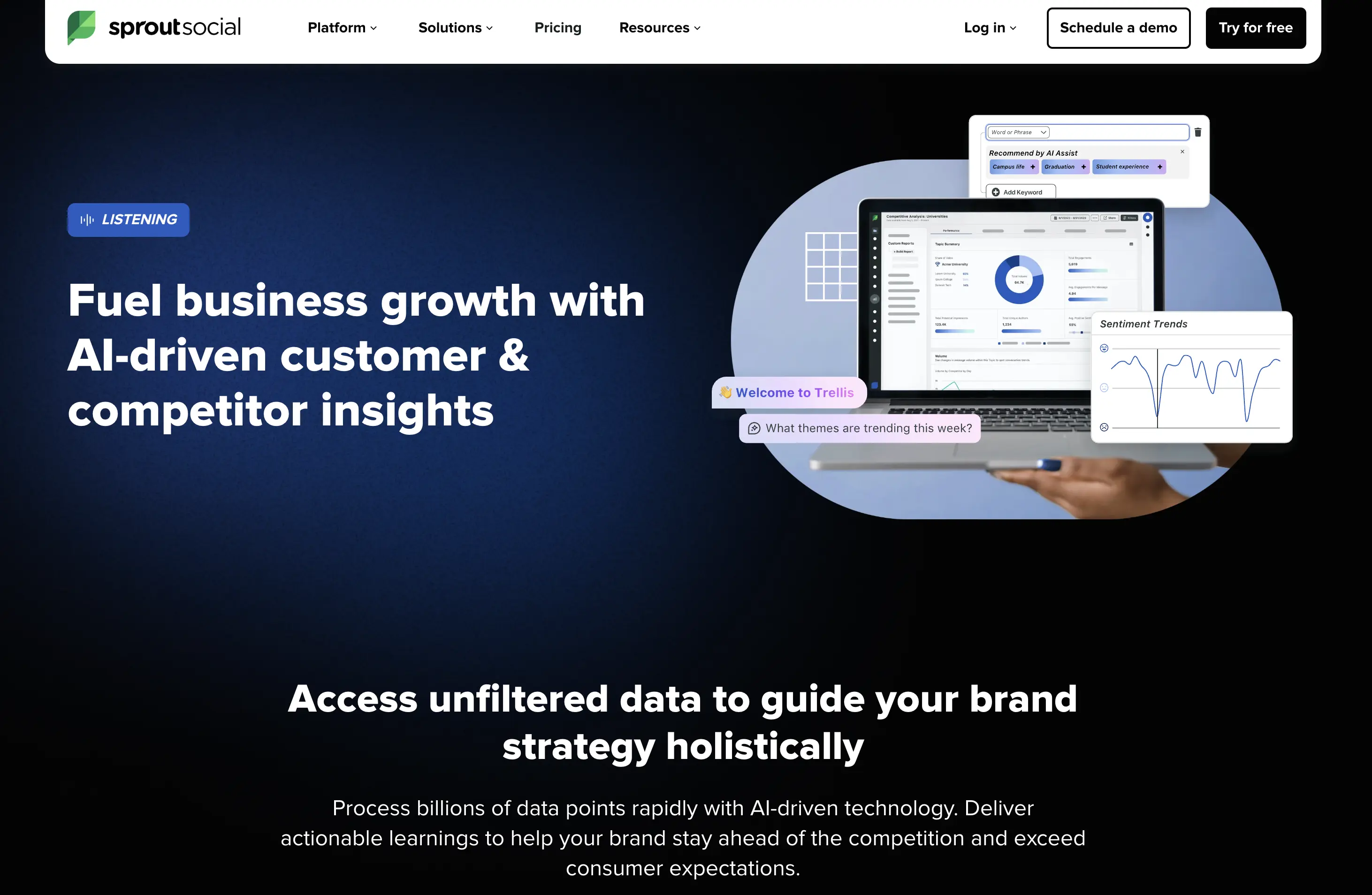
Published per-seat tiers (verified August 2026, annual billing): Essentials $79, Standard $199, Professional $299, Advanced $399 per seat/month; monthly billing runs $99/$249/$399/$499; Enterprise is custom. 30-day free trial, no credit card. Social Listening and Premium Analytics are each sold as individual add-ons to the Standard plan and up — no published add-on price; commonly reported around $999/month. The Sprout API is included on the Advanced tier.
Pros
- The most usable management suite in this pairing: polished publishing, shared inbox, and reporting your whole team picks up without training
- Transparent per-seat pricing with a 30-day self-serve trial — you can evaluate without talking to sales
- Well-reviewed at scale: 4.4/5 across 6,876 G2 reviews, with unlimited profiles on higher-tier contracts
Cons
- Listening — the part that competes with Brandwatch — is a separately sales-quoted add-on (commonly reported ~$999/month) on top of per-seat costs
- Per-seat pricing compounds: real deployments land in the $10k–$20k/year range before the listening add-on
- Listening depth is not the product's core: practitioners describe it as reactive and thinner than dedicated platforms
Best for: Teams hiring for day-to-day social management — publishing, inbox, engagement, reporting — who want listening as a bolt-on rather than the centerpiece.
Key differentiator: The polished per-seat management suite: easiest evaluation path in the pairing, with listening available as an add-on when you need it.
Brandwatch vs Sprout Social, dimension by dimension
Pricing & contracts
Sprout is transparent at entry — but with listening, both roads end in a five-figure sales conversation.
Sprout publishes its seat prices (verified August 2026): Essentials at $79/seat/month, Standard at $199, Professional at $299, and Advanced at $399 on annual billing — monthly billing runs $99/$249/$399/$499 — with a 30-day self-serve trial and no credit card required. That's the most honest evaluation path in this pairing. The compounding is the catch: prices are per seat, and the Listening add-on (Standard tier and up) has no published price and is commonly reported around $999/month. Real user reports put full deployments at $10k–$20k/year — one agency-side user in the quote wall pays $300/month for a single seat before listening.
Brandwatch doesn't publish anything: you book a demo, scope a package, and negotiate. Vendr's data across 40 recorded purchases puts the median at about $50,000/year, ranging from roughly $19.5k to $81k, with 15–25% discounts on multi-year commitments. So Sprout wins this dimension on transparency and entry cost — but if listening is why you're comparing these two, price the add-on before celebrating, because that's the part Sprout also sells through a sales conversation.
Listening & analytics depth
Brandwatch, decisively — it's the job the product was built for.
This is the dimension the whole comparison hangs on. Brandwatch's listening is its core product: research-grade queries over 100M+ sources, unlimited custom dashboards with custom metrics, deep historical archives, and Iris AI summaries on top. The 15-year practitioner quoted above puts it plainly: the data is better and more customizable, and the listening is “hands down” the best they've used. Sprout's listening is an add-on to a management suite — competent for tracking branded keywords, campaigns, and sentiment around your own channels, but practitioners consistently describe it as thinner and more reactive than dedicated platforms.
The honest caveats run in both directions. Brandwatch's depth costs ramp-up: boolean query structure takes real learning, and users report noisy alerts and sentiment scores that need human review. And the switcher who started the #1-ranking Reddit thread chose Brandwatch for exactly this dimension — then reported so many bugs they could hardly use it. Depth on paper only pays off if your team invests the time to operate it.
Publishing & engagement
Sprout, clearly — it's the suite your social team will actually enjoy using.
Flip the lens and the verdict flips with it. Sprout's publishing workflow, shared Smart Inbox, approval chains, and reporting are the most polished in this pairing — the same practitioners who rank Brandwatch's data higher concede Sprout is prettier and easier to use, and its 4.4/5 across 6,876 G2 reviews reflects a suite teams genuinely like living in. Review management and per-post analytics come standard; AI assistance for posts and replies arrives on the upper tiers.
Brandwatch does offer scheduling, engagement, and workflow tooling, but it's the suite's afterthought rather than its reason to exist — less slick, less loved, and rarely the reason anyone signs the contract. If your team's day is publishing and community management and listening is the side dish, Sprout is the tool they'll thank you for.
Source coverage
Brandwatch — the open-web and Reddit depth is a different league.
Brandwatch monitors 100M+ sources — forums, blogs, news, reviews, and the open web — and holds an official Reddit data partnership, which matters more every year as Reddit tightens third-party access. Sprout is strongest where your accounts are connected: the major social networks, review sites, and keyword monitoring around them. For brand conversations happening off your own channels, the coverage gap is real.
What neither covers well: developer platforms (GitHub, Hacker News, Stack Overflow) are an afterthought in both, neither touches Discord or Telegram, and podcast and newsletter monitoring is thin across the category. If your customers are technical and talk in those places, this dimension is a tie — at zero.
Setup & evaluation
Sprout — you can be evaluating today; Brandwatch starts with a sales cycle.
Sprout offers the cleanest evaluation path here: a 30-day free trial with no credit card, published prices, and a suite your team can assess without an enablement program. Brandwatch's road runs through a demo, contract scoping, structured onboarding, and query training — and its payoff assumes someone will own the platform. The pattern from public threads is consistent: teams with a dedicated owner extract Brandwatch's depth; teams without one pay enterprise rates for dashboards nobody reads.
One nuance from the practitioners: Sprout's usability advantage is front-loaded. It's immediately productive, but the users hitting its ceilings — custom metrics, listening depth, non-standard reporting — are the ones who end up in threads like the one ranking #1 for this query, asking about Brandwatch.
API & data access
Sprout, narrowly — at least the API lives on a published tier; neither offers webhooks or MCP.
If you want mentions and engagement data flowing into your own stack, Sprout at least puts its API on a published tier: Advanced, at $399/seat/month on annual billing. Brandwatch's API is another line item in an enterprise negotiation — real, capable, and unpriced until the demo. Neither offers webhooks, so event-driven automation means polling. And neither has shipped an MCP server, so AI assistants and agents have no native way in.
In 2026, if an agent can't reach the data, it's not a data source — and both of these products remain dashboards first, data layers a distant second. If programmatic access is the actual requirement, that's a different category of tool than either of these.
Which one should you choose?
Choose Brandwatch if…
- Deep listening and consumer research is the job — you need data quality, custom dashboards, and open-web coverage
- You have a dedicated owner (analyst or agency) who will learn the query language and live in the platform
- Official Reddit data access and deep historical archives matter to your coverage requirements
- You're consolidating into a Cision-suite PR and comms stack
- A $20k–$80k annual contract is a normal procurement event for your organization
Choose Sprout Social if…
- Day-to-day social management is the job: publishing, shared inbox, approvals, and reporting for a team
- You want published per-seat prices and a 30-day self-serve trial before any sales conversation
- Your listening needs are campaign- and brand-keyword-scale, and a quoted add-on is acceptable
- You'd rather have the suite your team enjoys using than the deepest data they won't open
- You may want API access on a published tier ($399/seat Advanced) instead of a negotiated enterprise line item
The third option: skip the five-figure listening conversation
Full disclosure: Octolens is our product, so read this section as the clearly-labeled sales pitch. Everything above it stands on its own.
Both tools above end the listening conversation in a sales quote — Brandwatch for the platform, Sprout for the add-on. If listening is the actual job and what you want is the data — every relevant mention, AI-filtered for relevance, delivered into Slack, your CRM, or your AI agents — that's the gap Octolens was built for. It monitors 15+ platforms including the ones both tools underserve (Reddit posts and comments, Hacker News, GitHub, Stack Overflow, podcasts, newsletters), scores every mention for relevance so noisy brands stay usable, and includes API, webhooks, and an MCP server on every plan from $199/month — a published price, no seats, no add-ons.
The limits: Octolens doesn't do publishing, inbox, or engagement — if the management suite is the job, Sprout is the right comparison above. And it's not a consumer-research platform — Brandwatch's historical archives and research dashboards have no Octolens equivalent. But if your team lives in Slack and your agents need ears, teams like Vercel, PostHog, and Cursor consume mentions where they already work and rarely open the app at all.
Frequently Asked Questions
Sprout Social at entry, structurally: published per-seat plans from $199–$399/seat/month on annual billing ($249–$499 monthly) versus Brandwatch's custom contracts with a ~$50,000/year Vendr median. But the comparison inverts as you add what you came for: Sprout's listening add-on is sales-quoted (commonly reported ~$999/month) and seats compound — real deployments land at $10k–$20k/year before listening. A full Sprout deployment with listening and a mid-size team can approach an entry Brandwatch contract.
Sprout doesn't publish it. Listening is sold as an individual add-on to the Standard plan and up (verified August 2026), quoted by sales per deployment. Users publicly report figures around $999/month, and Sprout account managers quote listening and custom metrics as separate extras. Budget for it explicitly — the per-seat sticker price doesn't include the capability that competes with Brandwatch.
If deep listening or consumer research is a funded, owned function — yes, it's the strongest product in this pairing, and practitioners with long tool histories consistently rank its data and listening first. If nobody will own it full-time, most of its depth goes unused at a $50k/year median price, and users do report bugs, noisy alerts, and sentiment accuracy limits that need human review. The worth question is really an ownership question.
Three come up consistently: per-seat pricing that compounds as teams grow (real deployments run $10k–$20k/year); listening sold as an unpublished, sales-quoted add-on rather than included capability; and listening depth that practitioners describe as reactive and thinner than dedicated platforms — strong around your connected channels, weaker on the open web. As a management suite it reviews excellently (4.4/5 across 6,876 G2 reviews); the downsides cluster around treating it as a listening platform.
For brand-keyword monitoring, campaign tracking, and sentiment around your own channels — often yes, especially if you're already paying for Sprout seats and add listening. For consumer research it can't: Brandwatch's open-web coverage, official Reddit data partnership, historical archives, and custom research dashboards have no Sprout equivalent. A practical test: if your listening deliverable is alerts and a monthly report, Sprout's add-on may suffice. If it's audience insight an analyst mines, it won't.
Both. Sprout includes its API on the Advanced tier ($399/seat/month annual billing) — a published, budgetable path. Brandwatch offers enterprise API access negotiated into your contract. Neither offers webhooks, and neither has an MCP server for AI assistants, so agent and automation workflows mean polling whatever API you've paid for. If API, webhooks, and MCP on every plan is the requirement, that's the model API-first tools like Octolens use.
Email hi@octolens.com and tell us what you're monitoring today. We typically reply the same day with a recommendation on which of the two fits your situation — including when the answer is one of them rather than Octolens.