The 15 Best AI Sentiment Analysis Tools in 2026 (By Use Case)
Sentiment analysis is a different product depending on where your text lives. Here are the best tools for each case — with verified prices, real user quotes, and the honest failure modes.
I'm the co-founder of Octolens, and Octolens is one of the fifteen tools below, so I'll say that upfront and make the case for where we win honestly — and tell you plainly where another tool is the better pick. Because here's what I learned researching this page: when people search for sentiment analysis tools, they land on lists that mix social listening platforms, survey analytics suites, call center software, and developer APIs as if they were interchangeable. They aren't. One buyer on r/SaaS who evaluated the category put it better than any vendor page:
"Some are really just social listening platforms with a sentiment layer bolted on. Some are survey tools that score open text responses. A few are trying to connect sentiment to the actual issues causing it, which is a different problem entirely." — u/AltruisticPumpkin238 on r/SaaS
So this list is organized by where your text actually lives, because that decides your tool before any feature comparison does:
- Social listening sentiment — what people say about your brand on Reddit, X, LinkedIn, news, and the rest of the internet
- Customer feedback sentiment — surveys, reviews, and support tickets
- Call sentiment — live phone conversations
- Sentiment analysis APIs — for developers building their own pipeline
- Free and open source — including just using an LLM directly
And one honest note before the list. The most common complaint about this entire category is the same everywhere I looked:
"A lot of tools bucket things into 'positive,' 'negative,' and 'neutral,' but I feel like that's not always enough. Like, a sarcastic tweet might be labeled 'positive,' but it's clearly not. Or a 'neutral' comment might still carry disappointment or frustration." — u/sibjunee on r/socialmedia
That complaint is the reason "AI" matters in this comparison. The tools below differ a lot in whether their sentiment layer is an old-style keyword model or an actual language model, and I'll flag which is which.
AI sentiment analysis is the use of machine learning models — today usually large language models — to automatically classify the emotional tone of text as positive, negative, or neutral, and increasingly to detect specific emotions or score sentiment per topic. It replaces older lexicon-based methods that added up word scores and missed context, sarcasm, and slang.
There are three main types, and knowing which one a vendor means saves you a bad purchase:
- Polarity detection — positive / negative / neutral buckets. What most tools ship.
- Emotion detection — anger, joy, frustration, surprise. Useful when "negative" alone doesn't tell you whether to escalate.
- Aspect-based sentiment analysis — one review saying "love the product, support is terrible" gets split into positive-on-product and negative-on-support. This is where the customer feedback tools earn their price.
Why the AI part matters in practice: sarcasm. Marketers keep running into the same failure with older models:
"The basic sentiment buckets are a good starting point, but they miss so much nuance, especially in places like Twitter where sarcasm is basically a second language. I've had 'positive' mentions turn out to be roasting the brand in a polite tone" — u/masoudraoufi2 on r/socialmedia
LLM-based classification handles this a lot better, which is why the newer tools in this list run every text through a language model, and the older platforms are retrofitting one.
Every tool on this page went through the same five checks:
- Where the text comes from. Does the tool collect the text for you (social, reviews, calls), or do you bring your own? A brilliant classifier with no data source is only half a product.
- What the sentiment layer actually is. LLM-based, transformer-based, or lexicon-based — and whether it does polarity only or aspects and emotions too.
- Pricing transparency. Can you find the price on the website? Where vendors hide it, we cite third-party contract data (Vendr) and label it as such.
- Where the results can go. API, webhooks, MCP, exports — or locked in a dashboard.
- Honest value. Including the cases where the right answer is a free library or a $0.05-per-million-tokens API call.
Every price below was checked against the vendor's page on September 1, 2026. G2 ratings were checked the same day; review counts are approximate. Every user quote links to its source.
| Tool | Best for | G2 (Sep 2026) | Starting price | Sentiment included from |
|---|---|---|---|---|
| Octolens (our tool, not ranked) | Brand mentions across the internet | 5/5 (6) | $159/mo (annual) | All plans, incl. API/MCP |
| Brand24 | Mainstream social + news on a budget | 4.6/5 (~340) | $199/mo (annual) | All plans |
| Mentionlytics | Cheapest credible social listening | 4.9/5 (small base) | $49/mo (annual) | All plans |
| Sprout Social | Listening inside a social suite | 4.4/5 (~7,400) | $79/seat/mo (annual) | Advanced, $399/seat/mo |
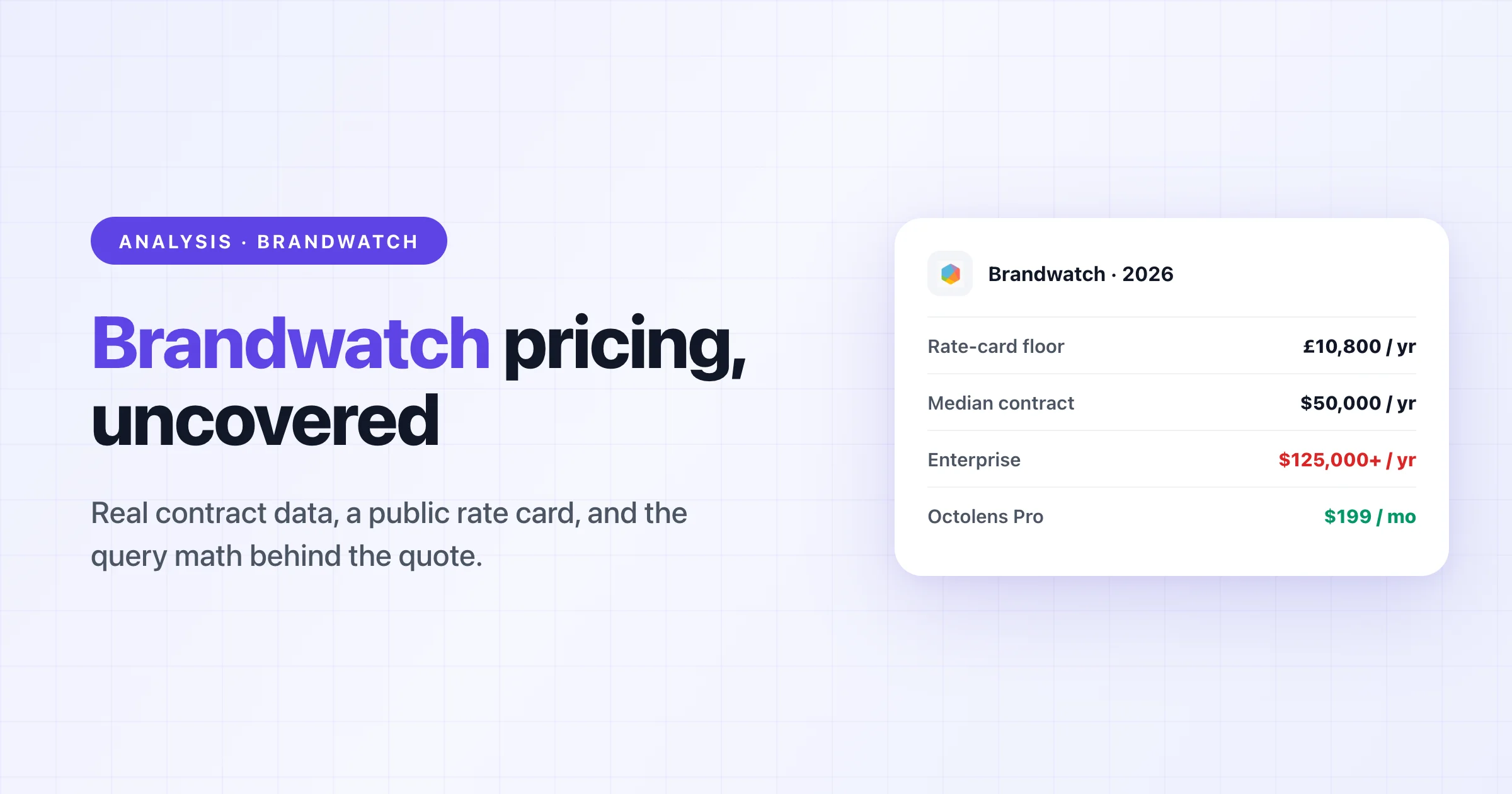
| Brandwatch | Enterprise consumer research | 4.4/5 (~730) | ~$50k/yr median (Vendr) | Enterprise contract |
| Thematic | Theme discovery in feedback | 4.8/5 (43) | $25,000/yr | All plans |
| Chattermill | Aspect-based CX sentiment | 4.4/5 (~240) | ~$64k/yr avg (Vendr) | All plans |
| Qualtrics | Sentiment inside a survey suite | 4.3/5 (~750) | Quote-only (CX) | License-dependent |
| Dialpad | Live call sentiment | 4.4/5 (~4,900) | $80/user/mo (Support) | All Support plans |
| Google Cloud Natural Language | Managed API, Google stack | — | $1/1k units after free tier | Pay-as-you-go |
| Amazon Comprehend | Managed API, AWS stack | — | ~$1 per 1M characters | Pay-as-you-go |
| Azure AI Language | Managed API, Azure stack | — | $1/1k records after free tier | Pay-as-you-go |
| VADER | Free rule-based baseline | — (open source) | Free (MIT) | — |
| Hugging Face models | Free transformer models | — (open source) | Free (run locally) | — |
| LLM APIs directly | DIY at LLM accuracy | — | ~$0.01 per 1k texts | — |
This is the case where the tool has to solve two problems: finding the text (millions of posts across platforms) and classifying it. If you only compare classifiers, you miss that the collection side is the harder half.
We make Octolens, so it sits outside the ranking. The numbered list below starts with the tools we don't make.
Best for: Sentiment on brand mentions across the internet, delivered into your stack | G2: 5/5 (6 reviews)
Ours, so let me explain exactly what the sentiment layer does and doesn't do. Octolens tracks mentions of your keywords across the internet, including Reddit, Hacker News, X, LinkedIn, Bluesky, GitHub, Stack Overflow, YouTube, TikTok, podcasts, newsletters, and news — and runs every single post through AI twice: once for relevance (is this actually about your company?) and once for classification, which includes a sentiment label and topical tags like bug_report or competitor_mention. The relevance step matters more than it sounds: roughly 70–76% of posts matching a typical keyword turn out to be irrelevant, and sentiment stats computed over unfiltered mentions are mostly noise about other things.
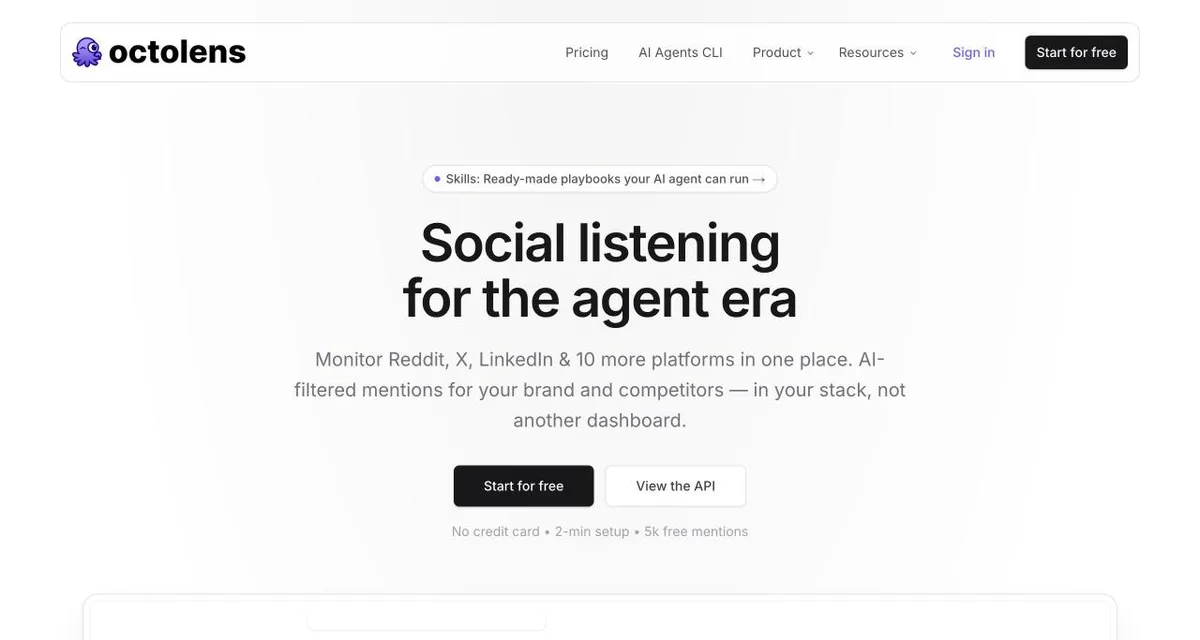
The part that's genuinely different is where the sentiment goes (full feature breakdown here). The API, webhooks, and the MCP server are included on every plan, so each mention arrives as structured JSON with its sentiment attached — into Slack, your warehouse, your CRM, or an AI agent that decides what to do with a negative post. Teams at Vercel, PostHog, Cursor, and Lovable run their monitoring this way, and the most common setup I recommend on calls is a feed of negative, high-relevance mentions going straight to the channel where someone can respond.
| Detail | Info |
|---|---|
| Pricing | Pro $159/mo (annual) / $199/mo monthly — 15,000 mentions, 10 keywords. Scale $499/mo (annual) / $599/mo — 50,000 mentions, 40 keywords. Enterprise custom. |
| Sentiment | LLM-based polarity + topical tags on every mention, all plans |
| Data access | REST API + webhooks + MCP on all plans |
| Free trial | 7 days |
Pros:
- Sentiment comes attached to mentions from the platforms where technical audiences actually talk (Reddit, HN, GitHub, podcasts)
- API, webhooks, and MCP on every plan — sentiment data is usable by your systems and agents from day one
- AI relevance filtering first, so sentiment percentages describe your brand and skip the junk
Cons:
- Sentiment is per-mention polarity plus tags — if you need aspect-based scoring of survey responses, Thematic or Chattermill below do that job properly
- No surveys, support tickets, or call transcripts; Octolens only analyzes public mentions
- Analytics dashboards are younger than what the enterprise suites ship
Website: https://octolens.com
Best for: Mainstream social and news monitoring with sentiment on every plan | G2: 4.6/5 (~340 reviews)
Brand24 covers the mainstream well — social platforms, news, blogs, podcasts, reviews — and its AI sentiment analysis is included on all plans, which stopped being common in this category a while ago. The AI feature set (Insights, Topics, Brand Assistant) has grown steadily, and since April 2026 the company sits inside Adobe, which acquired Semrush, which had acquired Brand24 in 2024. What that changes for buyers isn't clear yet; prices did move up this year, with the entry plan now at $199/mo billed annually.
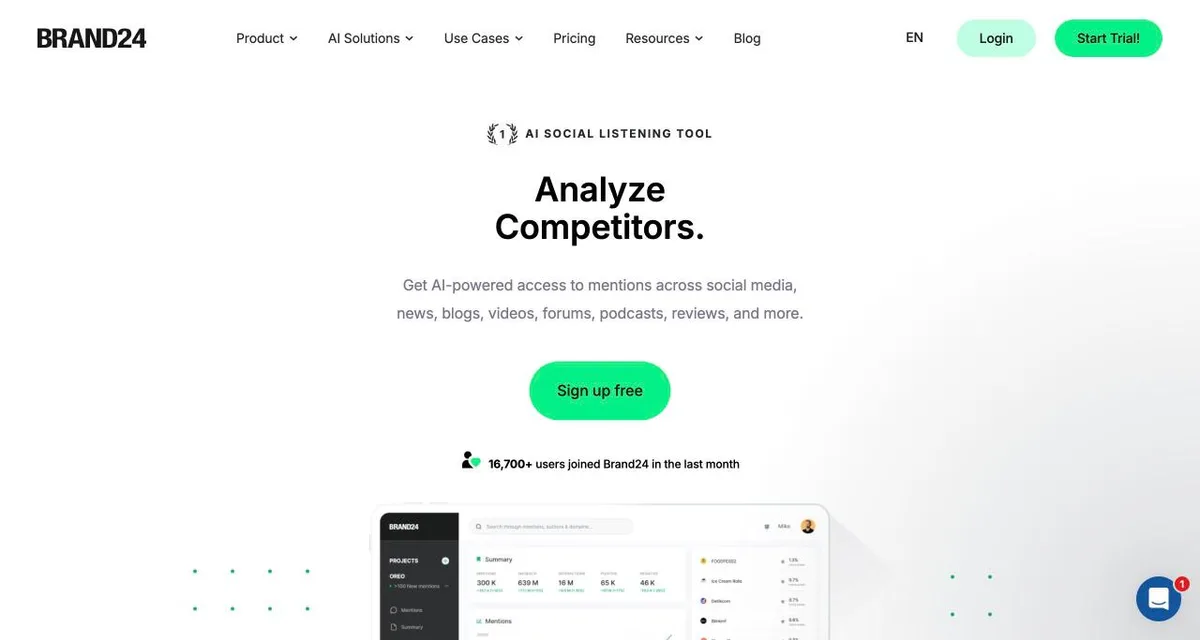
The catch for anyone who wants the data outside the dashboard: API access doesn't exist on the two lower plans at all, and above that it's a paid extra — the pricing page marks it as an added fee on Pro ($399/mo) and Business ($599/mo), and when we trialed Brand24 hands-on in August, the add-on could only actually be attached from the Business plan up. The MCP server is available from Pro up, which is a nicer story. If your endgame is sentiment data flowing into your own systems, price that in before comparing entry plans.
| Detail | Info |
|---|---|
| Pricing | Individual $199/mo (annual, 3 keywords, 2k mentions) → Team $299 → Pro $399 → Business $599 → Enterprise from $1,499. Monthly billing costs more. |
| Sentiment | AI sentiment on all plans |
| Data access | API: not on Individual/Team; extra fee on Pro and Business; included on Enterprise. MCP from Pro up. |
| Free trial | 14 days, no credit card |
Pros:
- Sentiment analysis on every tier, including the cheapest
- Broad mainstream coverage with solid reporting for the price
- 14-day trial without a card
Cons:
- API locked out of the lower half of the price list, then billed extra on the upper half
- Entry plan's 2,000 mentions/month runs out fast for any active brand
- Reviewers regularly mention irrelevant-mention noise that needs manual filtering
Website: https://brand24.com
Best for: The lowest entry price into real social listening sentiment | G2: 4.9/5 (small review base)
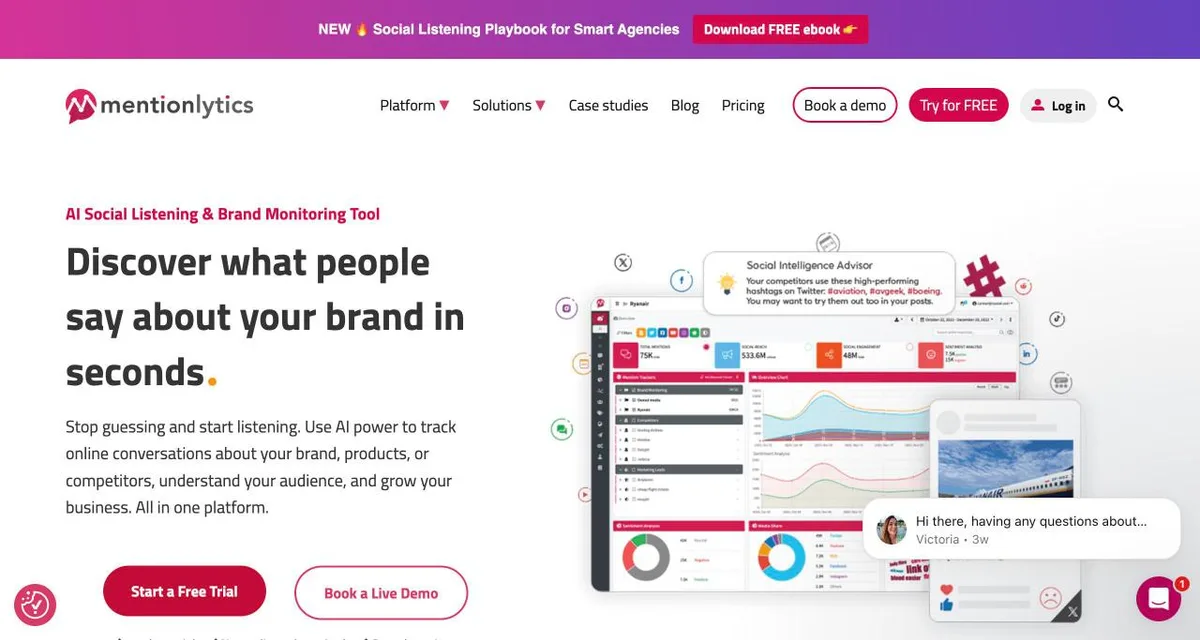
Mentionlytics is the budget entry into this category that practitioners actually bring up in threads. At $49/mo billed annually you get 3 keywords, 5,000 mentions, and their AI sentiment analysis, with emotion analysis arriving on the Advanced plan. For a small team that wants to know how sentiment is trending without a four-figure budget, that's a fair deal, and agencies in comparison threads consistently describe it as the reasonable mid-market choice.
The honest counterweight, from an agency comparing it head-to-head with Brandwatch:
"mentionlytics is easier to handle but the sentiment analysis can be pretty hit or miss. it often struggles with sarcasm or slang which means you end up cleaning the data manually anyway" — u/Strong_Teaching8548 on r/digital_marketing
That matches the pattern across budget tools: the sentiment layer is where the cost savings come from.
| Detail | Info |
|---|---|
| Pricing | Basic $49/mo (annual) / $69 monthly → Essential $131 → Advanced $239 → Pro $399 → Business $599 → Enterprise from $1,299 |
| Sentiment | AI sentiment on all plans; emotion analysis from Advanced |
| Data access | API from Advanced ($239/mo annual) up |
| Free trial | 14 days, no credit card |
Pros:
- Cheapest credible entry price in this roundup with sentiment included
- Emotion analysis exists at a mid-market price point
- Strong G2 satisfaction, though from a small review base
Cons:
- Sentiment accuracy on sarcasm and slang draws criticism from real users
- API gated to the $239+/mo tier
- Less analytics depth than the enterprise platforms it gets compared to
Website: https://www.mentionlytics.com
Best for: Sentiment inside a full social media management suite | G2: 4.4/5 (~7,400 reviews across products)
Sprout is a social media management platform first — publishing, inbox, reporting — with listening and sentiment layered on top. If your team already lives in Sprout for publishing, adding sentiment there is operationally simpler than adding another tool. The new $79/seat Essentials tier makes the suite itself more accessible than it used to be.
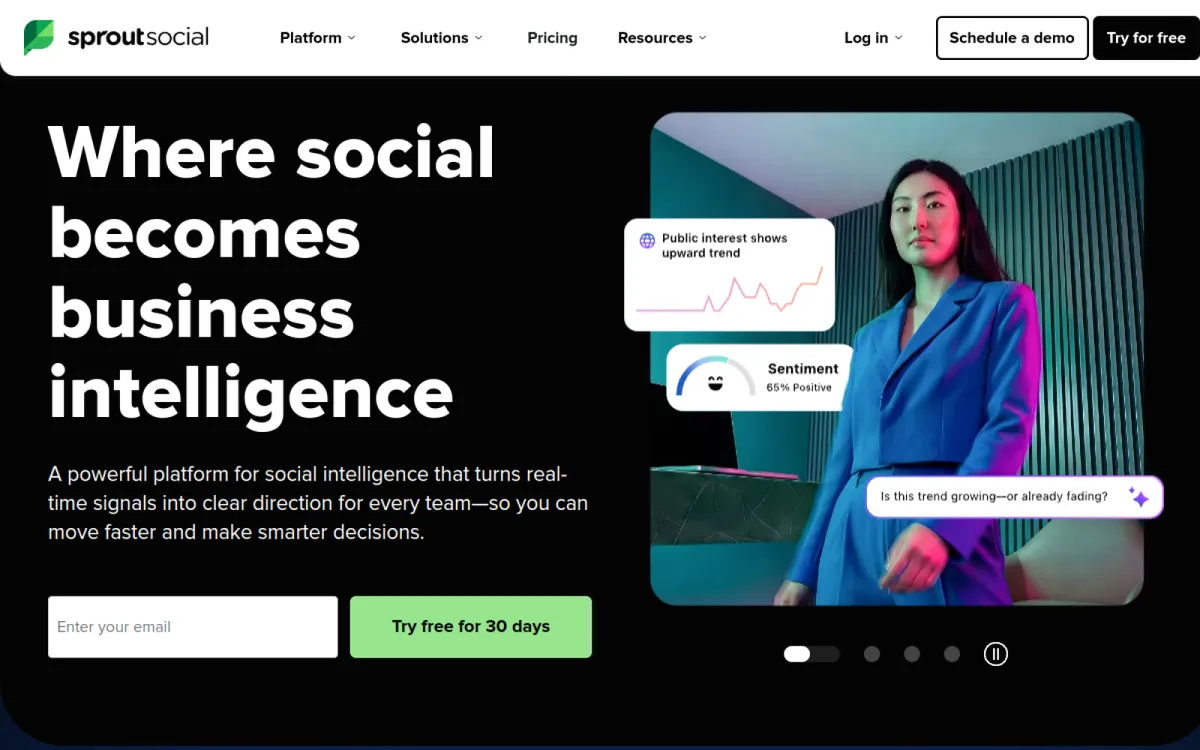
The sentiment math is the thing to check before you commit: sentiment in the Smart Inbox arrives on the Advanced plan at $399 per seat per month billed annually, and the full social listening module (topic-level sentiment, share of voice) is a separately-priced add-on that requires a sales conversation. Per-seat pricing also compounds in a way flat-priced listening tools don't — three seats on Advanced is already about $14k a year before the Listening add-on. If that's where it stops adding up, we compared Sprout Social alternatives by listening depth and price.
| Detail | Info |
|---|---|
| Pricing | Essentials $79/seat/mo (annual) → Standard $199 → Professional $299 → Advanced $399; monthly billing higher. Listening add-on priced by sales. |
| Sentiment | Inbox/review sentiment on Advanced; listening sentiment via add-on (Standard+) |
| Data access | API on Advanced and up |
| Free trial | 30 days, no credit card |
Pros:
- One suite for publishing, inbox, reporting, and sentiment
- 30-day trial is the most generous in this list
- Huge review base and mature product
Cons:
- Sentiment effectively starts at $399/seat/mo plus an unpriced add-on
- Per-seat pricing scales cost with team size, and listening data doesn't get cheaper per seat
- Community platforms like Reddit and HN aren't its strength
Website: https://sproutsocial.com
Best for: Enterprise consumer research with analyst-grade sentiment history | G2: 4.4/5 (~730 reviews)
Brandwatch is the research-grade option: the deepest historical archive in social listening, sentiment and emotion classification you can slice by demographic and topic, and dashboards built for insights teams. For a global consumer brand with analysts on staff, it does things nothing cheaper does.
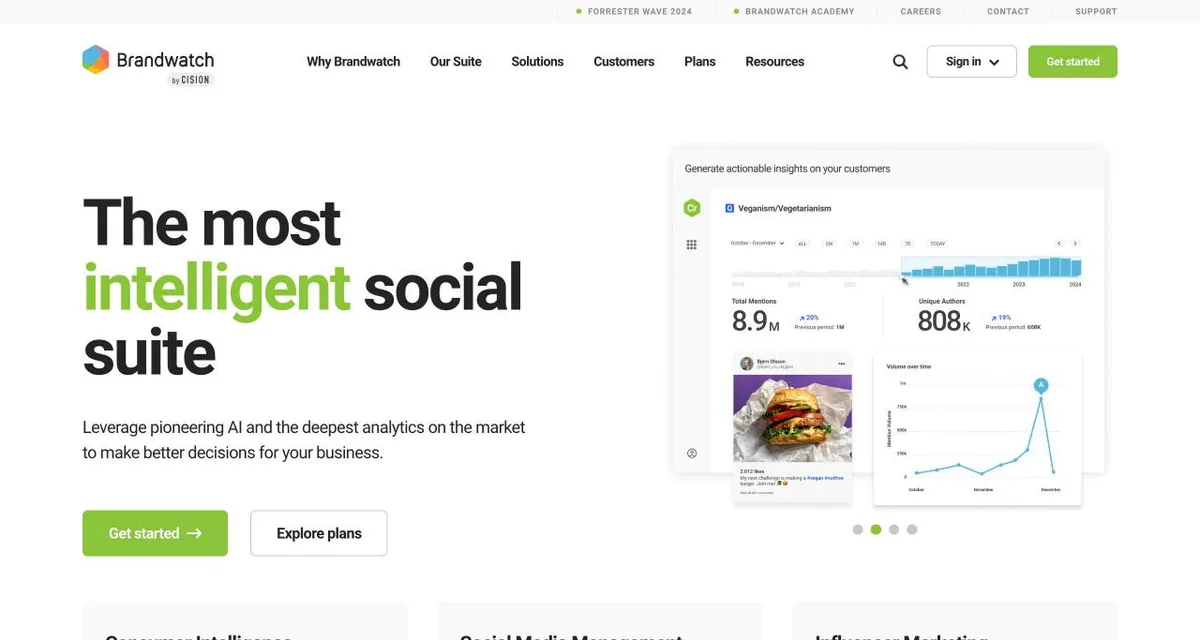
It's also the definition of enterprise procurement. There is no public pricing and no trial; Vendr's contract data puts the median at about $50,000/yr (range roughly $19.5k–$81k). And the practitioner threads repeat two costs beyond the invoice — the learning curve and the add-on structure:
"Now we've used Brandwatch in the past. Yes, visualization wise it's better … But their sources weren't as extensive and every new add on was behind a paywall. If I wanted to have a similar setup with that of Mentionlytics I would need to pay 35K at least." — u/icancount192 on r/digital_marketing
| Detail | Info |
|---|---|
| Pricing | Quote-only. Vendr median ~$50k/yr (40 purchases; range ~$19.5k–$81k) |
| Sentiment | LLM-assisted sentiment + emotion within Consumer Intelligence |
| Data access | API within enterprise contract scope |
| Free trial | None — demo only |
Pros:
- Deepest historical data and query power in the category
- Sentiment analysis you can segment properly for research
- Strong dashboards for analyst teams
Cons:
- Five-figure minimum spend, opaque pricing, no way to try before contract
- Boolean query setup takes real time to learn ("you'll spend more time trying to configure the complex boolean queries than actually looking at the insights", same thread as above)
- Add-ons priced separately, so the quoted number tends to grow
Website: https://www.brandwatch.com
Different problem: the text arrives through your own channels, volumes are lower but stakes per document are higher, and polarity alone is nearly useless — you need to know sentiment about what. That's why these tools lead with aspect-based analysis.
Best for: Discovering what themes drive sentiment in customer feedback | G2: 4.8/5 (43 reviews)
Thematic's angle is that the taxonomy should come from the feedback itself. Instead of you defining categories upfront, it reads your surveys, reviews, tickets, and call transcripts, finds the themes in the customers' own words, and tracks sentiment per theme over time — then ties themes to metrics like NPS so you can see which issue actually moves the score. That bottom-up approach is genuinely its differentiator, and its G2 rating is the highest in this roundup.
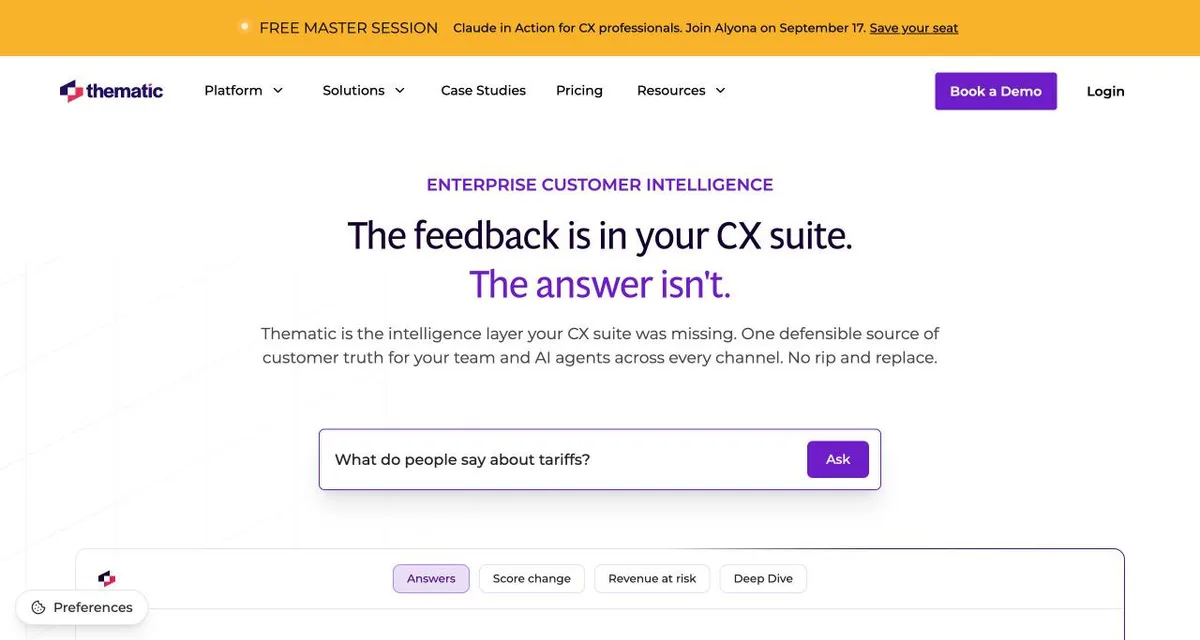
Unusually for this category, the price is public: the Foundation plan is $25,000/yr for up to 25,000 comments. That transparency deserves credit, and it also tells you clearly who this is for — enterprise insights teams, not a startup with a feedback form.
| Detail | Info |
|---|---|
| Pricing | Foundation $25,000/yr (up to 25k comments, 3 datasets); Enterprise custom |
| Sentiment | Theme-level and sentence-level sentiment, both plans |
| Data access | API and integrations on both plans |
| Free trial | No self-serve trial; demo and paid pilot |
Pros:
- AI theme discovery from the feedback itself, so you learn what you didn't think to ask
- Sentiment tied to outcome metrics (NPS, churn) rather than floating percentages
- Publishes its price — rare in enterprise CX
Cons:
- $25k/yr floor puts it out of SMB reach
- Small review base for an enterprise purchase
- No self-serve way to try it
Website: https://getthematic.com
Best for: Aspect-based sentiment across every feedback channel at once | G2: 4.4/5 (~240 reviews)
Chattermill unifies feedback from 65+ sources — Zendesk, Intercom, Trustpilot, app store reviews, surveys — and runs aspect-based sentiment through its Lyra AI layer, which combines dedicated models with LLMs. Aspect-based is the operative word: a single support ticket gets split into the things it's actually about, each scored separately. For CX teams drowning in multi-channel feedback, that's the real job. They also ship an MCP server, which makes them one of the few CX platforms thinking about agents reading this data, and that's a direction I obviously agree with.
Pricing is fully demo-gated. Vendr's data puts the average contract around $64,000/yr with entry points near $30k, and Chattermill themselves suggest the product makes sense from about 5,000 feedback pieces a month. Below that volume, you're paying for machinery you won't feed.
| Detail | Info |
|---|---|
| Pricing | Quote-only. Vendr: entry ~$30k+/yr, average ~$64k/yr, priced by integrations + volume |
| Sentiment | Aspect-based sentiment + themes (Lyra AI), core product on all plans |
| Data access | API plus an MCP server |
| Free trial | None — demo only |
Pros:
- Proper aspect-based sentiment rather than document-level buckets
- Widest feedback-connector set in this group (65+)
- MCP server means agents can query your CX data directly
Cons:
- No pricing transparency at all, and contracts average deep five figures
- Needs real feedback volume (their own guidance: 5,000+ pieces/month) to justify itself
- Setup and taxonomy tuning take onboarding effort
Website: https://chattermill.com
Best for: Sentiment analysis inside the survey platform you already run | G2: 4.3/5 (~750 reviews, CX listing)
If your feedback already flows through Qualtrics surveys, its Text iQ layer scores open-text responses from Very Negative to Very Positive without another vendor. There's an important distinction buyers keep tripping over: Text iQ is the survey-platform feature, while XM Discover — from the Clarabridge acquisition — is a separate, separately-sold conversational intelligence product that does sentence-level sentiment on a -5 to +5 scale plus emotion, effort, and intent across calls, chats, and reviews. Roundups conflate the two constantly; being quoted for Text iQ while imagining Discover-grade analysis is the classic mistake.
Core CX pricing is quote-only, though there's a free survey account and a self-serve research tier at $420/mo, so the platform itself is easy to start with. Discover-level sentiment lives firmly in enterprise-contract territory.
| Detail | Info |
|---|---|
| Pricing | CX suites quote-only; free survey account; self-serve Strategic Research $420/mo (annual). XM Discover sold separately. |
| Sentiment | Text iQ (survey responses, license-dependent); XM Discover (phrase-level, separate product) |
| Data access | API on paid/enterprise licenses |
| Free trial | Free survey account; 30-day Strategic Research trial |
Pros:
- Sentiment where your surveys already are, with serious stats tooling around it
- XM Discover is one of the deepest NLU engines in CX when you actually buy it
- Free account exists for small-scale starts
Cons:
- Text iQ vs XM Discover confusion is a real procurement trap
- CX pricing depends heavily on the sales process
- Heavy platform if sentiment is all you came for
Website: https://www.qualtrics.com
Best for: Real-time sentiment on live phone calls | G2: 4.4/5 (~4,900 reviews)
Dialpad does something none of the text tools above do: sentiment on calls while they're still happening. Supervisors see a live board where calls trending negative flag red, and they can listen in or join before the call ends badly. As an operational signal for a support floor, that's a different product from retrospective analytics, and it's why Dialpad belongs on this list even though it's a phone system.
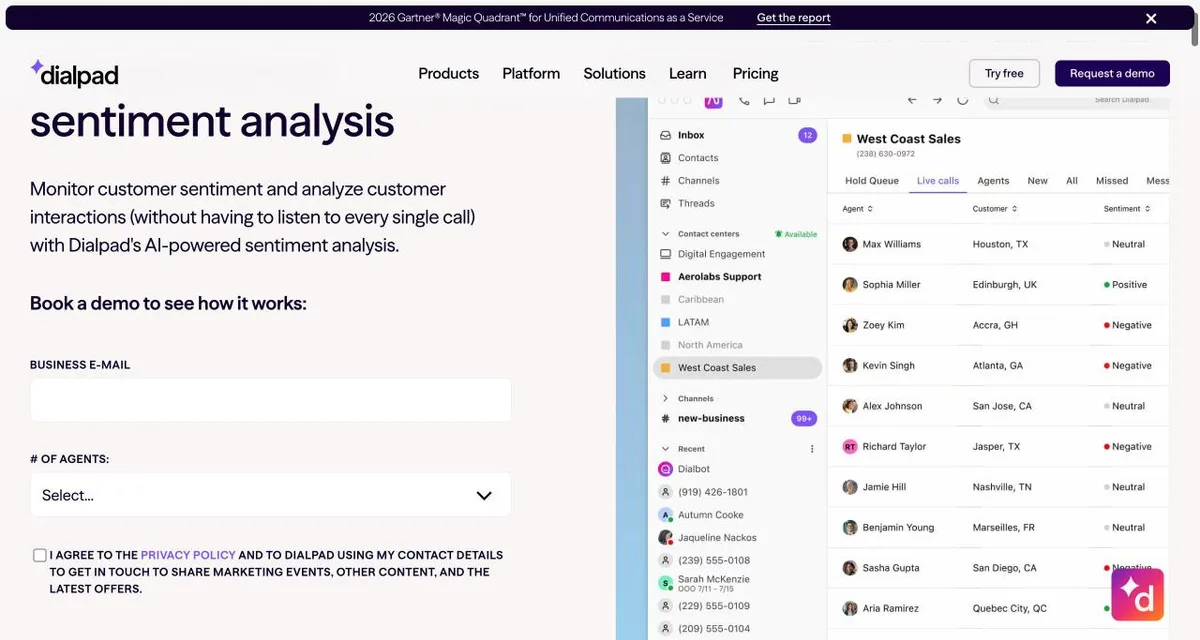
Scope it correctly though: real-time sentiment lives in Dialpad Support (the contact center product, from $80/user/mo billed annually) and Dialpad Sell. The $15/user Connect phone plans get transcription and recaps but not the sentiment dashboard, and the predicted-CSAT feature sits on the Premium tier. The classification itself leans on spotted phrases and keywords, so treat it as an escalation signal rather than analytics-grade sentiment.
| Detail | Info |
|---|---|
| Pricing | Support: Essentials $80 → Advanced $115 → Premium $150 per user/mo (annual), plus usage minutes. Connect (phone only, no sentiment dashboard): from $15/user/mo annual. |
| Sentiment | Real-time call sentiment on all Support and Sell plans; Ai CSAT on Premium |
| Data access | API; deeper integrations at higher tiers |
| Free trial | 14 days on Connect; Support is sales-led |
Pros:
- Live sentiment you can act on mid-call — unique in this list
- Included in all Support tiers without an extra AI fee
- Cheap self-serve entry into the platform via Connect
Cons:
- Phrase-based detection, so nuance is limited — think of it as an escalation signal
- The features in the marketing (Ai CSAT, scorecards) sit on the $150 Premium tier
- Voice-only scope; your Reddit thread or NPS verbatim never enters the system
Website: https://www.dialpad.com
If you already have the text — you're building a product, analyzing a corpus, enriching a pipeline — you don't need collection or dashboards, just a classifier behind an endpoint. All three clouds sell exactly that, priced per unit of text, and all three have free tiers that cover real experimentation. (A note on rumors: Google's Natural Language API is alive and taking new customers — what Google retired in 2025 was AutoML Text training, a different product. Same on AWS: Comprehend closed three niche features to new customers in April 2026, and sentiment detection isn't one of them.)
Best for: Managed sentiment with document and entity-level scores on GCP
The analyzeSentiment endpoint returns document and sentence-level score and magnitude; entity sentiment (how the text feels about each thing it names, a light version of aspect-based) is a separate, pricier call. First 5,000 units each month are free, then $1.00 per 1,000 units (a unit is 1,000 characters), dropping to $0.50 and $0.25 at millions of units. Google's strategic energy is visibly in Vertex AI and Gemini, so for anything beyond classic classification they'd rather you prompt a model — but for a stable, cheap sentiment endpoint this still does the job.
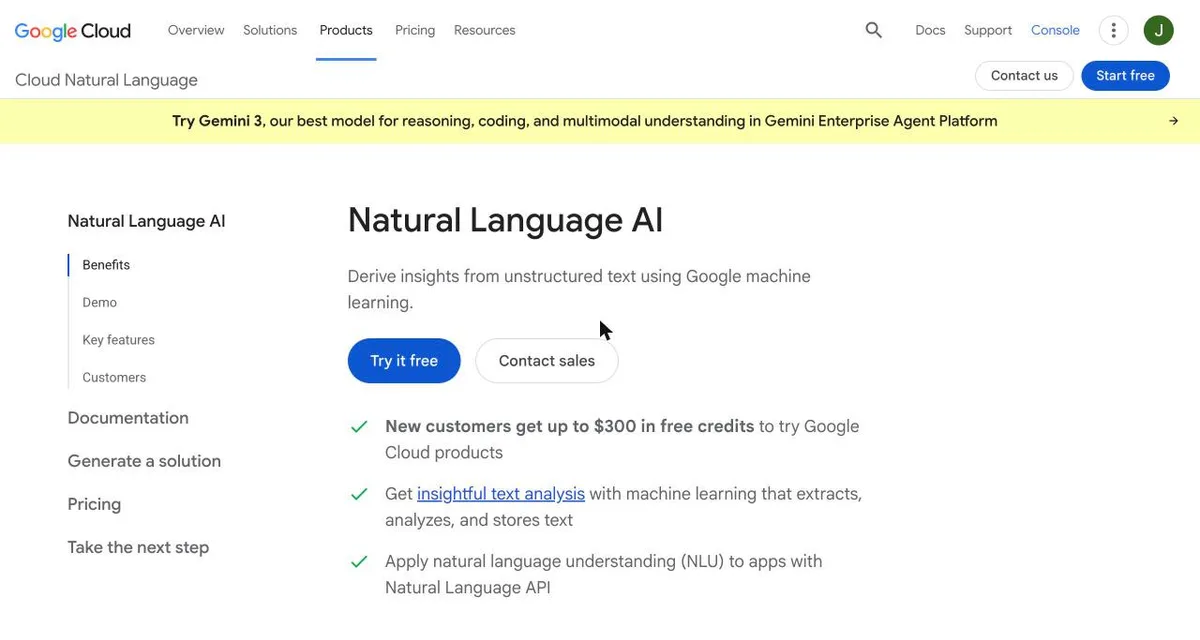
Pricing: 5k units/mo free, then $1.00/1k units (sentiment); entity sentiment $2.00/1k. Docs: cloud.google.com/natural-language
Best for: Managed sentiment inside an AWS pipeline
DetectSentiment returns positive/negative/neutral/mixed with confidence scores, and the targeted-sentiment variant scores per entity. Pricing is per 100-character unit at $0.0001 — about $1 per million characters — with volume discounts past 10M units, and a free tier of 50,000 units per month for your first 12 months. If your text already flows through AWS, this is the lowest-friction option; batch jobs read straight from S3.
Pricing: $0.0001/unit (100 chars), 3-unit minimum per request; free tier 50k units/mo for 12 months. Docs: aws.amazon.com/comprehend
Best for: Managed sentiment with opinion mining on Azure
Azure's sentiment endpoint (the service currently brands as Azure Language in Foundry Tools, after several renames) returns document and sentence sentiment, and its opinion-mining option extracts aspect-level opinions — the most aspect-capable of the three cloud APIs. The free tier is 5,000 text records per month; the standard tier starts at $1.00 per 1,000 text records and steps down to $0.25 at volume. Microsoft's naming churn is annoying, but the underlying API has been stable for years.
Pricing: 5k records/mo free; then $1.00/1k records, decreasing to $0.25 at scale. Docs: azure.microsoft.com/pricing/details/language
Best for: A free baseline in one pip install
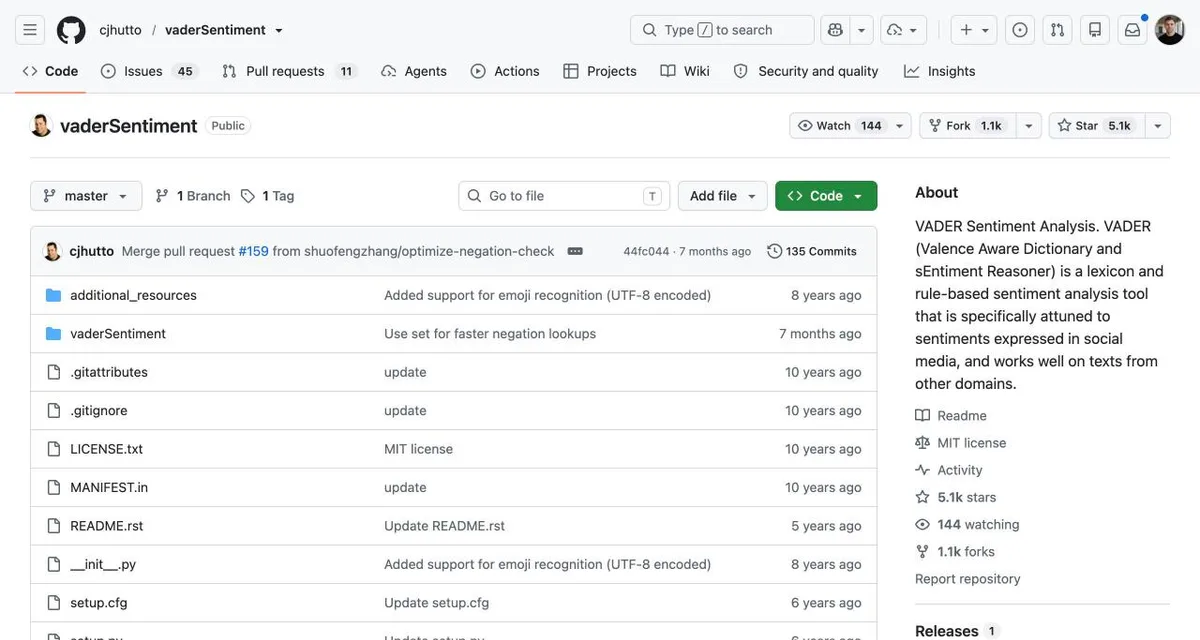
VADER is a lexicon and rule-based Python library tuned for social media text — it knows emoticons, slang, capitalization emphasis, and negations, outputs a compound score from -1 to +1, is MIT-licensed, and still gets maintained (last merged improvement March 2026). It runs anywhere instantly with no model download. It's also twenty-year-old technique, and the NLP crowd is blunt about where it stands now:
"VADER is just a dictionary mapping each word to a single sentiment weight and adding it up with some basic logic for negations and such. There's an ocean of smaller NLP ML between that naive approach and LLMs. … If all you need is a model trained to do sentiment analysis, using VADER over something like DistilBERT is NLP malpractice in 2025." — Cheer2171 on Hacker News
The counterpoint in the same thread is fair too: it's vastly cheaper than anything model-based, and for quick correlation checks over huge English corpora that tradeoff can be rational. Just don't ship customer-facing decisions on it.
Pricing: free, MIT license. Repo: github.com/cjhutto/vaderSentiment
Best for: Free transformer-grade accuracy you run yourself
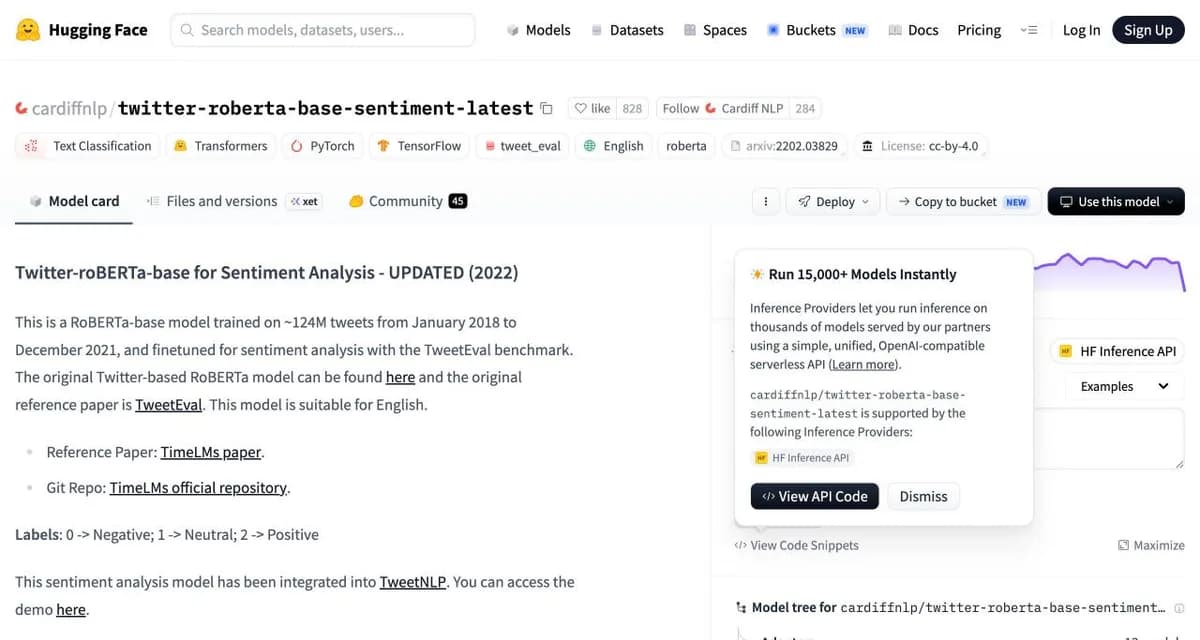
Two models dominate the sentiment downloads on Hugging Face: distilbert-base-uncased-finetuned-sst-2-english (~3.8M downloads/month, Apache-2.0) for general text, and Cardiff NLP's twitter-roberta-base-sentiment-latest (~3.2M/month, trained on 124M tweets) for social media text. Both are small enough to run on CPU, cost nothing locally, and sit clearly above lexicon methods on accuracy. The practical costs are engineering ones: you host it, you batch it, and you accept fixed labels with no reasoning about context beyond what the fine-tune learned. Hugging Face's Inference Providers can host the call for you at pass-through compute rates if you'd rather not.
Pricing: free locally; Inference Providers metered (small free credit tier). Models: huggingface.co/models?other=sentiment
Best for: The accuracy ceiling, if you build the pipeline
The honest observation about this whole category in 2026: a cheap LLM with a fixed prompt is an excellent sentiment classifier — it handles sarcasm, slang, and mixed languages better than everything above except the tools that are themselves LLM-based. Developers have internalized this:
"Literally anything else? Smaller models are fine. Classifiers, sentiment analysis, editing blog posts, tool calling, whatever." — com2kid on Hacker News
The economics work at almost any scale. Classifying 1,000 short texts (~150 input tokens each with the prompt, a few output tokens) costs roughly $0.01 with GPT-5-nano ($0.05/$0.40 per million tokens), ~$0.06 with GPT-5-mini, and ~$0.20 with Claude Haiku 4.5 ($1/$5 per million) — about half that with batch APIs. Those are estimates that scale with your prompt length, but the order of magnitude is the point.
What the API price doesn't include is everything else: collecting the text, deduplicating, prompt consistency so Tuesday's labels match Monday's, retries, and somewhere for results to live. That's the real boundary between this option and the tools above: at this point what you're paying a tool for is the pipeline around the classification. (If the text you want is public brand mentions, that pipeline is exactly what our social listening API is, with the classification already done.)
Pricing: GPT-5-nano $0.05/$0.40 per 1M tokens; Claude Haiku 4.5 $1/$5 per 1M; both ~50% off via batch. Docs: developers.openai.com/api/docs/pricing, platform.claude.com
Match the tool to where your text lives:
- You want sentiment on what people say about your brand publicly: Octolens. This is us, so the honest pitch is just: start the trial, add your keywords, and check the sentiment labels against the actual mentions for a day — with the API and MCP included you can also immediately test it inside your own stack. Brand24 or Mentionlytics if budget rules and mainstream social is enough; Brandwatch if you're a consumer brand with an insights team and $50k.
- Your text is surveys, reviews, and tickets: Thematic if you want the themes discovered for you, Chattermill for aspect-based analysis across many channels, Qualtrics if the surveys already live there (and be precise about Text iQ vs XM Discover in the sales process).
- Your text is phone calls: Dialpad Support. Nothing else here does live calls.
- You have the text and an engineer: Azure, Google, or Comprehend for a stable managed endpoint in your cloud — or skip straight to an LLM API with a fixed prompt, which is what we'd build today.
- You have no budget: VADER for a quick baseline, a Hugging Face model for real accuracy, and the cloud free tiers for a few thousand texts a month.
One thing I'd gently push back on regardless of tool: sentiment percentages in a dashboard don't do anything by themselves. The setups that work route classified text to where someone (or some agent) acts on it — a negative-mention feed in Slack, a churn-signal webhook, a weekly themes report. If you're deciding how to operationalize that for brand monitoring specifically, our guide to brand reputation monitoring covers the workflow side, and our ranking of the best social listening tools compares the collection side of these platforms in more depth. If you're pricing the enterprise suites, our breakdown of Meltwater pricing shows what those contracts actually look like.