23 Best Competitor Monitoring Tools in 2026 (By Category)
Competitor monitoring is seven different jobs, not one — from AI competitor analysis to competitor intelligence platforms. Here's the best tool for each, with G2 ratings, real prices, and real user quotes.
I'm the co-founder of Octolens, and Octolens is one of the twenty-three tools below. So no false neutrality: we're #1 on this list and I'll make the case for why. But I'll also tell you something most listicles won't — competitor monitoring is not one job, and no tool on this list does all of it. Octolens included. Most "best competitor monitoring tools" lists are written by the tools themselves; this one includes G2 ratings, real prices, and quotes from actual practitioners so you can disagree with my ranking using the data on this page.
When we researched this page, we pulled the tools that actually rank for "competitor monitoring" and the ones practitioners actually name in threads. You'll see the same category labeled competitor intelligence, competitive intelligence, or AI competitor analysis depending on who's writing — the names differ, but the work underneath splits into the same seven distinct jobs:
- Conversation monitoring — what customers say about competitors (and you) across the internet
- Competitive intelligence platforms — battlecards and win/loss enablement for sales teams
- Search intelligence — competitors' SEO and paid search footprint
- Website & price tracking — what competitors change on their own sites
- Social benchmarking — engagement and share-of-voice on social accounts
- Ad intelligence — every ad your competitors run, and what they spend
- AI search visibility — who ChatGPT and Perplexity recommend in your category
Here's how real this pain is: founders keep building tools for it out of frustration. From a Show HN three weeks ago:
"I run two small products I launched this year and as a daily task I was keeping an eye on my competitors… I was initially checking their blogs manually and handpicked the topics I was curious about" — nyku on Hacker News
Manual checking doesn't scale. Here's what does, by job.
Every tool on this page went through the same five checks:
- Job fit — Which of the seven monitoring jobs does it actually do well? A tool that's mediocre at four jobs lost to a tool that's excellent at one.
- Pricing transparency — Can you find the price on the website, or does it take a sales call? Where vendors hide pricing, we cite third-party buyer data (Vendr and 2026 buyer reports) instead.
- Signal vs. noise — Does it filter and prioritize, or dump everything on you? An alert stream you learn to ignore is worse than no alerts.
- API and workflow integration — Can you pipe competitor intel into Slack, your CRM, your warehouse, or an AI agent — or are you stuck in a dashboard?
- Honest value — Is it worth what it costs for the job it does? Including where the honest answer is "use the free option instead."
G2 ratings are included as of July 2026; review counts are approximate. Every user quote links to its source, and every price was checked against the vendor's page (or attributed where it wasn't published).
| Tool | Best for | G2 (Jul 2026) | Starting price | API |
|---|---|---|---|---|
| Octolens | Competitor mentions across the internet | 5/5 (6) | $159/mo (annual) | Yes (all plans) |
| Awario | Budget broad monitoring | 3.9/5 (~50) | €29/mo (annual) | Enterprise only |
| Brandwatch | Enterprise consumer intelligence | 4.2/5 (~1,700) | ~$50k/yr median | Yes (enterprise) |
| Klue | Sales battlecards & CI | 4.8/5 | ~$15k–30k+/yr | Yes |
| Crayon | Broad CI program | 4.6/5 (~385) | ~$13k–48k/yr | Yes |
| Contify | Market + competitive intel, multi-team | 4.5/5 (~114) | Custom | Yes |
| AlphaSense | Deep research on public companies | 4.6/5 (~346) | Custom | Yes |
| Semrush | SEO + PPC intel | 4.5/5 (~3,300) | $117/mo (annual) | Higher tiers |
| Ahrefs | Backlinks & content gaps | 4.5/5 (~700) | $29/mo (Starter) | Higher tiers |
| SpyFu | PPC history on a budget | 4.6/5 (~517) | $29/mo (annual) | Yes |
| Similarweb | Traffic benchmarking | 4.4/5 (~1,140) | ~$199/mo | Business tiers |
| Visualping | Website change alerts | 4.6/5 (~408) | Free / $10/mo | Business plans |
| changedetection.io | Selector-level page monitoring | N/A (open source) | Free / $8.99/mo | Yes |
| Hexowatch | Deep technical site monitoring | 4.7/5 (~52) | ~$29/mo | Yes |
| Prisync | E-commerce price tracking | 4.7/5 (~161) | $99/mo | +20% add-on |
| Sprout Social | Social account benchmarking | 4.4/5 (~6,400) | $199–299/seat/mo | Yes |
| Rival IQ | Head-to-head social benchmarks | 4.5/5 (~49) | $239/mo | Yes |
| Adbeat | Display & native ad intel | N/A (few reviews) | Free / $249/mo | Higher tiers |
| BigSpy | Ad creative search | 4.6/5 (~635) | ~$19/mo | No |
| Competitors.app | All-in-one for SMBs | N/A (12 reviews) | $19.95/mo (promo) | Custom plan |
| Owler | Company news, funding, M&A | 4.3/5 (~480) | Free / $39/user/mo | Max tier |
| Otterly.AI | AI search visibility (entry) | N/A (few reviews) | $29/mo | From $189/mo |
| Peec AI | AI search visibility (depth) | 4.9/5 (11) | ~€89/mo | Higher tiers |
The fastest-moving signal on this list. A competitor's unhappy customer asking for alternatives in public is the warmest lead on the internet — and it goes cold in hours.
Best for: Competitor mentions across the internet, delivered into your stack | G2: 5/5 (6 reviews, Jul 2026)
Ours. The job Octolens does: track every public mention of your competitors (and your own brand) across 15+ platforms — Reddit, Hacker News, Twitter/X, LinkedIn, Bluesky, GitHub, Stack Overflow, YouTube, TikTok, podcasts, newsletters, and 150k+ news outlets — filter it with AI so you only see relevant conversations, and deliver it wherever you work: Slack, email, webhooks, or straight into your own systems.
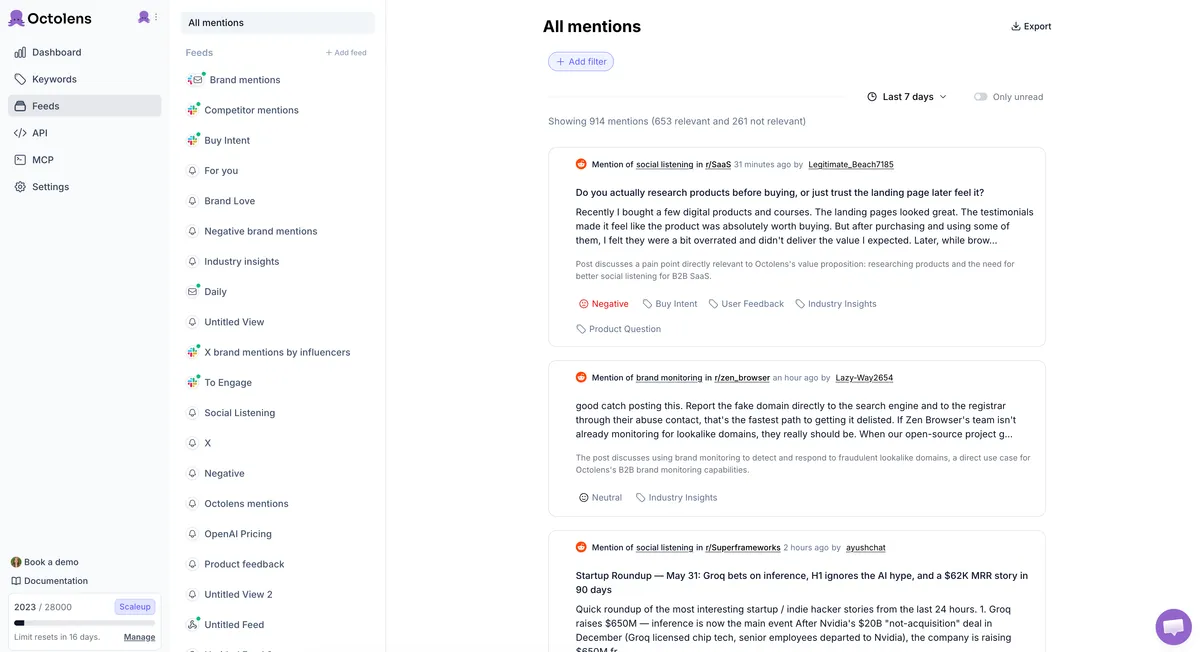
Competitor monitoring is one of the highest-leverage ways to use it. Add competitor names as keywords and you see their feature complaints, pricing gripes, and "any alternatives to X?" threads in real time. And because the API, webhooks, and MCP server are included on every plan — not gated behind enterprise — piping those mentions into your CRM, warehouse, or an AI agent workflow is the designed-for path, not a workaround. People already build on it:
"Used octolens API for the mention trigger and Interfaze for scraping the full post and reply generation" — @yoeven
"the only durable SaaS right now is unique data or action APIs to be used by agents. For example: Unique data: Octolens" — @andyhattemer
Teams at Vercel, Prisma, PostHog, Tally, and Juicebox run their monitoring through Octolens. Setup takes about 2 minutes — AI onboarding pulls your company info and suggests competitor keywords automatically.
| Detail | Info |
|---|---|
| Pricing | Pro $159/mo (annual) / $199/mo — 15,000 mentions, 10 keywords. Scale $499/mo (annual) / $599/mo — 50,000 mentions, 40 keywords. Enterprise custom. |
| Coverage | 15+ platforms incl. Reddit, HN, GitHub, Stack Overflow, podcasts, newsletters, 150k+ news outlets |
| API | REST API + webhooks + MCP on all plans |
| Free trial | 7 days |
Pros:
- Widest coverage of the platforms where technical and product-led audiences actually talk (HN, GitHub, Reddit, podcasts)
- API, webhooks, and MCP on every plan — competitor mentions go into your workflows, not another dashboard
- AI relevance filtering handles common-word competitor names ("Mention", "Crayon", "Linear"…) without flooding you
- Unlimited team seats on all plans; 2-minute AI-assisted setup
Cons:
- No print or broadcast media coverage — if your competitors live on TV, you need a PR suite
- Analytics layer is younger than the enterprise platforms'
- If your competitors get almost no public mentions, conversation monitoring isn't your bottleneck — website tracking below will tell you more
Website: https://octolens.com
Best for: Price-sensitive teams monitoring mainstream social and news | G2: 3.9/5 (~50 reviews, Jul 2026)
Awario is the budget end of broad conversation monitoring: news, blogs, X/Twitter, Reddit, and the general web, with Boolean search even on the entry plan. For a small team that wants wide coverage and generous mention quotas at the lowest possible price, the fundamentals are there — and the white-label reports make it a quiet agency favorite.
The trade-offs are what the price implies. There's no AI relevance filtering — Boolean queries are powerful but you tune them by hand, and common-word competitor names will flood the feed until you do. The entry plan caps you at 3 topics, which competitor monitoring eats instantly (your brand + two rivals and you're done). And developer-community coverage — Hacker News, GitHub, Stack Overflow, podcasts — isn't its territory, so for technical products the most valuable competitor conversations simply won't show up.
| Detail | Info |
|---|---|
| Pricing | Starter €29/mo (annual) / €49/mo — 3 topics. Pro €89/mo (annual) — 15 topics. Enterprise €249/mo (annual) — 100 topics. |
| Coverage | X/Twitter, Reddit, news, blogs, web; no HN/GitHub/SO/podcasts |
| API | Enterprise plan only |
| Free trial | Yes, no card |
Pros:
- Cheapest real entry into broad conversation monitoring (€29/mo annual)
- Boolean search and data export even on the entry plan
- White-label PDF reports make it agency-friendly
- Generous mention quotas (30k/mo on Starter)
Cons:
- No AI relevance filtering — hand-tuned Boolean or a noisy feed
- API gated to the Enterprise plan — no programmatic access on Starter or Pro
- 3 topics on Starter is instantly consumed by competitor monitoring
- No developer-community or podcast coverage
- Lowest G2 rating on this list (3.9), largely reflecting data-coverage complaints
Website: https://awario.com
Best for: Global consumer brands with analyst teams and six-figure budgets | G2: 4.2/5 (~1,700 reviews, Jul 2026)
Brandwatch (part of Cision) is the enterprise end of conversation monitoring: 100M+ sources, the deepest historical archive in the industry, an official Reddit data partnership, and consumer-intelligence analytics that can surface emerging narratives across millions of conversations. For a global consumer brand with an analyst team running multi-market competitor tracking, it's a legitimate shortlist tool — and its crisis-management workflows are battle-tested at Fortune 500 scale.
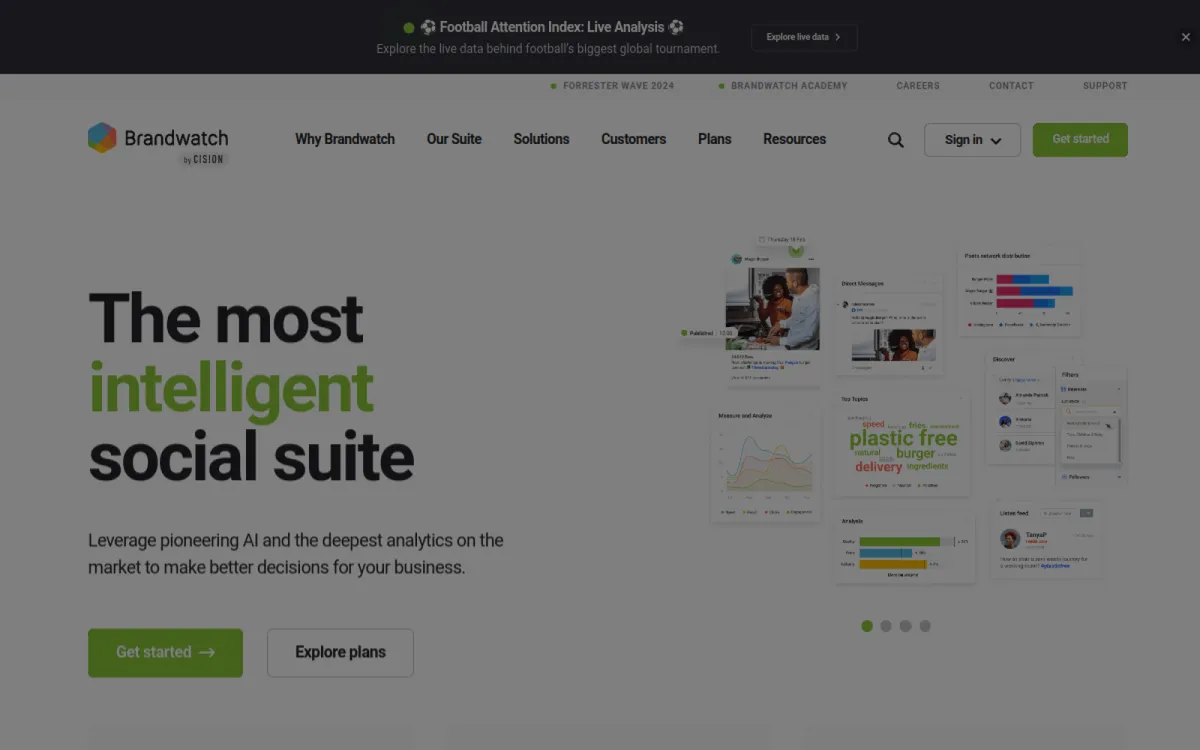
The entry bar is the story. Pricing is opaque and enterprise-only — Vendr's July 2026 buyer data puts the median contract at $50k/year, and you'll sit through a sales cycle just to see a number. Setup means complex Boolean query building and a multi-week onboarding (Brandwatch Academy exists for a reason). And for all the source volume, developer communities — GitHub, Hacker News, Stack Overflow — aren't its strength, so technical-product competitor chatter is exactly the slice it's weakest on. If you don't have a dedicated analyst, most of what you're paying for goes unused.
| Detail | Info |
|---|---|
| Pricing | Custom, enterprise-only; median contract ~$50k/yr (Vendr, Jul 2026) |
| Coverage | 100M+ sources; social, news, forums, reviews; official Reddit partnership |
| API | Enterprise contracts |
| Free trial | Demo only |
Pros:
- Deepest source coverage and historical archive in the category
- Enterprise analytics: narrative detection, image/logo recognition, crisis workflows
- Official Reddit data partnership
- Battle-tested at Fortune 500 scale
Cons:
- Median contract ~$50k/yr and no public pricing — a sales cycle just to see a number
- Multi-week onboarding and complex Boolean setup
- Weak on developer communities, where technical-product competitor chatter lives
- Overkill without a dedicated analyst — the tool doesn't run itself
See our full Brandwatch alternatives breakdown.
Website: https://www.brandwatch.com
The enterprise category, also called competitor intelligence: platforms that aggregate competitor signals into battlecards your sales team uses mid-deal. One honest caveat up front, from a practitioner this week:
"Intel PMM teams license Contify, Klue, Crayon and still launch on stale intel." — @polsia
These platforms work when someone owns them. Without a dedicated owner, any of them becomes an expensive RSS feed within a quarter.
Best for: B2B sales orgs with a product marketer who owns competitive intel | G2: 4.8/5 (Jul 2026 — highest in the CI category)
Klue is the category leader for sales-facing competitive intelligence. The core loop: it aggregates competitor signals (news, website changes, reviews, win/loss data), your PMM curates them into battlecards, and sales reps consume those battlecards inside their CRM mid-deal. Its G2 rating reflects the thing it does exceptionally well: making competitive knowledge usable during a deal, not after it. Recent releases lean hard into AI — auto-generated insights and win/loss interview clips — reportedly driving meaningful win-rate lifts for teams that actually operationalize them.
The catch is commitment. Klue doesn't publish pricing; 2026 buyer reports put typical contracts at $15k–$30k+/year. And like every tool in this category, it assumes a human owner — battlecards nobody curates go stale in a quarter.
| Detail | Info |
|---|---|
| Pricing | Custom; ~$15k–30k+/yr typical (2026 buyer reports) |
| Coverage | Competitor news, site changes, reviews, win/loss data → battlecards in CRM |
| API | Yes |
| Free trial | Demo only |
Pros:
- Best-in-class sales enablement: battlecards where reps actually work
- Highest G2 rating in the CI category (4.8)
- Win/loss program tooling built in
- Strong AI summarization of competitor signals
Cons:
- No public pricing; five-figure annual commitment
- Needs a dedicated PMM owner or it decays into an expensive feed
- Sales-first scope — broader market intelligence isn't the focus
Website: https://klue.com
Best for: Teams running a formal CI program beyond just sales enablement | G2: 4.6/5 (~385 reviews, Jul 2026)
Crayon is Klue's perennial comparison — most CI evaluations come down to these two. Crayon leans broader: it tracks 100+ signal types across competitor websites, pricing pages, job postings, reviews, and news, with AI summarization on top. Klue is sales-first; Crayon is CI-first with sales enablement attached.
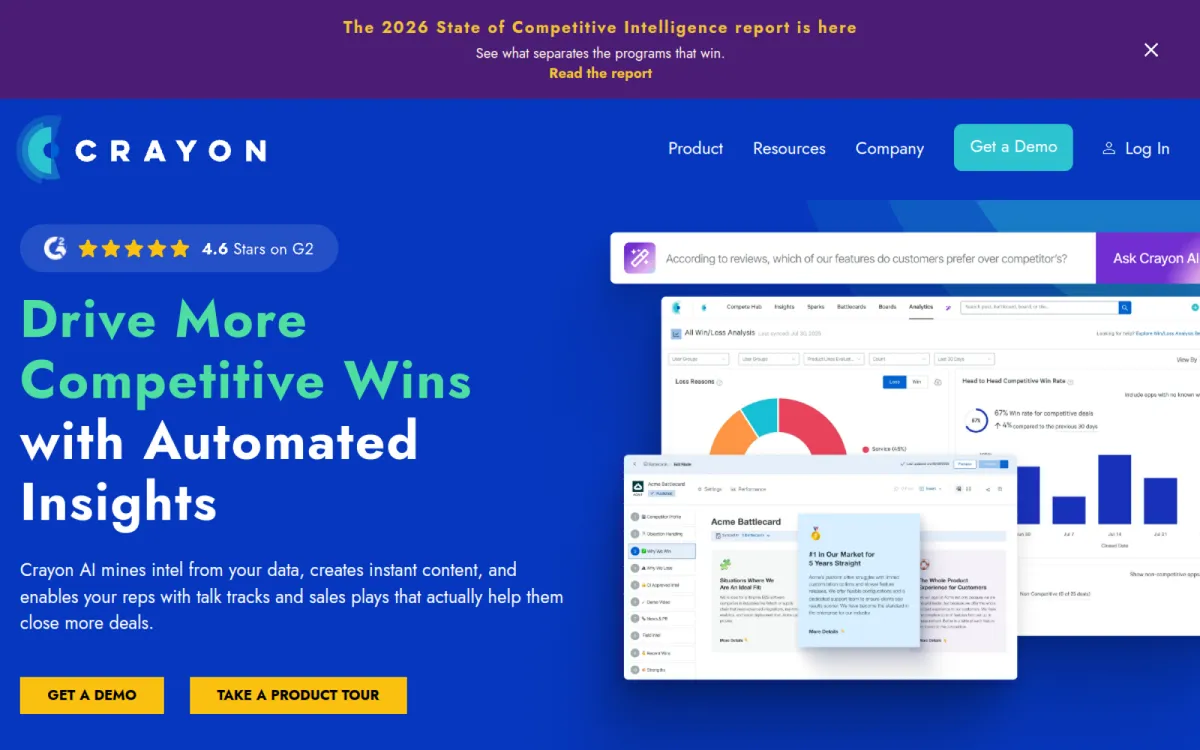
It's a classic high-touch enterprise purchase: sales-led, demo-only, no public pricing and no self-serve trial. Third-party estimates put contracts at roughly $13k–$48k/year depending on scope. Same honest caveat as Klue: these platforms assume a dedicated CI function. If "competitive intel" is 10% of one marketer's job, start with point tools and graduate later.
| Detail | Info |
|---|---|
| Pricing | Custom; ~$13k–48k/yr estimated (third-party, 2026) |
| Coverage | 100+ signal types: sites, pricing pages, job postings, reviews, news |
| API | Yes |
| Free trial | Demo only |
Pros:
- Broadest signal coverage in the CI category (100+ types)
- Strong AI digests of competitor moves
- G2 4.6 across ~385 reviews — consistently well-reviewed
- Battlecards and enablement included, not bolted on
Cons:
- Demo-only, no public pricing, no self-serve trial
- Five-figure annual contracts
- Assumes a formal CI program — light users won't extract the value
Website: https://www.crayon.co
Best for: Global or multi-team organizations where CI extends beyond sales | G2: 4.5/5 (~114 reviews, Jul 2026)
Contify positions itself as market and competitive intelligence — broader than the Klue/Crayon sales-enablement lane. It runs intelligence workflows across industries like pharma, financial services, procurement, and consulting: competitor tracking plus supplier research, market analysis, and analyst-led monitoring, with newsfeeds tuned per team. It was named a Visionary in Gartner's inaugural 2026 Magic Quadrant for Competitive and Market Intelligence Platforms.
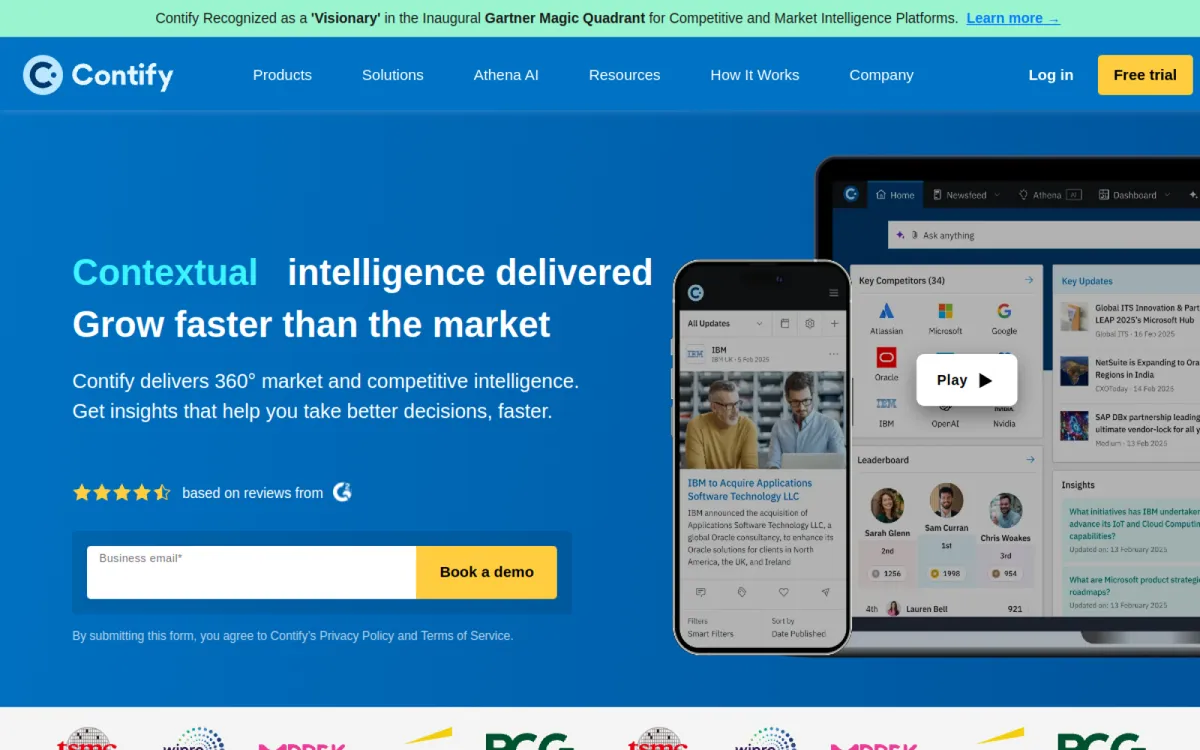
Pricing is custom like the rest of the category, but Contify offers a 7-day free trial — rare among enterprise CI vendors, and a sign it supports bottom-up evaluation rather than only top-down sales cycles.
| Detail | Info |
|---|---|
| Pricing | Custom |
| Coverage | Competitor + market + supplier intelligence, multi-vertical, per-team newsfeeds |
| API | Yes |
| Free trial | 7 days — unusual for enterprise CI |
Pros:
- Broader than sales enablement: market, supplier, and analyst-led intelligence
- Only enterprise CI vendor here with a self-serve trial
- Gartner MQ Visionary (2026); praised on G2 for support quality
- Fits multi-team, multi-vertical deployments
Cons:
- Custom pricing — budget conversation still required
- Less sales-enablement depth than Klue for pure battlecard use cases
- Smaller review base than Klue/Crayon
Website: https://www.contify.com
Best for: Strategy, finance, and corp-dev teams doing deep competitor research | G2: 4.6/5 (~346 reviews, Jul 2026)
AlphaSense comes at competitive intelligence from the research side: its core asset is a searchable universe of earnings calls, filings, broker research, expert call transcripts, and news, with AI summarization on top. For deep-dive questions — "what is this competitor telling investors about their roadmap?" — nothing else on this list comes close. It's the tool of choice for investment and corporate strategy teams rather than day-to-day PMM work.
Custom pricing with a 2-week free trial. Expect enterprise numbers; this is a research platform, not a monitoring point tool.
| Detail | Info |
|---|---|
| Pricing | Custom (enterprise) |
| Coverage | Earnings calls, filings, broker research, expert transcripts, news |
| API | Yes |
| Free trial | 2 weeks |
Pros:
- Unmatched depth on public and late-stage companies
- Expert call transcript library is a genuine moat
- Strong AI search and summarization across financial documents
- G2 4.6 across ~346 reviews
Cons:
- Enterprise pricing for what's fundamentally a research subscription
- Not a monitoring tool — alerts and workflows are secondary
- Overkill for tracking private startup competitors with thin public footprints
Website: https://www.alpha-sense.com
The SEO tools get expensive, and practitioners feel it:
"stop paying $140+/month for SEO tools 😳 someone open sourced an Ahrefs/Semrush alternative" — @SahilPanhotra
Still, for most teams one of these four earns its keep.
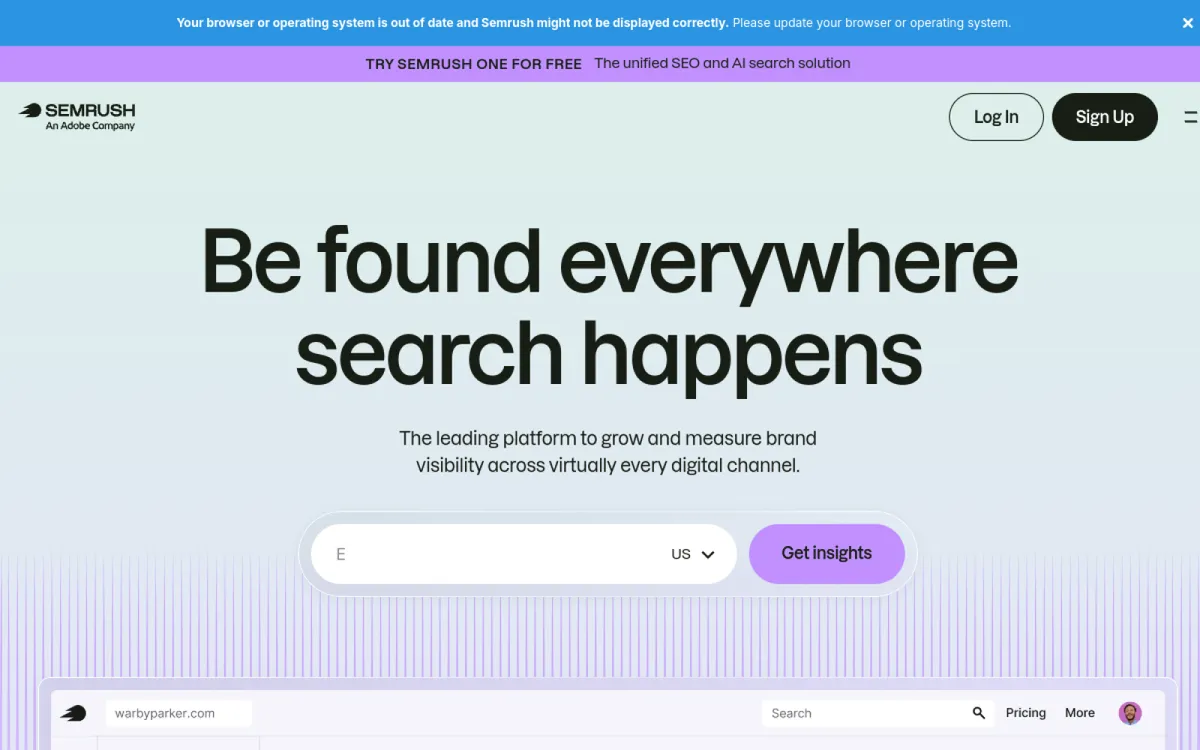
Best for: Marketing teams that want SEO, PPC, and content competitor intel in one subscription | G2: 4.5/5 (~3,300 reviews, Jul 2026)
The all-in-one. Type in a competitor's domain and you get their top organic keywords, estimated traffic, paid search spend, ad copy history, and backlink profile. The Keyword Gap and Backlink Gap tools directly answer "what do they rank for that we don't?" — the single highest-value SEO competitor question. In 2026 Semrush also tracks AI visibility (how often ChatGPT, Perplexity, and Gemini surface each domain), which is quickly becoming its own battleground.
| Detail | Info |
|---|---|
| Pricing | SEO plan $117.33/mo (annual); Starter bundle with AI tracking $165.17/mo; Pro+ $248.17/mo |
| Coverage | Organic keywords, PPC history, backlinks, traffic estimates, AI visibility |
| API | Higher tiers (Advanced) |
| Free trial | Free tier + 7-day trial |
Pros:
- Broadest single-subscription competitor coverage: SEO + PPC + content + AI visibility
- Keyword Gap / Backlink Gap answer the highest-value questions directly
- Position tracking with competitor comparison built in
- Massive review base (G2 4.5, ~3,300 reviews)
Cons:
- Gets expensive as you add seats and add-ons
- Depth per module trails specialists (Ahrefs on links, SpyFu on PPC history)
- Traffic numbers are estimates — directionally useful, not analytics
Website: https://www.semrush.com
Best for: SEO-led teams that care most about backlinks and content gaps | G2: 4.5/5 (~700 reviews, Jul 2026)
Ahrefs runs the second-most active crawler on the web, and it shows in backlink data quality — for "who links to my competitors and not to me," it's the reference tool. Site Explorer on a competitor domain gives you their top pages, keyword movements, and link growth; Content Gap does the rank-comparison job. The $29/mo Starter plan is one of the cheapest real entries into competitor SEO data.
Compared to Semrush it's deeper on links and lighter on PPC intelligence — if paid search spying matters, pair it with SpyFu instead.
| Detail | Info |
|---|---|
| Pricing | Starter $29/mo; Lite $129/mo; Standard $229/mo (annual saves ~17%) |
| Coverage | Backlinks, organic keywords, content gaps, top pages |
| API | Higher tiers |
| Free trial | Free tier (Ahrefs Webmaster Tools) |
Pros:
- Best backlink index in the industry — the link-intersect job is its home turf
- $29 Starter is the cheapest serious entry into competitor SEO data
- Content Gap and Top Pages make competitor content strategy legible
- Clean UX that SEO teams genuinely like
Cons:
- Light on paid-search intelligence
- Costs climb fast beyond Starter as limits bite
- No meaningful social or conversation coverage — it's SEO-only by design
Website: https://ahrefs.com
Best for: Small teams and agencies doing PPC competitor research on a budget | G2: 4.6/5 (~517 reviews, Jul 2026)
The budget pick for paid search. SpyFu's specialty is history: years of competitor Google Ads copy, keyword targeting, and spend estimates, so you can see not just what a competitor bids on today but what they tried and abandoned — which is often the more useful signal. From $39/mo ($29/mo annual) with unlimited searches, it's the cheapest way to answer "what is their PPC strategy?"
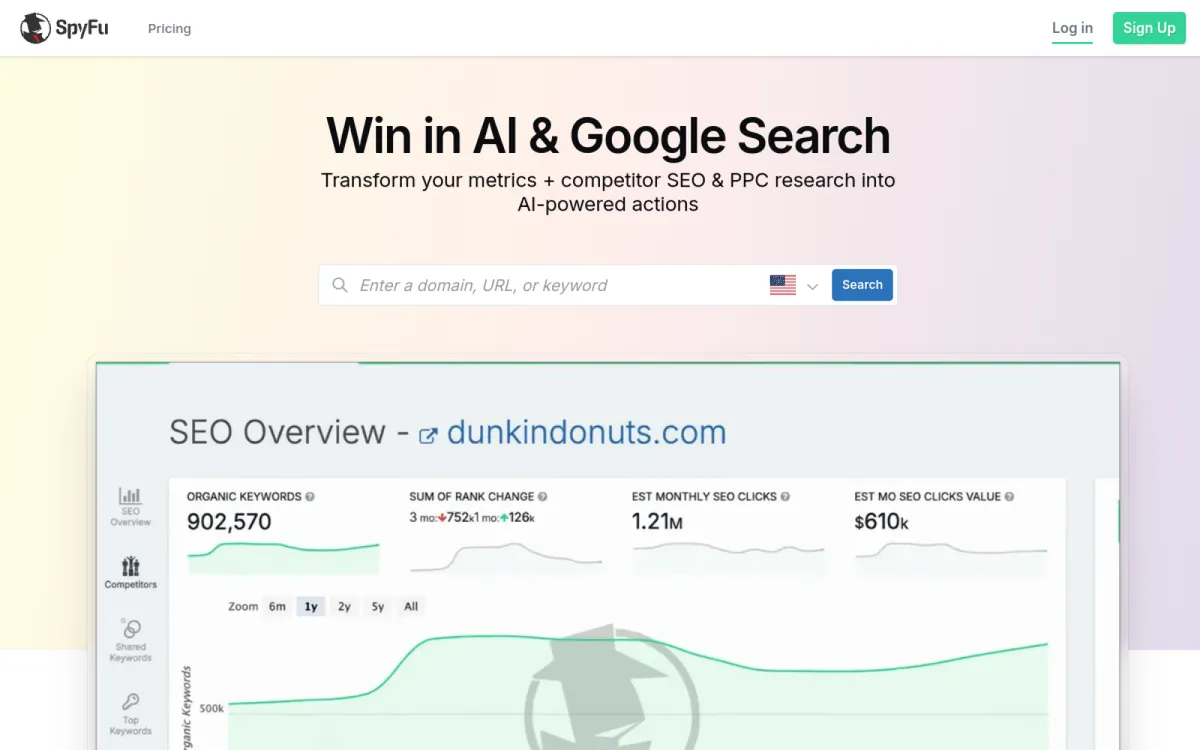
Estimates are estimates: spend and click numbers are directional, not precise, and the SEO side is thinner than Ahrefs or Semrush.
| Detail | Info |
|---|---|
| Pricing | $39/mo ($29/mo annual); Professional $79/mo ($39 annual) |
| Coverage | Google Ads history, keyword targeting, spend estimates, basic SEO |
| API | Yes |
| Free trial | Limited free lookups |
Pros:
- Years of competitor ad history — see what rivals tried and abandoned
- Unlimited searches at every tier; cheapest PPC intel on the list
- G2 4.6 across ~500 reviews — well-liked for its price point
- Simple enough for non-specialists
Cons:
- Spend/click estimates are directional, not audited numbers
- SEO features are secondary — pair with Ahrefs for organic depth
- US/UK-centric data; thinner in other markets
Website: https://www.spyfu.com
Best for: Benchmarking traffic and market share against sizable competitors | G2: 4.4/5 (~1,140 reviews, Jul 2026)
Similarweb estimates any website's traffic, its sources, and its audience overlap with yours — the closest thing to seeing a competitor's analytics. It's become the default sniff test for claims:
"no bro my SimilarWeb extension shows 0 traffic on your site for the past 3 months" — Hacker News
That quote also illustrates the limitation: the data is modeled, and small sites fall below the modeling threshold. For competitors doing meaningful volume the directional trends are solid; for niche B2B products with 10k visits/month, take it with salt.
| Detail | Info |
|---|---|
| Pricing | Free tier; self-serve ~$199/mo; business tiers custom |
| Coverage | Traffic estimates, sources, audience overlap, app data |
| API | Business tiers |
| Free trial | Free tier + trial |
Pros:
- The reference tool for "how big are they really?"
- Traffic-source breakdown reveals competitor channel strategy
- Audience-overlap analysis is unique at this price point
- Free tier covers quick sanity checks
Cons:
- Modeled data — small sites (under ~50k visits/mo) are unreliable or missing
- Meaningful analysis needs paid tiers; enterprise features are custom-priced
- Can't tell you why traffic moved, only that it did
Website: https://www.similarweb.com
The cheapest high-signal monitoring you can set up: watch competitor pricing pages, changelogs, and careers pages, and get told the moment they change. This category is active — people keep building alternatives on top of LLMs, pitching them on Hacker News for exactly this use case ("monitor your competitors… their pricing, products, TOS").
Best for: No-setup website change alerts on pricing pages, changelogs, and careers pages | G2: 4.6/5 (~408 reviews, Jul 2026)
Visualping watches any page — a competitor's pricing page, changelog, careers page — and alerts you when it changes, with AI summaries of what actually changed so a font tweak doesn't page you. Careers pages are the underrated one: engineering job posts telegraph roadmap months ahead.
| Detail | Info |
|---|---|
| Pricing | Free (150 checks/mo); personal from $10/mo; business from ~$100/mo |
| Coverage | Any webpage; visual, text, and element-level monitoring |
| API | Business plans |
| Free trial | Free plan |
Pros:
- Two-minute setup, no technical skills needed
- AI change summaries filter trivial diffs
- Free plan is genuinely useful (150 checks/month)
- G2 4.6 across ~400 reviews; #1 in multiple G2 categories
Cons:
- Business features (API, team workflows) jump to ~$100/mo
- Per-page check model — large-scale monitoring gets costly
- Email-first support on lower tiers
Website: https://visualping.io
Best for: Technical teams that want selector-level page monitoring without a per-page bill | G2: N/A (open source — 32k+ GitHub stars stands in for reviews)
The practitioner favorite. changedetection.io is fully open source — self-host it and competitor page monitoring costs you nothing but a Docker container — or pay $8.99/mo for the hosted version with up to 5,000 URL watches, a real Chrome browser for JavaScript-heavy sites, and 85+ notification integrations. CSS/XPath selectors let you watch exactly the element you care about (a price, a plan name, a version number) instead of the whole page.
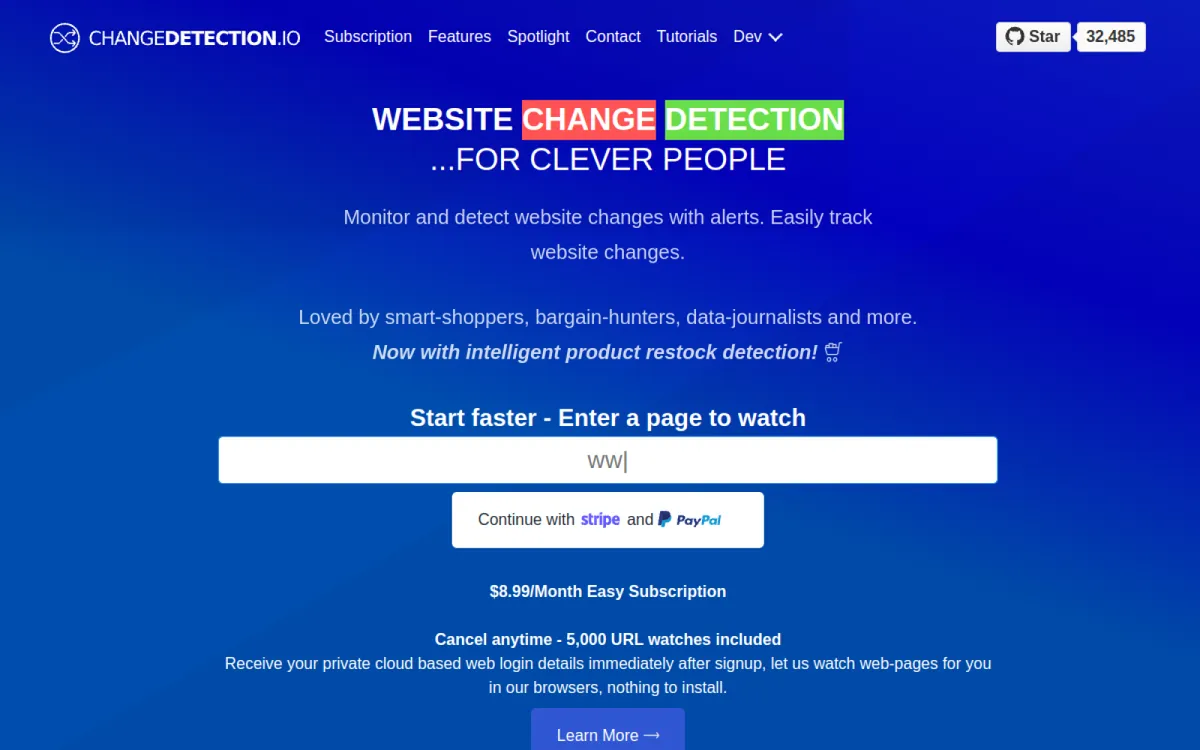
The trade-off is polish: it's a technical tool with a technical UI, and there are no AI summaries or team workflows. For a developer, that's a fair trade for the price and control.
| Detail | Info |
|---|---|
| Pricing | Free (self-hosted, open source); hosted $8.99/mo — 5,000 URL watches |
| Coverage | Any webpage; CSS/XPath selector-level watching; JS rendering via real Chrome |
| API | Yes |
| Free trial | Open source is the trial |
Pros:
- Open source — full control, zero vendor lock-in, self-host for free
- 5,000 watches for $8.99/mo hosted is an order of magnitude cheaper than commercial rivals
- Selector-level precision: watch the price, not the page
- 85+ notification integrations (Slack, Discord, webhooks…)
Cons:
- Technical UI, technical setup — not for non-developers
- No AI summaries, team roles, or audit trails
- Community support only (self-hosted)
Website: https://changedetection.io
Best for: Technically-minded marketers monitoring below-the-surface site changes | G2: 4.7/5 (~52 reviews, Jul 2026)
Hexowatch goes deeper than visual page monitoring: it watches content, HTML source, technology stack, backlinks, sitemaps, and even WHOIS records — 13 monitoring types in total. That makes it the pick when the change you care about isn't visible on the rendered page: a competitor quietly adding a new analytics tool, changing their schema markup, or staging pages appearing in a sitemap.
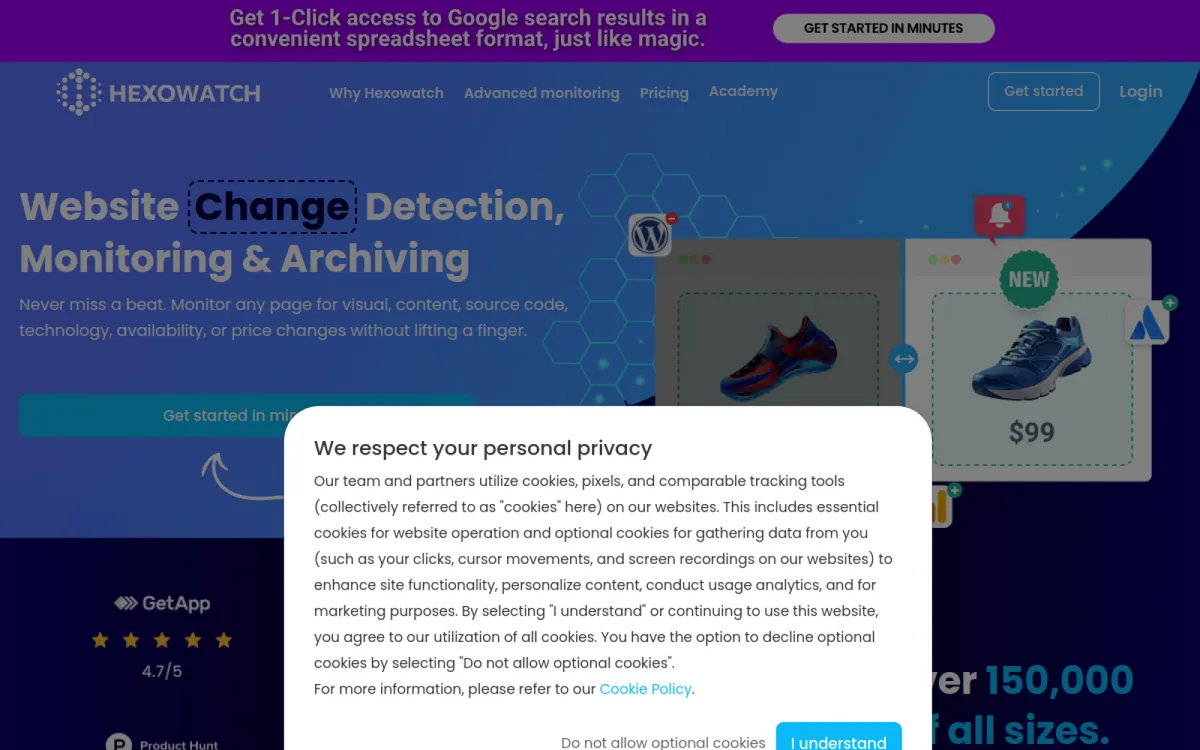
Setup takes more thought than Visualping — choosing the right monitor type per target is on you.
| Detail | Info |
|---|---|
| Pricing | Paid plans from ~$29/mo (Pro; per HubSpot's Jul 2026 roundup — tier prices aren't exposed on-site) |
| Coverage | 13 monitor types: content, source, tech stack, sitemap, WHOIS, backlinks… |
| API | Yes |
| Free trial | 7 days |
Pros:
- Monitors what visual tools can't see: source code, tech stack, sitemaps
- G2 4.7 — small but very happy user base
- Strong automation options (Zapier, webhooks)
- Reasonable entry price for the depth
Cons:
- Pricing not clearly published on-site
- Setup requires knowing which of the 13 monitor types fits each target
- Overkill if all you need is "tell me when the pricing page changes"
Website: https://hexowatch.com
Best for: E-commerce teams tracking price and availability across a catalog | G2: 4.7/5 (~161 reviews, Jul 2026)
If you sell physical products, competitor pricing is the whole game, and doing it by URL-watching doesn't scale to a catalog. Prisync is purpose-built: it tracks competitor prices and stock across thousands of SKUs, with dynamic repricing rules on higher tiers.
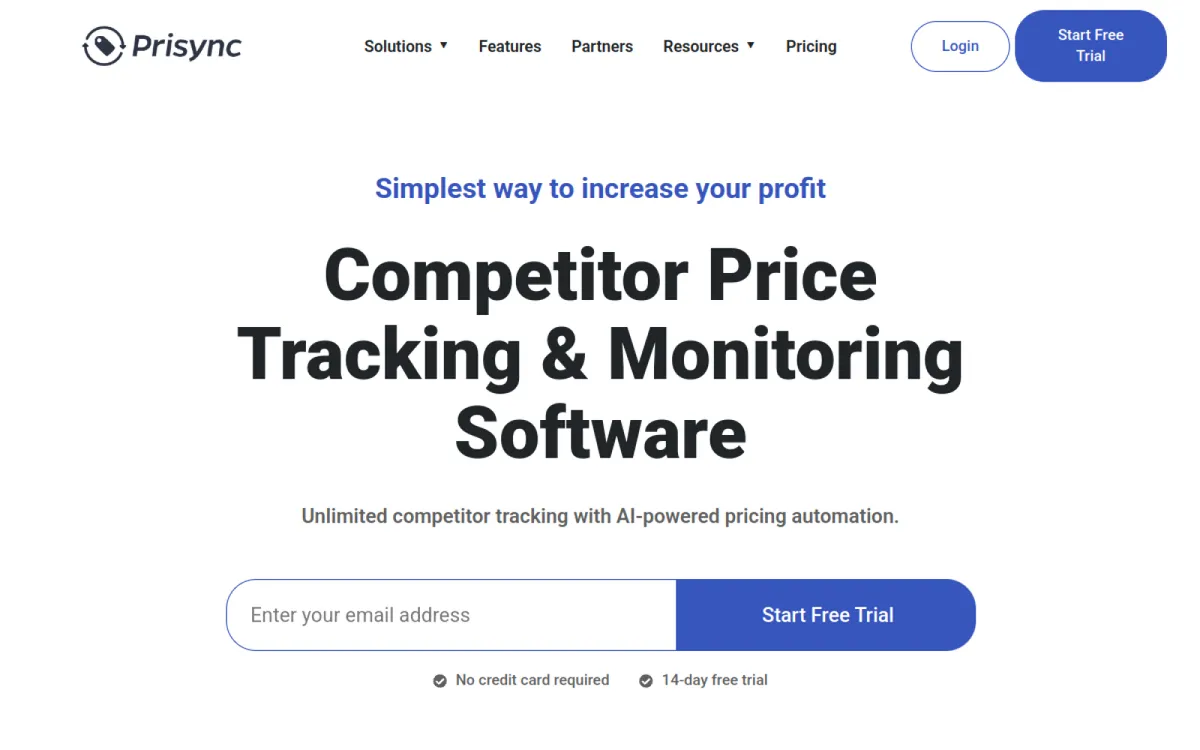
It's an e-commerce specialist — if you're SaaS, Visualping or changedetection.io on pricing pages does the job for a tenth of the price.
| Detail | Info |
|---|---|
| Pricing | URL-based: $99/mo (100 products) → $399/mo (5,000). Channel-based with auto-discovery: from $199/mo. |
| Coverage | Competitor prices + stock across catalogs; dynamic repricing on higher tiers |
| API | +20% add-on |
| Free trial | 14 days, with onboarding |
Pros:
- Catalog-scale price tracking that URL-watchers can't do
- Dynamic repricing automation on Premium+
- G2 4.7 with strong support reviews
- Free onboarding on the trial
Cons:
- E-commerce only — wrong tool for SaaS pricing pages
- Channel-based and hybrid models get expensive fast
- API costs +20% on top of any plan
Website: https://prisync.com
A different question than conversation monitoring: not "what are people saying?" but "how is their content performing against ours?"
Best for: Social teams already in a management suite who want account-level benchmarks | G2: 4.4/5 (~6,400 reviews, Jul 2026)
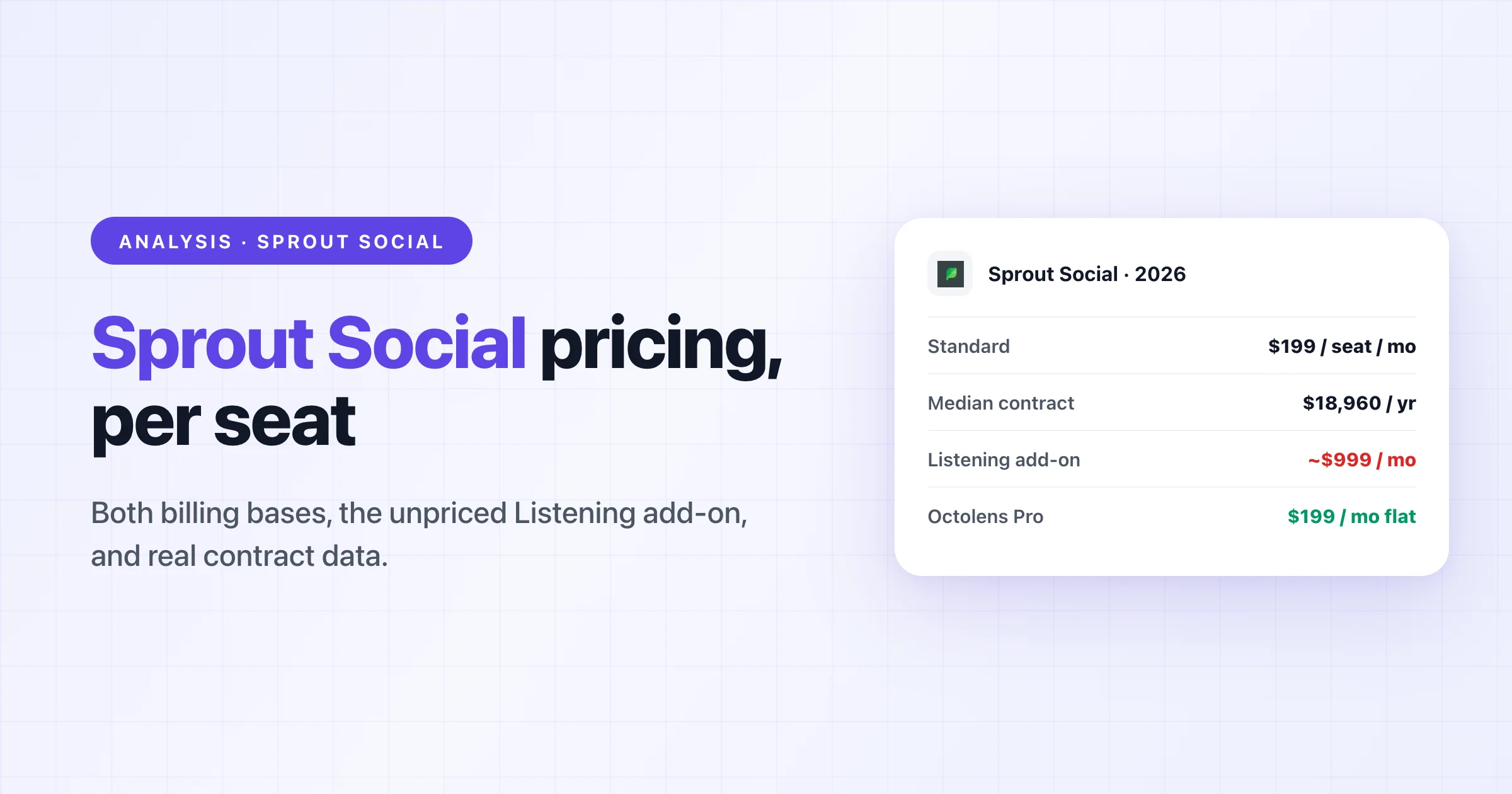
Sprout is a social media management suite whose competitor reports benchmark posting cadence, engagement rates, follower growth, and share of voice, account against account.
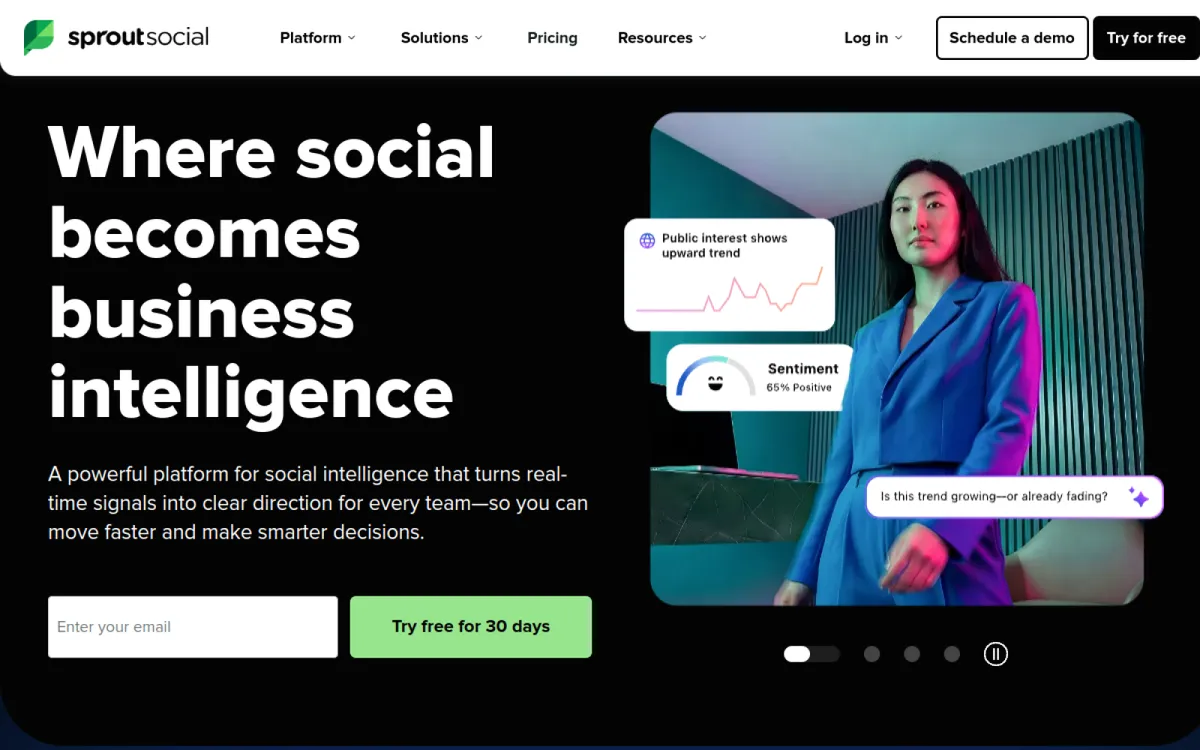
The competitive reports unlock on the Professional plan at $299/seat/mo (annual $199/seat on Standard doesn't include the full set), and deeper listening is a separate add-on. Per-seat pricing compounds fast. If you already run publishing through Sprout it's a natural add; buying it only for competitor benchmarking is expensive. We've compared Sprout Social alternatives if the price makes you flinch.
| Detail | Info |
|---|---|
| Pricing | Standard $199/seat/mo (annual), Professional $299/seat/mo — competitor reports unlock at Professional; Listening is an add-on |
| Coverage | FB, IG, X, LinkedIn, TikTok account benchmarking |
| API | Yes |
| Free trial | 30 days |
Pros:
- Clean, genuinely well-designed competitor reports
- One tool for publishing + engagement + benchmarking
- Huge review base (G2 4.4, ~6,400 reviews)
- 30-day trial is the longest on this list
Cons:
- $299/seat/mo for full competitive reports; listening costs extra on top
- Per-seat model punishes growing teams
- No community/dev-platform coverage — social accounts only
Website: https://sproutsocial.com
Best for: Social and brand teams whose leadership asks "how do we compare?" every month | G2: 4.5/5 (~49 reviews, Jul 2026)
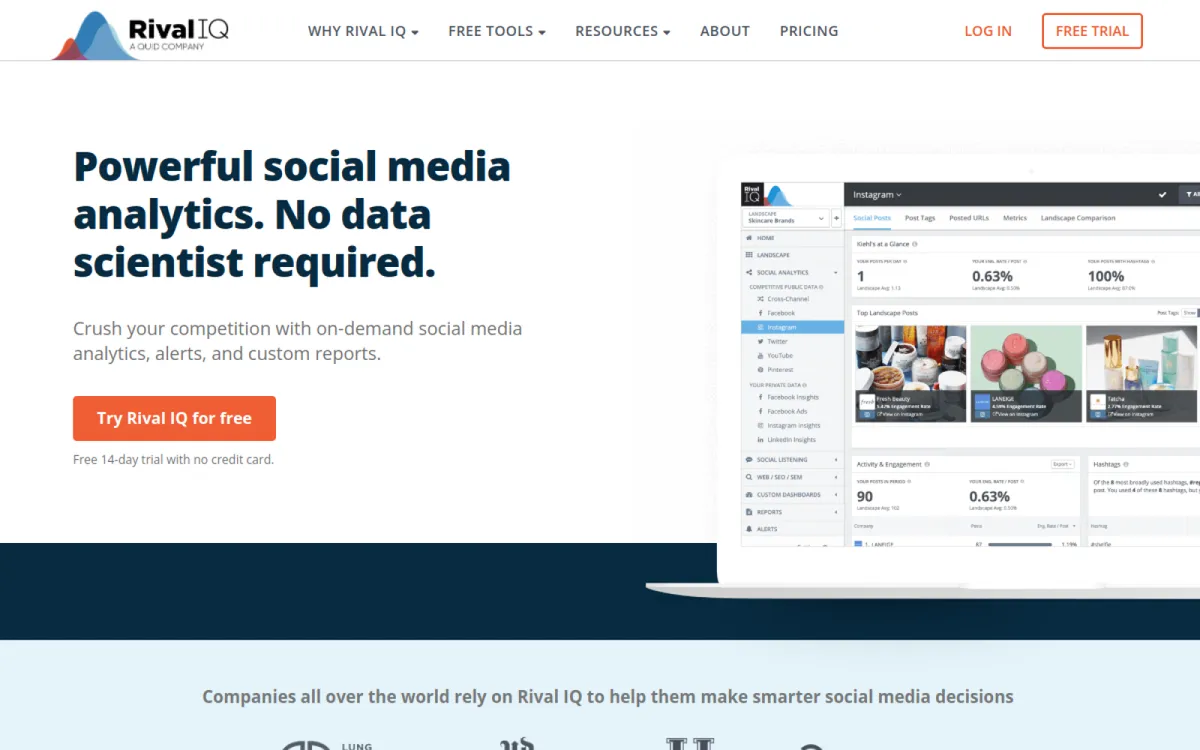
Rival IQ is the benchmarking specialist — it exists specifically to compare social accounts head-to-head. Track up to 10–40 companies (by tier) across Facebook, Instagram, X, LinkedIn, and TikTok, and it surfaces the analysis suites bury: engagement rate benchmarks by industry, detection of competitors' boosted posts, and alerts when a rival's post takes off. Its free industry benchmark reports are a staple in social marketing decks for a reason.
| Detail | Info |
|---|---|
| Pricing | Drive $239/mo (10 companies), Engage $349/mo (20), Engage Pro $559/mo (40); 15% off annual |
| Coverage | FB, IG, X, LinkedIn, TikTok head-to-head benchmarking |
| API | Yes |
| Free trial | 14 days, no card |
Pros:
- Purpose-built for head-to-head benchmarking — depth suites don't match
- Boosted-post detection reveals competitors' paid amplification
- Industry benchmark reports (free) are excellent context
- Alerts when a competitor's content takes off
Cons:
- $239/mo entry is steep for social analytics alone
- Small review base (~49 on G2)
- No conversation/mention monitoring — accounts, not discussions
Website: https://www.rivaliq.com
What competitors spend money on reveals their actual strategy. And it's often the first place you learn you've been noticed, as one founder put it this week:
"You want to know if you are winning? If your competitors are starting to buying your app name on Google Ads, you are winning 😂" — @nerder_
Best for: Performance teams competing in display, native, and programmatic | G2: N/A (few reviews)
Adbeat is the display and native advertising specialist: it monitors 145+ display networks, DSPs, and exchanges plus 29 native ad networks across 35+ countries, showing you competitors' creatives, landing pages, publishers, and (on Enterprise) estimated spend. For the "where are they buying display, and with what message?" question, it's the deepest dataset available at self-serve prices.
| Detail | Info |
|---|---|
| Pricing | Free Basic account; Standard $249/mo; Advanced $399/mo (adds alerts, 12-month history) |
| Coverage | 145+ display networks/DSPs, 29 native networks, 35+ countries |
| API | Higher tiers |
| Free trial | Free Basic + 30-day satisfaction guarantee |
Pros:
- Deepest self-serve display/native dataset available
- Competitor landing pages and publisher placements, not just creatives
- Free Basic account for unlimited browsing
- Transparent pricing — rare in ad intelligence
Cons:
- Display/native only — no social ad depth (pair with BigSpy or the free libraries)
- Spend estimates gated to Enterprise
- Thin public review footprint
Website: https://www.adbeat.com
Best for: Social ad creative research on a shoestring | G2: 4.6/5 (~635 reviews, Jul 2026)
The budget end of ad intelligence: BigSpy is an ad creative search engine across Meta, TikTok, YouTube, Pinterest, and more. Search a competitor's name and browse their current and historical ad creatives — useful less for spend analysis than for creative inspiration and "what offer are they running this month?" checks.
The data is broad rather than deep: don't expect spend estimates or publisher breakdowns at this price.
| Detail | Info |
|---|---|
| Pricing | Free tier; paid from ~$19/mo (per HubSpot's Jul 2026 roundup) |
| Coverage | Meta, TikTok, YouTube, Pinterest + more — creative search |
| API | No |
| Free trial | Free tier |
Pros:
- Cheapest multi-platform ad creative research available
- Big creative database with useful filters (format, CTA, dates)
- G2 4.6 across ~635 reviews
- Free tier covers casual checks
Cons:
- No spend estimates or placement intelligence
- Creative-first: strategy questions need other tools
- UI shows its ad-tech-tool roots
Website: https://bigspy.com
Best for: Startups and small teams that want the whole checklist covered cheaply | G2: N/A (12 reviews, strongly positive)
Competitors.app bundles a bit of everything above — website change tracking, social posts, email campaigns (it signs up to competitor newsletters for you), SEO movements, reviews — into one timeline per competitor, at SMB pricing.
The honest trade-off: it does six jobs at maybe 60% of the depth of each specialist on this list. For a founder or one-person marketing team, that's usually the right trade — one dashboard beats six subscriptions you won't check. Teams with a dedicated owner for any single job will outgrow that slice of it.
| Detail | Info |
|---|---|
| Pricing | Business $14.95/mo, Business Plus $19.95/mo (long-running 50% promo off $39.90); Custom for enterprise |
| Coverage | Site changes, social, competitor newsletters, SEO, reviews — one timeline |
| API | Custom plan |
| Free trial | 15 days |
Pros:
- Absurdly cheap for the breadth ($19.95/mo covers six monitoring jobs)
- Competitor email-campaign tracking is a genuinely rare feature
- One timeline per competitor beats six dashboards for small teams
- White-label reports on Business Plus
Cons:
- ~60% of specialist depth in each area
- Tiny review footprint — less independent validation
- LinkedIn tracking costs extra per competitor
Website: https://competitors.app
Best for: Tracking competitors' business moves — funding, M&A, exec changes — for free or cheap | G2: 4.3/5 (~480 reviews, Jul 2026)
Owler is company intelligence rather than marketing intelligence: crowdsourced and aggregated data on 15M+ companies — funding rounds, acquisitions, leadership changes, revenue estimates — with daily news alerts per company you follow. It answers "what is happening to this company?" rather than "what is their marketing doing?", which makes it a good complement to everything else here, especially for sales teams and emerging-competitor watching.
| Detail | Info |
|---|---|
| Pricing | Free Community tier; Pro $39/user/mo (annual); Max custom (team deployments) |
| Coverage | 15M+ company profiles: funding, M&A, leadership, revenue estimates, news |
| API | Max tier |
| Free trial | Free tier |
Pros:
- The free tier genuinely covers basic competitor-news alerting
- Funding/M&A/exec-change signals no marketing tool captures
- Big community-validated dataset (G2 4.3, ~480 reviews)
- Cheap Pro tier for daily digests
Cons:
- Revenue estimates are crowdsourced — treat as rough
- No marketing-signal depth (content, ads, SEO)
- Team features gated to custom-priced Max
Website: https://www.owler.com
The newest job on this list: when someone asks ChatGPT or Perplexity "what's the best tool for X," is the answer you or your competitor? The category barely existed two years ago:
"We track 80 tools in this category. 84% were founded after 2020… Profound (2024) and Peec AI (2025) prove the point: in a market this young, being early counts for more than being big." — @rankmyai
Methodologies are still settling — treat the numbers as trend lines, not gospel. But if your buyers research via AI assistants (increasingly: yes), not watching this is the 2026 version of ignoring Google rankings in 2010. We've written about the flip side — how to get your brand mentioned in ChatGPT.
Best for: Marketing teams that want an affordable first AI-visibility tracker | G2: N/A (few reviews; 9.7+ sub-scores for setup and support)
Otterly tracks your prompts daily across ChatGPT, Google AI Overviews, Perplexity, and Copilot, and reports who gets mentioned, who gets cited, and how sentiment compares — the AI-era equivalent of rank tracking. It's the accessible entry point to the category: cheap enough to start measuring this quarter without a procurement cycle.
| Detail | Info |
|---|---|
| Pricing | Lite $29/mo (15 prompts); Standard $189/mo (100 prompts, API + MCP); Premium $489/mo (400 prompts) |
| Coverage | ChatGPT, Google AI Overviews, Perplexity, MS Copilot; add-on engines extra |
| API | From $189/mo (incl. MCP) |
| Free trial | Yes |
Pros:
- $29 entry — the cheapest way to start tracking AI visibility
- Daily tracking with unlimited team members on all tiers
- API and MCP access at mid tier
- G2 reviewers consistently praise setup speed
Cons:
- Prompt limits bite fast (15 on Lite); extra prompts $99/100
- Additional AI engines (Claude, Gemini) cost extra
- Young category — methodology still maturing (true of every tool here)
Website: https://otterly.ai
Best for: Teams treating AI search as a channel, with competitor share-of-voice as a KPI | G2: 4.9/5 (11 reviews, Jul 2026)
Peec is the analytics-heavy pick in the category, tracking visibility, sources, and competitor share across ChatGPT, Perplexity, Gemini, Copilot, and Google AI Overviews, with API and MCP access on higher tiers. Full disclosure: we're a paying Peec customer at Octolens — it's the measurement layer for our own AI search work, so this entry is written from daily use. Their research output is also unusually strong for a young company:
"Peec AI is producing some of the sharpest LLM research in the industry." — @jabezreuben
Worth noting the category's price sensitivity: a recent Show HN launched a free bring-your-own-keys tracker specifically because "all the AI tracking services were charging" too much — if you just want a monthly sanity check, DIY works; if you want daily competitive tracking, this is the depth pick.
| Detail | Info |
|---|---|
| Pricing | Starter ~€89–95/mo; Pro and Advanced scale by projects/countries; Enterprise custom |
| Coverage | ChatGPT, Perplexity, Gemini, Copilot, AI Overviews; source/citation analytics |
| API | Higher tiers (incl. MCP) |
| Free trial | Yes |
Pros:
- Deepest source/citation analytics in the category — see why AI cites competitors
- Competitor share-of-voice tracking across five AI engines
- G2 4.9 with reviewers citing data quality and founder-level support
- Ships research that actually advances the field (we read it; you should too)
Cons:
- Pricier than Otterly at entry
- Small review base — the category is two years old
- Daily prompt tracking means costs scale with ambition
Website: https://peec.ai
Before you pay for anything, four free sources cover the basics:
- Google Alerts — web mentions of competitor names. Misses most of social and all community platforms, but it's free and takes two minutes.
- Meta Ad Library and Google Ads Transparency Center — every ad your competitor currently runs on Meta and Google, free, no account needed. This is the single most underused competitor research source on the internet.
- changedetection.io self-hosted — full page-change monitoring for the cost of a Docker container (see #13).
- DIY with AI — practitioners increasingly script it. One workflow making the rounds: "open tabs for the 3-4 competitor sites or listing pages you track… 'Visit each open tab, summarize any changes since Friday in 1 sentence each, flag new pricing or listings specifically.'" It works until the day you forget to run it — which is the argument for tools with alerts.
A lot of the lists in this space are now titled "AI competitor analysis tools," so it's worth being concrete about what the AI label means, because it's a different thing in each category on this page.
In conversation monitoring, the AI is relevance filtering and sentiment: every competitor mention gets scored against your company context, which is what makes tracking a common-word competitor name workable at all. That's the part Octolens automates — real-time competitor intelligence from public conversations, without someone triaging a raw keyword feed. In the battlecard platforms, the AI generates insight summaries and win/loss analysis from the signals your PMM curates — Klue and Crayon have both leaned hard into this. AlphaSense applies AI summarization to filings and earnings calls. And Otterly.AI and Peec AI point the lens the other way: they analyze what the AI assistants themselves say about your market.
What the AI doesn't do, in any of these tools, is make the call. It automates collection and triage — which mentions matter, what changed, what a quarter of earnings calls said about a roadmap. Deciding what your team does about it stays human, and the practitioner quote earlier in this page is what happens when teams forget that: licensed tools, stale intel, because nobody owned the analysis.
The practical takeaway: if you want to automate competitor intelligence workflows, look at how the data leaves the tool, because that's where automation actually happens. Octolens exposes competitor mentions through API, webhooks, and MCP on every plan, which means an agent can classify mentions into tickets, enrich a CRM when someone asks for alternatives to a competitor, or draft a weekly competitor brief, which is where the automation actually pays off.
Match the tool to the job that actually changes your decisions:
- You want to know what customers say about competitors (and catch switchers): Octolens. This is us, so start the free trial and judge the mention quality yourself within a day — that's a better test than anything I can write here. Awario if budget is the constraint and mainstream social is enough; Brandwatch if you're a global consumer brand with an analyst team and a six-figure budget.
- Your sales team keeps losing to the same competitor: Klue, if you have someone to own it and five figures of budget. Crayon for a broader CI program, Contify if intelligence spans multiple teams, AlphaSense if the questions are strategic rather than deal-level. If none of that budget exists, a Slack channel fed by conversation monitoring plus Visualping on their pricing page gets you 70% of the value for 3% of the price.
- You compete on Google: Semrush if you want breadth, Ahrefs if links and content gaps matter most, SpyFu if it's mostly PPC and budget is tight, Similarweb for the traffic-level view.
- You want to know the moment their site changes: Visualping for no-setup alerts, changedetection.io if you're technical and want it free, Hexowatch for below-the-surface changes, Prisync if it's a product catalog.
- You compete on paid social and display: Adbeat for the deep display dataset, BigSpy plus the free ad libraries for creative research.
- You're a solo founder: Competitors.app plus the free stack and Owler's free tier, then graduate to specialists as specific jobs start to matter.
- Your buyers ask ChatGPT for recommendations: start with Otterly, or go straight to Peec if AI share-of-voice will be a tracked KPI.
Most teams that take this seriously end up with two or three of these, not one — typically conversation monitoring + website changes + one search tool. If you're still deciding what to monitor before picking tools, our guide to competitor monitoring covers the workflow: what signals matter, what's vanity, and a weekly routine that doesn't eat your calendar.
And if your scope is your own brand rather than competitors, we've ranked the best brand monitoring tools and best social media monitoring tools the same way — real prices, honest cons, no "contact sales" hand-waving.