Competitor Social Media Monitoring: The Insider's Guide
Building Your Competitor Intelligence Foundation

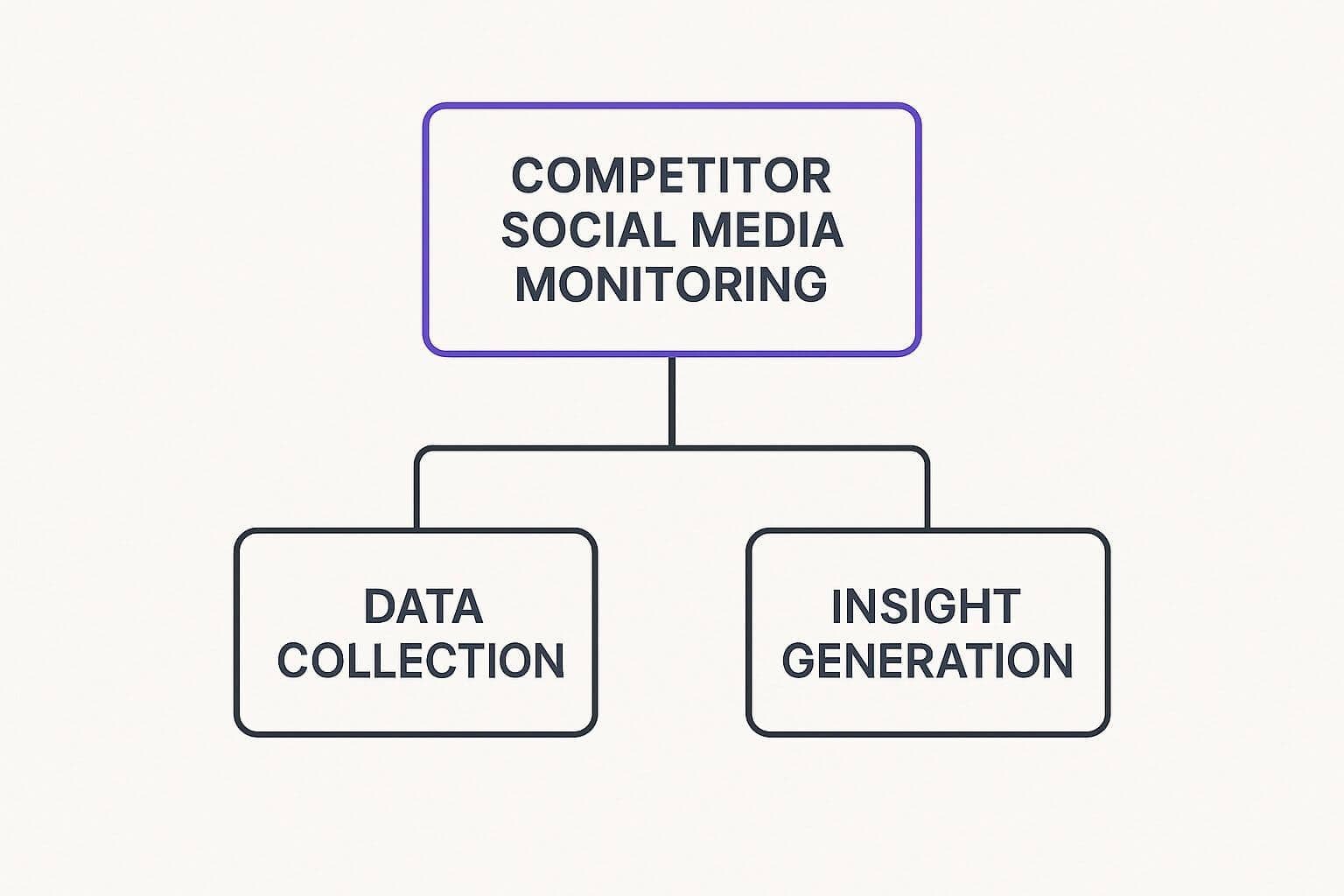
This infographic nicely visualizes the core components of competitor social media monitoring: data collection and insight generation. It really boils down to gathering the right data and turning it into usable knowledge. Let me share some tips on building that foundation. Many brands fixate on their obvious competitors—the ones everyone in the industry knows. But that’s only part of the story. Real competitor intelligence comes from understanding the entire playing field.

I like to think of competitors in three categories: direct, indirect, and emerging. Direct competitors offer nearly identical products or services to the same audience as you. Indirect competitors might offer different products, but they solve the same customer problem.
Think of it this way: if you sell project management software, a direct competitor would be another project management platform like Asana. An indirect competitor, however, could be a team collaboration tool like Slack or even a powerful spreadsheet software like Google Sheets.
And don't forget those emerging competitors – the disruptive startups that seem to appear out of nowhere! Keeping an eye on them can prevent you from being blindsided down the road. This broader view gives you a much more complete picture of what's happening in your market.
So, how do you actually find these competitors? Keyword research is a great starting point. Look at who's ranking for your target keywords in search engines and who’s using them on social media. Industry reports and online forums are goldmines of information too.
Don't underestimate the power of your sales team, either. They’re talking to customers every day and hearing firsthand about which other solutions they're considering. Tools like Hootsuite Analytics offer robust competitor analysis features. You can track up to 20 competitor profiles per network and get valuable insights into their top-performing content and hashtags. Here’s a resource that I’ve found useful for deeper social media stats: Discover more insights.
To help you prioritize your monitoring efforts, I've put together a handy table:
Competitor Categories and Monitoring Priorities
A breakdown of different competitor types and how much attention each deserves in your monitoring strategy
Competitor Type Examples Monitoring Frequency Key Metrics Direct Companies offering similar products to the same audience (e.g., Coke vs. Pepsi) High (Daily/Weekly) Pricing, product features, marketing campaigns, social engagement Indirect Companies offering different products that fulfill the same need (e.g., Netflix vs. YouTube) Medium (Weekly/Monthly) Content strategy, audience engagement, brand perception Emerging New or rapidly growing companies with disruptive potential Medium (Weekly/Monthly) Product innovation, marketing tactics, audience growth
This table illustrates how you can adjust your monitoring frequency and the metrics you focus on based on the type of competitor. Direct competitors need closer attention, while indirect and emerging competitors can be monitored less frequently.
Once you’ve identified your competitors, set clear monitoring goals. What are you hoping to achieve? Are you trying to understand competitor pricing strategies? Track their campaign performance? Identify emerging industry trends? Your goals should always align with your overall business objectives. For example, if your goal is to increase market share, you’ll likely want to prioritize monitoring competitor pricing and promotional activities.
Laying this groundwork—identifying all your competitors and setting clear goals—is essential for effective competitor social media monitoring. Without it, you risk wasting time and resources tracking the wrong data. Next, we'll discuss choosing the right monitoring tools.

Having personally wrestled with dozens of competitor social media monitoring platforms, I can tell you firsthand: flashy dashboards don't always equal useful information. Some pricey enterprise-level platforms are bloated with features you'll never touch. Meanwhile, some budget-friendly options pack a surprising punch.
Before diving into specific tools, take stock of your current social media presence. A solid social media audit checklist is a great starting point. Your tool choices should match your unique goals and resources.
For example, if you're primarily using Twitter, Reddit, and Linkedin for competitor social media monitoring, a specialized tool like Octolens, which offers AI-powered Twitter monitoring features, might be a perfect fit. You can dig deeper into this in our article about Twitter monitoring.
Don't feel like you have to commit to one big, all-in-one platform right off the bat. Plenty of successful brands strategically mix and match tools. This lets them build a really thorough monitoring system without emptying their wallets.
I've seen this approach work wonders, especially for smaller teams or tighter budgets. Begin with a few essential tools covering your most immediate needs, maybe content performance analysis or sentiment tracking. As your strategy evolves, you can gradually add more specialized tools.
Remember, competitor social media monitoring isn't about amassing mountains of data. It's about extracting actionable insights to fine-tune your strategy.
Let's say a competitor's campaign suddenly goes viral. Don't just track the numbers. Go deeper. Figure out why it resonated with their audience. Was it the message itself? The timing? The platform they chose?
This type of in-depth analysis can uncover opportunities to improve your own campaigns. It's not enough to just see what your competitors are doing. You need to understand why they're doing it, and how you can adapt those learnings to your own business. That’s where the real competitive edge comes from.

Effective competitor social media monitoring isn't about chasing vanity metrics. It’s about truly understanding what each platform offers and picking up on the signals that actually move the needle. A thousand likes on a feel-good Instagram post doesn't always translate to business results. You need to go deeper.
For example, on LinkedIn, meaningful engagement often comes down to thought leadership and industry conversations. If a competitor consistently sparks comments and shares on insightful articles, they might be building serious clout with your target audience. This intel is pure gold for shaping your own content strategy. Speaking of which, you might find our guide on social network selection helpful.
Now, switch gears to TikTok. This platform thrives on short-form video content and viral trends. High engagement here could mean a competitor knows how to grab attention with entertaining content, but it doesn't guarantee they can turn those views into sales. This is why tailoring your monitoring approach to each platform is so important. Don't get me wrong, going viral can be awesome, but you need to see the difference between a flash in the pan and a real, sustainable competitive advantage.
In 2025, platforms like TikTok stand out with high engagement rates, averaging 2.50%. That’s a huge leap compared to Facebook and X (formerly Twitter), both hovering around 0.15% engagement. It just shows how platform dynamics really shape those engagement metrics. Want to dive deeper into this? Discover more insights.
One practical tip? Analyze your competitors' content formats. Are their video tutorials sending traffic to product pages? Are their LinkedIn polls generating leads? By figuring out what content formats actually deliver business results for your competitors, you’ll unlock valuable lessons for your own content strategy. And having the right tools makes all the difference. If you’re just getting started, check out this helpful article on Social Media Management Tools.
Competitor social media monitoring also gives you a heads-up on emerging trends. By tracking hashtags, keywords, and topics gaining traction with your competitors' audiences, you can anticipate changes in customer preferences and adapt your strategy before everyone else. This proactive approach can be a game-changer in today’s fast-moving market. Plus, monitoring can uncover competitive threats, like new product launches or partnerships, giving you time to react strategically.
So, you're monitoring your competitors on social media. Great! But are you just skimming the surface, seeing their posts and calling it a day? True competitor analysis goes way beyond that. It's about uncovering their advertising strategies – the real secret sauce. Think of yourself as a digital detective, piecing together clues to understand their every move.
One of the most fascinating aspects of this detective work is spotting A/B testing patterns. Competitors are constantly tweaking their ads. Look closely for small variations in their copy, visuals, and targeting. Are they trying out different headlines? Testing different calls to action? These subtle shifts are gold. They reveal what your competitors are trying to optimize and what resonates with their audience. For example, I once noticed a competitor constantly testing different discount offers. This told me loud and clear that pricing sensitivity was a major factor for their target market. A valuable insight I could then use in my own strategy.
Another crucial piece of the puzzle is understanding their targeting strategies. I've even found knowing how they are using automation on professional platforms, like LinkedIn Automation, has provided insights into what clients they are focusing on. Analyze who they're trying to reach – the demographics, interests, and behaviors they're targeting with their ads. This reveals which customer segments they’re prioritizing. And then there’s the thrill of spotting campaign launches before they even hit the mainstream. It's like getting a sneak peek at their playbook! Look for sudden jumps in ad spend, brand new creative assets, and changes in targeting. That early detection gives you precious time to prepare your own competitive response.
Keeping an eye on ad spend patterns is key too. Track how much they're investing on different platforms and campaigns over time. This gives you a sense of where they see the most value. Combine this with analyzing their creative performance. What ad formats and messaging are driving the most engagement and conversions for them? This unveils their winning strategies. It's worth noting, by the way, that social media ad spend is exploding. Projections show a 9.37% annual growth rate until 2030, with almost three in ten marketing dollars going to social media. Pretty significant, right? Check out more stats here.
To help you understand different tracking methods, I've put together a handy table:
Platform-Specific Ad Monitoring Techniques
Different approaches for tracking competitor advertising across major social media platforms
Platform Native Tools Third-Party Options Key Metrics to Track Facebook Facebook Ad Library Brandwatch, SproutSocial Ad spend, reach, engagement, impressions Twitter Twitter Analytics Octolens Mentions, Retweets, Likes Reddit N/A Octolens, F5bot Comments, Upvotes LinkedIn LinkedIn Campaign Manager Octolens Impressions, clicks, engagement, lead generation
This table summarizes some of the most common tools and metrics you'll want to explore. Each platform offers its own unique insights, so experiment to see what works best for you.
Here's the real power of competitor advertising intelligence: identifying gaps in their coverage. Are they missing out on certain platforms? Neglecting specific audience segments? These gaps are golden opportunities for you to reach untapped markets. And finally, use all this intel to time your own campaigns strategically. Consider launching your campaigns when competitors are quiet or targeting segments they're overlooking. This maximizes your impact and minimizes direct competition.
By mastering these techniques, you transform competitor social media monitoring from passive observation into active advertising intelligence. This empowers you to make informed decisions, optimize your strategies, and ultimately, gain a significant competitive edge.

Anyone can tally likes and shares. But to really understand what a competitor's social media campaign is doing, you need to dig deeper. It's about going beyond those surface metrics and looking at the quality of the engagement and the overall sentiment. This is where competitor social media monitoring gets interesting.
Think about it: a post might have thousands of likes, but if those likes aren't turning into website visits, purchases, or sign-ups, what's the point? I saw this happen firsthand with a competitor. Their Twitter campaign was blowing up, but their website traffic was completely flat. When I looked closer, I realized their campaign messaging, while funny, wasn't actually relevant to their product. Lots of noise, zero impact. This illustrates the critical difference between social buzz and tangible results. Don't get caught up in vanity metrics. Focus on the engagement that moves the needle.
Share of voice is another crucial element. This isn't just about how many times a competitor is mentioned. It's about understanding how their messaging is shaping the wider conversation. Are they setting the agenda? Are they influencing key opinion leaders? Are they controlling the narrative? Tools like Prowly offer media monitoring features for tracking things like mentions, retweets, and sentiment. This offers a real peek into how competitors are perceived and how effective their campaigns really are. Prowly's competitive monitoring guide dives into this further. Also, consider the context of those mentions. Lots of negative mentions? Could be a PR nightmare brewing. Lots of positive mentions with relevant hashtags? Maybe they launched a successful campaign.
Tracking campaign sentiment over time is key. This means analyzing the emotional tone of conversations related to the campaign. Are people excited, skeptical, or angry? Sustained positive sentiment is a good sign. A sudden drop in sentiment, though, could signal a problem. Remember, sentiment can shift quickly on social media, so keeping an eye on it constantly is crucial. And figuring out which specific messages are driving positive or negative sentiment is gold. This highlights the strengths and weaknesses of the campaign, allowing you to adjust your own strategies accordingly.
Finally, create frameworks that tie campaign performance to real business outcomes. How does campaign performance relate to website traffic, leads, or sales? Making these connections keeps your monitoring efforts laser-focused on what truly matters to your business. By honing these analytical skills, you can go beyond simple data collection and extract actionable insights. This knowledge is incredibly valuable for shaping your own social media strategy and gaining a competitive edge.
Competitor social media monitoring isn't about hoarding data. It's about turning that data into a real competitive edge. Think of it like scouting the other team before a big game. You're not just watching them play; you’re analyzing their strengths and weaknesses to inform your own strategy.
Data without action is just a fancy report. I've seen brands invest heavily in monitoring tools like SproutSocial only to let the insights sit unused. Don't make that mistake. The key is to translate your observations into actionable strategies.
For example, let's say your monitoring reveals a competitor is struggling with engagement on Instagram. Don't just celebrate. Ask why. Is their content boring? Are they missing key trends? Are they ignoring a segment of their audience?
Once you understand the why, you can use it to your advantage. Maybe you create content that speaks directly to the audience they're neglecting. Or perhaps you capitalize on the trends they’re missing. For more ideas on leveraging this data, check out this helpful resource: Competitor Monitoring to Grow Your SaaS.
Another great tactic is adapting successful competitor strategies to your own brand. I’m not suggesting you copy them outright – that's never a good idea. Instead, analyze why their tactics work and apply those principles to your own unique approach.
For instance, if a competitor’s humor is killing it on Twitter, consider how you can use humor in a way that feels authentic to your brand. Maybe witty Instagram stories or humorous blog posts that resonate with your target audience?
Timing is crucial. Knowing when to respond can make all the difference. A competitor launches a new product? You could counter immediately or wait, observe, gather intel, and launch a more targeted response later.
Similarly, if a competitor has a PR mishap on social media, you could offer a contrasting message of support and empathy. But be cautious. Capitalizing on misfortune can backfire if it seems opportunistic.
Competitor monitoring can also reveal market gaps and underserved audiences. Maybe your competitors all focus on one demographic, leaving another untapped. That's a golden opportunity to tailor your messaging to that neglected audience. Careful analysis can uncover hidden needs and position your brand as the solution.
Once you've identified those gaps, create content that addresses unmet needs. This could be blog posts, videos, or social media updates offering valuable information to the audience your competitors are ignoring. Or even new products or services! This targeted approach can give you a real edge, allowing you to capture market share and become an industry leader.
So, let's talk shop. How do you actually monitor your competitors on social media without it taking over your life? I've been there, pulling my hair out trying to keep up with everything. The secret? A system that works for you, your business, and your resources.
Don't try to do everything at once. Start small, get comfortable, then build it up. If you're a small business, a simple daily checklist might look like this:
- Check mentions of your brand and your biggest competitors on the main platforms (think Twitter, Reddit, Linkedin).
- Look for relevant industry hashtags. What are people talking about?
- Respond to any direct questions or comments. Engagement is key!
As your business grows, so can your monitoring. A weekly checklist could include:
- Analyzing how your competitors' campaigns are performing (engagement, reach, sentiment). What's working for them? What's not?
- Keeping tabs on their ad activity. Are they running new campaigns? Have they changed their targeting?
- Spotting emerging trends and important industry conversations. Where is the market heading?
- Summarizing key insights and sharing them with your team. Knowledge is power!
Larger companies might need even more detailed daily and weekly checklists. Think deeper analysis and more frequent reporting. Realistically, a basic system can take a week or two to set up. Something more sophisticated? Maybe a few months. It really depends on your team and how complex your market is.
Now, what do you do with all that juicy competitive intel? A simple spreadsheet can work wonders. Seriously. Create columns for the competitor's name, platform, date, key metrics, and any interesting observations.
For sharing insights, I like to use a template. Mine usually includes a quick summary of the main findings, actionable recommendations (what should we do with this information?), and the data to back it all up.
Don't let those insights sit in a folder somewhere! Share the wealth! The sales team can use competitive intelligence to tailor their pitches. The product team can learn from competitor launches. Marketing can refine their content strategy based on what's resonating with competitor audiences. Regular updates, even short email summaries, keep everyone in the loop.
How do you know if your competitor monitoring is actually working? Define clear benchmarks and track your progress. Are you gaining market share? Is your own social media engagement improving? Are you spotting competitive threats early enough to react effectively? These are the tangible results that prove the value of your monitoring efforts.
Ready to level up your competitor monitoring and gain a real edge? Octolens can help you automate the whole process, so you can focus on the insights that actually matter. Give it a shot!