

I'm one of the two founders of Octolens, so I'm not neutral here. People compare Syften and Octolens a lot, and we do compete for some of the same customers, but the two tools are built for different jobs. I set up both with the same keywords and wrote down what happened.
My Syften facts come from Syften's public pricing page and docs, a Syften PRO trial I set up on October 14 with the keywords we track in Octolens, and public threads where Syften's founder and users talk about it (all linked). The Syften screenshots come from that trial account and the Octolens ones from our own workspace. I masked people's names and handles in both. Prices are as of October 14, 2026.
TL;DR
Syften is a fast, precise and cheap keyword alert tool. It suits founders and small teams who want Reddit, Hacker News, forum and Slack-community mentions within about a minute and don't mind writing their own filters. Octolens costs more and refreshes hourly on its entry plan. In exchange you get LinkedIn, X, TikTok and YouTube without add-ons, relevance and sentiment scoring on every mention, and the API, webhooks and MCP server on every plan. Syften is the better deal if alerts are all you need. Octolens makes more sense once mentions have to flow into your team's tools and your agents.
Part 1: How each tool finds mentions
How Syften works
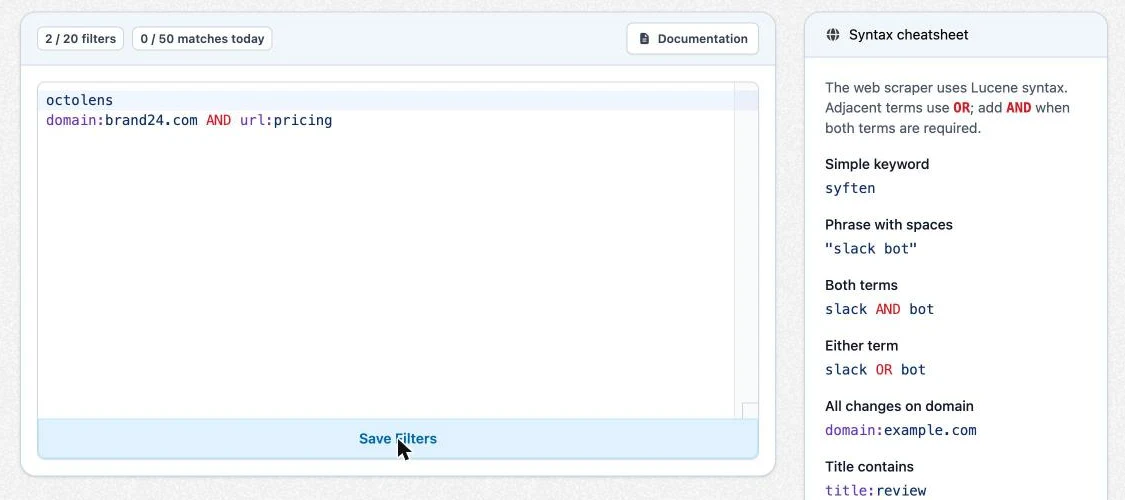
Syften is built around filters. A filter is a search rule you write yourself, listing the words, phrases, domains, authors and exclusions that decide whether a new post counts. The syntax goes deep: site: limits a filter to one subreddit, type: matches only posts or only comments, author: follows one account, lang: requires a language, and NOT excludes terms. Syften checks every new item from the communities it watches against your filters and sends matches to email, Slack, RSS, the API or a webhook.
Syften's pricing splits sources into three buckets, and the split comes up again throughout this comparison:
- Communities: Reddit, Hacker News, forums, Stack Exchange, Indie Hackers, GitHub comments, public Slack communities, Product Hunt, Bluesky, Mastodon, Lobste.rs, Dev.to, some tech newsletters, and podcasts (Syften transcribes around 35,000 episodes a day). Every plan covers these.
- Web: public pages such as articles, changelogs, docs and competitors' blogs. You search them with a separate Lucene-style syntax, and the limits are much lower.
- Add-ons: X costs $40/month for 1,000 tweets a month (the in-app screen says 30 tweets a day), and YouTube costs $20/month. Neither is on the Entry plan, and both ask for a credit card even during the trial.
Standard and PRO add an AI filtering step. After a filter matches, you can add an $accept: rule written as a prompt, like "true if the post mentions Acme the product, even briefly; false otherwise". Syften then asks a model to accept or reject each match before it goes to Slack or email. Rejected matches still show up in the archive and the API.
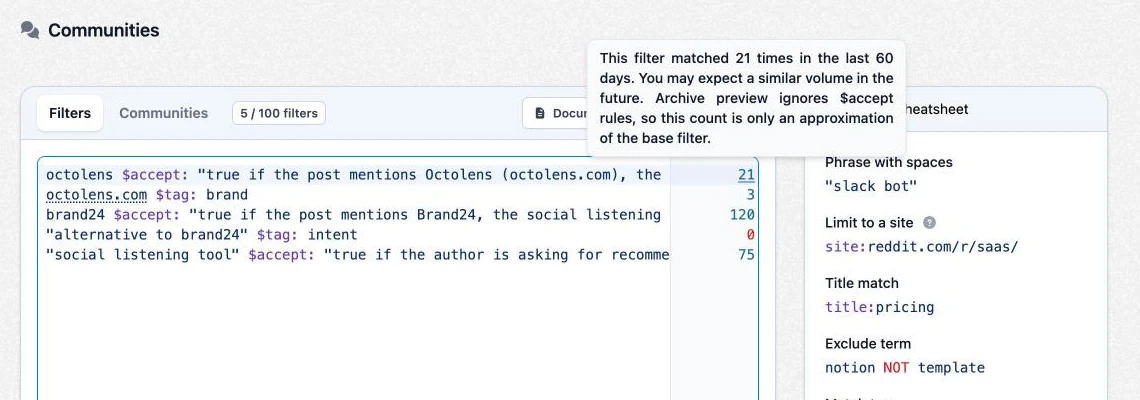
Saving a filter shows you how often it matched over the last 60 days, and clicking the number opens an archive preview with a chart and a source breakdown. I liked that for sanity-checking a filter before it starts sending alerts. One problem I hit right away is that the preview ignores your $accept rules, so the count covers the raw keyword match and AI filtering only applies to live notifications.
How Octolens works
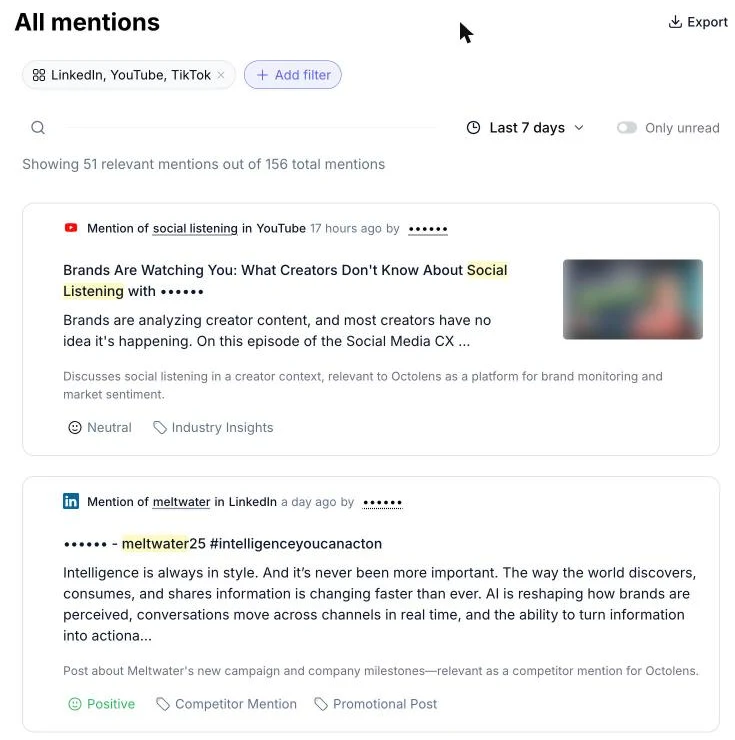
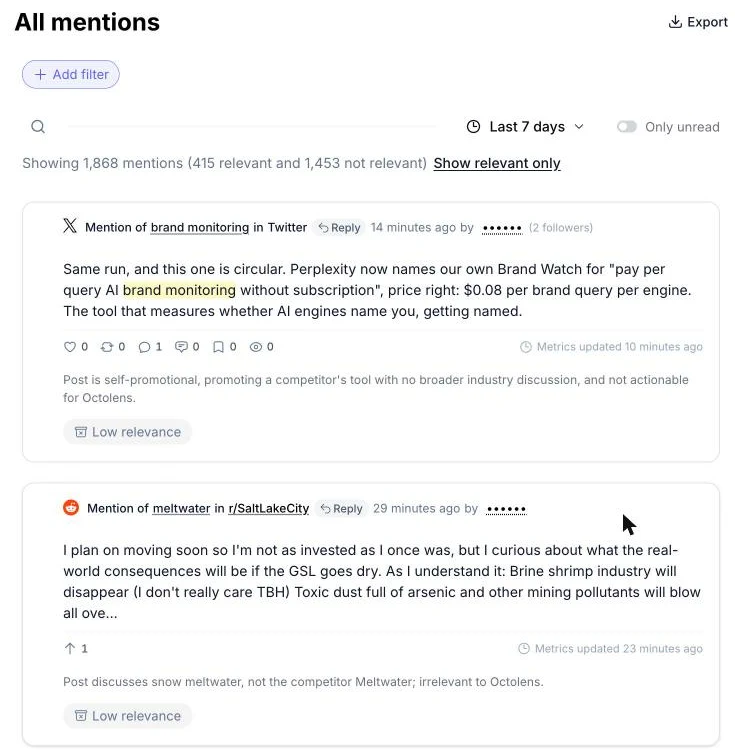
Octolens is built around keywords plus a company profile. You add the keywords you care about (your brand, competitors, category terms) and describe your company once. Our AI then scores every matching mention for relevance to your business, labels its sentiment, and adds tags like bug_report, feature_request, competitor_mention or buy_intent. You don't write a prompt per keyword. You route mentions with feeds, which are saved filters (say, "negative mentions on Reddit and X") that you can send to a Slack channel, an email digest or a webhook.
Pro covers Reddit, X, LinkedIn, TikTok, YouTube, Hacker News, GitHub, Bluesky, DEV and Stack Overflow. News, podcasts, newsletters and the wider web come with Scale. Pro refreshes hourly and Scale in real time.
Where each tool looks
| Source | Octolens | Syften |
|---|---|---|
| Reddit posts + comments | ✓ every plan | ✓ every plan, ~1 min delay |
| Hacker News | ✓ every plan | ✓ every plan |
| X / Twitter | ✓ included in mention volume | Add-on: $40/mo for 1,000 tweets (~30/day) |
| LinkedIn posts + comments | ✓ every plan | Partial, per Syften's founder |
| TikTok | ✓ video transcripts + descriptions | ✕ |
| YouTube | ✓ every plan | Add-on: $20/mo, 10 filters, checked daily |
| GitHub | ✓ issues, discussions | ✓ issue, PR review and commit comments |
| Bluesky | ✓ | ✓ |
| Stack Overflow / Stack Exchange | Stack Overflow | Whole Stack Exchange family |
| Product Hunt | ✕ | ✓ comments + forum |
| Public Slack communities | ✕ | ✓ |
| Mastodon, Indie Hackers, Lobste.rs, forums | ✕ | ✓ |
| Podcasts | Scale plan | ✓ every plan |
| News + web pages | Scale plan | ✓ separate web filters, 5 to 50 results/day |
| Page-change alerts (e.g. competitor pricing page) | ✕ | ✓ added: / removed: operators |
Syften's long tail of developer and indie communities is a real strength, and I don't know another tool that monitors public Slack communities the way Syften does. Octolens is stronger on LinkedIn, X and TikTok, where a lot of B2B buyers post, and all three come with the plan.
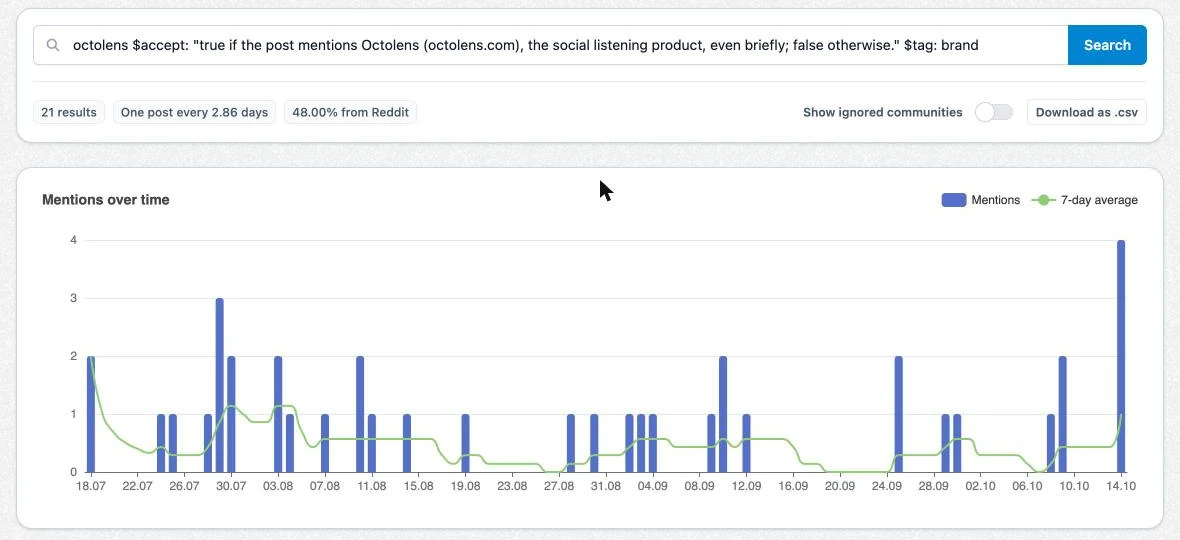
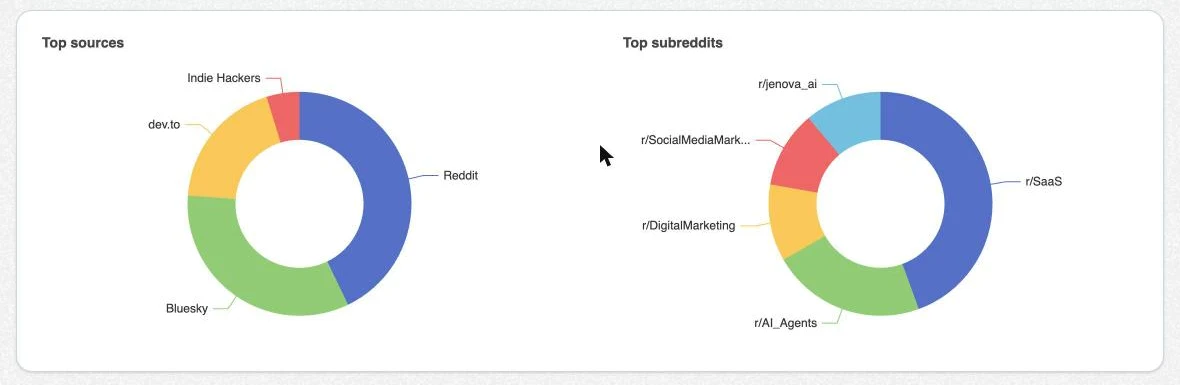
Our own brand shows the difference. Syften's 60-day archive for "octolens" came from four places: Reddit, Bluesky, dev.to and Indie Hackers. X and YouTube aren't part of its archive, and no LinkedIn posts showed up. I saw the same pattern for "brand24" (120 matches, 64% Reddit) and for the buying-intent phrase "social listening tool" (75 matches, 60% Reddit). In Octolens, the same brand keyword picked up 82 mentions over the last 30 days, and 49 of them were on X.
What it costs
Syften (monthly; no annual pricing is listed):
- Entry: $29.95, 3 community filters, 100 community results/day, 1 web filter with 5 results/day, 7 days of archive, API access. No Slack, no AI filtering.
- Standard: $49.95, 20 community filters, 200 results/day, 5 web filters with 20 results/day, 30 days of archive, Slack, AI filtering.
- PRO: $119.95, 100 community filters, 500 results/day, 20 web filters with 50 results/day, full archive, webhooks, MCP.
- X add-on +$40/month (1,000 tweets, then $0.04 per tweet). YouTube add-on +$20/month.
Octolens:
- Pro: $199/month or $159/month billed annually. 15,000 mentions a month across all included sources, 10 keywords ($10 per extra keyword), hourly refresh, API, webhooks, MCP, Slack, email, unlimited seats, 2 years of history.
- Scale: $599/month or $499/month annually. 50,000 mentions, 40 keywords, real-time refresh, adds news, podcasts, newsletters and web.
- Overage: $0.013 per mention on Pro, $0.01 on Scale.
Syften sets its limits per day. PRO's 500 community results a day comes to roughly 15,000 a month, close to Octolens Pro's 15,000 mentions a month. Syften's cap resets every day, though, so a quiet week leaves you nothing extra for a launch day, while ours is a monthly pool across every source. Syften also counts filters (one filter can hold several terms) where we count keywords, so you can't compare "20 filters" and "10 keywords" one to one.
Summary: how Syften stacks up on sourcing and price
- Cheaper at every tier, starting at $29.95/month
- Reddit alerts within about a minute on every plan
- Covers niche dev and indie communities, public Slack groups and podcasts on every plan
- Precise filter syntax, plus page-change alerts on the web
- X and YouTube cost extra, and X is capped at 1,000 tweets a month
- LinkedIn is partial and TikTok isn't covered
- No sentiment, and AI filtering means writing a prompt for each filter
- Webhooks and MCP require the $119.95 PRO plan
Verdict
If your conversations happen on Reddit, Hacker News and developer communities and you want to spend under $100 a month, Syften gives you more for the money. Once LinkedIn, X or TikTok matter, or you want mentions going into other systems, the price gap shrinks to $20 to $40 a month and Octolens covers more of what you need.
Part 2: Five workflows, side by side
I set up both tools with the same terms: our own brand, two competitors, and a "looking for an alternative to" phrase.
1. Catching a Reddit thread while it's still live
Syften was built for this. Michal, its founder, made it to promote another product of his. Syften targets a Reddit delay of under a minute on every plan, Entry included, so when someone posts "anyone know a good alternative to X?" you can be in the thread before it has five comments.
Octolens Pro checks hourly. That works for brand monitoring and reporting, but if your goal is the first helpful reply, an hour is often too late on a fast subreddit. Scale refreshes in real time and closes the gap, but it costs $599 a month.
2. Keeping noise out of Slack
In Syften, you write an AI rule yourself for each filter you want screened. Their docs recommend a "robotically explicit" prompt, and the wording does matter: "true only when the post is about Acme" rejects posts that mention you in passing, while "true if the post mentions Acme, even briefly" keeps them. If you like that level of control, it works well. With 20 filters, though, you're writing and tuning 20 prompts. For our five test filters I wrote three of these rules, and because the archive preview ignores them, I couldn't see what they would have rejected until live alerts came in.
In Octolens, every mention gets a relevance score based on your company profile, so a brand like "Linear" or "Notion" doesn't need hand-written rules to tell the product apart from the ordinary word. Each mention also gets a sentiment label and tags, so you can send only negative mentions to a support channel, or only competitor_mention + buy_intent to a sales channel. Teams with a Slack channel per product area use feeds for this; Vercel routes mentions into more than 20 channels.
3. Getting mentions into your agents and tools
We rebuilt Octolens around the API this year, so this is where the two products differ most.
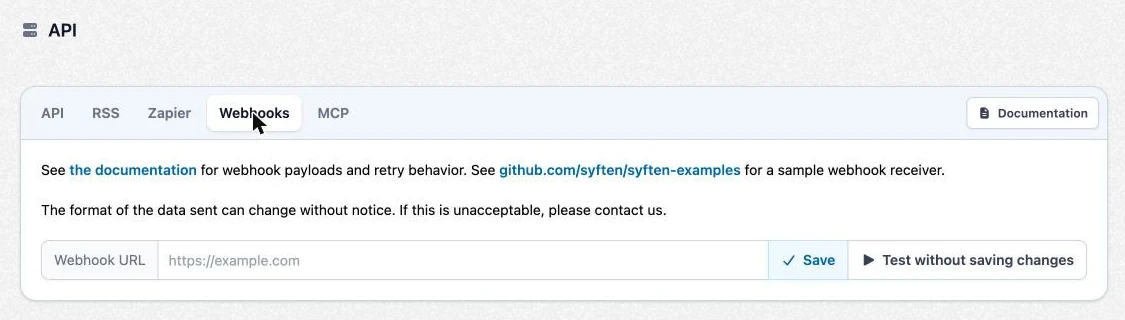
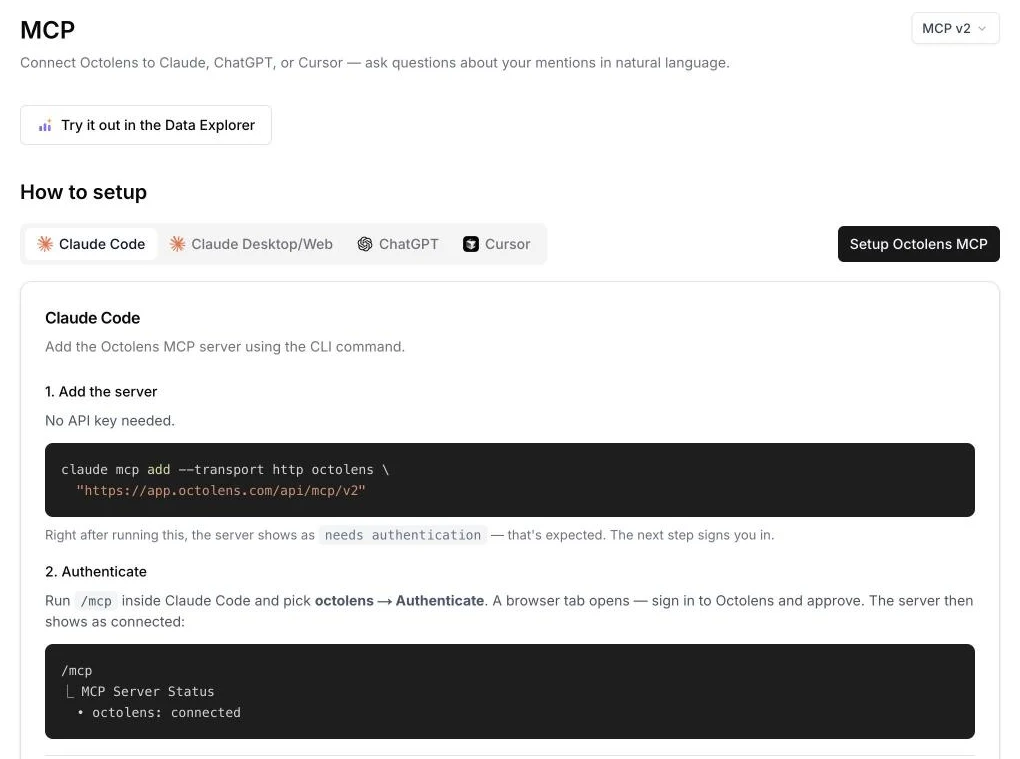
Syften has a small JSON API on every plan that reads your recent matches (up to 100 per request, 6 requests per 5 minutes) and edits filters. Webhooks, archive search through the API and the MCP server need PRO. The MCP server is well designed for tuning filters: an agent can test a proposed filter against the archive, browse your matches and save filters after you approve. Syften says its payload format isn't version-locked, and the webhook settings screen warns: "The format of the data sent can change without notice." To connect the MCP server you paste your personal API key into the client as a request header, and Syften's setup page notes that Claude.ai offers this header option only in beta, for some organizations. Octolens' MCP server signs in with OAuth.
Octolens includes the REST API, webhooks and a remote MCP server on every plan. Webhook payloads carry the relevance score, sentiment and tags, so the agent or Zap on the other end doesn't have to classify anything. Over MCP, an agent can search mentions, run analytics, create keywords and set up feeds. Our customers run workflows like "new negative mention → agent drafts a CS ticket" and "mention tagged bug_report → Linear issue with the thread linked" in production.
4. Covering where your buyers post
For a developer tool whose users hang out on Hacker News, GitHub, Lobste.rs and a few public Slack groups, Syften's coverage is excellent and arguably better than ours. Podcasts on every plan help too, though Syften warns that transcripts can garble startup and domain names.
A B2B product whose buyers post on LinkedIn, or a consumer brand that comes up on TikTok, is a different story. Syften's founder says LinkedIn coverage is only partial, and Syften doesn't cover TikTok. X costs $40/month for 1,000 tweets, which a brand with an active X audience will use up fast, and tweets the AI rejects still count toward that limit. On Octolens Pro, LinkedIn, X, TikTok and YouTube all draw from the same 15,000-mention pool.
5. Sharing with a team
Syften has no separate user seats. Its FAQ suggests sharing one company login and sending alerts to different email addresses, Slack channels or webhooks. That works for a founder or a two-person team. It gets awkward once marketing, support and product all want to triage in the app, because nobody can see who handled what.
Octolens has unlimited seats on every plan, so each person who works with mentions gets their own login and can bookmark mentions and mark the ones they've engaged with.
What people say about Syften
We looked for public posts comparing the two tools directly and found few, so these quotes are about Syften on its own. Some come from Syften's founder, who is clear in public about what the product is and isn't for. Two come from people who build competing tools, and we've marked those.


Every quote above is reproduced word-for-word from a public post; ellipses shorten longer passages and square brackets note small editorial substitutions. Every card links to the original source. The opinions are the authors' own.
Part 3: Feature comparison
Most teams choose between Octolens Pro, Syften Standard and Syften PRO, so those are the three columns.
| Feature | Octolens Pro ($199/mo, $159 annual) | Syften Standard ($49.95/mo) | Syften PRO ($119.95/mo) |
|---|---|---|---|
| Monthly volume | 15,000 mentions, all sources | ~6,000 community results (200/day) + 20 web/day | ~15,000 community results (500/day) + 50 web/day |
| Tracked terms | 10 keywords (+$10 each) | 20 community + 5 web filters | 100 community + 20 web filters |
| Reddit alert speed | Hourly (real time on Scale) | ~1 minute | ~1 minute |
| X / Twitter | ✓ included | +$40/mo, 1,000 tweets | +$40/mo, 1,000 tweets |
| YouTube | ✓ included | +$20/mo | +$20/mo |
| ✓ posts + comments | Partial | Partial | |
| TikTok | ✓ | ✕ | ✕ |
| Podcasts, news, newsletters | Scale plan | ✓ | ✓ |
| AI relevance filtering | ✓ automatic, from company profile | ✓ per-filter prompt you write | ✓ per-filter prompt you write |
| Sentiment | ✓ | ✕ | ✕ |
| Topic tags (bug, feature request, buy intent…) | ✓ | ✕ (manual $tag routing) | ✕ (manual $tag routing) |
| Slack + email | ✓ | ✓ | ✓ |
| REST API | ✓ | ✓ account API | ✓ + archive search |
| Webhooks | ✓ | ✕ | ✓ |
| MCP server | ✓ remote, read + write | ✕ | ✓ |
| History | 2 years | 30 days | Full available history |
| Seats | Unlimited | Shared login | Shared login |
| Free trial | 7 days, no card | 14 days of PRO, no card | 14 days of PRO, no card |
Where Syften wins
- Syften PRO costs less than Octolens Pro on monthly billing, even with the X and YouTube add-ons.
- Reddit alerts arrive in about a minute on every plan. Our entry plan checks hourly.
- It covers communities we don't: public Slack groups, Mastodon, Indie Hackers, Lobste.rs, Product Hunt, the full Stack Exchange network and a curated list of forums.
- Podcasts and web pages come with every plan, including page-change alerts that tell you when a competitor's pricing page adds or drops a phrase.
- The filter syntax is more precise, with literal matching, handling for obfuscated domains, and author and reply tracking. If you think in search operators, you'll like it.
- The trial is longer: 14 days of the top plan.
Where Octolens wins
- LinkedIn, X, TikTok and YouTube are included in one mention pool, with no add-ons.
- Every mention gets relevance, sentiment and tags without you writing prompts.
- The API, webhooks and MCP come with every plan, and the payload already carries the classification.
- The entry plan has unlimited seats and two years of history.
- Analytics work across sources: volume over time, sentiment breakdowns, and how your keywords compare with your competitors'.
Cost comparison
These four setups use monthly list prices.
| What you need | Syften | Octolens |
|---|---|---|
| Reddit + HN alerts for one product, email only | Entry: $29.95 | Pro: $199 (more than you need) |
| Brand + 2 competitors, Slack, AI filtering, X | Standard + X: $89.95 | Pro: $199 ($159 annual) |
| Same, plus YouTube, webhooks and MCP for agents | PRO + X + YouTube: $179.95 | Pro: $199 ($159 annual) |
| Real-time refresh, news, podcasts, 30+ terms, team of 5 | PRO + add-ons: $179.95, one shared login | Scale: $599 ($499 annual) |
Syften is cheaper for the first two setups, and we'd tell you to use it there. In the third, the tools cost about the same. On annual billing Octolens comes out $20 a month cheaper and also covers LinkedIn and TikTok, with no 1,000-tweet cap. The fourth setup is where Octolens Scale makes sense, mostly for teams that want news and podcasts alongside social, with sentiment and a seat for everyone.
Octolens vs Syften: which should you choose?
Syften is a well-made tool from a small, focused team, and it's hard to beat at its core job. It has run since 2019, ships often, and its founder is upfront in public about what it doesn't do.
Choose Syften if:
- you're a founder or a small team and your audience lives on Reddit, Hacker News, forums and developer communities
- being first into a new thread matters most to you
- you're comfortable writing search filters and AI rules yourself
- your budget is under $100 a month
- you need public Slack communities, Mastodon or page-change alerts, which we don't cover
Choose Octolens if:
- your buyers post on LinkedIn, X or TikTok and you need those covered properly
- mentions should flow into Slack channels, CRMs, Linear or AI agents, with relevance, sentiment and tags done before they arrive
- several people across marketing, support and product will work with mentions
- you have a common-word brand name and don't want to maintain per-filter prompts
- you want news and podcasts alongside social (on Scale)
Both have free trials without a credit card. The fairest test is to run the same three or four terms through both for a week and see which inbox you'd rather work from.
We checked pricing and features for both tools against their official pricing pages and documentation on October 14, 2026. If anything here is out of date, email us and we'll fix it.
Frequently asked questions
Yes. Syften starts at $29.95/month and its top self-serve plan, PRO, is $119.95/month. Octolens starts at $199/month ($159/month billed annually). The gap narrows once you add sources: Syften charges $40/month for X and $20/month for YouTube, and webhooks and MCP need PRO, so a Syften setup with X, YouTube, webhooks and MCP costs $179.95/month. Octolens includes X, YouTube, LinkedIn, TikTok, API, webhooks and MCP on its $199 Pro plan.
No. Syften's AI step accepts or rejects each keyword match based on a rule you write, and its own team says it does not score mentions as positive or negative. Octolens labels every mention as positive, negative or neutral, scores relevance, and adds topic tags such as bug report or competitor mention.
Only partially. Syften's founder describes its LinkedIn and Facebook coverage as partial, and LinkedIn is not part of its searchable archive. Octolens monitors LinkedIn posts and comments on every plan.
Syften. It aims for at most a one-minute delay on Reddit on every plan. Octolens refreshes hourly on Pro and in real time on Scale.
Both do. Syften's account API is on every plan, while webhooks, archive search through the API, and its MCP server need the $119.95 PRO plan. Octolens includes the REST API, webhooks and a remote MCP server on every plan.
It depends on why you're leaving. If you need LinkedIn, TikTok, news or podcasts, sentiment, or API, webhooks and MCP without paying for a top tier, Octolens is the closest alternative with broader coverage, from $199/month. F5Bot is enough for free Reddit and Hacker News keyword alerts if you can live without AI filtering. And when fast, cheap Reddit alerts are the whole point, staying on Syften is often the right call.
Syften has no separate user seats, so teams share one login and send alerts to different email addresses, Slack channels or webhooks. Octolens includes unlimited seats on every plan.