13 Best Social Media APIs for Developers in 2026
Auth headaches, rate limits, pricing walls, and which APIs are actually worth integrating.
Last year we needed to pull brand mentions from Twitter, Reddit, and LinkedIn into a single dashboard. Three APIs meant three OAuth implementations, three different JSON schemas, three sets of rate limit logic, and three pricing pages that required creative accounting to understand.
The Twitter integration broke twice when X changed their API tiers. Reddit's commercial approval took three weeks. LinkedIn returned roughly nothing useful unless we had a Marketing Developer Platform partnership.
This guide is what I wish existed when I started. Every social media API that matters in 2026 — with real pricing, actual rate limits, auth complexity, and an honest take on whether you should bother with the official API or skip straight to an aggregator.
Looking for complete social listening tools with dashboards and alerts? See our best social listening tools comparison. This guide is for developers who want raw API access to social media data.
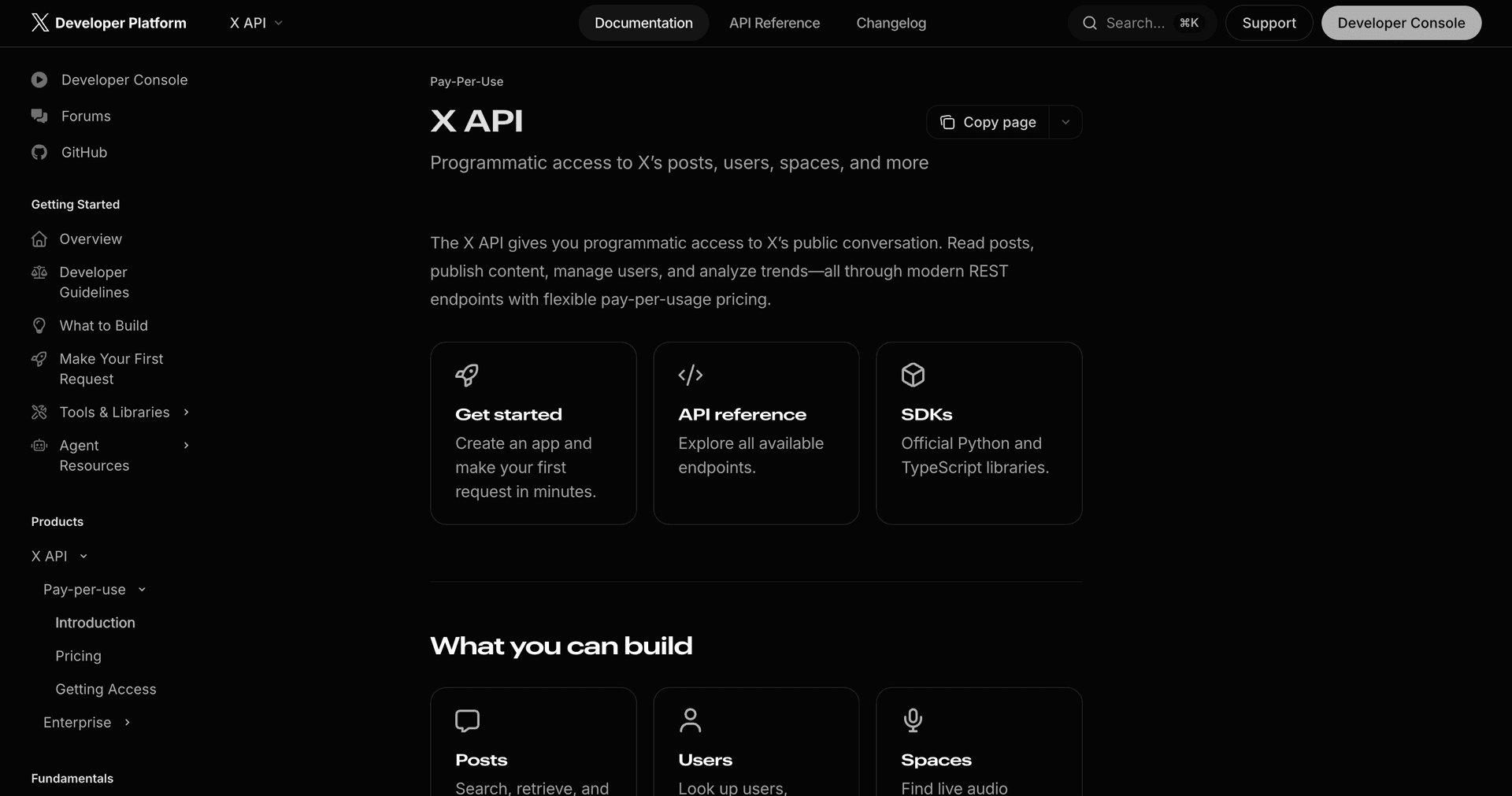
The most searched-for social media API, and currently the most chaotic.
X killed the old tiered model for new developers in February 2026. If you're signing up today, you're on pay-per-use — no monthly subscription, no free tier. You buy credits upfront and they're debited per request.
| Operation | Cost |
|---|---|
| Read a post | $0.005 |
| Look up a user profile | $0.01 |
| Create a post (no URL) | $0.015 |
| Create a post with URL | $0.20 |
| Owned reads (your own posts, bookmarks) | $0.001 |
That URL post pricing is not a typo. X raised it from $0.01 to $0.20 in April 2026 — a 1,900% increase. If you're building anything that creates link posts at scale, this is a dealbreaker.
Legacy subscribers who signed up before February 2026 kept their old plans: Basic at $200/mo (15,000 reads/month) and Pro at $5,000/mo (1,000,000 reads/month). Neither is available to new developers.
Enterprise starts at $42,000/mo and includes full firehose access, filtered stream, and full-archive search.
- 900 requests per 15-minute window (OAuth 2.0)
- Hard cap of 2 million reads/month on pay-per-use
- Monthly caps per endpoint on legacy tiers
OAuth 2.0 with PKCE. Moderate complexity — access tokens expire every 2 hours unless you request offline.access for refresh tokens.
Best for: Apps that need Twitter/X data specifically and can budget for pay-per-use costs.
Skip if: You need data from multiple platforms. Managing X's pricing unpredictability alongside Reddit and LinkedIn APIs is a full-time job.
Docs: docs.x.com
Reddit's API has been in flux since the 2023 pricing crackdown that killed Apollo and dozens of other apps. The free tier still exists, but commercial access has gotten harder to get.
We wrote a complete breakdown of Reddit API pricing — here's the summary.
| Tier | Cost | Limits |
|---|---|---|
| Free (non-commercial) | $0 | 100 QPM (OAuth), 10 QPM (without) |
| Commercial | ~$0.24/1K calls | Entry contracts from $12K/year |
| Enterprise | Negotiated | $50K-$500K+/year |
The catch: commercial access requires explicit Reddit approval, and since January 2026, applications are frequently rejected without clear reasons. You need to detail your use case, which subreddits you'll access, and expected volume. Anything that looks like scraping or competitive intelligence gets rejected.
OAuth 2.0. Getting a free API key is straightforward (create an app at reddit.com/prefs/apps). Commercial approval is a separate, slower process — expect 2-4 weeks with no guarantee.
Post titles, body text, scores, comments, author info, subreddit metadata, search results. No real-time streaming — polling only.
Best for: Academic research, personal projects, or products where you've already secured commercial approval.
Skip if: You need fast access to Reddit data for a commercial product. The approval process is slow and opaque. Consider an aggregation API or social listening API instead.
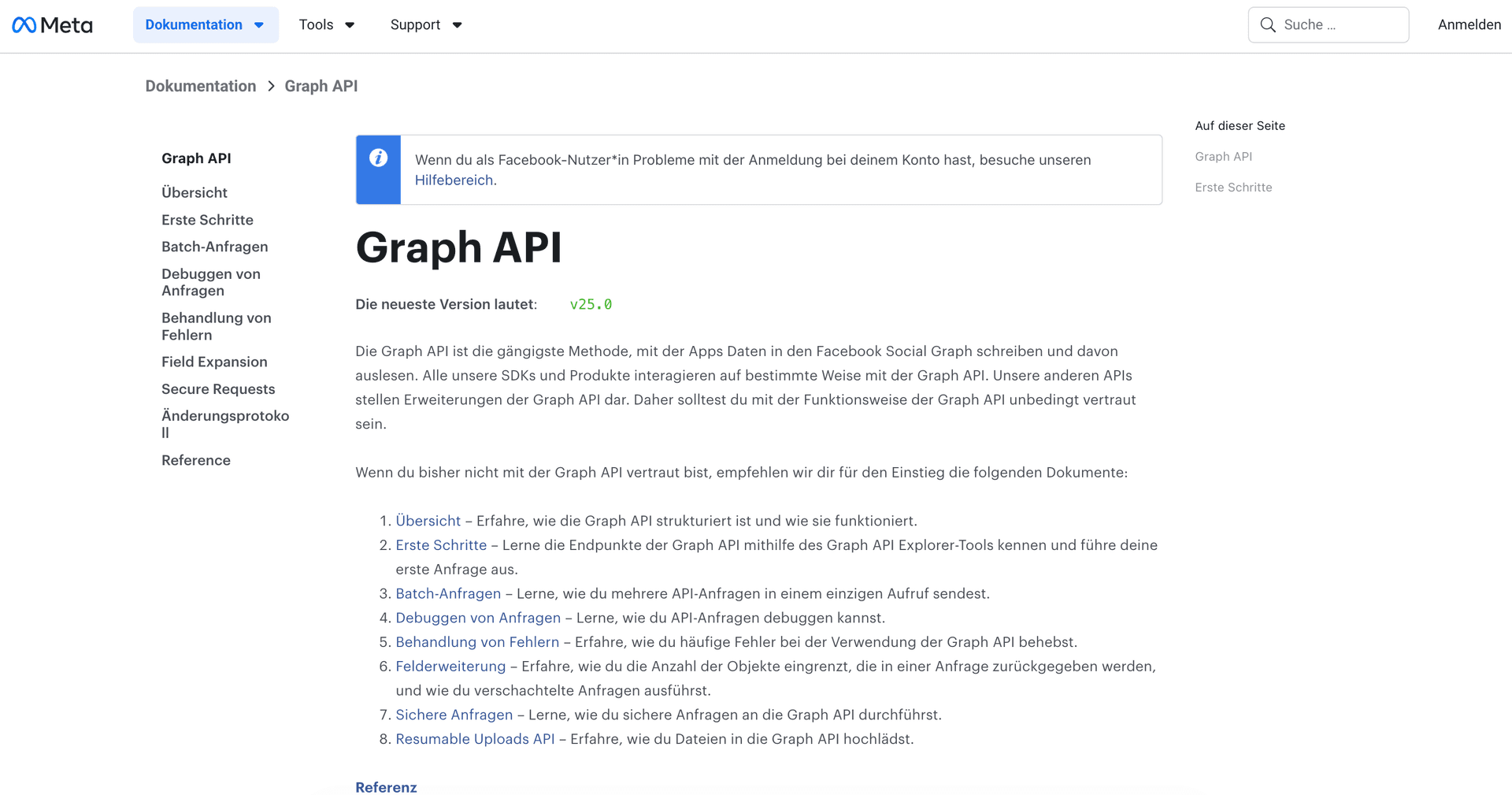
Meta doesn't charge for API access. The cost is entirely in development time, App Review friction, and compliance overhead.
The biggest change you need to know: Instagram Basic Display API is dead. It was shut down in December 2024. Personal Instagram account access via API is completely gone. Everything now requires a Business or Creator account connected to a Facebook Page.
- Instagram Graph API — full-featured (media, comments, insights, hashtag search, content publishing), but requires Business/Creator account + Facebook Page
- Instagram API with Instagram Login — simpler OAuth without Facebook Page, but limited scope (consumer-facing apps only)
- Facebook Graph API — Pages, posts, comments, reactions, insights, ad accounts. Current version: v22.0
200 API calls per user per hour. App-level limit scales with your user base: 200 x number_of_users per hour.
This is where Meta earns its "Complex" rating. Every permission beyond basic profile requires manual review by Meta staff. You'll need to submit video walkthroughs demonstrating how you use each permission. Reviewers can request revisions, which resets the clock.
Timeline: 2-4 weeks minimum, often longer. Apps that look like data scraping are rejected without explanation.
Best for: Building features that integrate with Facebook Pages or Instagram Business accounts (scheduling, analytics, comment management).
Skip if: You want personal Instagram data, you need fast time-to-market, or you don't have the patience for App Review.
Docs: developers.facebook.com/docs/graph-api
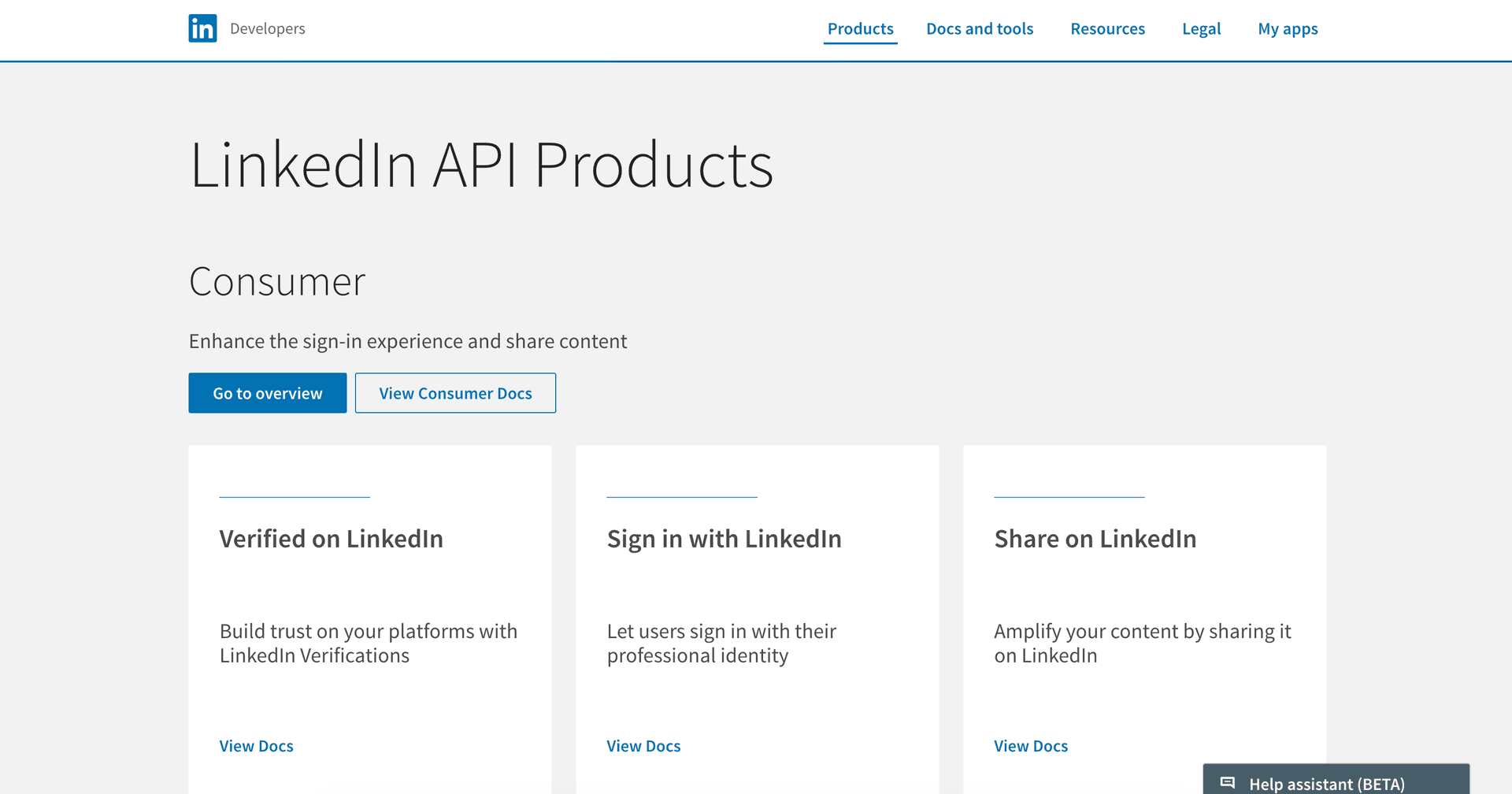
The most restrictive API on this list, and it's not close.
Without a formal Marketing Developer Platform (MDP) partnership, LinkedIn gives you exactly two things: Sign In with LinkedIn (name, headline, photo, email) and Share on LinkedIn (post on behalf of users). That's it.
Everything useful for monitoring — company page analytics, follower data, ad campaign management, organization insights — requires MDP approval. The approval rate is less than 10%. The process takes 3-6 months. You need to prove you have a legal entity, a detailed use case, and an established user base.
Consumer products (sign-in, share) are free. MDP starts around $699/month, with enterprise deals running $50K-$300K+/year.
100,000 API calls per day (app-level). Per-endpoint limits vary and are not publicly documented — you check your Developer Portal. Some endpoints are as low as 10 requests per day per member.
OAuth 2.0 via OpenID Connect. The auth itself is straightforward. Getting meaningful permissions is the hard part.
Best for: Apps that only need user authentication or the ability to post on LinkedIn. Enterprise products with the resources to pursue MDP partnership.
Skip if: You're an individual developer or startup that needs to read LinkedIn data. The access you'll get without MDP is nearly useless for monitoring or analytics.
Docs: learn.microsoft.com/en-us/linkedin/
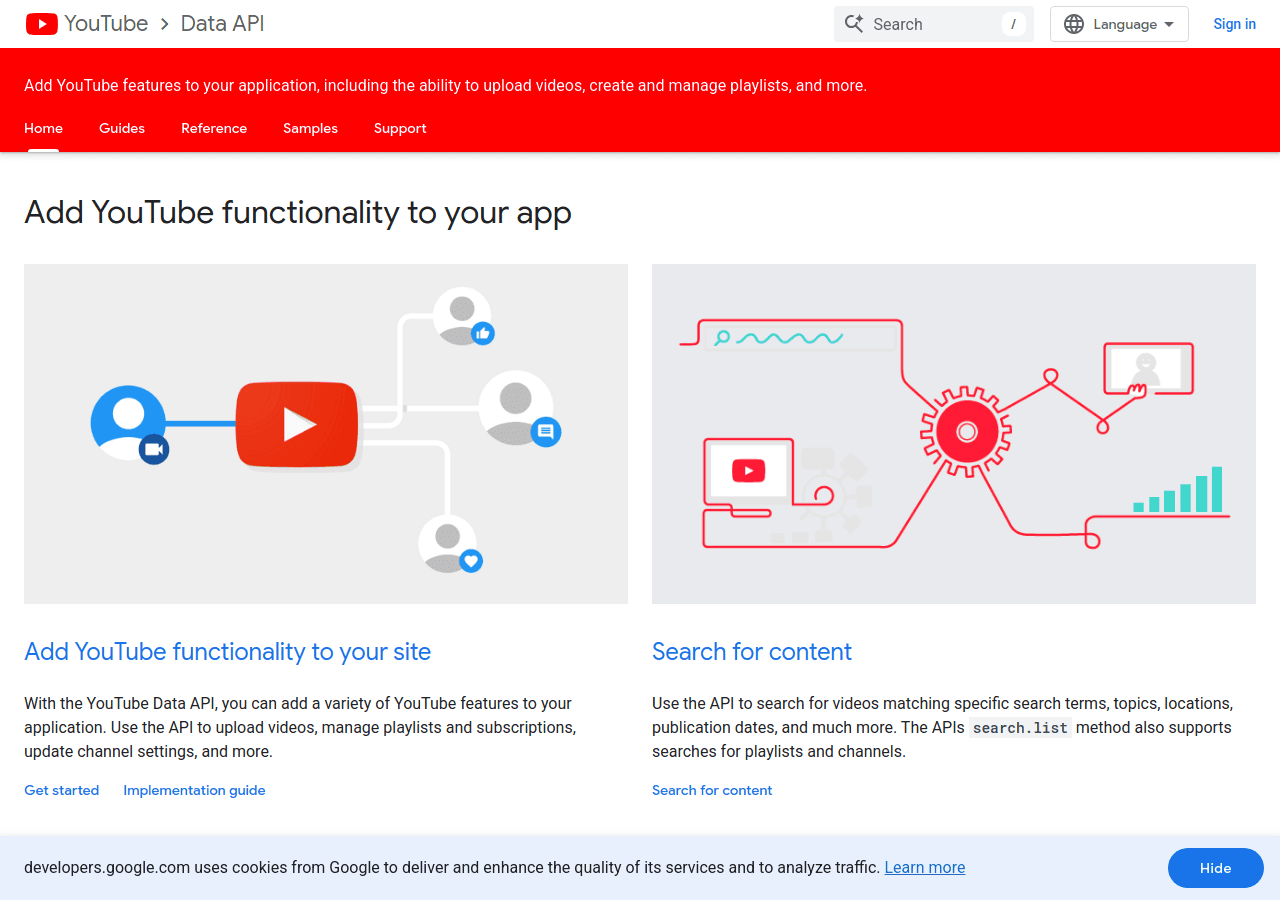
After the pain of the previous four APIs, YouTube is a breath of fresh air.
The developer experience is genuinely good. Docs are clear, auth is simple, the free tier is generous, and the API has been stable for years.
Free. YouTube does not charge per API call. Access is gated by a daily quota system:
| Operation | Quota cost |
|---|---|
| Read (videos, channels, playlists) | 1 unit |
| Search | 100 units |
| Write (create/update/delete) | 50 units |
| Video upload | 1,600 units |
You get 10,000 free units per day — enough for 10,000 video lookups or 100 searches. Quota resets at midnight Pacific Time.
Need more? Submit an audit form. Review takes 3-4 days, and quota increases are free. You need to re-audit every 12 months.
API key for public data (no user login needed, generated in Google Cloud Console in minutes). OAuth 2.0 for private data and write operations.
Best for: Any app that needs YouTube data. The best developer experience on this list — generous free tier, excellent docs, simple auth, stable API.
Skip if: You need real-time notifications of new content (YouTube doesn't offer streaming; use webhooks via PubSubHubbub instead).
Docs: developers.google.com/youtube/v3
TikTok has three separate API products, and none of them do what most developers actually want.
- Research API — for reading data, but restricted to academic/institutional researchers in the US, UK, and a handful of European countries. Still in beta. Rate-limited to 1,000 requests per day.
- Content Posting API — lets you post content, but without an audit review, all posts are forced to private mode. Audit takes 2 days to 2 weeks.
- Login Kit — "Sign in with TikTok." No data reading beyond basic profile.
If you're a commercial developer who wants to read TikTok data at scale, the official API doesn't serve you. The Research API is the only read path, and it requires a professional/institutional email, a defined research proposal, and ethical review evidence.
1,000 requests per day, 100 records per request. Maximum: 100,000 records per day. No paid quota increase option.
Best for: Academic researchers with institutional affiliations who need TikTok data.
Skip if: You're a commercial developer. Use a scraping API (Apify) or an aggregation API that covers TikTok (like Octolens, which pulls transcripts and descriptions from all TikTok videos).
Docs: developers.tiktok.com
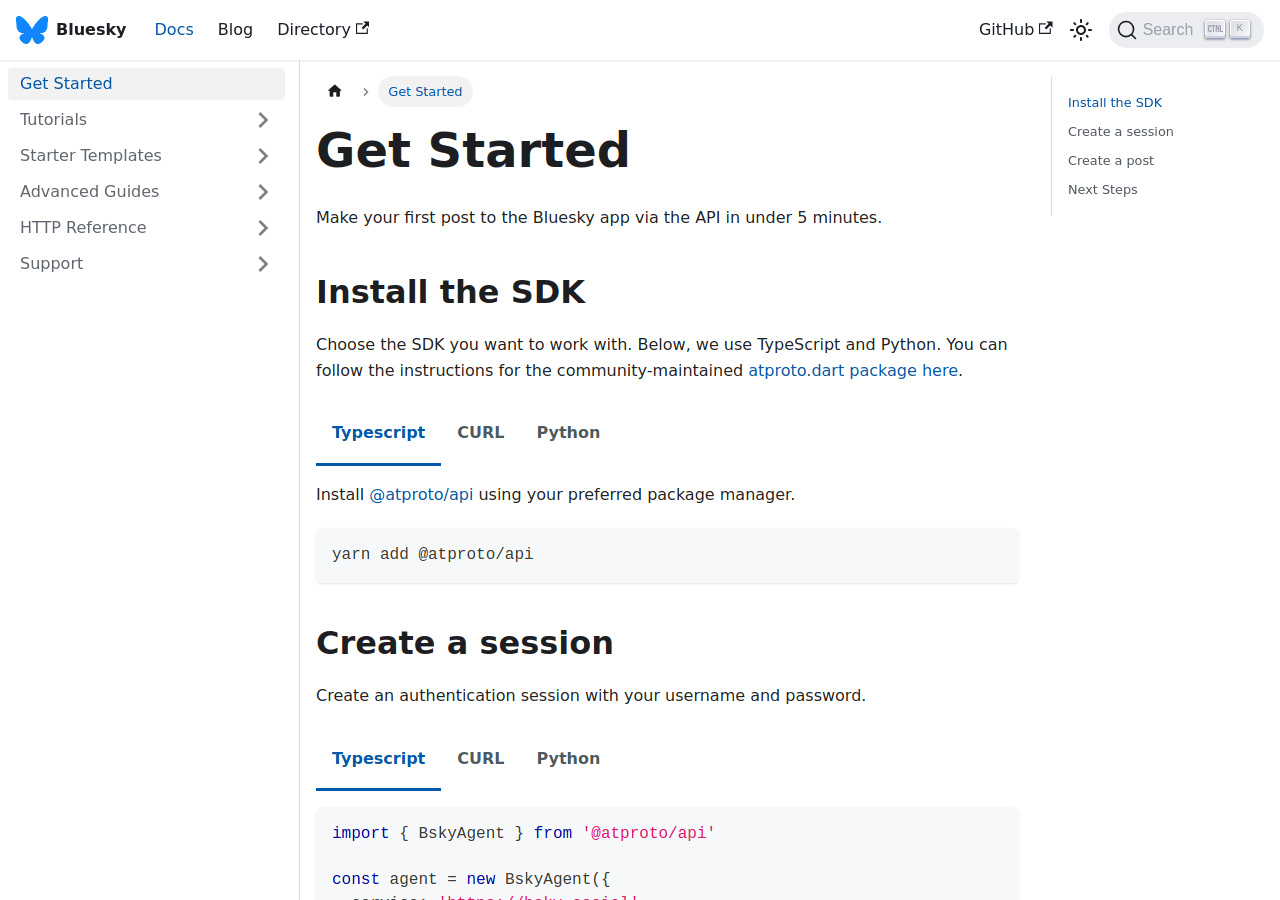
The antidote to everything above. Bluesky's AT Protocol is completely free, open, and developer-friendly. No API key required for public data. No pricing tiers. No App Review.
The AT Protocol is a federated protocol — Bluesky is one app built on it, but anyone can build clients, feeds, or services on the same infrastructure.
- 3,000 requests per 5 minutes (IP-based) on the hosted PDS
- Write operations: 5,000 points per hour (a create costs 3 points, update costs 2, delete costs 1)
- Public data endpoints don't require authentication
None needed for reading public data. OAuth for authenticated actions (posting, following, etc.).
Posts, profiles, follows, blocks, feeds, labels, moderation data. The data model is transparent — everything is stored in personal data repositories that are publicly auditable.
Best for: Prototypes, side projects, or any app that needs social data with zero friction. The best starting point if you're learning how to work with social APIs.
Skip if: You specifically need Twitter, Reddit, or LinkedIn data. Bluesky's user base is growing but still a fraction of the major platforms.
Docs: docs.bsky.app
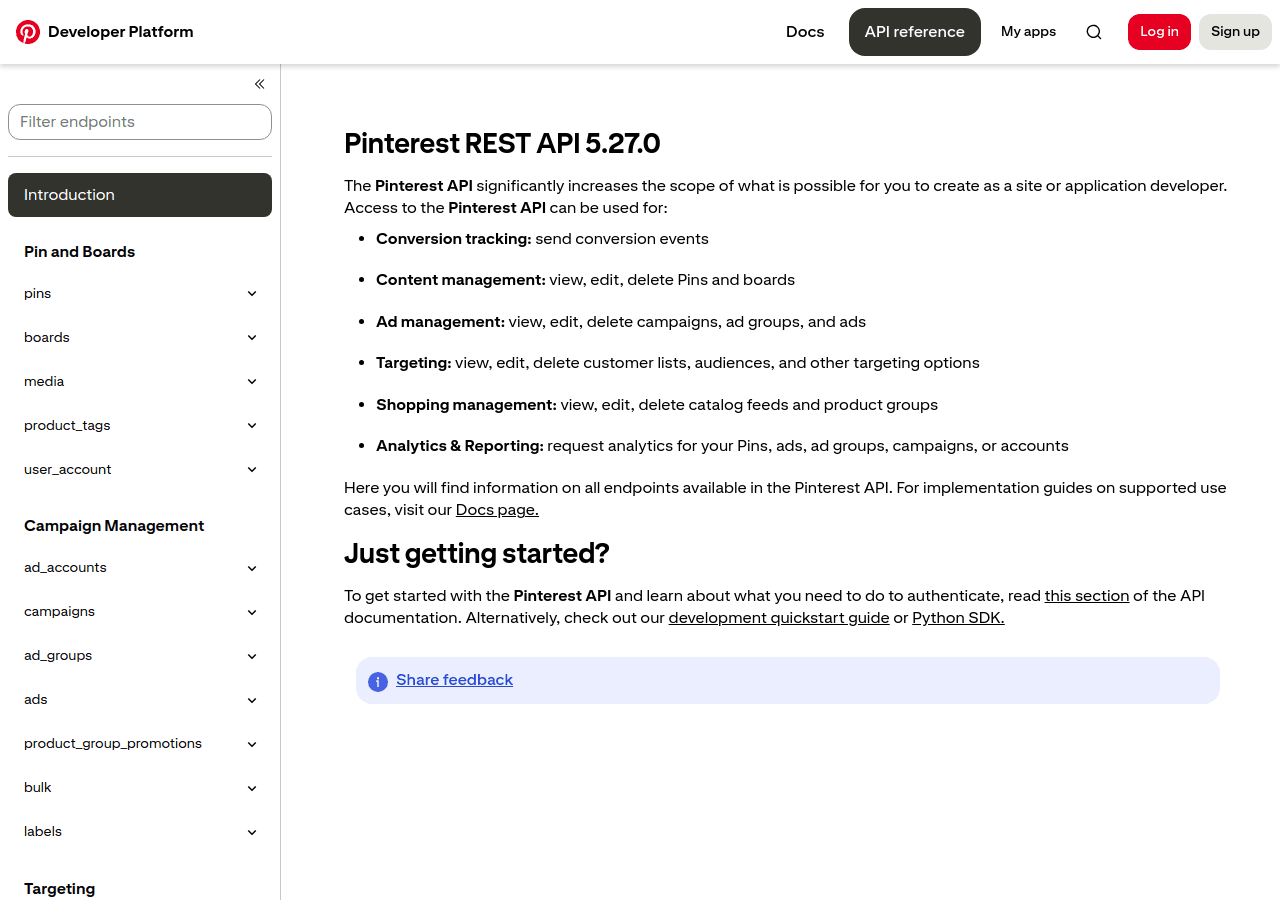
Pinterest's API is open to developers, but the scope is narrow. It's primarily designed for managing pins, boards, and ad campaigns — not for reading social data at scale.
Access requires creating a developer app and going through App Review for production access. The API supports reading pin metadata, board contents, and user profile info. Write access lets you create and manage pins programmatically.
Rate limits aren't publicly documented in detail, but developers report reasonable limits for standard use cases. Auth is OAuth 2.0.
Best for: E-commerce apps that need to publish or manage pins. Pinterest-specific analytics tools.
Skip if: You're building social listening or brand monitoring. Pinterest data is a nice-to-have, not a primary source, and individual API integration isn't worth the maintenance cost for most B2B use cases.
Docs: developers.pinterest.com
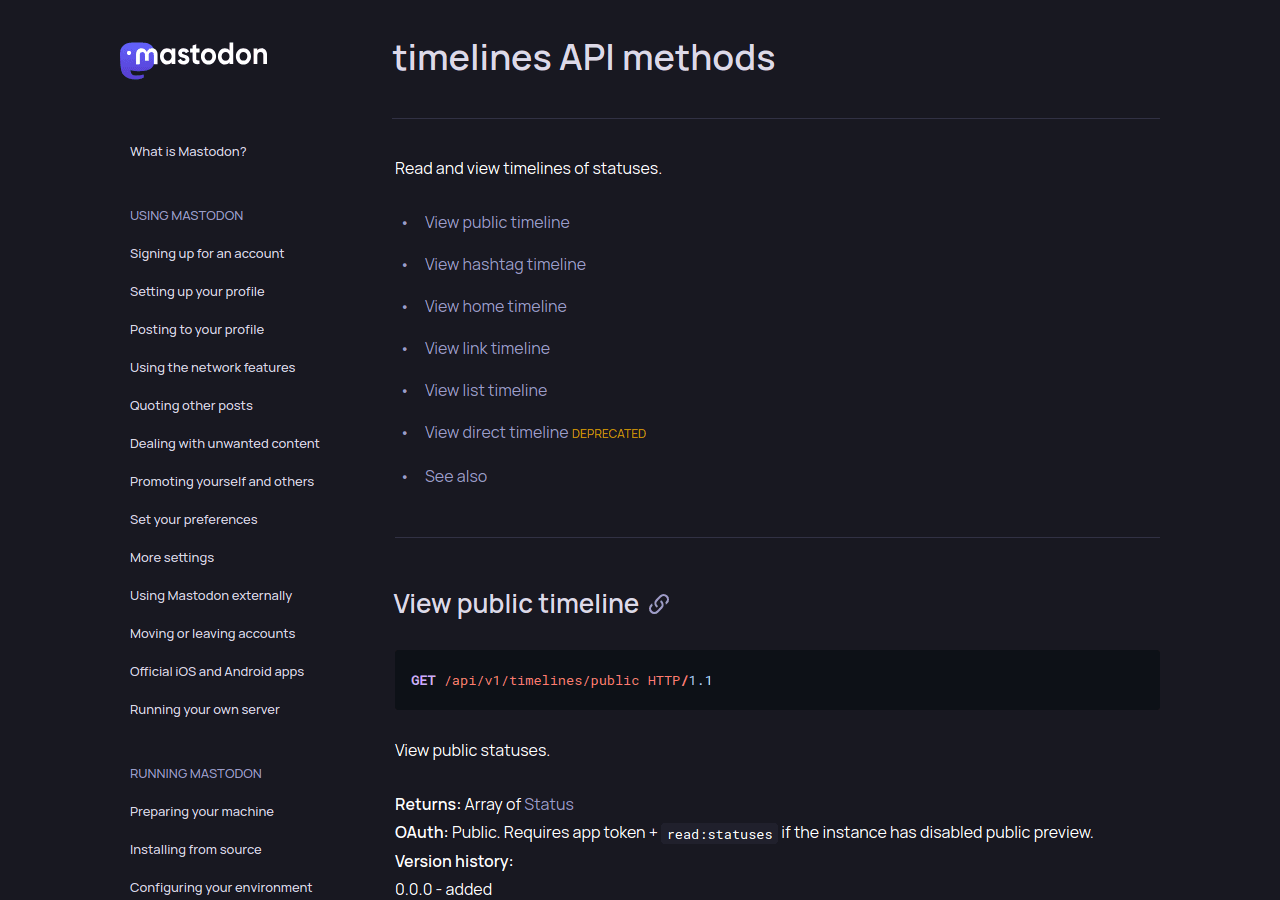
Mastodon's API is open-source and well-documented. Since Mastodon is federated (thousands of independent instances), there's no single company gatekeeping access.
300 requests per 5 minutes per account and per IP address. Media uploads and status deletions are capped at 30 per 30 minutes. These are instance-level defaults — individual instances can set their own limits.
OAuth 2.0 for user-level actions. Public data (timelines, user profiles, public posts) is accessible without auth on most instances.
Searching across Mastodon means querying individual instances. No single API endpoint gives you "all of Mastodon." Your app sees what the instance you're connected to knows about — which is its local users plus anyone its users follow on other instances. For comprehensive coverage, you'd need to query multiple instances or run your own relay.
Best for: Building Mastodon clients, moderation tools, or apps targeting specific Mastodon communities.
Skip if: You need comprehensive cross-instance search or monitoring. The federated model means completeness requires significant infrastructure.
Docs: docs.joinmastodon.org
If managing individual platform APIs sounds painful, aggregation APIs handle the complexity for you. They maintain the integrations, handle rate limits and auth, and give you a unified endpoint.
Focuses on Twitter/X data specifically. Pricing is per-request — roughly $0.25 per 1,000 tweets. A good alternative to X's official API if you only need read access to Twitter data and want predictable pricing.
A general-purpose scraping platform with pre-built "actors" for most social platforms. Pricing varies by platform:
- Twitter/X: ~$0.25-0.40 per 1,000 posts
- Instagram: ~$2.30 per 1,000 comments, or $0.005/query + $0.0005/post
- YouTube: ~$2.40 per 1,000 video metadata lookups
Apify offers a permanent free plan with $5/month in credits. Good for prototyping, but the per-platform pricing adds up at scale, and you're still managing separate actors for each platform.
The closest direct competitor in the API-first social listening space. Trigify (trigify.io) positions itself as "agentic social listening for modern B2B teams" with signal-led intelligence — they focus on routing actionable insights to the right teams rather than delivering raw data dumps. Pay-as-you-go pricing, integrations with HubSpot, Salesforce, and Linear.
If you're evaluating API-first social listening tools, it's worth testing alongside Octolens. They focus in on letting you build workflow automations on their platform, while Octolens delivers the data into your own systems via API, Webhooks, or MCP.
Best for: Teams that want social data without managing platform-level API integrations.
Skip if: You need deep control over the data pipeline, or you need platforms that the aggregator doesn't cover.
Full disclosure: this is ours. I'm including it because it's the option we built after dealing with exactly the problems described in this guide.
Octolens is a social listening API that gives you structured mention data from 13 platforms through a single REST endpoint. Instead of building and maintaining integrations with Twitter, Reddit, LinkedIn, YouTube, and 10+ other platforms, you get one API that returns clean, AI-enriched data.
Every mention includes the post body, author, source platform, timestamp, sentiment label (positive/negative/neutral), relevance score, and AI-generated tags (feature_request, bug_report, competitor_mention, etc.).
You also get webhooks for real-time alerts and an MCP server for AI agents that need social context.
LinkedIn, Twitter/X, Reddit, Bluesky, GitHub, YouTube, DEV.to, Hacker News, Stack Overflow, Newsletters, Podcasts, TikTok, and News/Blogs (150K+ outlets).
| Plan | Price | Mentions | Keywords |
|---|---|---|---|
| Pro | $199/mo ($159/mo annual) | 15,000 | 10 |
| Scale | $599/mo ($499/mo annual) | 50,000 | 40 |
| Enterprise | Custom | Unlimited | Unlimited |
API, webhooks, and MCP access are included on all plans. One endpoint replaces building and maintaining 15 separate platform integrations — you get structured JSON and AI filtering across all of them out of the box, instead of stitching together a different API, auth flow, and rate limit for each.
Free 7-day trial, no credit card required.
Best for: Anyone who wants to build internal tools, automations, dashboards, or entire products on top of social mention data — without managing multiple platform APIs.
Skip if: You need full platform access (posting, DMs, ad management) — Octolens is read-only monitoring. You need raw firehose data for ML training.
Docs: octolens.com/docs/api/overview
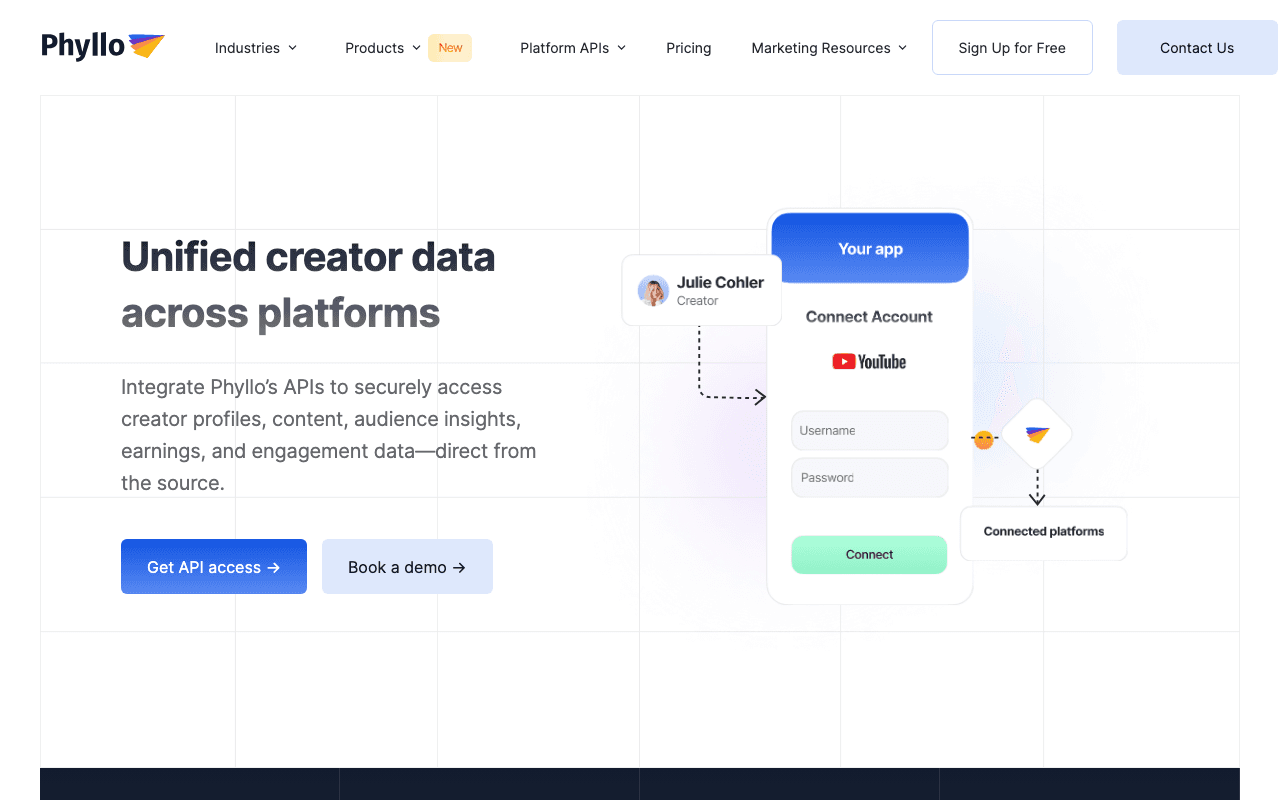
Phyllo is social data API infrastructure for creator and social data across 25+ platforms. Instead of maintaining separate scrapers, proxies, auth flows, and schemas for every network, you integrate one interface and one normalized schema.
The interesting part is the two access modes. Public APIs return profiles, posts, comments, and engagement without the account owner connecting anything. When your product needs non-public, account-level data — verified audience demographics, story reach, saves, content performance, earnings — Phyllo's authenticated APIs use official platform sign-in and creator consent to return first-party data instead of estimates.
- Creator discovery and public profile analytics across supported networks
- Posts, reels, videos, stories, and comments with performance signals
- Audience demographics, location, language, interests, and authenticity indicators (fake vs. real followers)
- Creator-consented reach, saves, engagement, and income data (ad revenue, sponsorships, affiliate)
- Webhooks for products that need current account and content data
25+ platforms, including Instagram, YouTube, TikTok, TikTok Shop, X, LinkedIn, Twitch, Reddit, Snapchat, and Facebook. Field availability varies by platform and by whether you're using public or consented access.
Custom, based on data products, use case, and volume — no published price list. There's a free sandbox to test the schema and available fields before committing to a paid plan.
Phyllo reports a 99.99% uptime SLA, SOC 2 Type II controls, and GDPR compliance.
Best for: Creator platforms, influencer marketing products, and audience-verification systems that need both public and creator-consented data across several networks.
Skip if: You only need one low-volume dataset from a single network — a dedicated platform API is simpler. Or you want brand monitoring across the open web: Phyllo is account- and creator-centric, not open-web listening.
Docs: docs.getphyllo.com
Zernio is a unified social media API for publishing, engagement, and ads across 16 platforms. You don't register a developer app, and you don't sit through Meta's App Review or TikTok's audit, as Zernio holds those approvals already.
Scheduling and publishing from a single payload, with media handled for you: images, video, carousels, Stories, Reels, and first comments. A shared inbox for reading and replying to comments and DMs across platforms. Analytics that come back in the same shape everywhere. Ad campaigns across Meta, Google, LinkedIn, TikTok, Pinterest, X, and OpenAI Ads.
Instagram, TikTok, X/Twitter, Facebook, LinkedIn, YouTube, Threads, Reddit, Pinterest, Bluesky, Telegram, Google Business, Snapchat, Discord, Slack, and WhatsApp.
| Connected accounts | Price per account/mo |
|---|---|
| 1–2 | Free forever |
| 3–10 | $6 |
| 11–100 | $3 |
| 101+ | $1 (no cap) |
Everything is included at every level, with no add-ons, no feature tiers, no enterprise wall.
Best for: Products, agencies, and agents that need to post and reply on behalf of a lot of accounts without building 16 integrations.
Skip if: You want brand monitoring. Zernio works with accounts you're connected to, it doesn't listen across the open web.
Docs: docs.zernio.com
| API | Auth | Free tier | Paid from | Rate limits (free) | Platforms | Real-time | Best for |
|---|---|---|---|---|---|---|---|
| Twitter/X | Moderate | No (pay-per-use) | $0.005/read | 900 req/15min | 1 | Yes (Enterprise) | Twitter-specific data |
| Moderate | Yes (non-commercial) | ~$12K/year | 100 QPM | 1 | No | Academic research | |
| Meta Graph | Complex | Yes (but App Review) | Free (gated) | 200/user/hour | 2 | Webhooks | FB/IG business integrations |
| Restrictive | Sign-in only | ~$699/mo (MDP) | 100K/day (app) | 1 | No | Enterprise partnerships | |
| YouTube | Simple | Yes (generous) | Free increases | 10K units/day | 1 | No | YouTube data, any scale |
| TikTok | Complex | Academics only | No paid tier | 1K req/day | 1 | No | Academic research |
| Bluesky | Simple | Yes (everything) | No paid tier | 3K/5min | 1 | Yes | Prototypes, open social |
| Moderate | Limited | Free (gated) | Undocumented | 1 | No | E-commerce, pin mgmt | |
| Mastodon | Simple | Yes (everything) | No paid tier | 300/5min | Per-instance | Yes | Mastodon clients |
| Apify | Simple | $5/mo credits | ~$49/mo | Varies | Multi (via actors) | No | Scraping, prototyping |
| Octolens | Simple | 7-day trial | $159/mo | N/A (mention-based) | 15 | Yes (webhooks) | Multi-platform monitoring |
| Phyllo | Simple (public) / OAuth (consented) | Sandbox | Custom | Not published | 25+ | Yes (webhooks) | Creator & influencer data |
| Zernio | Simple | Yes (2 accounts) | $6/account/mo | 60 req/min | 16 + 7 ad networks | Yes (webhooks) | Posting and replying at scale |
Building a prototype or side project? Start with Bluesky (AT Protocol) or YouTube Data API. Both have generous free tiers and straightforward auth. Get your concept working before dealing with Twitter or LinkedIn.
Need Twitter/X data specifically? Budget $0.005 per read on pay-per-use, or look at SocialData for predictable per-request pricing. If you also need Reddit and LinkedIn data, stop here — managing three separate integrations is a full-time engineering role.
Building social listening or brand monitoring into your product? Skip the individual platform APIs. The maintenance burden of 3+ integrations (different auth flows, rate limits, data formats, deprecation schedules) compounds fast. Use Octolens or a similar aggregation API — one endpoint, one schema, one set of rate limits.
Building an AI agent that needs social context? Use an MCP-compatible endpoint. Octolens has an MCP server that plugs into Claude, cursor, and other agent frameworks. Individual platform APIs don't offer this.
Need raw, high-volume data for ML training or analytics? You're looking at Twitter Enterprise ($42K+/mo), Reddit Enterprise ($50K+/year), or a data licensing deal. This guide probably isn't for that use case.
If you're building social media monitoring into your product or internal tools, you have two paths: integrate with each platform's API individually, or use a social media monitoring API that aggregates data from multiple sources.
Individual platform APIs give you the deepest access. You can post, read DMs, manage ads, and pull granular analytics. But each platform has its own auth flow, data format, rate limits, and deprecation schedule. Maintaining 3+ integrations is a real engineering burden — and some platforms (LinkedIn, Meta) make it intentionally hard to get read access.
A social media monitoring API trades depth for breadth. You get one endpoint, one auth method, one data schema across all platforms. The data is typically read-only and focused on mentions, sentiment, and conversations rather than full platform access. But for monitoring use cases — brand mentions, competitor tracking, product feedback, community sentiment — that's exactly what you need.
The math is simple: if you only need Twitter data, use the Twitter API. If you need mentions from 3+ platforms, the integration tax of individual APIs will cost you more in engineering time than a monitoring API costs in dollars.
A few. Bluesky's AT Protocol is completely free and open — no API key needed for public data. YouTube Data API gives you 10,000 free quota units per day. Mastodon's API is free with 300 requests per 5 minutes. Reddit's free tier gives you 100 requests per minute but bans commercial use. Twitter/X killed its free tier in early 2026 — new developers start on pay-per-use at $0.005 per read. Meta's Graph API is free to call, but the App Review process to get permissions takes weeks.
Depends on what you're building. For single-platform data with the best developer experience, YouTube Data API is hard to beat. For open/decentralized social data, Bluesky's AT Protocol is the most developer-friendly option. For multi-platform monitoring data, Octolens covers 13 platforms through one endpoint. For raw Twitter/X data, you're stuck with X's pay-per-use API or a third-party aggregator.
Technically yes, but it's a losing game. Platforms actively block scrapers, rotate selectors, and rate-limit IPs. Your integration will break regularly. Scraping also violates most platforms' Terms of Service, which matters if you're building a commercial product. Third-party scraping APIs (Apify, SocialData) handle the maintenance but add cost and legal gray area. Official APIs or aggregation APIs are more reliable for production use.
X moved to pay-per-use pricing in February 2026. Reading a post costs $0.005, looking up a user profile costs $0.01, and creating a post with a URL costs $0.20. There's no free tier for new developers. Legacy subscribers kept their old plans (Basic $200/mo, Pro $5,000/mo), but those aren't available to new signups. Enterprise starts at $42,000/mo.
LinkedIn gates API access to protect its business model. Without a formal Marketing Developer Platform partnership (less than 10% approval rate, 3-6 month process), you can only use Sign In with LinkedIn and Share on LinkedIn. Reading company analytics, follower data, or ad campaign data requires partnership approval that most individual developers won't get.
Not necessarily. If you need data from 3+ platforms, managing separate integrations gets expensive fast — different OAuth flows, different JSON schemas, different rate limit logic. Aggregation APIs like Octolens let you query multiple platforms through one endpoint. The trade-off: you get structured mention data rather than full platform access (no posting, no DMs).