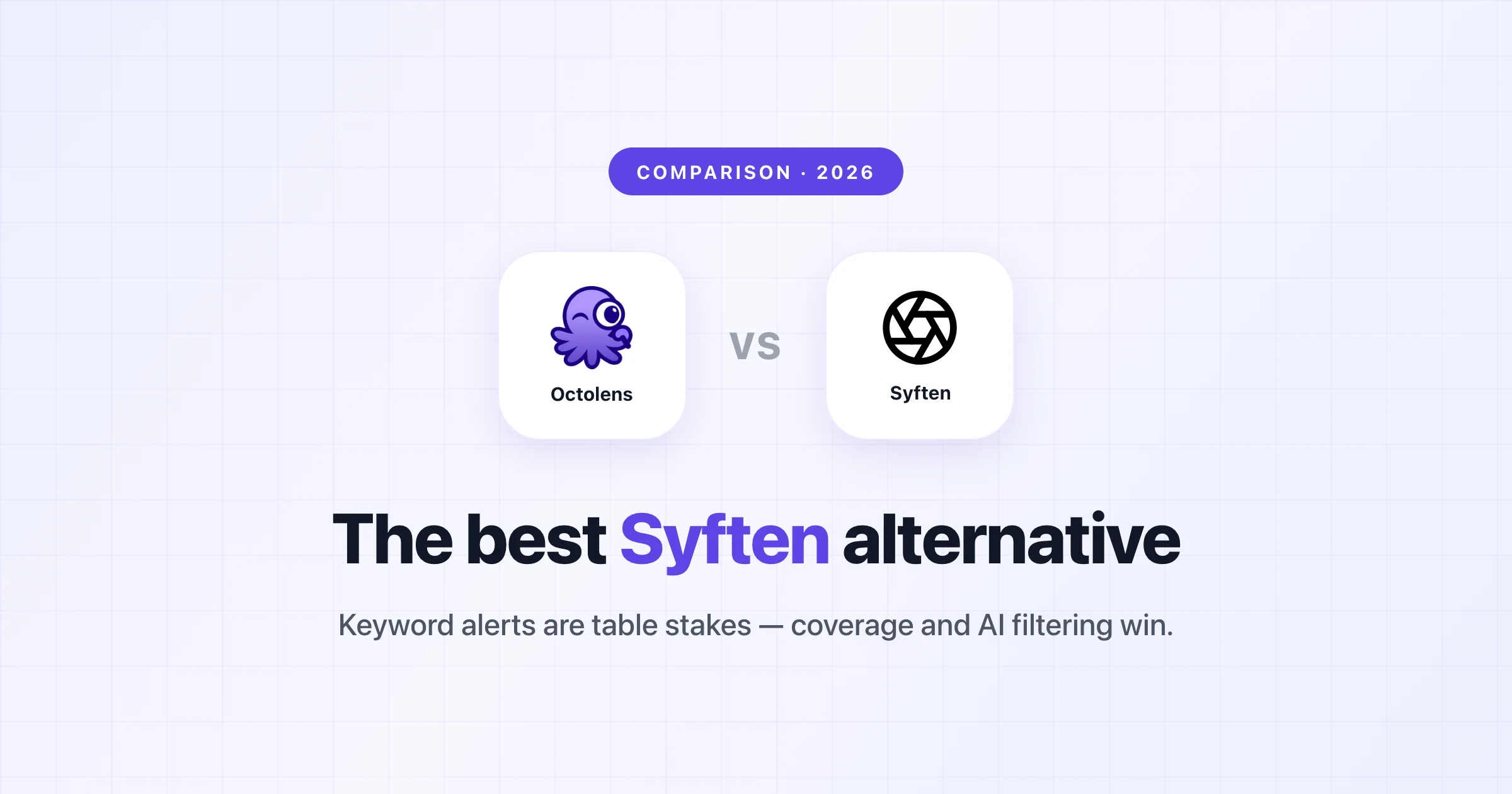
The Best Syften Alternative in 2026
Syften works for small indie projects, but it falls short once you scale. See how Octolens compares.
Syften is a solid little tool if you're an indie hacker or solo developer who wants to know when someone mentions your project on Hacker News or Indie Hackers. It's simple, it does what it says, and for that specific use case it works.
But here's where people run into problems: the moment you grow beyond a handful of mentions per week, Syften starts to struggle. There's no AI filtering, so you manually sift through every result. LinkedIn isn't covered. Twitter/X costs extra. And the interface assumes you know exactly what Boolean syntax to use to get relevant results.
We hear from teams regularly who started on Syften and outgrew it. They need LinkedIn monitoring, better noise filtering, and a tool that works for a team — not just one person. That's what we built Octolens to be.
Here's how the two tools actually compare.
Octolens monitors brand mentions across 15 platforms — Twitter/X, LinkedIn, Reddit, Hacker News, GitHub, YouTube, Bluesky, DEV.to, Stack Overflow, podcasts, newsletters, Product Hunt, Medium, TikTok, and news sites.
Every mention runs through AI that scores it for relevance and sentiment, then delivers it via Slack, email, webhooks, or API. The goal: your team sees what matters without manually filtering hundreds of results.
Companies like Vercel (20+ teams using it), Prisma, Tally, and Juicebox use Octolens daily.
Syften tracks mentions across technology communities — Hacker News, Reddit, DEV, Stack Exchange, Indie Hackers, Lobste.rs, forums, news sites, and podcasts. It's built for smaller teams and individual makers who want to find conversations about their projects.
The filtering is keyword-based with Boolean operators — you define include/exclude terms manually. Twitter/X monitoring is available but costs extra, and LinkedIn isn't supported at all.
This is the biggest gap. Syften is focused on indie/tech communities, which is great for early-stage projects. But once you're a growing B2B company, you need LinkedIn and Twitter/X — that's where prospects, customers, and partners talk about you.
Octolens covers:
- LinkedIn, Twitter/X, Reddit, Bluesky
- Hacker News, GitHub, Stack Overflow, DEV.to
- YouTube, TikTok, Product Hunt, Medium
- Podcasts, Newsletters, News sites
Syften covers:
- Hacker News, Reddit, DEV, Stack Exchange
- Indie Hackers, Lobste.rs, Product Hunt
- Forums, News sites, Podcasts
- Twitter/X (extra cost), Upwork, Newsletters
- No LinkedIn, No GitHub, No YouTube
The LinkedIn gap is a dealbreaker for B2B teams. If you're selling to other businesses, LinkedIn is where your buyers discuss tools, ask for recommendations, and evaluate options. Missing that platform means missing some of your most valuable mentions.
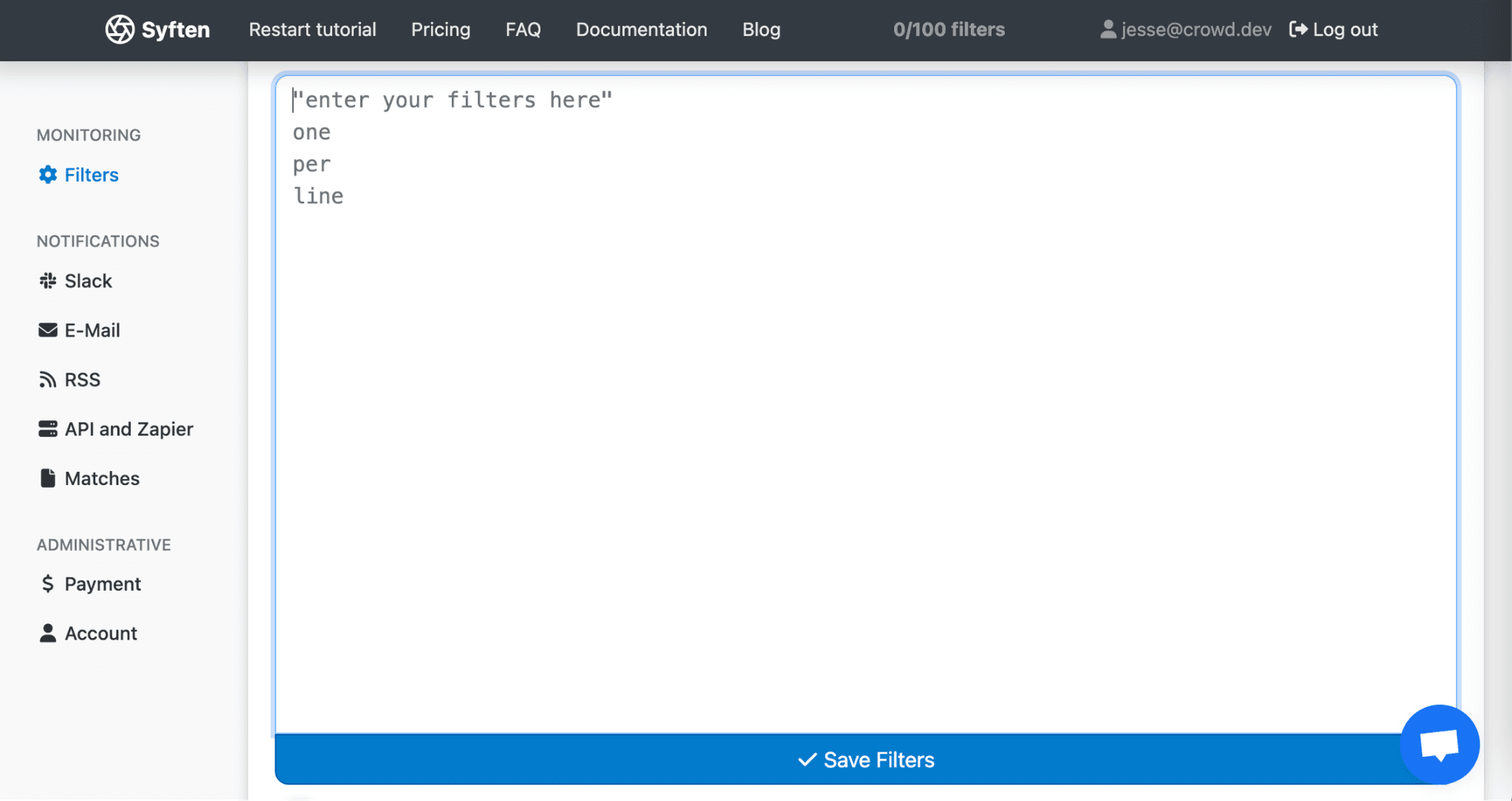
This is where the experience diverges most. Syften relies on you to get the filtering right through keyword syntax — include terms, exclude terms, and Boolean operators. Their onboarding email literally walks you through the syntax you need to learn.
If you're technical and have a unique product name, this works. If your brand name is a common word (like "Tally" or "Juicebox") or you're tracking competitors with ambiguous names, you'll spend a lot of time tuning your queries — and still miss relevant mentions or get flooded with noise.
Octolens handles this differently. Our AI knows your company context — what you do, who your competitors are, what's relevant — and scores each mention automatically. High relevance posts surface first, irrelevant ones get filtered out. No syntax to learn, no manual tuning.

Octolens: Sign up, enter your company URL, and the AI generates keyword suggestions and a company profile. You'll have mentions — including a 7-day backfill — within minutes. No syntax to learn, no manual configuration.
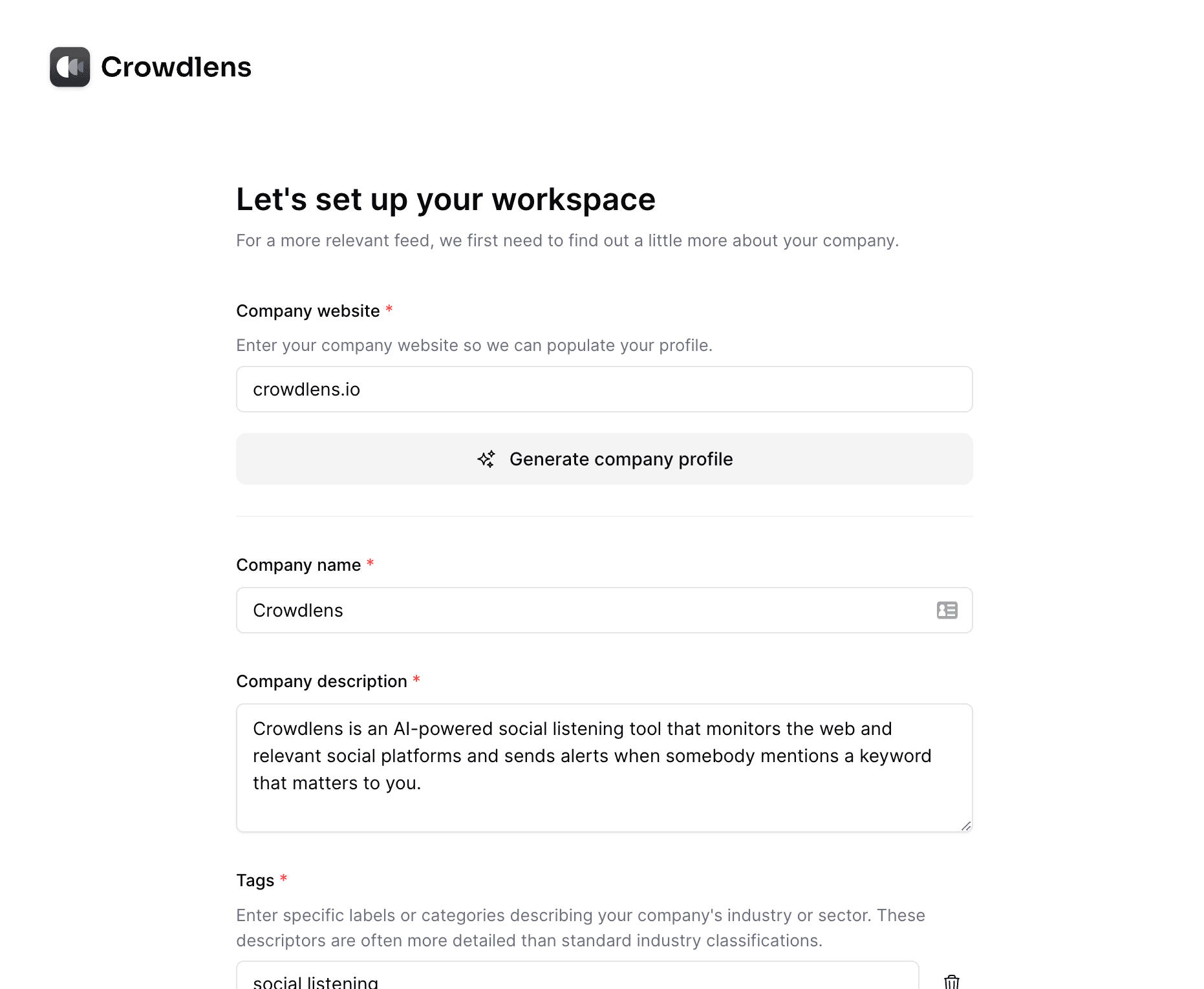
Syften: Sign up with email, verify, and start entering keywords. You'll need to configure Boolean filters and select platforms. The setup is fast if you know what you're doing, but non-technical team members (marketing, sales, customer success) might find the syntax-driven approach harder to work with.
Syften is built for individuals and small teams. It works well when one person is tracking a few keywords. But it wasn't designed for company-wide use — there's no easy way to share monitoring across departments or give multiple people visibility into the same mention feed.
Octolens includes unlimited team seats on every plan. At Vercel, for example, 20+ teams each have their own Slack channel fed by Octolens — product, DevRel, marketing, and engineering all see the mentions relevant to them. That kind of team-wide visibility is core to how we designed the product.
Octolens starts at $159/month (Pro, annual) with 15,000 mentions across all 15 platforms, 10 keywords, hourly alerts, and analytics. Every plan includes API, webhooks, and MCP access. 7-day free trial.
Syften starts at $29.95/month for 3 filters, but that doesn't include Twitter/X or Quora — those cost extra. Slack notifications also require a higher plan. The per-platform add-on pricing can add up quickly if you need more than the basics.
At the entry level, Syften is cheaper. But once you add Twitter/X and Slack notifications, the gap narrows — and you're still without LinkedIn, GitHub, YouTube, or AI filtering.
Octolens: Slack, email (configurable), webhooks, REST API. Most customers use Slack for real-time alerts and email digests for weekly recaps.
Syften: Email, Slack (higher plans), RSS, API, and Zapier. Syften actually has a good range of notification options — RSS and Zapier integrations are nice touches that Octolens doesn't offer yet.
Octolens: Live chat, direct access to the team. We're a small company and we actually want to hear from customers — feedback shapes our roadmap.
Syften: Chat support with daily response times, plus email. They're responsive, though it's less clear how quickly you'll get help during off-hours.
| Octolens | Syften | |
|---|---|---|
| Pricing | From $159/mo | From $29.95/mo |
| Keyword monitoring | Yes | Yes |
| AI relevance scoring | Yes | No (manual Boolean) |
| AI-assisted setup | Yes | No |
| Update speed | Up to real-time | Up to 15 minutes |
| Mentions feed | Yes | Limited |
| Email notifications | Yes | Yes |
| Slack notifications | Yes (all plans) | Yes (higher plans) |
| Webhooks & API | Yes (all plans) | API available |
| RSS | No | Yes |
| Yes | No | |
| Twitter/X | Yes | Extra cost |
| GitHub | Yes | No |
| YouTube | Yes | No |
| Hacker News | Yes | Yes |
| Yes | Yes | |
| DEV | Yes | Yes |
| Stack Overflow | Yes | Yes |
| News/Blogs | Yes | Yes |
| Podcasts | Yes (Scale+) | Yes |
Syften is a good fit if you're an indie developer or small technical team tracking a few keywords across tech communities. You're comfortable with Boolean syntax, you don't need LinkedIn, and you want a budget-friendly option.
Octolens is the better choice if you're a growing B2B company that needs LinkedIn and Twitter/X coverage, AI-powered filtering, team-wide visibility, and a tool that scales with you. Especially if you're getting more than a few dozen mentions per week — the AI filtering alone will save your team hours of manual sorting.
Most teams that switch from Syften to Octolens tell us two things: they had no idea how many mentions they were missing on LinkedIn, and the AI filtering is the feature they didn't know they needed until they had it.
Start a free trial to see the difference for yourself.