Competitor Social Media Monitoring: The Insider's Guide
How to track competitors on social media without wasting time on vanity metrics.
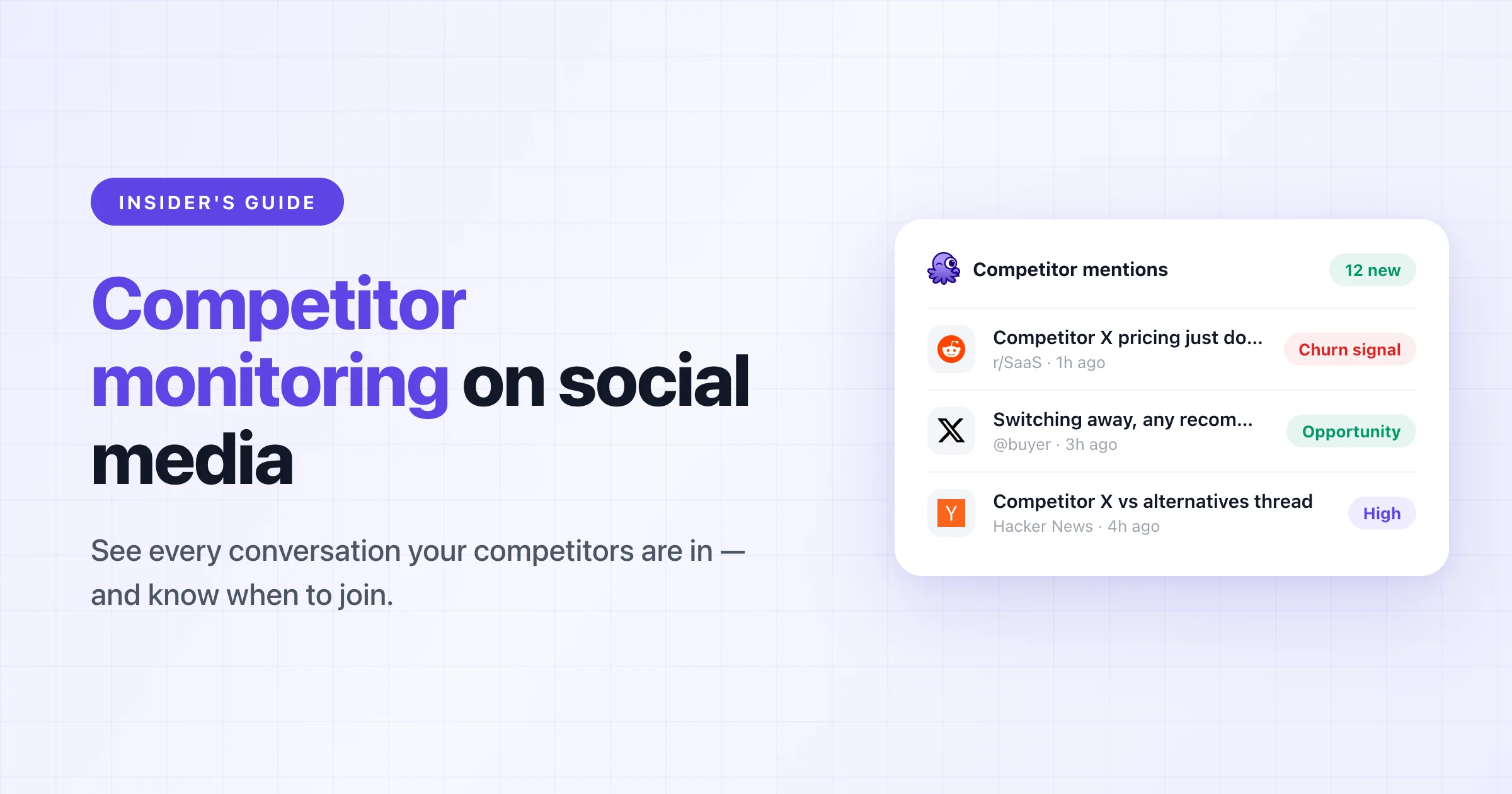
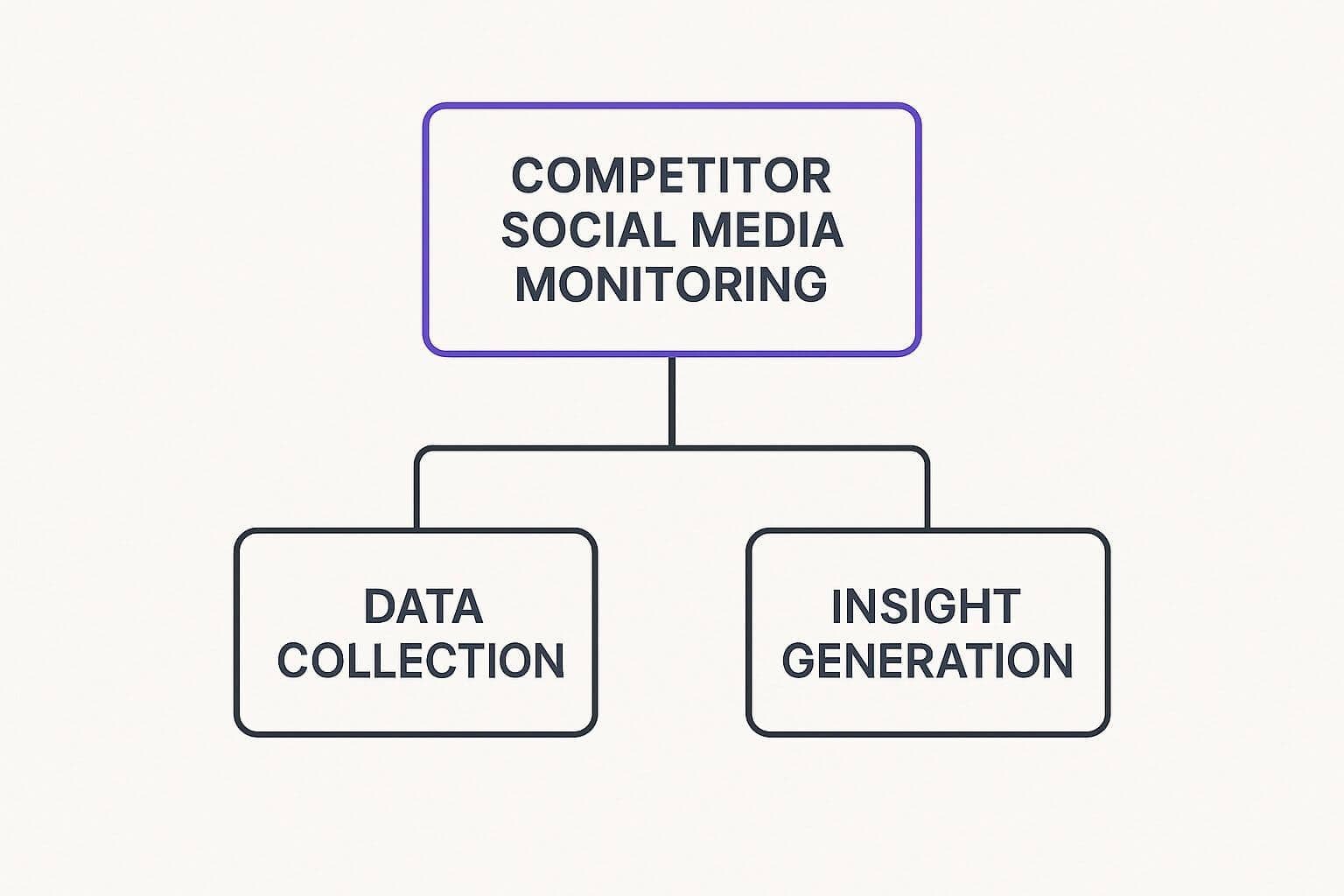
Most competitor monitoring fails for the same reason: teams track too many things and act on too few. You set up alerts for five competitors, get 200 mentions a week, skim through them occasionally, and nothing changes.
The companies that actually benefit from competitor monitoring do something different. They focus on a few specific questions — What are our competitors' customers unhappy about? What messaging is working for them? Where are the gaps we can fill? — and build a lightweight system around those questions.
This guide is how to do that without it becoming a full-time job.
The obvious competitors — the ones everyone in your category knows — are just the start.
Think in three categories:
- Direct competitors sell a similar product to the same audience. If you sell project management software, that's Asana, Monday, Notion.
- Indirect competitors solve the same problem differently. A team using Google Sheets and Slack reminders instead of project management software is an indirect competitor.
- Emerging competitors are the startups that seem irrelevant today but could eat your lunch in 18 months. These are worth watching even if they're small.
| Competitor type | How often to check | What to watch |
|---|---|---|
| Direct | Daily/Weekly | Pricing changes, feature launches, campaign messaging, customer complaints |
| Indirect | Weekly/Monthly | Content strategy, audience engagement, market positioning |
| Emerging | Monthly | Product innovation, growth signals, hiring patterns |
Direct competitors need the most attention. Indirect and emerging competitors are background monitoring — you're looking for shifts, not daily updates.
Where to find competitors you might be missing: Your sales team hears about them in calls ("We're also looking at X"). Keyword research shows who's ranking for your terms. Industry forums surface tools you've never heard of. And Reddit threads asking "What's the best tool for X?" are goldmines — people recommend tools you might not have on your radar.
Before you set up any monitoring, answer this: What will you actually do with the information?
Vague goals like "track the competition" lead to dashboards nobody checks. Specific goals lead to action:
- "Understand why competitor X's latest campaign went viral" — you'll focus on content analysis and engagement patterns
- "Know within 24 hours when a competitor changes pricing" — you'll set up targeted alerts
- "Find the complaints competitor customers have that we already solve" — you'll track social signals and monitor sentiment on Reddit and Twitter
Your monitoring goals should connect to something you'll actually change: your messaging, your pricing, your product roadmap, your content calendar. If a piece of intel wouldn't change any decision, you don't need to track it.

Expensive dashboards don't automatically equal better intelligence. Some of the priciest enterprise platforms are loaded with features most teams never touch. Meanwhile, a focused tool that covers the right platforms can deliver more useful intel at a fraction of the cost. We've compared the full landscape — CI platforms, SEO tools, price trackers, website-change alerts, and mention monitoring — in our roundup of the best competitor monitoring tools.
A few practical guidelines:
Start with one or two tools, not a full stack. You can always add more later. A common setup for B2B SaaS companies: a dedicated social media monitoring tool for Twitter/Reddit/LinkedIn + Google Alerts for news and blog mentions.
Match the tool to the platforms that matter. If your competitors' customers are on Twitter and Reddit, you need a tool that actually monitors those platforms well — not one that just checks news sites. For B2B SaaS, Octolens covers Twitter/X, LinkedIn, Reddit, Hacker News, and 11 other platforms where developer and SaaS conversations happen. More details in our Twitter monitoring deep-dive.
Don't confuse data with insight. A tool that gives you 500 mentions a day but no way to sort them by importance isn't saving you time — it's creating work. AI-powered filtering (like relevance scoring) matters a lot more than raw volume.
| Platform | What to track | Useful tools |
|---|---|---|
| Twitter/X | Complaints, feature requests, launch reactions | Octolens, native analytics |
| Recommendation threads, comparisons, candid feedback | Octolens | |
| Thought leadership, company updates, hiring signals | Octolens, manual checks | |
| Ad Library for competitor ad creative | Facebook Ad Library |
A competitor's post getting 1,000 likes doesn't tell you much by itself. What matters is why it resonated and whether that engagement connects to business results.
Engagement quality matters more than volume. A competitor's LinkedIn post with 50 thoughtful comments from potential buyers is more meaningful than a viral tweet with thousands of likes from people who'll never purchase. If you see a competitor consistently sparking discussions with your target audience, pay attention — they're building credibility where it counts.
For context on platform-specific engagement benchmarks, check our guide on which social networks to start with.
Track content formats, not just topics. Are their product demo videos driving signups? Are comparison blog posts generating backlinks? Are LinkedIn polls sparking conversations with decision-makers? Understanding what format works for competitors helps you pick your own content battles.
Watch for sentiment shifts over time. A competitor suddenly getting more negative mentions could signal a botched product update, a pricing change that frustrated customers, or a support quality decline. These are windows of opportunity — but only if you catch them while they're happening.

Organic social media is just the surface. Competitor advertising — what they're spending money on — reveals their real strategic priorities.
Spot A/B tests. Watch for small variations in ad copy, visuals, or targeting across a competitor's ads. If they're testing different discount levels, pricing sensitivity is a factor in their market. If they're testing different value propositions, they haven't found their winning message yet. Both are useful intel.
Track ad spend patterns. Where competitors invest most heavily tells you where they see the best returns. If a competitor is pouring budget into LinkedIn ads targeting CTOs while ignoring Twitter, that tells you something about their ICP and where they're finding traction.
Check the Facebook Ad Library regularly. It's free and shows all active ads for any company page. You can see creative, copy, and when campaigns launched. It's one of the most underused free tools for competitive intelligence.
Find the gaps. If every competitor is running Google Ads but nobody's doing Reddit-native content, that's an open lane. If everyone targets the same enterprise audience, the mid-market might be underserved. Competitor advertising patterns reveal not just what they're doing, but what they're not doing.
Competitor intelligence that sits in a spreadsheet doesn't help anyone. The point is to change what you do based on what you learn.
React to competitor weaknesses. When a competitor ships a buggy update and their subreddit fills with complaints, that's a window to reach those frustrated users with empathetic, helpful content (not schadenfreude — that backfires). When their customers publicly ask for a feature you already have, make sure your content surfaces for those conversations.
Adapt successful tactics — don't copy them. If a competitor's humor-driven Twitter presence is working, don't imitate their jokes. Instead, ask why humor is working for their audience and whether a different personality angle could work for yours.
Share intel across your team. Competitive intelligence is useful beyond marketing. Sales teams can use it to handle objections ("Yes, we saw CompetitorX launched that too — here's why our approach is different..."). Product teams can use it to validate or reprioritize roadmap items. Customer success can use it to proactively address concerns before they become churn risks.
Time your responses. Not every competitor move requires an immediate reaction. When a competitor launches a new product, sometimes the best play is to wait, let the initial buzz settle, observe what customers like and dislike, then respond with something more targeted. Rushed responses often look desperate.
For the tooling side, see how Octolens handles competitor monitoring — switching-thread alerts, sentiment comparison, and CRM routing.
You don't need to spend hours on this. Here's a realistic weekly rhythm:
Daily (5-10 minutes):
- Check Slack/email alerts for competitor mentions
- Flag anything that needs a response today (customer complaints about competitors, buying-intent threads)
Weekly (30 minutes):
- Review competitor campaign activity — new ads, new content, messaging changes
- Check sentiment trends — is perception shifting for any competitor?
- Share 2-3 key findings with your team (a short Slack message works fine)
- Note any new emerging competitors that surfaced
Monthly (1 hour):
- Zoom out: how has the competitive landscape shifted?
- Update your competitor tracking keywords if needed
- Review whether your monitoring is answering the questions you set at the start
The key is consistency, not intensity. Thirty minutes a week of focused competitor monitoring beats three hours of unfocused data collection.
If you're manually checking competitor Twitter accounts and Reddit threads, you already know that doesn't scale. Octolens automates the collection across 15 platforms and uses AI to surface the mentions that actually matter — so you spend your time on the insight, not the search.
Start a free trial and set up your first competitor keyword in under two minutes.