
A Human's Guide to Online Reputation Repair
A practical guide to online reputation repair. Learn proven strategies to manage negative feedback, rebuild trust, and protect your brand's digital presence.

Online reputation repair is all about regaining control of your story online. It’s a deliberate process of handling negative content—whether that means addressing it head-on, pushing it down in search results, or getting it removed—while actively promoting the good stuff. The goal is simple: when someone looks you up, they see a fair and accurate picture of who you are.
Finding something negative about your brand online can feel like a punch to the gut. The first instinct for most people is to either panic or fire back a defensive response. The absolute best thing you can do? Pause. Take a breath. Think strategically.
Before you can even think about fixing the problem, you need to understand exactly what you're dealing with. A comprehensive digital audit is your non-negotiable first step. This isn’t just a quick Google search; it’s a deep dive into every corner of the web where your name might appear.
This initial phase is about mapping out your entire online footprint. You need to know what's being said, where it's being said, and if possible, who's saying it. This means digging past the first page of search results and exploring forums, social media chatter, niche blogs, and review sites relevant to your industry.
Think of your audit as an intelligence-gathering mission, not just a link-collecting exercise. Start by searching your brand name, the names of key executives, and your main products. Don't forget to throw in common variations or misspellings. A crucial pro-tip: always use your browser's incognito or private mode to get clean, unbiased search results that aren't skewed by your own browsing history.
To start organizing what you find, you need a system to separate the minor annoyances from the major fires.
Here’s a simple framework I use to categorize negative content and figure out the right immediate action. It helps turn a feeling of being overwhelmed into a clear, prioritized plan.
Threat Level Example Scenario Your First Action Low A neutral or slightly negative comment on a low-traffic forum. Monitor the conversation. Don't jump in unless it starts gaining traction. Medium A one-star review on a major platform like or . Draft a thoughtful, public response to address the specific issue. High A negative article on a popular news site or a viral social media post. This becomes your top priority. It requires immediate, strategic action.
This process helps you see that not all negative mentions are created equal. Some are just background noise, while others are code-red threats that demand your full attention right away.
This initial audit provides a solid baseline for your entire online reputation repair strategy. It’s about moving from reacting emotionally to acting with purpose. The infographic below really captures this workflow, showing the progression from audit to analysis and, finally, to prioritization.
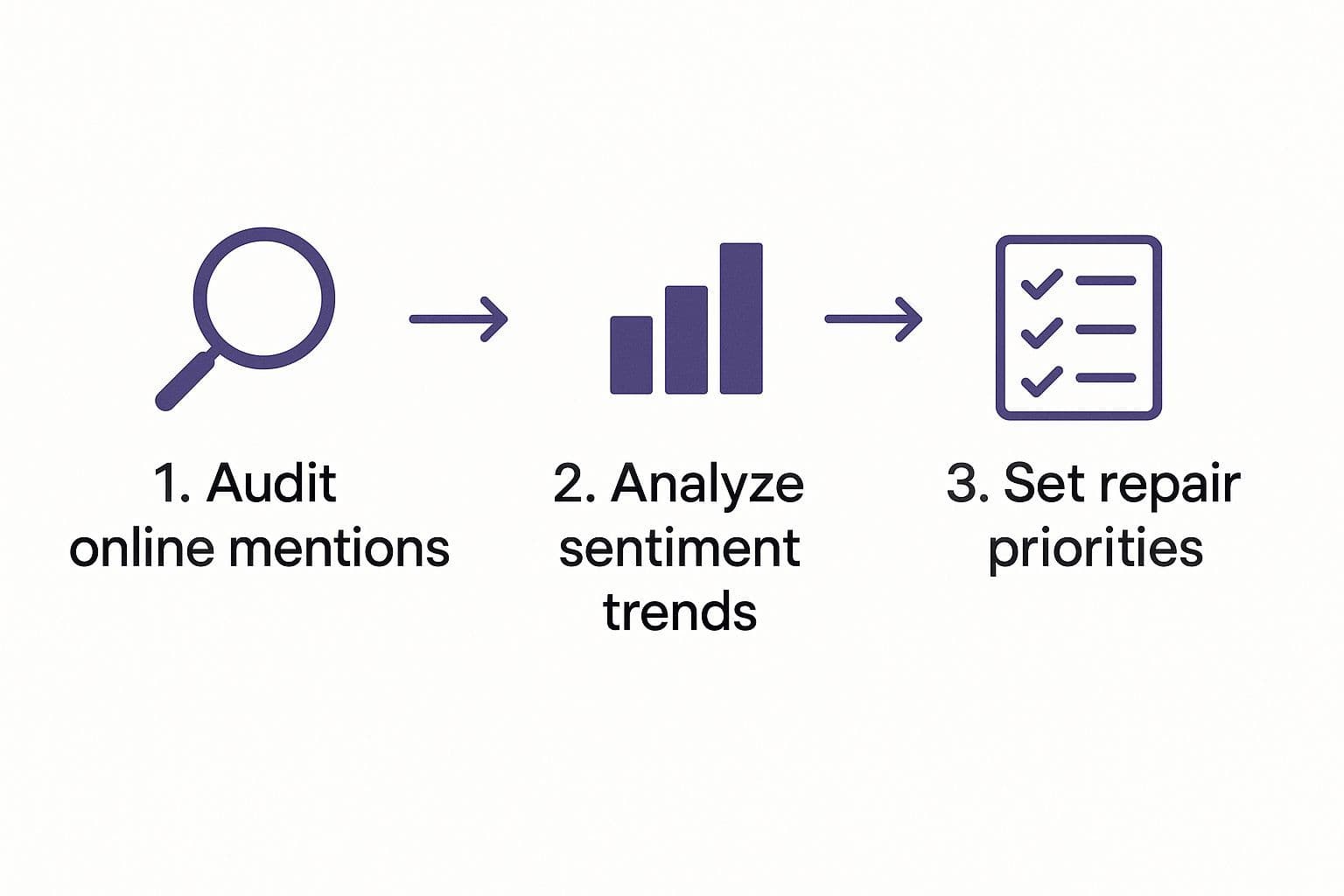
This visual brings home the importance of a structured approach. You have to tackle the most damaging issues first to have the biggest impact.
Don't underestimate the real-world business impact of a negative online reputation. The numbers don't lie: 90% of customers read online reviews before visiting a business. Even a single-star increase in your overall rating can boost revenue by up to 10%. With financial stakes this high, ignoring your digital footprint simply isn't an option anymore. You can dig into more data on how reputation impacts revenue on Erase.com.
The point of an audit isn’t to get into a shouting match with every critic. It’s about understanding the big picture—the overall sentiment, recurring complaints—and building a targeted plan that fixes the root causes, not just the symptoms.
By conducting your own audit first, you get the clarity you need to decide your next move, whether that's handling it in-house or bringing in professional help.
How you handle negativity online can either put out a small fire or turn it into a full-blown crisis. A defensive, canned, or dismissive reply often does more damage than the original complaint ever could.
The goal here isn't just to apologize; it's to turn every negative interaction into a public showcase of your integrity and commitment to getting things right.

Think of your public response as a performance. The original poster is just one person in the audience, but thousands of potential customers are watching to see how you handle the heat. A great response doesn't just placate one unhappy customer—it builds trust with everyone who sees it.
In fact, one study found that 89% of travelers said seeing a thoughtful response to a negative review improves their impression of a business. This isn't just about damage control; it's a core part of effective online reputation repair.
A truly effective response is more than just saying "sorry." It follows a specific formula that de-escalates tension and demonstrates accountability. It’s a skill that blends empathy with strategic communication, and it's absolutely essential for anyone facing public criticism.
Here’s a breakdown of the key ingredients:
- Acknowledge and Validate: Start by thanking them for their feedback, even if it’s harsh. Use phrases like, "Thank you for bringing this to our attention," or "We're really sorry to hear your experience didn't meet your expectations." This immediately shows you're listening, not just reacting.
- Show Empathy (Without Admitting Fault Initially): You can be empathetic without immediately accepting blame, which is crucial if you still need to gather all the facts. Say something like, "That sounds incredibly frustrating," or "I can completely understand why you're disappointed."
- Take it Offline: This is the most critical step. Your goal is to move the sensitive part of the conversation out of the public eye. Provide a direct contact, like an email address or a specific person's name, to show you're serious about finding a resolution.
- Keep it Brief and Professional: The public space is not the place for a lengthy back-and-forth. Keep your reply concise, professional, and laser-focused on the solution.
A great public response is a bridge, not a battlefield. Your goal is to move the conversation from a public complaint to a private resolution, showing everyone else that you take feedback seriously.
This approach transforms a complaint from a public spectacle into a powerful demonstration of your customer service. The strategy shifts from winning an argument to winning over the audience.
Not every piece of negativity deserves a reply. Part of mastering the art of the response is knowing when to engage and when to just let it go. Responding to obvious trolls or baiting comments only gives them the attention they crave and drags your brand into the mud with them.
Here's a quick guide to help you decide your next move:
Type of Comment Should You Respond? Why or Why Not? Legitimate Customer Complaint Yes, always. This is your chance to solve a real problem and showcase your customer service. Factually Incorrect Information Yes, gently. Politely correct the information without being condescending. Just stick to the facts. Obvious Trolling or Spam No, never. Engaging fuels the fire. It's best to ignore, delete, or report these comments.
Deciding how to act under pressure can be tough. For a deeper look into handling high-stakes situations, our guide on public relations crisis management offers strategies for navigating even the most challenging scenarios. Understanding these principles helps you maintain control of the narrative when it matters most.
Let's walk through a practical scenario. A customer leaves a one-star review on Google: "Your software is buggy and support never got back to me. Waste of money!"
A Bad Response (Defensive and Generic):"We are sorry you had a bad experience. Our software is used by thousands of happy customers and our support team has a 95% satisfaction rate. We will look into your ticket."
This reply immediately invalidates the customer's feelings and reads like a cold, corporate template. It basically says, "You're wrong, we're great."
A Good Response (Empathetic and Action-Oriented):"Hi [Customer Name], thank you for sharing this feedback. I'm genuinely sorry to hear about the bug you encountered and the delay from our support team—that's definitely not the experience we want for our users. I want to personally look into this for you. Could you please email me directly at [manager@email.com] with your ticket number?"
This response validates their frustration, takes ownership, and provides a clear, personal path to a solution. It turns a public failure into a public promise of excellent service.
Responding to negative comments is a critical defensive move, but you can’t win a football game just by playing defense. The most powerful strategy in reputation repair is to go on offense—building a formidable wall of positive content that you own and control.
The goal is pretty straightforward: when someone searches for your brand, the first page of results should be dominated by positive, authoritative websites, profiles, and articles that tell your story the way you want it told. This process, often called suppression, doesn't actually remove the negative stuff. It just pushes it down to page two or three of the search results, where almost no one ever looks.
Think of the first page of Google as prime real estate. If you don't own the properties on that block, someone else will, and you might not like what they decide to build there. By actively creating and promoting your own content, you take back control of that incredibly valuable space.
Your best allies in this fight are the digital properties that naturally rank well for your name. These are the foundational bricks in your positive content wall. If you haven't already, your immediate priority is to claim, create, and optimize these assets.
The single most important digital asset you have is your own website. It’s the one piece of the internet you truly own. Even a simple, professional site acts as the central hub for your brand and is a massive ranking signal for search engines.
Beyond your website, get these key platforms locked down:
- Social Media Profiles: Create and maintain active profiles on platforms where your audience actually hangs out. For B2B brands, this is almost always LinkedIn and X (formerly Twitter). For others, it might be Instagram or YouTube. The key is to be active; an empty, dormant profile doesn't do you much good.
- Business Directories: Make sure your business is listed and fully filled out on major directories like Google Business Profile, Yelp, and any industry-specific sites. These platforms carry a lot of authority with search engines.
- Professional Profiles: For individuals and key executives, profiles on sites like LinkedIn are non-negotiable. A well-optimized profile can often rank on the first page for a person's name all on its own.
The core idea is to create a diverse ecosystem of high-quality content that you control. When search engines see multiple authoritative sources all pointing to the legitimacy of your brand, they are far more likely to rank those sources above a single negative review on some obscure, less authoritative site.
This proactive approach is what separates long-term, sustainable reputation management from frantic, short-term damage control.
Once you've secured your core digital properties, it's time to start publishing. Search engines are hungry for fresh, relevant content, so a steady stream of new material is crucial for effective online reputation repair. You need to give Google positive things to find.
But don't just create content for the sake of it. Each piece should be valuable, well-written, and optimized to rank for your brand name and related terms. This means weaving your brand name naturally into titles, headings, and the body of your text.
Here are a few powerful content ideas to get you started:
Content Type Why It Works for Reputation Repair Example in Action Company Blog Posts You have full control over the message and can showcase expertise, company culture, and positive news. A post titled "How [Your Company Name] Is Tackling [Industry Challenge] in 2024." Press Releases Announcing company milestones, new hires, or awards can get picked up by news outlets, creating positive third-party validation. Distributing a release about a recent charity partnership or a significant product launch. Guest Articles Publishing on respected industry blogs builds authority and creates high-quality backlinks to your own site. Your CEO writes an article for a major industry publication, with a byline mentioning your company.
This strategy directly influences what potential customers see, and the numbers back it up. With around 83% of consumers distrusting direct advertising, they turn to reviews and organic search results to make decisions. In fact, research shows that for every one-star rating increase on a platform like Yelp, a business can see its sales jump by up to 9%. You can discover more insights about how reputation impacts consumer trust on llcbuddy.com.
This is precisely why creating your own positive narrative is so critical. It's not just about pushing down the bad; it's about building up the good to win over a naturally skeptical audience. For your social channels, mastering the art of the message is key. If you need help refining your voice, check out our guide on copywriting for social media for practical tips.
Ultimately, building this wall of content is an investment in your brand's future resilience. It ensures that your story is told on your terms, making your reputation far less vulnerable to the unpredictable nature of online negativity.
A steady flow of positive reviews is your brand's best long-term defense against negativity. Think of it as the offensive play that reinforces all your defensive work. It builds a powerful buffer of social proof that makes any random negative comment look like what it is—an outlier, not the norm.
Here’s a little secret, though: most of your happy customers will never think to leave a review on their own. It’s not that they wouldn’t; it’s just not on their radar. Your job is to make it incredibly easy and natural for them to share their good experiences.
This is a critical part of sustainable online reputation repair. While you’re busy pushing down negative content, you absolutely have to be cultivating positive signals that tell both search engines and potential customers you’re a brand they can trust.
The biggest fear I see from businesses is coming across as pushy or desperate. The trick is to time your request perfectly and make the entire process frictionless. You want to ask when the customer's good feelings about your brand are at their peak.
Think about the natural high points in your customer journey. Is it right after they’ve successfully used your product for the first time? Or maybe immediately after a great interaction with your support team? That’s your window.
Here are a few simple, non-intrusive systems you can get up and running quickly:
- Targeted Email Follow-ups: A few days after a purchase or a successful service interaction, send a simple, personal email. Don't bury the request in a long newsletter. It should be a standalone message focused entirely on their experience.
- QR Codes at Point of Sale: For brick-and-mortar businesses, a simple QR code at the checkout counter that links directly to your Google review page can work wonders. Make it as easy as "scan, tap, and share."
- Text Message Prompts: If you’re a service-based business, a quick text message the day after you've completed the job can have a surprisingly high engagement rate. Just keep it short and provide a direct link.
The golden rule is to ask once, make it easy, and then get out of the way. Your goal is to remove every possible barrier between a customer's happiness and them sharing that feeling with the world.
This proactive approach really pays off. Businesses that actively ask for reviews almost always see their star ratings climb, which has a direct impact on their bottom line.
Don't spread yourself too thin trying to get reviews on every platform under the sun. Instead, focus your efforts on the one or two places that matter most to your audience. The goal here is to build up a high volume of positive reviews on the sites that carry the most weight.
Platform Type Why It's Important Best For Google Business Profile This is the most visible review platform for almost any business. Your Google rating shows up right in search results and on Maps. Virtually every business, especially local ones. Industry-Specific Sites These sites (like Yelp for restaurants or Capterra for software) are highly trusted because they are specialized. Businesses in established niches with dedicated review platforms. Trustpilot or G2 Broad-based review platforms that carry a lot of authority for online businesses, SaaS, and e-commerce. Companies that operate nationally or globally online.
Focusing your energy this way allows you to build momentum where it actually counts. Having 50 great reviews on Google is far more powerful than having two reviews scattered across 25 different websites. This concentrated effort will make a much bigger dent in your reputation repair campaign.
Once you start getting those great reviews, don't just let them sit there. Turn them into powerful marketing assets. This is how you amplify the positive voices and build a fortress of social proof that drowns out the occasional bit of negativity.
Your best reviews should be showcased everywhere. Seriously.
- Put them right on your website's homepage.
- Feature them on dedicated product or service pages.
- Turn them into graphics for your social media posts.
- Include them in email newsletters and sales proposals.
By strategically featuring your best testimonials, you take back control of the narrative. You’re not just hoping people stumble upon good things about you; you're actively showing them, reinforcing the positive reputation you've worked so hard to build. This transforms review collection from a passive chore into an active part of your brand-building and reputation strategy.
Successfully repairing your online reputation isn't a one-and-done project; it’s a long-term discipline. Once you’ve put out the immediate fires, the real work begins. You need an efficient system to spot smoke before it turns into another inferno.
This isn’t about spending hours every day scouring the internet. It’s about setting up a smart, low-effort dashboard that brings critical mentions directly to you. This way, you can catch potential issues early, engage with positive feedback, and stay in control of your brand’s narrative.

As you can see, setting up a basic alert is straightforward and takes just a few seconds. This simple action creates an automated search that delivers new mentions of your chosen keywords directly to your inbox, acting as your first line of defense.
You don't need a massive budget to start monitoring effectively. The best place to begin is with free, powerful tools that are easy to set up.
Your first move should absolutely be Google Alerts. It’s a free service that emails you whenever it finds new results—like web pages, news articles, or blog posts—that match the search terms you give it. Think of it as the simplest way to keep a finger on the pulse of what's being said about you online.
To get the most out of it, don’t just track your brand name. Set up alerts for:
- Key Executives: Monitor the names of your CEO, founders, and other public-facing team members.
- Product Lines: Keep tabs on what people are saying about your specific products or services.
- Common Misspellings: Catch mentions that might otherwise slip through the cracks.
While this gives you a great baseline, just remember that free tools have their limits. They won’t catch every conversation, especially on social platforms.
A solid monitoring strategy goes way beyond just your brand name. To truly protect your reputation, you need to cast a wider net. A thoughtful checklist ensures you’re not just reacting to problems but are actively aware of the entire conversation happening around your brand and industry.
Consider adding these to your weekly review:
Category to Monitor Why It Matters Example Keywords Competitor Names Helps you spot industry trends, competitive threats, and opportunities where you can shine. "[Competitor Name] reviews", "[Competitor] vs [Your Brand]" Industry Keywords Understand broader conversations and find opportunities to position yourself as an expert. "best tools for [your industry]", "problems with [your niche]" Brand Slogans See how your marketing messages are being used or discussed by others online. "[Your Slogan]"
Proactive monitoring is the difference between being a participant in the conversation about your brand and being a victim of it. It allows you to shape the narrative instead of just cleaning up after it.
The stakes are higher than ever. With 92% of users stating they will only consider businesses with at least a four-star rating, even one unaddressed negative mention can have a real financial impact. You can learn more about how reputation statistics affect customer decisions on ReputationX.com.
Setting up a solid monitoring system is the most effective insurance policy for your brand's future.
We’ve walked through the strategies, from tackling negative feedback head-on to building a fortress of positive content. But when you’re actually in the trenches, the same practical questions always bubble up. Let's get straight to the point and answer the common hurdles people face when they start repairing their online reputation.
This is the million-dollar question, and the honest-to-goodness answer is: it depends. There's no magic wand here. The timeline is directly linked to how severe the damage is and how visible that negative content has become.
If you're just dealing with a handful of bad reviews on a site like Yelp, you could start seeing a positive shift in a matter of weeks. This is especially true if you’re actively getting new, positive reviews to come in. That’s the more manageable end of the spectrum.
But trying to bury a negative article from a major news outlet or a top-ranking complaint on a consumer watchdog site? That's a different beast entirely. We're talking about a marathon, not a sprint. You are likely looking at a 6-to-12-month campaign, maybe even longer, of consistent, focused work. Patience and persistence are your best friends here.
Think of it like gardening. You can’t just plant a seed and expect a full-grown tree the next day. You have to water it, give it sunlight, and pull the weeds day after day. It's the exact same principle for building a positive online presence.
In almost every scenario, the answer is a hard no. You can't just throw money at Google or a review platform to make a legitimate piece of feedback you dislike disappear. Doing so would completely destroy their credibility.
Removal is really only on the table under a couple of very specific conditions:
- It’s Illegal: The content is straight-up defamatory, libelous, or violates your copyright. This usually means getting lawyers involved.
- It Violates Terms of Service: The post includes things like hate speech, spam, or private information, which breaks the platform's own rules.
For the vast majority of negative content—like a scathing review or a critical blog post—your best strategy isn't removal. It's suppression. The idea is to create and promote so much high-quality, positive content that it pushes the negative stuff down to page two or three of Google, where it's basically invisible.
It's easy to use these terms interchangeably, but they're two sides of the same coin, representing very different approaches. Nailing down the distinction is crucial for building a brand that can weather any storm.
A good way to think about it is like a firefighter versus a fire inspector.
Approach Role & Function Analogy Reputation Repair This is your emergency response team. It’s a reactive process designed to fix damage that’s already been done—like putting out a fire that's already burning. The Firefighter Reputation Management This is the proactive, everyday work. It’s all about monitoring what’s being said, encouraging positive reviews, and building a strong digital presence to stop fires from starting in the first place. The Fire Inspector
Effective online reputation repair pulls you out of a crisis. But strong, ongoing reputation management is what keeps you from landing in another one.
Knowing when to call in backup is a critical skill. Not every reputation hiccup requires bringing in a specialized agency.
You can probably handle things yourself if you're dealing with a few negative reviews on the usual platforms. The tactics we've covered in this guide—responding thoughtfully, creating positive content, and asking for good reviews—are incredibly powerful and well within reach for most business owners.
However, it's time to call in the pros if you're facing a full-blown crisis, like:
- A viral negative story from a major news publication.
- A coordinated, malicious attack designed to tank your brand.
- Complex legal issues like slander or libel that are ranking on page one of Google.
- Negative content on highly authoritative websites that you simply can't outrank on your own.
Reputation repair agencies come armed with specialized tools, deep SEO expertise, and established relationships that give them a real edge. In these high-stakes situations, they can often get results much faster and more effectively than you could on your own.
Your online reputation is one of your most valuable assets. While these strategies give you a solid playbook, keeping up with every conversation can feel like a full-time job. Octolens helps you catch every critical mention across platforms like Reddit, X, and industry forums—without the noise. You can respond faster to threats, gather unfiltered feedback, and protect the brand you've worked so hard to build.
See how real-time monitoring can give you an edge at https://octolens.com.