
Public Relations Crisis Management: Proven Strategies
When Crisis Strikes: Understanding The New PR Battlefield
The digital age has dramatically changed how public relations crises unfold. Social media accelerates the spread of both information and misinformation at an alarming rate. This means organizations must react much faster, sometimes within minutes, to control the narrative and minimize damage.
Traditional, slow-moving PR strategies are no longer effective and can even worsen the situation. This new landscape demands a proactive and agile approach to public relations crisis management.
Different industries face unique challenges and vulnerabilities. A data breach is a major threat to a SaaS company like Octolens, while a product recall poses a greater risk to a consumer goods manufacturer. Understanding these industry-specific vulnerabilities is the first step in developing a robust crisis management plan.
Even seemingly minor incidents can quickly escalate into full-blown crises if mishandled. A single negative tweet, if ignored, can spiral into a viral nightmare, significantly impacting a company’s reputation. This interconnectedness necessitates constant vigilance and proactive monitoring of online conversations.
For example, the financial sector is highly sensitive to public opinion. A key trend in crisis management within the BFSI (Banking, Financial Services, and Insurance) sector is the rapid expansion of the global crisis management market. This market is projected to reach $30.46 billion by 2027 and grow to $72.3 billion by 2033.
This represents a remarkable compound annual growth rate (CAGR) of 16.7%. This growth highlights the increasing importance of managing crises in the financial world, where trust is paramount. For deeper insights into this trend, learn more about crisis management market growth. Effective and transparent communication is vital to mitigating damage and preserving stakeholder trust.
Distinguishing between everyday PR challenges and actual crises is crucial. Not every negative review or customer complaint signifies a crisis. However, failing to identify a developing crisis can be devastating.
A genuine crisis typically involves a serious threat to the organization's reputation, operations, or financial stability. These critical situations require a different level of response than routine PR activities. This underscores the importance of having a clear framework for identifying and assessing potential threats before they escalate.

Many organizations only think about crisis management when a crisis is already happening. By then, it's often too late. Resilient organizations take a different approach. They proactively build a foundation to prepare for challenges. This begins with understanding vulnerabilities and creating a structured response.
A vulnerability audit identifies your organization's weaknesses and potential crisis triggers. This involves examining everything from operational risks and cybersecurity threats to possible public perception issues. For example, a SaaS company might analyze the potential fallout from a data breach. A restaurant chain might prioritize food safety concerns. Knowing your weaknesses helps you allocate resources efficiently, focusing on high-impact areas before a crisis occurs.
After identifying potential vulnerabilities, create a dedicated crisis management team. This cross-functional group should include members from different departments, such as PR, legal, IT, operations, and customer service. Clearly define each member's responsibilities to ensure a coordinated and effective response.
A surprising 49% of U.S. businesses lack a documented crisis communication plan. However, those with plans rate their effectiveness highly. This underscores the importance of preparedness. More detailed statistics can be found here. Social listening can also be a valuable tool. Learn more in our guide on How Social Listening Can Help To Find Leads.
Your crisis plan should include specific procedures for different crisis scenarios. These response protocols act as a playbook, guiding your team's actions and communications. For common crises like product recalls or service outages, establish pre-written messages. These templates save valuable time during the critical initial stages of a crisis.
To help you build a robust crisis management plan, the following table outlines key components:
Crisis Management Plan Components: A comparison of essential elements that should be included in a comprehensive crisis management plan.
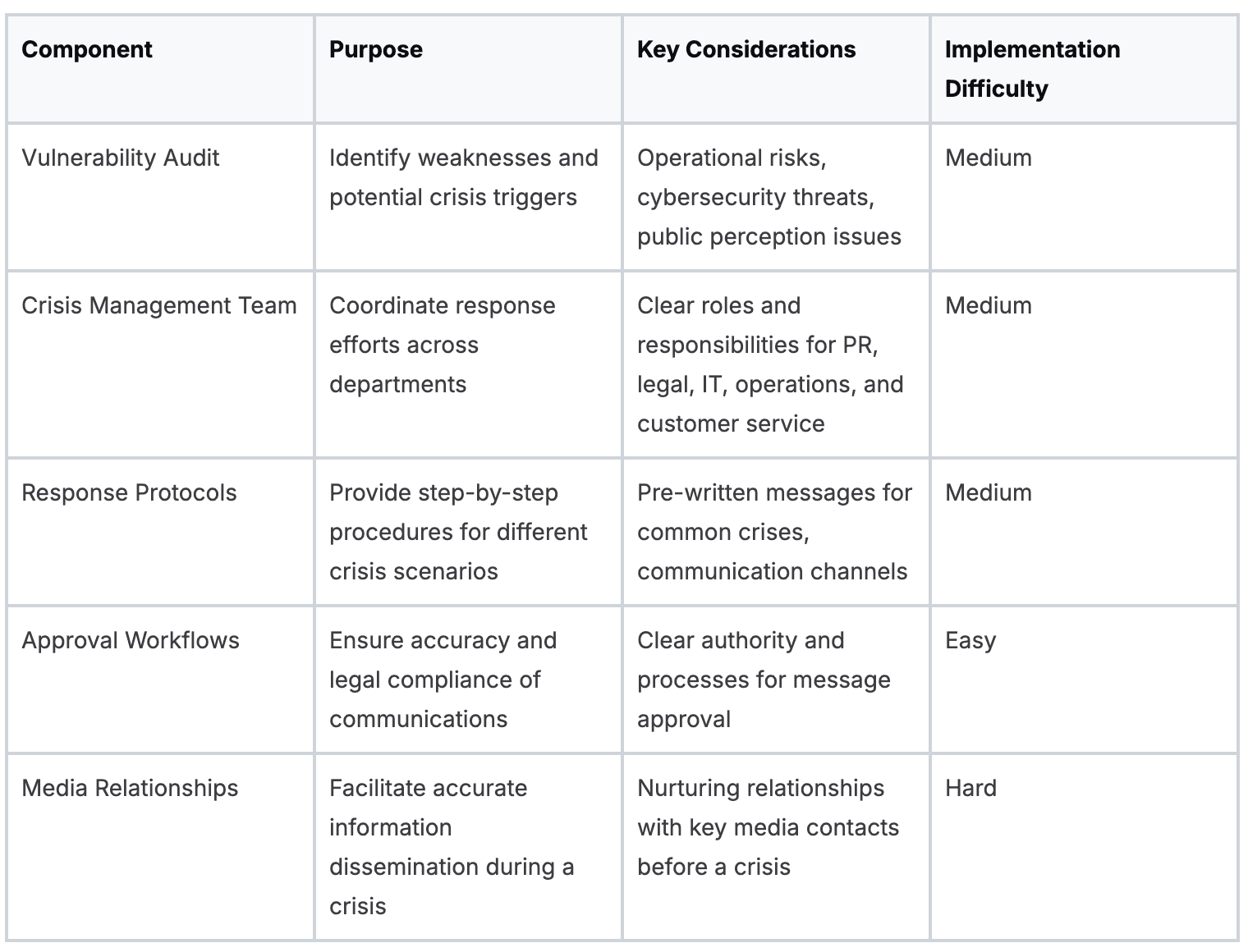
This table highlights the essential elements of a crisis management plan, ranging from identifying potential vulnerabilities to building strong media relationships. While some components are easier to implement than others, each plays a vital role in effectively navigating a crisis.
Create an efficient approval workflow for crisis communications. This process balances the need for a rapid response with ensuring accuracy and legal compliance. Define who can approve messages and how approval will be obtained. This streamlined system ensures consistent messaging and minimizes conflicting information.
Strong relationships with key media contacts are crucial for public relations crisis management. These relationships provide channels for accurate information dissemination during a crisis. Nurturing these connections before a crisis builds trust and enables open communication, vital for navigating challenges effectively.
The first 24 hours of a public relations crisis are critical. This initial period can determine whether an incident remains contained or escalates into a full-blown reputational disaster. Successfully navigating these crucial hours demands quick action, accurate information, and carefully considered communication.
One of the most important first steps in effective public relations crisis management is gathering accurate information. This prevents misguided initial responses based on incomplete or inaccurate details. Avoid speculation at all costs and stick to verifiable facts. Much like a doctor diagnosing a patient, a PR professional shouldn't communicate without first understanding the situation.
Crafting the initial statement requires careful consideration. It needs to acknowledge the incident and express appropriate concern without prematurely admitting liability. This initial communication sets the tone for all future interactions and is crucial for building a foundation of trust.
Choosing the appropriate communication channels is also vital. Social media platforms like Twitter or Linkedin are effective for quick updates and reaching a broad audience. For more complex situations, a formal press release or an official statement on your website offers greater control and context.
Effective crisis communication hinges on understanding human psychology. Your messaging should strike a balance between empathy and authority. Acknowledge the concerns of those affected while projecting an image of confidence and control. A measured, authoritative response reassures stakeholders that the situation is being handled competently.
Addressing misinformation is another key component of public relations crisis management. Inaccurate information, particularly online, can spread rapidly. Counter inaccuracies swiftly with verified facts and transparent communication. This proactive approach helps maintain control of the narrative and preserve public trust.
Internal audiences – your employees – are often overlooked during a crisis. However, they are essential. Keep employees informed and provide clear messaging guidance. Informed employees become valuable advocates, helping to disseminate accurate information and address concerns within their networks.
Managing external audiences effectively often requires specialized tools. Social listening tools like Octolens can help identify the origin and spread of misinformation, offering critical insights to inform your response strategy. This real-time data provides a crucial advantage in controlling the narrative and minimizing potential damage. For more information about social listening, see our blog post, Social Listening vs. Social Monitoring.
Finally, learn from the past. Analyze how other organizations have successfully navigated crises and incorporate their best practices. This constant learning process will strengthen your crisis management plan, leaving your organization more resilient. The first 24 hours are crucial for shaping public perception and determining the long-term impact on your organization.

Moving beyond the initial response, the ongoing management of a public relations crisis presents a significant challenge. This phase truly separates organizations that recover stronger from those that suffer long-term reputational damage. Effective and strategic communication is the key to navigating these difficult circumstances.
During a crisis, every single word matters. Messages must demonstrate a sense of responsibility and empathy without inadvertently creating legal exposure for the organization. This requires careful wording and thorough review by legal counsel.
For example, acknowledging the situation and expressing concern for those affected is crucial. However, it's equally crucial to avoid language that could be interpreted as an admission of guilt. This delicate balance is vital for maintaining public trust while protecting the organization's legal standing.
Additionally, maintaining transparency is paramount, especially during periods of uncertainty. However, information gaps are common in the early stages of a crisis. While full transparency is the ultimate goal, responsibly acknowledging what is not yet known is better than providing inaccurate or speculative information. This measured approach helps build credibility and manages expectations, preventing further erosion of public trust.
Different stakeholder groups—customers, employees, investors, and the media—have unique needs and perspectives. A message that resonates with one group might alienate another. This requires adapting communication strategies to address these varying concerns.
For instance, employees need reassurance about job security and clear guidance on their roles during the crisis. Customers, on the other hand, need information about how the crisis will affect them directly, such as product availability or service disruptions.
This brings us to a key finding: even with crisis plans, many organizations struggle with public relations crisis management. A Deloitte survey found that while 84% of large companies claim to have crisis response plans, significant gaps exist in their preparedness. Learn more about the disconnect between planning and preparedness. This reinforces the idea that simply having a plan is insufficient; proper execution is essential.
As a crisis unfolds, media scrutiny intensifies. Maintaining control of the narrative becomes increasingly difficult. Proactive communication, regular updates, and consistent messaging are essential to counter misinformation and shape public perception. This requires constant monitoring of media coverage and social media conversations.
Moreover, crises are dynamic. What works in the initial stages might become ineffective as the situation evolves. This necessitates flexibility and a willingness to adapt communication approaches. For example, a strategy of frequent updates might be appropriate early on. But as the situation stabilizes, a shift towards less frequent, more substantive communication could be more effective.
Crises often require difficult decisions with significant consequences. Communicating these decisions effectively, particularly in emotionally charged environments, is a critical skill. Honesty, transparency, and empathy are crucial in these situations.
Clearly explain the rationale behind decisions, acknowledge the potential impact on stakeholders, and express genuine concern for those affected. While these conversations are never easy, handling them with sensitivity and respect can help maintain trust and mitigate further damage. Ultimately, mastering crisis communication involves preparation, strategic messaging, stakeholder awareness, and the ability to adapt to the changing dynamics of a challenging situation.
Social media has fundamentally changed how we manage public relations crises. Algorithms can amplify negative comments, and public opinion can shift drastically in a matter of minutes. This demands a proactive and adaptable strategy. Organizations need to be ready to identify and respond to online threats swiftly and effectively.
Effective public relations crisis management today requires a robust monitoring system. It's like a radar, constantly scanning social media for potential threats. Tools like Octolens help you track keywords and brand mentions across various platforms. This early warning system identifies negative sentiment and emerging crises before they escalate. For a better understanding of these critical functions, check out this helpful guide on Social Listening vs. Social Monitoring.
Once a potential threat is identified, a rapid response is essential. Develop platform-specific protocols for different online attacks. A factual error on Twitter might need a quick correction, while a complex issue on LinkedIn could require a detailed statement. Having pre-approved messaging for common scenarios can save precious time.
Imagine a central command center where your crisis management team coordinates efforts in real-time. This is your digital war room. It should include representatives from PR, legal, marketing, and customer service. This collaborative approach ensures a unified and consistent response across all channels.
Managing online sentiment is crucial during a social media crisis. This means actively engaging with your audience, addressing their concerns, and correcting misinformation. Knowing when to engage and when to stay silent is a critical skill. Sometimes, directly addressing criticism can worsen the problem. In other cases, strategic silence is the best course of action.
Combating viral misinformation requires a rapid, decisive response. Provide accurate information through credible sources. Engage with influencers to help spread the truth. It’s like combating a virus; you need to contain the spread and provide an antidote quickly.
Your employees and loyal customers are your greatest allies during a crisis. These digital advocates can amplify positive messages and counter negative narratives. Give them accurate information and empower them to share your organization's perspective.
At the same time, prevent well-intentioned team members from accidentally making things worse. Provide clear guidelines for online engagement and emphasize avoiding emotional or defensive responses. A single ill-advised tweet can escalate the crisis.
To help illustrate a structured response strategy, consider the following framework:
Digital Crisis Response Framework: A structured approach to handling crises across different digital platforms
This framework helps tailor responses to each platform. By prioritizing response time, content strategy, monitoring, and measurable outcomes, organizations can effectively manage their digital presence during a crisis. Effective public relations crisis management demands a proactive, adaptable, and strategic approach.
The true measure of successful public relations crisis management isn't just surviving the initial fallout. It's about emerging stronger and more adaptable. This means leveraging crisis recovery to actually improve your reputation. This section explores how to achieve this critical shift.
Once the immediate crisis subsides, a thorough damage assessment is essential. This involves evaluating the impact on various stakeholder groups. Customer trust may be damaged, employee morale could be low, and investor confidence might be shaken. Each group needs a specific approach.
For example, addressing customer concerns might involve offering refunds or improving customer service. Rebuilding employee morale could require internal communications and dedicated support programs. Each action should be carefully considered.
Developing recovery narratives that acknowledge past missteps while highlighting positive change is the next step. This means accepting responsibility, outlining corrective actions, and presenting a clear vision for the future. It's like rebuilding a bridge after a collapse – acknowledge the failure, explain how you'll prevent it from happening again, and demonstrate the improved strength of the new structure.
Identifying opportunities to demonstrate a renewed commitment is key to rebuilding trust. This could involve implementing new policies, strengthening ethical guidelines, or investing in community initiatives. These actions must be genuine and consistent with your organization's values. Empty gestures will be easily spotted and can further erode your reputation.
You might be interested in: How Can Social Media Listening Increase Customer Advocacy. Rebuilding trust requires time, especially after a crisis. There are no shortcuts. It demands consistent positive actions and open communication. Like mending a broken relationship, it takes patience, empathy, and a genuine dedication to change.
Setting realistic timelines for reputation recovery is crucial. Some damage can be repaired quickly, but regaining lost trust can be a longer process. Establishing achievable milestones helps manage expectations and provides a clear path forward.
Measuring progress through relevant metrics helps track the effectiveness of your strategy. This could include monitoring social media sentiment, customer satisfaction scores, and media coverage. Regular monitoring helps identify areas for improvement and allows you to adapt your strategy as needed. This constant feedback is vital.
Addressing lingering concerns requires continuous communication and transparency. Even after the initial crisis has passed, some stakeholders may still have questions or doubts. Actively address these concerns and maintain open communication channels. This ongoing engagement shows your commitment to resolving the issue and rebuilding trust.
Crisis anniversary dates often attract renewed media scrutiny. Be prepared for this with a clear communication strategy. This could involve proactively releasing a statement or responding to media inquiries. This proactive approach allows you to manage the narrative and prevent old wounds from resurfacing.
Finally, institutionalize the lessons learned. Every crisis offers valuable insights. Use these to strengthen your public relations crisis management plan, improve internal processes, and cultivate a more resilient organization. This process of continuous improvement helps reduce the risk of future crises and ensures your organization is better prepared for any future challenges.
Ready to manage your brand reputation and navigate the complexities of online discussions? Octolens, an AI-powered social listening tool designed for B2B SaaS businesses, allows you to monitor important mentions of your brand, competitors, and industry keywords across various social media platforms. Visit Octolens today and learn how to transform social listening into a powerful asset for protecting and strengthening your brand reputation.