
How to Measure Social Media for B2B SaaS Growth
Learn how to measure social media performance for your B2B SaaS. This guide covers setting clear goals, tracking key metrics, and turning insights into growth.

For B2B SaaS teams, the best way to measure social media is to move beyond vanity metrics like likes and follows. It’s about tuning into the conversations that tell you what customers really think, what your competitors are up to, and how you can build a better product.
This approach transforms random social chatter into a goldmine of business intelligence.

Does your social media strategy feel like you're shouting into the void? You post, you get some engagement, but it’s hard to pin down the real impact on your business. If you’re nodding along, it’s time to stop guessing.
The old playbook of chasing follower counts and engagement rates is broken. A viral post might look great in a report, but does it actually help reduce churn or inform your product roadmap? Rarely. The real value is buried in the unstructured conversations happening across platforms every single day.
Vanity metrics are tempting because they’re easy to track, but they offer little to no strategic value. They tell you that people clicked, but they don't tell you why or what they truly think about your product. Relying on them creates a huge disconnect between your social media activity and your actual business goals.
We’ve all seen the common pitfalls:
- High Engagement, Low Impact: A clever meme gets hundreds of likes but doesn't bring in a single qualified lead or offer a shred of useful feedback.
- Ignoring the Unseen: The most critical conversations about your product often happen in niche communities or threads where your brand isn't even tagged. Vanity metrics miss these completely.
- Misaligned Incentives: When your team is chasing likes, they're pushed to create popular content, not the valuable content that actually solves customer problems.
Here's the key takeaway: The most valuable insights for a B2B SaaS company don't come from your own posts; they come from unfiltered conversations about you, your competitors, and the problems you solve.
Instead of just counting clicks, a modern approach to measuring social media dives deep into qualitative data. This means tracking brand mentions, analyzing user sentiment, benchmarking your share-of-voice against competitors, and systematically capturing product feedback.
This guide gives you a clear framework to do just that. You'll learn how to turn raw social data into a powerful engine for growth, giving your product, marketing, and success teams a direct line to what the market is really saying.
Trying to measure social media without clear goals is like driving without a destination. You'll end up with a ton of data, but none of it will tell you if you're actually getting anywhere. Before you can measure anything effectively, your team needs to agree on what success actually looks like—and it has to tie back to real business outcomes.
Vague targets like "increase engagement" just don't cut it. Engagement is a means to an end, not the end itself. What does that engagement actually do for the business? With over 5.24 billion people on social platforms (a stat from Backlinko), the potential for gathering targeted intelligence is massive. You just need a plan.
One of the most common mistakes is treating social media as a siloed marketing channel. In a B2B SaaS company, its value ripples across the entire organization. When you start setting goals, think bigger. How can the insights you're gathering help other teams?
This approach immediately proves that social listening is a core business function, not just a marketing line item. It turns your social presence from a simple broadcast tool into a company-wide intelligence engine.
Here’s how different teams can set their own distinct, yet aligned, goals:
- Product Team: Forget just "listening." A real goal is to identify 10 high-impact feature requests every month from user conversations on Reddit and X. This directly feeds the product roadmap with validated customer needs.
- Customer Support Team: How about this for a powerful goal: reduce negative sentiment by 15% in a quarter. They can do this by proactively spotting and resolving customer issues before they ever become support tickets.
- Marketing Team: Let's move beyond simple reach. A much better goal is to increase share-of-voice by 5% against a key competitor, or to tangibly improve brand awareness in a specific niche. Our guide offers deeper insights on how to measure brand awareness.
Pro-Tip: Frame every goal with a clear, quantifiable business outcome. After you set a goal, ask yourself, "So what?" If the answer doesn't connect to a better product, happier customers, or a competitive edge, it’s not strong enough.
Once you've drafted goals for each team, the final step is to map them back to the company's big-picture objectives. This is absolutely crucial for getting buy-in and proving the ROI of your efforts.
For example, if the company’s main priority for the quarter is to improve user retention, the support team's goal of reducing negative sentiment is a direct and measurable contribution.
This alignment ensures everyone is pulling in the same direction. It transforms your social media measurement from a boring checklist of metrics into a strategic program that actively drives growth and innovation across the business.
Let’s be honest: not all social media metrics are created equal, especially in the nuanced world of B2B SaaS. Sure, a viral meme might give your engagement rate a nice little spike, but it won’t tell you why one of your power users is about to churn or what feature your customers are practically begging for.
To really get value out of social media, you have to focus on the signals that actually drive business decisions.
And the digital noise is overwhelming. As of October 2025, there were roughly 5.66 billion social media 'user identities' out there—a staggering number of conversations happening all at once. With over two-thirds of the world's population scrolling through social media every month, your ability to filter the signal from all that noise is a massive competitive advantage. You can dive deeper into these numbers with DataReportal's latest findings.
This is the high-level flow of how we turn all that chatter into something genuinely useful.
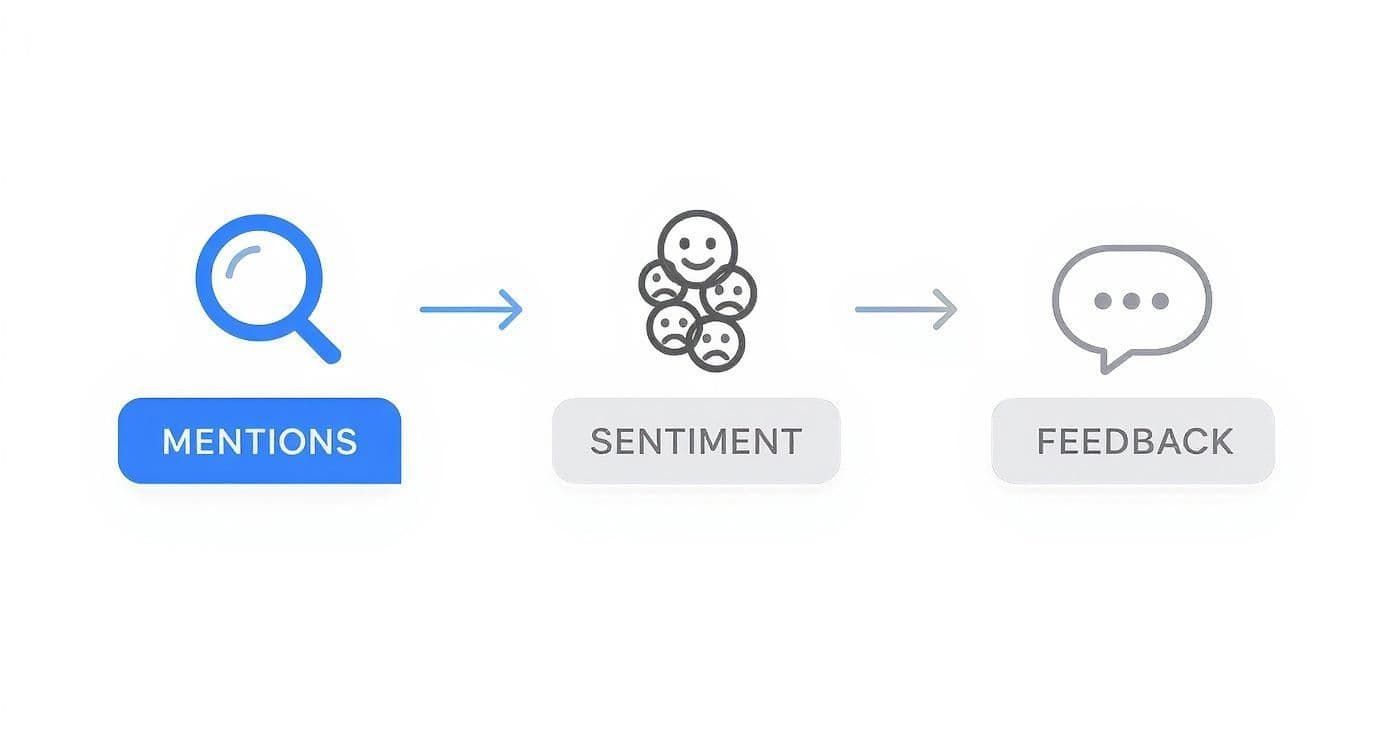
It all starts with capturing what people are saying, then figuring out how they're saying it, and finally, pulling out the feedback you can actually act on.
To get started, we need to move past the surface-level numbers. Let's look at the metrics that provide real strategic value for a SaaS business—the ones that help you understand your market position, customer health, and product-market fit.
Here are four essential metrics to build your measurement framework around:
- Brand Mentions (Untagged): This is about tracking every conversation about your brand, not just the ones where you're conveniently tagged. These unfiltered discussions on platforms like Reddit or in private newsletters are often the most honest and valuable.
- Sentiment Analysis: Are people raving about your new UI, or are they frustrated by a recurring bug? Sentiment analysis moves beyond if people are talking about you to how they're feeling, giving you a real-time pulse on public perception.
- Share of Voice (SoV): This one is huge. It benchmarks your brand's presence against your direct competitors. It answers a simple but critical question: In the conversations that matter in your industry, how much of that real estate do you own? A rising SoV is a strong leading indicator of growing market authority.
- Product Feedback Signals: For any SaaS company, this is the goldmine. It involves systematically identifying, categorizing, and tracking feature requests, bug reports, and clever use cases people mention in public forums.
Actionable Tip: Measuring these signals is the difference between simply having a social media presence and having a social media strategy. It connects your activity directly to product development, customer success, and competitive intelligence.
The real magic happens when you map these metrics to specific business objectives. This ensures you're not just collecting data for the sake of it but are actively using it to make smarter decisions across the entire company.
Here’s a simple table to connect common B2B goals to the metrics that matter most.
Business Goal Primary Metric What It Tells You Improve Product Roadmap Product Feedback Signals The most requested features and urgent bugs, straight from your users. Enhance Brand Reputation Sentiment Analysis How customers actually feel about your brand and product over time. Gain Competitive Edge Share of Voice Your visibility and authority in the market compared to your rivals. Proactive Customer Support Brand Mentions Early warnings of customer issues before they ever become support tickets.
By aligning your metrics this way, every piece of data you collect has a clear purpose. You're no longer just counting likes; you're gathering intelligence that helps you build a better product and a stronger brand.
Knowing what to measure is one thing. Actually building a system that captures it all without drowning your team in noise is another beast entirely. A great listening setup doesn't just collect data—it gets the right information to the right person, right when they need it.
This is all about graduating from manually checking feeds to creating an automated, intelligent infrastructure. The endgame is to turn chaotic social chatter into an organized hub of signals your entire company can actually use.
First things first, you need to set up real-time monitoring for the keywords that matter most. And I don’t just mean your brand name. A truly effective setup casts a wider net to give you the full picture of your ecosystem.
Here’s what I recommend monitoring from day one:
- Brand Keywords: This is the obvious one. Your company name, product names, and even common misspellings. Don’t forget to track key executives or public figures tied to your brand, too.
- Competitor Names: Keep a close watch on your top 2-3 competitors. Monitoring their mentions helps you benchmark your share-of-voice and spot opportunities or threats the moment they pop up.
- Industry Topics: Track the core problems your product solves. If you're building a project management tool, this might be "agile workflow issues" or "sprint planning tips." This is how you find relevant conversations where your brand can jump in and add real value.
A huge piece of any solid social listening system is the right tooling. Using specialized social media comments analyzer tools, for example, can give you much deeper insights into what people are really saying and feeling.
Once your monitors are live, the next move is to ensure the insights don’t just die in a dashboard. You need automated workflows that push critical information to the teams who can act on it immediately. This is the step that connects listening to action.
Think about setting up these kinds of automated routes:
- Urgent Customer Complaints: A mention with words like "outage," "broken," or "can't log in" should instantly create a high-priority ticket in your support system. Or, at the very least, fire off a notification to your on-call support channel in Slack.
- Feature Requests: Any mention with phrases like "I wish it could" or "feature request" can be automatically sent to a dedicated Slack channel for your product managers. It creates a live feed of user ideas.
- Positive Mentions: When someone praises your product, route it to a marketing or community channel. This lets your team engage quickly, thank the user, and amplify that positive feedback.
The Takeaway: The goal isn't just to listen; it's to create a nervous system for your company. A well-configured system ensures that a critical tweet gets the same urgency as a high-priority support ticket.
Finally, you need to bring it all together in one place. While real-time alerts are for immediate action, a centralized dashboard gives you that high-level view you need for bigger, strategic decisions. The trick is to avoid a one-size-fits-all approach. If you want to go deeper on this, our guide on the fundamentals of social media listening has some great strategies.
A good dashboard should give every stakeholder a clear, customized view of the metrics they actually care about. A product manager wants to see trends in feature requests, while a marketer is zeroed in on share-of-voice and sentiment. This is what turns your listening system from a simple monitoring tool into a source of company-wide intelligence.
Collecting data is one thing. Actually using it to drive growth is something else entirely. A dashboard packed with metrics is just noise unless it sparks real change, informs tough decisions, and ultimately makes your product better. This is where we close the loop between listening and doing—transforming all that social intelligence into tangible business outcomes.
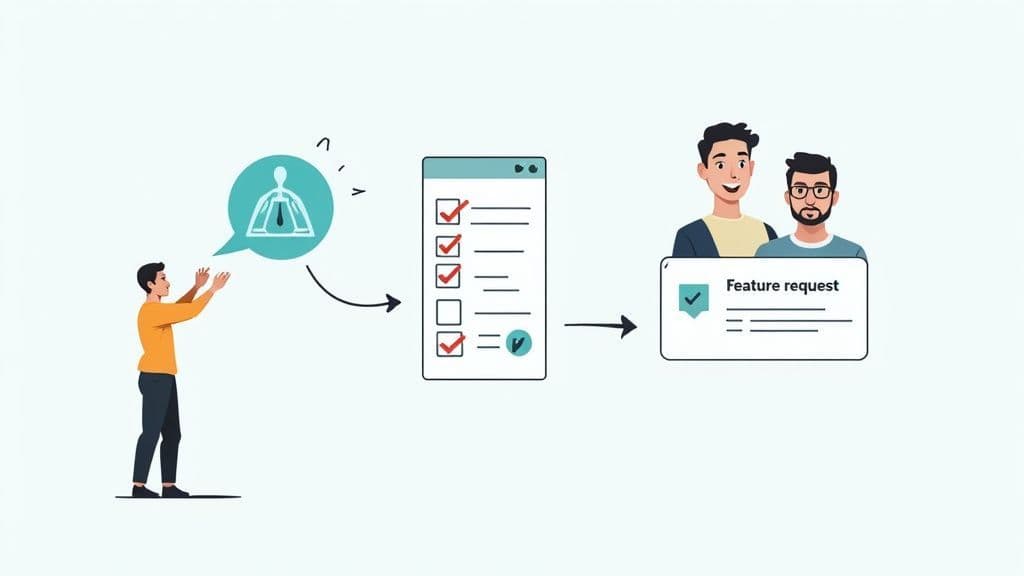
The real goal here is to weave social listening into your company’s DNA. It should be an active, breathing part of how you operate, not just another report that gets filed away and forgotten. When you get this right, the insights feel like a direct line to your customers.
Let's not forget the sheer scale of these conversations. As of October 2025, there are around 6.04 billion internet users—that's 73.2% of everyone on the planet. Out of those, a staggering 5.24 billion are active on social media. This data, highlighted by Statista, shows just how deeply intertwined our digital and social lives are. Tapping into that is a massive opportunity.
The trick is to build clear, repeatable workflows that pipe insights from social platforms directly into the tools your teams already live in every day. This simple step removes friction and makes acting on feedback a natural part of everyone's job.
Beyond just the numbers, it's crucial to know how to analyze qualitative data from comments and conversations. That's where you find the real stories and the context behind the metrics.
Here are a few practical examples:
- For Product Teams: A product manager notices a recurring theme on X and Reddit—users are clamoring for a specific integration. This feedback gets captured, tagged as a "feature request," and instantly pushed into a dedicated Slack channel. It might even create a new ticket in Jira, ready for the next sprint planning session.
- For Marketing Teams: A big launch is on the horizon. The marketing team starts monitoring sentiment around competitors and key industry topics. They quickly realize a competitor’s new messaging is falling flat because it's way too technical. Boom—that's a golden insight. They pivot, refining their own launch copy to be more user-friendly and benefit-focused.
- For Customer Success Teams: A high-value customer vents their frustration about a bug on a small, niche forum. A real-time alert fires off, catching the mention. The customer success manager can then proactively jump in with a solution before the customer even thinks about submitting a formal support ticket.
Actionable Tip: Your social media measurement system should function like a nervous system for your business—sensing important events in your market and automatically triggering the right response from the right team.
The most effective programs are the ones that don't force people to change their habits. Instead of making everyone log into yet another platform, you feed the insights directly into their existing environments.
This seamless integration is what turns social listening from a quarterly review into a daily habit. The easier you make it for your teams to see and act on data, the more they'll actually do it. A well-designed social media analytics dashboard can be a great central hub, but the real magic happens when you push those insights out to your operational tools.
Common Integration Workflows:
Insight Type Destination Tool Action Triggered Bug Report Jira / Linear Creates a new high-priority ticket for the engineering team. Feature Request Productboard / Slack Adds a new idea to the product backlog for consideration. Negative Sentiment Spike PagerDuty / Slack Alerts the on-call comms team to a potential PR issue. Glowing Testimonial CRM / Slack Notifies the sales team of a happy customer for a case study.
By building these kinds of bridges, you make sure the valuable feedback you're collecting doesn't just sit in a spreadsheet somewhere. It becomes a living, breathing part of your company's growth engine.
Even with a solid framework, questions always pop up when you start measuring social media in a more meaningful way. Let's tackle some of the most common ones B2B SaaS teams ask, from picking the right tools to finally proving the value of all your hard work.
The single most important shift is to stop chasing vanity metrics and start prioritizing signals that have a direct business impact. For B2B SaaS, this means focusing on the story behind the numbers.
Here are the heavy hitters I always recommend:
- Share of Voice: This tells you how much of the conversation in your market you actually own compared to your competitors. It’s a direct indicator of your brand's presence and authority. Are you a known player or a ghost?
- Sentiment Analysis: Are people happy, frustrated, or just indifferent when they talk about you? Tracking the tone of conversations helps you gauge brand health and, just as importantly, see the real reception to a new feature or campaign.
- Product Feedback Signals: This is the absolute goldmine. It involves systematically tracking feature requests, bug reports, and clever use cases that users mention in the wild. These signals are infinitely more valuable than likes because they feed directly into your product and customer success strategies.
Let's be honest: for B2B SaaS, the long sales cycle makes direct attribution from a single tweet nearly impossible. Don't fall into that trap. Instead, the game is to demonstrate value through proxy metrics that show clear business contributions.
ROI in this context isn't just about revenue. It's about efficiency, innovation, and risk mitigation. You're proving that social listening makes the entire business smarter and more responsive.
Instead of trying to draw a straight line from a post to a sale, track these outcomes:
- The volume of qualified feature ideas sent to the product team.
- A measurable decrease in support tickets because you proactively jumped on issues you found on social media.
- A noticeable lift in positive sentiment right after a product launch or marketing campaign.
These points demonstrate real, tangible value, even if they don't have a dollar sign attached. They show how your efforts are improving the product and the customer experience—which, down the line, absolutely impacts the bottom line.
A small, fast-moving team doesn't need a clunky, enterprise-level suite that takes a month to learn. Your biggest priority should be a platform that combines monitoring, analytics, and—most importantly—smart alerts.
Look for solutions that integrate seamlessly with the tools your team already lives in, like Slack or Jira.
This integration is key. It avoids tedious manual work and ensures that crucial insights don't get lost in yet another dashboard nobody checks. The goal is to find a tool that delivers clean, actionable signals, not one that just dumps raw data on you.
Your reporting cadence should also match your goals. Set up real-time alerts for critical issues (like a sudden spike in negative mentions), review product feedback trends weekly, and report on the big-picture metrics like Share of Voice monthly or quarterly to track your long-term progress.
Ready to stop guessing and start acting on the conversations that matter? Octolens helps you catch every critical mention across Reddit, X, podcasts, and more—without the noise. See how fast-moving B2B SaaS teams gather unfiltered feedback and track competitors in real-time. Get started with Octolens.