
How to Reduce Customer Churn: A B2B SaaS Playbook
how to reduce customer churn: A practical B2B SaaS playbook to cut churn and grow revenue

Fighting customer churn in B2B SaaS isn't about frantic, last-ditch efforts to save canceling accounts. It’s about building a proactive, four-part system: measuring churn signals, segmenting at-risk customers, launching targeted interventions, and closing the loop with your product team. This is how you shift from reactive damage control to a data-driven process for keeping your best customers.
Customer churn is more than just a number on a KPI dashboard; it's a silent killer of revenue. For any B2B SaaS company, churn is the leak in the bucket you're working tirelessly to fill with new logos. Put simply, it’s the rate at which your customers stop paying you.
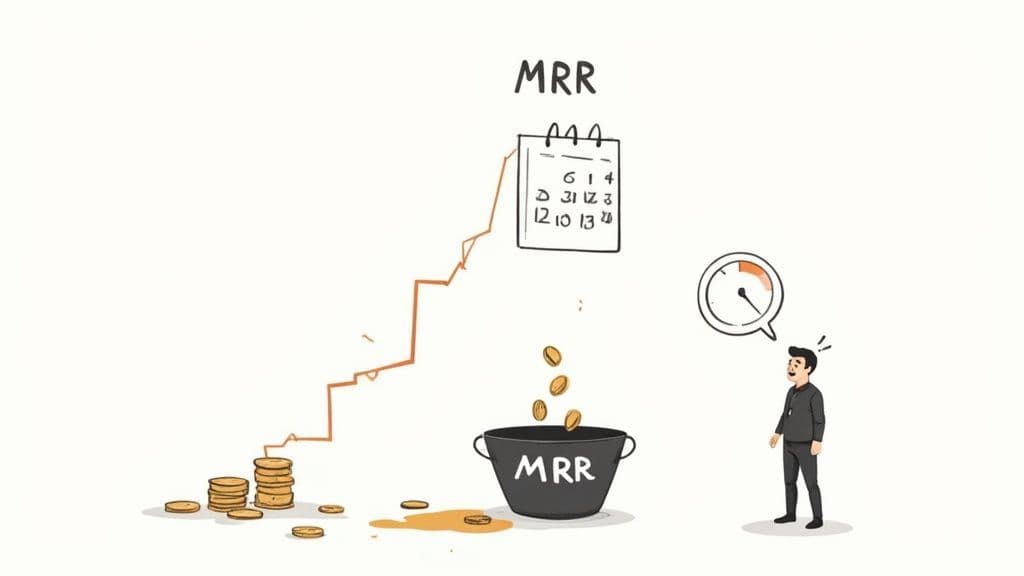
But here's a critical distinction: not all churn is created equal. You have to separate losing a customer (logo churn) from losing the revenue they bring in (MRR churn). Losing a small startup account hurts, but losing an enterprise client paying ten times more is a completely different kind of pain—even though both count as just one lost logo. Focusing on MRR churn gives you a much truer sense of the financial damage.
One of the biggest mistakes I see founders make is shrugging off a seemingly low monthly churn rate. It compounds, and it erodes your customer base and revenue much faster than you’d expect.
For example, a monthly churn rate of just 5% might not sound alarming, but it translates to losing nearly 46% of your customers over a single year. If that rate creeps up to 10% a month, you're on track to lose over 70% of your customers annually. That's a hole that's almost impossible to fill with new sales alone. You can dig into more industry benchmarks in this insightful report on retention rates.
This is why you have to stop treating churn as a lagging indicator. By the time a customer hits "cancel," the real problem—whether it was a botched onboarding, unmet expectations, or a critical missing feature—likely happened weeks or even months ago.
The real solution to reducing customer churn isn't reactive damage control; it's building a proactive, data-driven system that identifies dissatisfaction early and allows you to intervene before it's too late.
To actually get ahead of churn, you need a playbook. A truly effective strategy is built on four core pillars that create a continuous cycle of measurement, action, and improvement. Think of it as your high-level game plan for turning churn from a scary metric into a manageable—and even preventable—part of your business.
This framework gives you a clear-eyed view of what’s at stake and provides an immediate roadmap to follow. Here’s a high-level summary of those strategic components.
Pillar Objective Key Activities Measure & Segment Understand the "who" and "why" behind your churn. Calculating churn rates, segmenting by cohort, identifying signals. Monitor & Alert Create an early warning system for at-risk customers. Tracking product usage, support tickets, and brand mentions. Intervene & Engage Deploy targeted actions to address dissatisfaction. Proactive outreach, onboarding improvements, win-back campaigns. Analyze & Improve Use churn insights to improve your product and processes. Funneling feedback to product, A/B testing, tracking outcomes.
With these pillars in place, you're no longer just reacting to cancellations. You're building a system that anticipates needs, solves problems, and ultimately keeps customers around for the long haul.
Before you can fix a leaky bucket, you need to know where the holes are. The same is true for customer churn. Trying to reduce it without measuring it properly is like flying blind—you’ll keep busy, but you’ll have no idea if your efforts are actually making a dent.
The first real step is moving beyond a single, top-level churn percentage. You need to dig into the numbers to find the real story behind why customers are walking away. This means tracking a few key metrics that tell you not just how many customers are leaving, but how much revenue is walking out the door with them.
Your journey into understanding churn starts with three core calculations. They might seem similar on the surface, but each one tells a very different part of your retention story.
- Customer Churn Rate: This one’s the most straightforward. It's the percentage of customers who cancel their subscriptions in a given period, usually a month. It tells you how many logos you've lost, but it makes a critical mistake: it treats a tiny startup and a massive enterprise client as equals. That can be incredibly misleading.
- Revenue Churn Rate (MRR Churn): This is where things get interesting. MRR Churn tracks the percentage of monthly recurring revenue lost from those cancellations. Suddenly, the financial impact of churn becomes crystal clear. Losing one high-value account can hurt more than losing ten small ones, and this metric makes that pain visible.
- Net Revenue Churn: This is the most powerful of the three. It takes your MRR Churn and subtracts any new revenue you’ve gained from existing customers through upgrades or add-ons (expansion MRR). If your expansion revenue is greater than your churned revenue, you can achieve negative net churn—the holy grail for SaaS growth.
A common mistake is focusing only on logo churn. While losing customers always stings, MRR and Net Revenue Churn are the metrics that truly connect your retention efforts to the bottom line and overall business health.
Once you have these numbers, the real work begins. A single, blended churn rate for your entire customer base is just a vanity metric. To find insights you can actually act on, you have to segment your data to uncover the patterns. Who is churning, and why?
Start by slicing your churn rate by different customer groups:
- By Customer Cohort: Are customers who signed up in January churning faster than those from March? This can point to a flawed onboarding flow you were running that month or a problematic marketing campaign.
- By Plan Type: Are users on your basic plan leaving more often than enterprise clients? Maybe the value isn't clear at the lower tiers, or perhaps your best features are locked behind a paywall that’s just too steep.
- By Acquisition Channel: Do customers from paid ads churn at a higher rate than those from organic search? This helps you understand not just customer acquisition cost, but customer acquisition quality.
Analyzing churn by segment transforms it from a single, scary number into a series of smaller, solvable problems. It points your team directly to the highest-impact areas for improvement.
Metrics tell you what’s already happened. To actually get ahead of the problem and prevent churn, you need to spot the leading indicators—the subtle signals that a customer is becoming disengaged long before they hit the "cancel" button.
These signals come in two flavors: quantitative and qualitative.
These are the measurable shifts in user behavior you can track in your product analytics or CRM.
- Declining Product Usage: A steady drop in logins or key feature adoption is the classic sign of a customer drifting away.
- Fewer Support Tickets: This one is counterintuitive, but important. A sudden drop in support tickets from a previously active account might not mean they're happy; it could mean they've given up trying to solve their problems.
- Downgrades: When a customer moves to a lower-priced plan, it’s an obvious signal they are re-evaluating the value they get from your product.
These signals are less about numbers and more about sentiment. They often show up in conversations and public forums before they ever appear in your analytics dashboard.
- Negative Feedback: Direct complaints in support chats, emails, or NPS surveys are clear cries for help.
- Public Complaints: Unfiltered feedback on social media or review sites can be an early warning. Knowing how to track social media mentions for your brand is crucial for catching these signals in real-time.
- Your Champion Leaves: When your main contact or internal advocate at a client company leaves, your relationship is immediately at risk. The new person won't have the same context or loyalty, and you have to rebuild that trust from scratch.
It’s also crucial to contextualize these signals against industry standards. For instance, customer retention rates in the media and professional services sectors are a high 84%, while industries like hospitality hover around 55%. If you’re in a high-churn sector like telecom, where rates can be around 21%, a proactive monitoring system is not just helpful—it’s essential for survival. You can explore more about these customer retention benchmarks across industries on ExplodingTopics.com.
By building a dashboard that tracks both quantitative metrics and qualitative signals, you can create an early warning system that flags at-risk customers while you still have time to step in and make a difference.
If you're waiting for a cancellation email to land in your inbox, you've already lost. By that point, the customer has mentally checked out, and your chances of winning them back are slim to none. The real key to cutting churn is shifting from a reactive "oh no, they're leaving" mindset to a proactive one.
You need to build an early warning system that flags dissatisfaction long before it turns into a lost account. This isn't about some overly complex, black-box algorithm. It’s about listening—really listening—to what your customers are saying, both directly to you and out in the wild.
The goal is to measure the right signals, segment what you find, and analyze the results to take targeted action.
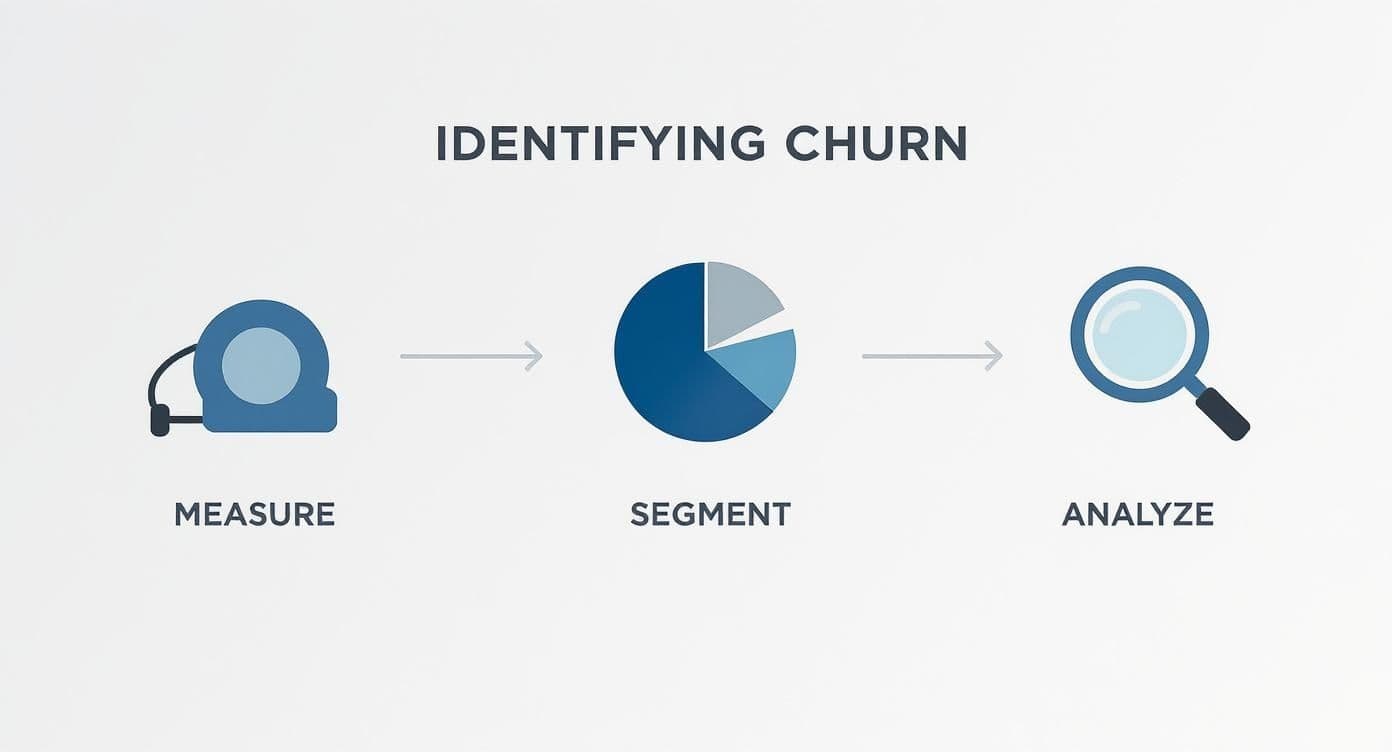
Structuring your efforts this way creates a repeatable process for turning raw, messy feedback into a clear, actionable churn prevention plan.
Your early warning system is only as good as the channels it's tuned into. Think of these as your "listening posts," each one giving you a unique and valuable perspective on the customer experience. The idea is to catch friction the moment it happens, not weeks later in a quarterly business review.
Here are the most valuable channels to monitor:
- Product Feedback Channels: These are your direct lines of communication—in-app feedback widgets, feature request boards, and NPS/CSAT surveys. A sudden dip in scores or a flurry of frustrated comments is a massive red flag you can't ignore.
- Support Interactions: Your support desk is an absolute goldmine. Are tickets for a specific feature suddenly spiking? Are response times creeping up? Digging into support transcripts can quickly reveal the recurring pain points that quietly push customers to churn.
- Public Brand Mentions: This is where the truly unfiltered feedback lives. Customers often voice their frustrations on platforms like X (formerly Twitter), Reddit, or industry review sites long before they ever think about contacting your support team.
Just monitoring these channels isn't enough. The real magic happens when you turn that firehose of information into a focused stream of actionable alerts. You don't need to read every single comment; you need a system that surfaces the critical few that signal real risk.
This is where mention monitoring tools become indispensable. They let you filter out all the noise and listen for specific keywords and phrases that are strong indicators of churn risk. Imagine setting up a real-time alert that pings you anytime your brand is mentioned alongside phrases like:
- "frustrated with [your feature]"
- "issue with [your company]"
- "looking for an alternative to [your product]"
- "can't get [feature] to work"
The difference between just tracking mentions and building a true early warning system is intent. The goal isn’t just to know that people are talking about you. It’s to identify specific, high-risk conversations that demand an immediate, personal response.
Understanding the nuance between passive tracking and active engagement is crucial. If you want to go deeper, we've broken down the key differences between social listening vs. monitoring in our guide.
Okay, so an alert gets triggered. What happens next? A successful early warning system doesn't just flag a problem; it connects that signal to a person who can actually do something about it.
Here’s what a simple but incredibly powerful workflow looks like:
- Trigger: Your monitoring tool detects a negative mention on Reddit containing the phrase "frustrated with [your company]."
- Alert: An automatic alert is fired off to a dedicated Slack channel for your Customer Success team.
- Assign: The on-duty Customer Success Manager (CSM) immediately claims the alert with an emoji or a quick message.
- Outreach: The CSM jumps in and reaches out to the user directly, either publicly on the platform or privately if possible, with a helpful, non-defensive message.
That last step is critical. Here’s how that outreach might look in practice:
Channel Outreach Script Example Reddit Comment "Hey [Username], saw your comment about the issues you're having. That sounds really frustrating, and I'd like to help get it sorted out. Mind if I send you a DM to get some details?" X (Twitter) Mention "@[Username] Thanks for the feedback. Sorry to hear you're running into trouble with that feature. Our support team is standing by to help, or I'm happy to connect you with your CSM directly."
This kind of proactive approach does more than just solve one user's problem. It sends a powerful public signal that you’re listening and that you care enough to step in. More often than not, this can turn a potential churn event into a moment of renewed loyalty.
Spotting an at-risk customer is a huge win, but it’s only half the battle. A warning signal without a playbook is just noise. This is where you pivot from simply monitoring to taking meaningful action—deploying targeted, helpful interventions that get to the root cause of their frustration.
The goal isn't to toss a random discount their way and hope it sticks. It's about delivering the right kind of value at the exact moment they need it most. This proactive approach shows you're listening and are genuinely invested in their success, which is the bedrock of long-term loyalty.
So many churn problems trace back to a rocky start. If users don't quickly find that "aha!" moment and grasp your product's value, they lose momentum and quietly drift away. One of the most effective ways to get ahead of this is to nail your customer onboarding best practices from day one.
And I don't just mean a one-and-done product tour. Think of it as an ongoing educational experience.
- Trigger-Based Guidance: Set up automated emails or in-app messages that fire when a user hasn't used a key feature after a certain period.
- Targeted Webinars: Host live sessions focused on specific use cases or advanced features that you know align with a customer's stated goals.
- Success Plans: For high-value accounts, collaborate on a 30-60-90 day success plan during onboarding. This ensures they hit their initial milestones and feel the momentum.
By guiding new users toward success, you build confidence and prove your value long before they ever start thinking about the cancellation button.
When your early warning system flags a drop in usage or a negative social mention, it’s go-time for your Customer Success Managers (CSMs). But their outreach has to be strategic, helpful, and human—not another generic "just checking in" email that gets immediately archived.
The key is to lead with value, not a sales pitch. Your CSMs should be armed with a few simple templates they can personalize. This makes it easy to act fast at scale while still sounding like a real person who cares.
And the stakes are high. Globally, businesses lose an estimated $4.7 trillion annually due to poor customer service. With 73% of consumers saying they'd switch brands after multiple bad experiences, a timely, empathetic outreach can be the difference-maker.
Here are a couple of practical script templates your CSMs can adapt:
Situation Outreach Template Example Usage Drop Detected "Hey [Name], I noticed you haven't used [Feature X] lately. Many teams find it helps them achieve [Specific Goal]. Do you have 15 minutes next week for a quick walkthrough? I have a few tips I think you'll find useful." Negative Mention Alert "Hi [Name], I'm [Your Name], a CSM here at [Company]. I saw your comment on Reddit and wanted to reach out personally. It sounds like you're running into some real frustration with [Issue], and I'd love to help get that sorted out for you."
Sometimes, the best intervention isn't an email or a call—it's fixing the damn thing in your product. When you spot recurring complaints or feature requests bubbling up from at-risk users, that feedback is pure gold. It’s a user-validated roadmap for what you should prioritize.
You need to create a tight feedback loop between your customer-facing teams and your product team.
- Tag Everything: When a CSM or support rep fields a complaint, they should tag it with relevant keywords (e.g., "bug," "feature-request," "UI-frustration").
- Quantify the Impact: Regularly run reports on these tags. Which issues are mentioned most frequently by at-risk or high-value accounts?
- Arm the Product Team: Use this data to make a compelling case. "This bug isn't just an annoyance; it was mentioned by three enterprise accounts that are now at risk of churn."
This approach turns customer friction into a product improvement engine, directly tackling the root causes of churn.
Even with your best efforts, some customers will still churn. But a cancellation isn't always the final word. A smart win-back campaign can often reignite the relationship, but only if it acknowledges why they left in the first place.
Forget the generic "We miss you!" emails with a measly 10% discount. A powerful win-back message shows you heard their feedback, demonstrates you've made improvements, and offers genuine value.
Subject: A quick question about your experience with [Your Company]
Hi [Name],
I saw that you recently canceled your account. No hard feelings at all, but I was hoping you might have a moment to share what led to your decision.
When you first signed up, you told us you were hoping to achieve [Original Goal]. It's clear we fell short on that, and for that, I'm truly sorry.
Based on feedback from you and others, we’ve actually just released [New Feature or Improvement] that directly addresses the [Pain Point] you mentioned.
If you're open to it, I'd love to personally give you a tour and set you up with a free month to see if it makes a difference. No strings attached.
Either way, thank you for giving us a try.
Best,[Your Name]
This kind of empathetic, value-driven approach proves you were listening and makes a compelling case for giving your product another shot.
An intervention is only as good as its outcome. Identifying an at-risk customer and reaching out is a great start, but it's not the end of the story. The final, critical piece of the puzzle is tracking your results and creating a feedback loop that drives continuous improvement.
This is how you turn one-off "saves" into a systematic process for long-term retention. It transforms churn reduction from a reactive fire drill into a core business function that improves your product, sharpens your messaging, and ultimately builds a stickier platform. It's about learning from every single interaction—successful or not.
Your customer-facing teams—Support, Success, Sales—are on the front lines every day. They hear the unfiltered feedback, the frustrations, and the feature requests directly from your users. Too often, this invaluable intelligence lives and dies in individual conversations or siloed spreadsheets.
To truly cut down on churn, you have to build a structured process for funneling these insights back to the people who can act on them: your Product and Engineering teams. This creates a virtuous cycle where real user pain points directly influence your product roadmap.
Here’s a simple way to get that started:
- Standardize Feedback Logging: Create a simple, shared process for tagging and categorizing customer feedback in your CRM or a tool like Slack. Use clear tags like feature-request, bug-report, or usability-issue.
- Hold Regular Syncs: Schedule bi-weekly or monthly meetings between customer-facing team leads and product managers. The agenda is simple: review the top feedback trends from the past few weeks.
- Quantify the Impact: Don't just share anecdotes. Frame the feedback with data. For example, "The request for a better exporting feature came up in conversations with three enterprise accounts currently flagged as 'at-risk'."
This system ensures product decisions are grounded in real user needs, which is one of the most powerful ways to build a product that people won't want to leave. For more ideas on structuring this process, check out our in-depth guide on how to gather customer feedback effectively.
So, how do you know if your interventions are actually working? You need to track the right metrics. This isn't just about watching your overall churn rate; it's about connecting your specific actions to tangible outcomes.
The goal is to move beyond hope and into data. By tracking outcomes, you can confidently double down on the strategies that work and scrap the ones that don't, saving your team time and energy.
Here are the key metrics to monitor:
Metric What It Tells You How to Track It Churn Rate Post-Intervention Did the targeted outreach prevent churn in the next 30-60 days? Tag accounts that receive an intervention in your CRM and monitor their status. Health Score Over Time Is customer engagement and usage improving after your team stepped in? Compare the account's health score before the intervention to their score after. Expansion MRR from "Saved" Accounts Are retained customers eventually upgrading or adding new services? Track upsell revenue from the cohort of previously at-risk customers.
Finally, the best way to figure out what truly works for your unique customer base is to test it. Treat your retention campaigns like an ongoing series of small experiments. You don't need a massive data science team; simple A/B tests can provide powerful insights into what resonates with your users.
Start with a few simple, high-impact tests:
- Test Win-Back Email Subject Lines: Does a subject line focused on a new feature ("We've Added the Integration You Asked For") perform better than one focused on a discount ("A Special Offer to Welcome You Back")?
- Experiment with CSM Outreach Channels: When a usage drop is detected, is a personal email more effective than an in-app message? Track the response and re-engagement rates for each.
- Vary the "Save" Offer: When a customer initiates a cancellation, test offering a temporary pause on their subscription versus a small discount to stay. Measure which one leads to a higher rate of retention over the next quarter.
By constantly testing and learning, you build a playbook of proven tactics tailored to your customers. This experimental mindset ensures your strategy to reduce customer churn never gets stale and continuously adapts to what your users truly value.
Even with a solid game plan, you're bound to run into questions when you're in the trenches fighting customer churn. Let's tackle some of the most common ones I hear from B2B SaaS teams. My goal here is to give you clear, practical guidance you can put to work immediately.
Everyone wants a magic number, but the honest answer is: it depends entirely on who you're selling to. That said, there are some widely accepted benchmarks. For most B2B SaaS companies, a monthly customer churn rate between 1-3% is considered healthy.
But context is everything. Your target market makes a huge difference:
- Enterprise Clients: If you serve massive enterprise customers, your monthly churn rate should be well under 1%. These are sticky, high-value relationships that shouldn't be turning over often.
- Mid-Market: For companies in the mid-market, a rate between 1-2% is a good, sustainable target.
- Small Businesses (SMBs): It's a different ballgame with SMBs. They naturally have higher churn—often in the 3-5% monthly range—due to things completely out of your control, like going out of business or facing tight budgets.
The most important thing isn't hitting some arbitrary number. It's about tracking your own rate religiously and pushing for a consistent downward trend. A 5% monthly churn might not sound like much, but it means you're losing nearly half your customers over the course of a year. That's a leaky bucket you can't afford to ignore.
Getting this right is critical because the fixes are completely different. The easiest way to think about it is customers leaving on purpose versus by accident.
Voluntary churn is when a customer actively makes the decision to cancel. This is the one that stings—it’s driven by dissatisfaction. Maybe they didn't see the value, found a better tool, or had a string of bad support experiences. You uncover this by digging into cancellation reasons, support tickets, and exit survey feedback.
Involuntary churn, on the other hand, is when a customer just... disappears. It's almost always because of a failed payment. The usual suspects are expired credit cards, insufficient funds, or some other outdated billing info. You'll spot this by looking at your payment processor logs and flagging transaction failures.
The good news? Involuntary churn is almost entirely preventable. Simple dunning emails and proactive reminders to update payment methods can recover a massive chunk of that revenue you'd otherwise lose.
Feeling a bit overwhelmed? Don't be. You can start making a real impact with just a few focused moves. If you want to get the ball rolling this week, here are three things you can do right now.
- Start Measuring Accurately. You can't fix what you can't see. The very first step is to get a handle on your numbers. Set up a simple dashboard to track your Customer Churn Rate and, even more importantly, your MRR Churn Rate. Your first action item? Segment that data by customer cohort. Are users who signed up last month churning faster than those from six months ago? That'll point you straight to a fire in your onboarding process.
- Talk to Customers Who Left. Seriously, stop guessing. Pick up the phone or send a personal, non-automated email to the last 10 customers who churned. Ask for 15 minutes of their time for some brutally honest feedback. The insights you’ll get from these raw, unfiltered conversations are worth more than a thousand survey responses.
- Set Up a Simple Monitoring Alert. A huge part of getting ahead of churn is actively listening to what people are saying outside your support channels. Responding well to public feedback is a skill; for example, knowing How to Respond to Negative Google Reviews can turn a potential disaster into a win. As a starting point, use a monitoring tool to track your brand name alongside keywords like "frustrated," "issue," or "alternative" on places like Reddit or X. This is the first building block of your early warning system.
Catching critical feedback shouldn't be a full-time job. Octolens surfaces the high-signal conversations you need to see across Reddit, X, Podcasts, and more—without the noise. See how fast-moving B2B SaaS teams stay ahead of churn signals and gather unfiltered user feedback. Learn more about Octolens.