
Effective Crisis PR Strategy to Protect Your Brand
Why Your Brand Needs a Crisis PR Strategy Before Disaster Strikes
Here’s an uncomfortable truth: your brand’s reputation can crumble faster than you can say “damage control.” In our hyper-connected world, a single negative tweet or a service outage can snowball into a full-blown reputation nightmare within hours. Waiting for a disaster to happen before you think about a crisis PR strategy is like waiting for a house fire to start before you buy insurance—it’s too little, too late. A reactive approach almost always fails because it’s panicked, disorganized, and lacks the foresight that solid planning provides.
Today’s brands, especially B2B SaaS companies, are walking through a unique and ever-present minefield of vulnerabilities. The digital nature of the business creates specific risks that can spark a crisis instantly:
- Data Breaches: A security incident isn't just a technical problem; it’s a massive breach of trust that can send customers fleeing and attract serious regulatory scrutiny.
- Service Outages: When your platform is the backbone of your clients' operations, downtime isn't just an inconvenience—it's a business-stopping catastrophe for them.
- Executive Misconduct: A poorly worded post or a public misstep from a leader can quickly tarnish the entire brand image.
- Viral Customer Complaints: A single, compelling story from an unhappy customer can catch fire on platforms like Reddit or X, defining your brand’s narrative before you can even respond.
A fundamental part of proactive crisis prevention involves implementing robust website security best practices to protect your brand from online threats. This isn't just an IT task; it's a core piece of protecting your reputation.
Thinking a crisis won't happen to you is a dangerous gamble. A recent PwC survey revealed that 96% of organizations have experienced at least one crisis in the last two years. This statistic tells us that crises are no longer a matter of "if," but "when." You can explore the full scope of modern PR statistics and trends to get a better sense of the current environment.
The difference between a company that weathers a crisis and one that doesn’t often comes down to preparation. We’ve all seen brands lose millions in market value overnight from a poorly handled incident. On the flip side, companies like Johnson & Johnson (during the Tylenol crisis) and Slack (during major outages) have actually emerged stronger by responding with speed, transparency, and a well-rehearsed plan.
Their success wasn't luck; it was the result of having a crisis communication framework ready to go. You can explore more real-world examples in our complete guide to public relations crisis management. Proactive planning is what separates thriving companies from those that become cautionary tales.

A solid crisis PR strategy isn't some dusty manual you pull off a shelf when things go wrong. It's a living system built with specific people and clear protocols that can withstand intense pressure. Think of it less like a single fire extinguisher and more like a well-drilled fire department, ready to jump into action. The core of this system is your crisis response team—a pre-selected group of people empowered to make decisions when every second counts.
Your first job is to get this core team together. This isn't just about grabbing people with impressive titles; it's about filling critical roles. You need a blend of authority, specialized knowledge, and communication savvy. For a B2B SaaS company, a strong team usually looks something like this:
- Executive Sponsor: This is a C-suite leader, often the CEO or COO, who has the final say on major decisions.
- Communications Lead: Your Head of Marketing or PR takes this seat, responsible for crafting and controlling every message that goes out.
- Legal Counsel: An essential player who reviews all public statements to check for potential legal risks.
- Technical Lead: For a SaaS company, this is non-negotiable. Your CTO or Head of Engineering is vital for crises like data breaches or platform outages.
- Customer Support Lead: This person manages the frontline response, gathering real-time feedback and sentiment from your users.
Having this cross-functional group means you're managing the entire incident, not just the PR fallout. A key part of this is adopting effective incident management best practices that mesh with your communication plan. The goal is to establish a clear command structure and decision-making flowchart before a crisis hits. This preparation prevents the chaos of trying to figure out who's in charge when you're in the middle of it.
With your team defined, it’s time to build the organizational muscle memory to react properly. This is where you shift from simply planning to actively practicing. A great starting point is stakeholder mapping. List every group your company deals with—customers, employees, investors, partners, and the media. For each one, figure out their main concerns and the best way to reach them.
This focus on transparency didn't just appear overnight. The field of crisis communication has a rich past, evolving in the mid-20th century as pioneers moved away from "no comment" and toward openness. This principle is more important than ever. You can actually explore the history of crisis communication as a specialized field to see how these foundational ideas still hold up.
Finally, the most crucial element: practice. Run tabletop exercises or crisis simulations based on realistic B2B SaaS scenarios, like a major security flaw discovery or a customer complaint going viral on social media. These drills are invaluable for finding the holes in your plan and training your team to stay calm and execute perfectly when the pressure is on.
When things go sideways, every word you publish can either douse the flames or throw gasoline on the fire. Creating messages that rebuild trust isn't about finding the right corporate jargon; it’s about connecting with people who are worried and frustrated. The heart of a solid **crisis PR strategy** is walking the tightrope between transparency and legal caution, a balancing act many brands get wrong.
Take Slack's handling of its major service outages as a great example. Instead of a bland "we're experiencing technical difficulties," their team gave frequent, honest updates on their status page and social media. They owned their mistakes in real time and broke down complex technical problems into simple terms. This approach turned a massive headache for users into a masterclass on accountability. It proved they respected their customers enough to be candid, which builds more long-term loyalty than a perfect uptime record ever could.
One of the trickiest parts of crisis communication is showing accountability without inviting legal trouble. The secret is to focus on the impact, not the culpability. Acknowledge the frustration and disruption your customers are facing. Show genuine empathy for their situation. You can say, "We understand how disruptive this outage is to your workflow, and we sincerely apologize for the impact," without immediately admitting legal fault for what caused it.
This human-centered language is essential. You have to translate technical disasters into relatable problems. Instead of, "a database configuration change caused cascading failures," try something like, "a change we made had an unexpected effect that took our system offline." It’s honest and clear, and it avoids the kind of jargon that just makes people feel more confused and alienated.
To get your message right, you need to think about who you're talking to. Different groups have different concerns, and your messaging should reflect that. This table breaks down how to approach key stakeholders during a crisis.
A comparison of messaging approaches for different stakeholder groups during various crisis scenarios
Stakeholder Group Primary Concern Message Focus Communication Channel Response Timeline Customers Service disruption, data security, impact on their business Empathy, transparency on the issue, clear steps for resolution, estimated timelines In-app notifications, email, social media, status page Immediate (within 15-60 minutes) Employees Job security, company stability, their role in the solution Internal honesty, leadership visibility, clear instructions on their roles All-hands meetings, internal Slack/Teams channels, email from CEO Immediate (concurrent with customer comms) Investors Financial impact, long-term brand reputation, leadership competence Confidence in leadership, strategic plan for recovery, potential financial implications Direct email from CEO, investor relations portal, scheduled calls Within hours (1-4 hours) Partners Impact on joint customers, contractual obligations, integration stability Proactive outreach, collaborative problem-solving, reassurance of partnership value Direct calls from partner managers, dedicated partner emails Within hours (1-4 hours) The Public/Media The scale of the problem, broader impact, company's ethical stance A single source of truth, controlled information flow, demonstration of responsibility Official press statement, designated spokesperson, social media updates As needed, but within the first few hours (2-6 hours)
As the table shows, a one-size-fits-all message doesn't work. Customers need empathetic, practical updates, while investors require a focus on strategic stability. Tailoring your communication shows each group you understand their specific concerns.
The infographic below shows just how important speed and channel choice are in your initial response.
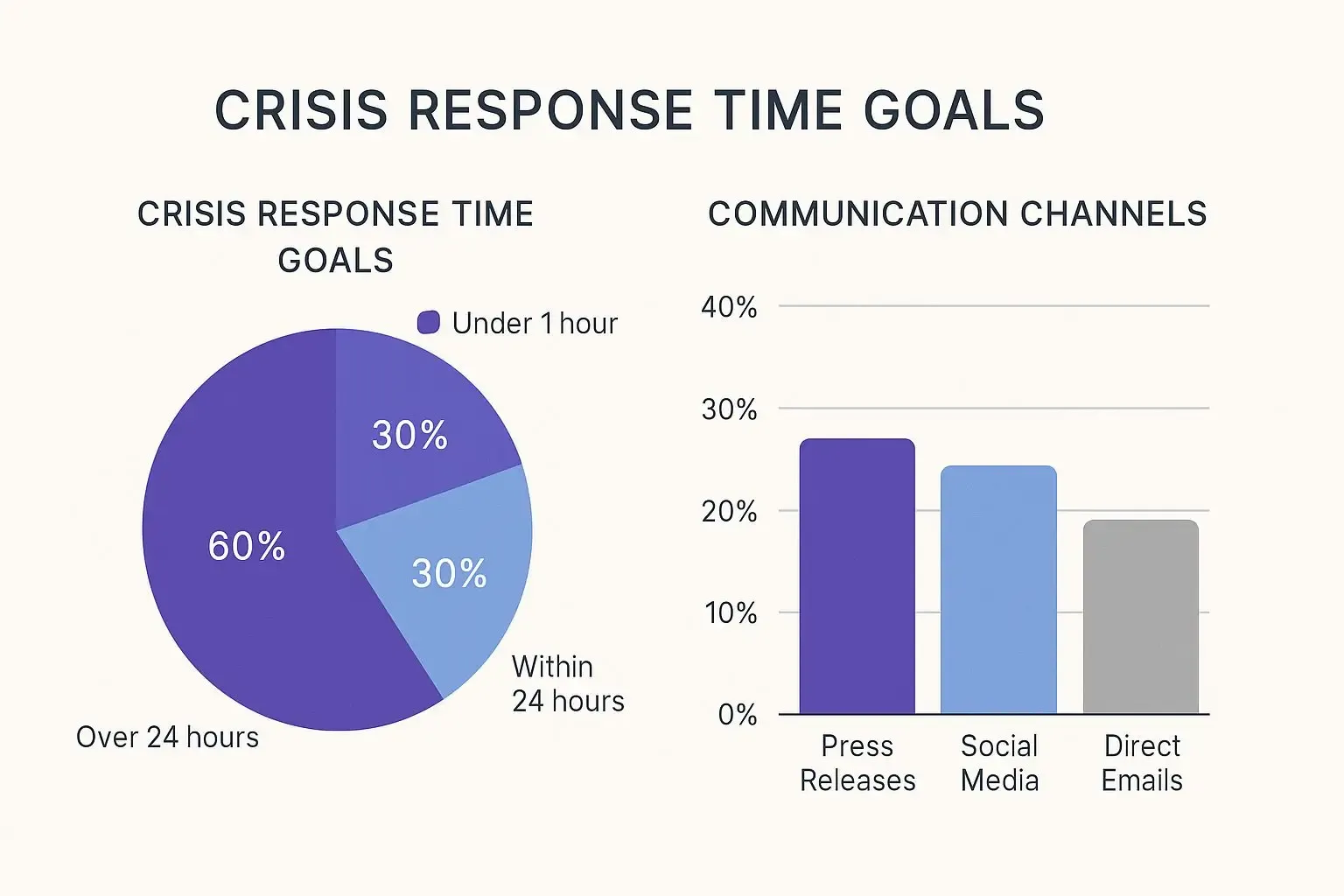
This data shows that while 60% of companies aim to respond in under an hour, the channels they use matter immensely. A fast response sent to the wrong place is a wasted effort. Ultimately, your crisis messaging should pass a simple test: Does it sound like it was written by a lawyer, or by a person who genuinely cares?
When trust is on the line, people don't expect perfection. They expect honesty. Authenticity always beats perfection in a crisis.

In a crisis, social media can be your best friend or your worst enemy. It can help you share your side of the story and show you’re on top of things, or it can escalate a small fire into a full-blown PR disaster. With billions of users ready to screenshot, share, and judge, your social media crisis PR strategy has to be incredibly sharp and lightning-fast. The days of just drafting a press release and waiting are over; today, the court of public opinion opens on platforms like X and Reddit within minutes.
This new reality has completely changed crisis PR. With over 4.9 billion people on social media, a problem can spread globally in an instant, making real-time monitoring essential. You can learn more about how data informs modern crisis management from the pros. This is where AI-powered social listening tools come in handy, cutting through the chatter to show you what conversations actually matter.
A one-size-fits-all response doesn't work on social media. Copying and pasting the same message everywhere looks lazy and impersonal. You need to adapt your approach to each platform.
- X (formerly Twitter): This is where you post quick, factual updates. Use it to share breaking information and point people toward a more detailed blog post or status page. For minute-by-minute communication, X is your go-to.
- LinkedIn: Reserve this platform for more formal, in-depth statements, especially from your leadership. A message from your CEO here can reassure investors, partners, and employees that the situation is being managed from the top.
- Reddit: This is where you’ll find raw, unfiltered customer feedback. Don't just jump into threads with corporate jargon. Instead, have a clearly identified employee engage genuinely in relevant subreddits, answering questions transparently and collecting feedback.
When the criticism gets intense, it’s tempting to either delete comments or get defensive. Don't do either. Deleting comments makes it look like you're hiding something, and getting into an online argument is a fight you can’t win. The best strategy is to acknowledge, empathize, and redirect.
A strong response often looks something like this: "We understand your frustration and we hear you. We’re taking this very seriously. We've posted a full update here [link to your official statement] and are happy to answer more specific questions via DM." This approach validates their feelings, keeps you in control of the narrative by moving the conversation to your own channels, and takes the heat out of the public forum.
For a deeper look, check out our guide on crisis management in social media. By using social media as a tool for recovery instead of letting it amplify the crisis, you can take back control of your story.
When a crisis hits, your relationships with customers, investors, employees, and partners are put under the ultimate stress test. A solid crisis PR strategy understands that each of these groups has unique fears and expectations. A one-size-fits-all approach is a fast track to losing the very support you need to recover. The goal isn't just to push out information; it's to protect and even strengthen these vital connections when trust is hanging by a thread.
For your customers, the worries are often immediate and personal: "Is my data safe?" or "When will your service be back online?" Your communication needs to be empathetic, frequent, and straight to the point. Take a look at how Slack handles major outages. They provide constant, honest updates on their status page and social media, clearly explaining what they know and what they're doing to fix it. This level of transparency shows respect and helps maintain confidence, even when the service isn't working.
Investors, on the other hand, are thinking about the long-term picture. They need to hear from leadership with a clear, strategic message that shows control and a plan for financial and reputational recovery. This is not the time for vague reassurances. They need to feel confident that leadership has a firm grip on the situation and that the crisis won't throw the company’s future off course.
To manage these different needs effectively, it's helpful to map out your communication priorities. This matrix can guide your team on who to talk to, what to say, and when to say it during the different phases of a crisis.
Crisis Phase High Priority Stakeholders Key Messages Communication Method Expected Outcomes Initial Response (0-24 hrs) Customers, Employees "We are aware of the issue. Here's what we know, and here's what we're doing. Your security/service is our top priority." Status Page, Social Media, Internal All-Hands, Email Blast Contain panic, demonstrate control, provide a single source of truth Ongoing Management (Days 2-7) Customers, Investors, Partners "Here are the latest updates on the fix. Here is the initial impact assessment. We have a plan for recovery." Scheduled Updates (Email, Blog), Leadership Video Message, Investor Briefing Maintain confidence, show progress, manage expectations for resolution Post-Crisis Recovery (Week 2+) All Stakeholders "The issue is resolved. Here's what happened, what we learned, and the steps we're taking to prevent it from happening again." Post-Mortem Blog Post, Customer Webinars, Detailed Investor/Partner Report Rebuild trust, demonstrate accountability, reinforce long-term value
This table shows that a structured communication plan is crucial. By tailoring messages and channels, you address specific concerns head-on, which helps stabilize relationships when they are most fragile.
Never forget that your employees are your most important ambassadors during a crisis. If they’re confused or feel left in the dark, that uncertainty will inevitably spill over into their conversations with customers and partners. Keeping them aligned is not just good practice; it’s a strategic necessity.
Here's how to keep your team engaged and supportive:
- Be Radically Honest Internally: Tell your team what's happening before they read about it online. A quick all-hands meeting or a direct message from the CEO can make a world of difference in showing respect and building trust.
- Provide Clear Instructions: Give them the information they need to be helpful, not harmful. What should they say if a customer asks a tough question? Who should they direct media inquiries to? A simple script or FAQ can empower them.
- Reinforce Their Value: Acknowledge their hard work under immense pressure. Making them feel like part of the solution boosts morale and keeps them focused when you need them most.
Ultimately, protecting these relationships is a core function of reputation management. By addressing each stakeholder's unique concerns with targeted, empathetic communication, you can turn a moment of vulnerability into a chance to build even stronger, more resilient bonds. To dig deeper into this, you can check out our guide on proactive reputation management.
The real test of a crisis PR strategy isn't just about weathering the storm; it's about what happens after the news cycle moves on. A genuine recovery isn't marked by a return to silence. Instead, it’s defined by a systematic approach to measurement and a commitment to transforming painful lessons into a stronger, more resilient brand. This post-crisis period is your chance to turn a reputation-threatening event into a real competitive edge.
Once the immediate danger has passed, your focus needs to pivot to analysis. This isn't about assigning blame; it's about getting an objective look at the aftermath. To understand the full scope of your recovery, you should start tracking a combination of quantitative and qualitative metrics.
- Sentiment Analysis: How are people talking about you now? Use a social listening tool like Octolens to monitor brand sentiment on platforms such as X, Reddit, and LinkedIn. Are conversations shifting back to the positive tone you had before the crisis? A steady stream of neutral or positive mentions is a powerful sign that you're on the right track.
- Share of Voice: Are you still part of the conversation in your industry, or have you gone quiet? A healthy recovery means you’re reclaiming your narrative, not just fading into the background while competitors dominate the discussion.
- Customer Churn & Support Tickets: Keep a close eye on your customer data. Are churn rates stabilizing after a potential spike? A noticeable drop in crisis-related support tickets is a great indicator that your solutions and communications are effectively addressing customer concerns.
Gathering data is just one piece of the puzzle; the real value comes from acting on it. A thorough post-crisis debrief should lead to concrete actions that strengthen your business for the future. As this Wikipedia entry on crisis management shows, the process is cyclical, with learning being a key part of preventing future issues.
.jpg&w=3840&q=75)
The diagram makes a crucial point: the "Learning" phase feeds directly back into "Prevention." Every crisis gives you a priceless dataset on how to avoid the next one. Think about Johnson & Johnson’s Tylenol crisis back in 1982. They didn’t just bounce back; they introduced tamper-proof packaging, which set a new industry standard and built enormous consumer trust. They used a disaster as a catalyst for innovation.
That should be your objective: not just to get back to business as usual, but to establish a new, stronger normal. Collect feedback from everyone involved, update your crisis playbooks with what you've learned, and run follow-up training sessions. A well-handled recovery doesn't just mend your reputation—it demonstrates that your brand is accountable, resilient, and ultimately, more trustworthy than it was before.
So, you've done the groundwork and have a solid grasp of the risks. Now, how do you turn those insights into a real, functional crisis PR strategy? This isn’t a task you can knock out over a weekend. It’s a deliberate process of preparing your defenses, getting the right people in the room, and lining up the necessary tools and support.
For a typical mid-sized SaaS company starting from scratch, you should expect this to take about three to six months. This timeline is realistic because it allows you to conduct a proper risk assessment, train your team, and build out your initial response plans without derailing your day-to-day business.
Let's be honest: one of the toughest parts is getting leadership to invest in a problem that hasn't happened yet. The key is to frame this not as an expense, but as essential insurance for the company's reputation and, ultimately, its market value. You need to make the threat feel real.
Instead of just talking about hypotheticals, bring data to the table. Show them what happened to a competitor's stock price after a data breach. Find an example of a similar brand that actually gained market share because they handled a crisis exceptionally well. Concrete examples like these transform an abstract "what if" into a tangible business case.
When you do get that budget, prioritize the essentials:
- A solid social listening tool: Trying to manually track brand mentions during a full-blown crisis is like trying to drink from a firehose. It's impossible. A dedicated tool is a must-have.
- Proper training: This isn't just about a quick media training session. You need to budget for realistic tabletop crisis drills for the core response team and dedicated coaching for your spokespeople.
- Legal expertise: Make sure you have a legal expert on retainer who gets PR and can review your public statements quickly. The last thing you want is a legal delay when every second counts.
To keep this from feeling overwhelming, break the implementation into manageable chunks. Think of it as building your crisis readiness in stages, where each phase builds on the last.
Phase Timeline Key Activities Desired Outcome Phase 1: Laying the Foundation Month 1-2 Assemble the core crisis team, run a thorough risk assessment, secure the budget, and choose your social listening tool. You'll have a fully formed team with a clear mission and the basic tools they need to get started. Phase 2: Building Your Playbooks Month 2-4 Draft your first response plans for high-risk scenarios, create communication templates for key stakeholders, and hold your first media training. Your core crisis documents are ready, and your key people have their initial training under their belts. Phase 3: Testing and Sharpening Month 5-6 Run a full-scale crisis simulation, get feedback from everyone involved, update your playbooks, and set up a schedule for regular reviews. You'll have a plan that’s been tested under pressure and a team that knows how to work together when things get heated.
Building this kind of resilience is a marathon, not a sprint. But by taking a structured, phased approach, you can develop a crisis PR strategy that does more than just sit on a shelf—it will genuinely protect your brand when you need it most.
Don't wait for a crisis to see what people are saying about you. Octolens automates social listening across platforms like X, Reddit, and LinkedIn, sending you AI-vetted, buy-intent conversations directly to Slack. Start tracking the conversations that matter today.