$200k in 60 Days: An Honest AppSumo Select Review (2024)
My reflections and learnings from selling Octolens through AppSumo Select as a Lifetime Deal (LTD)
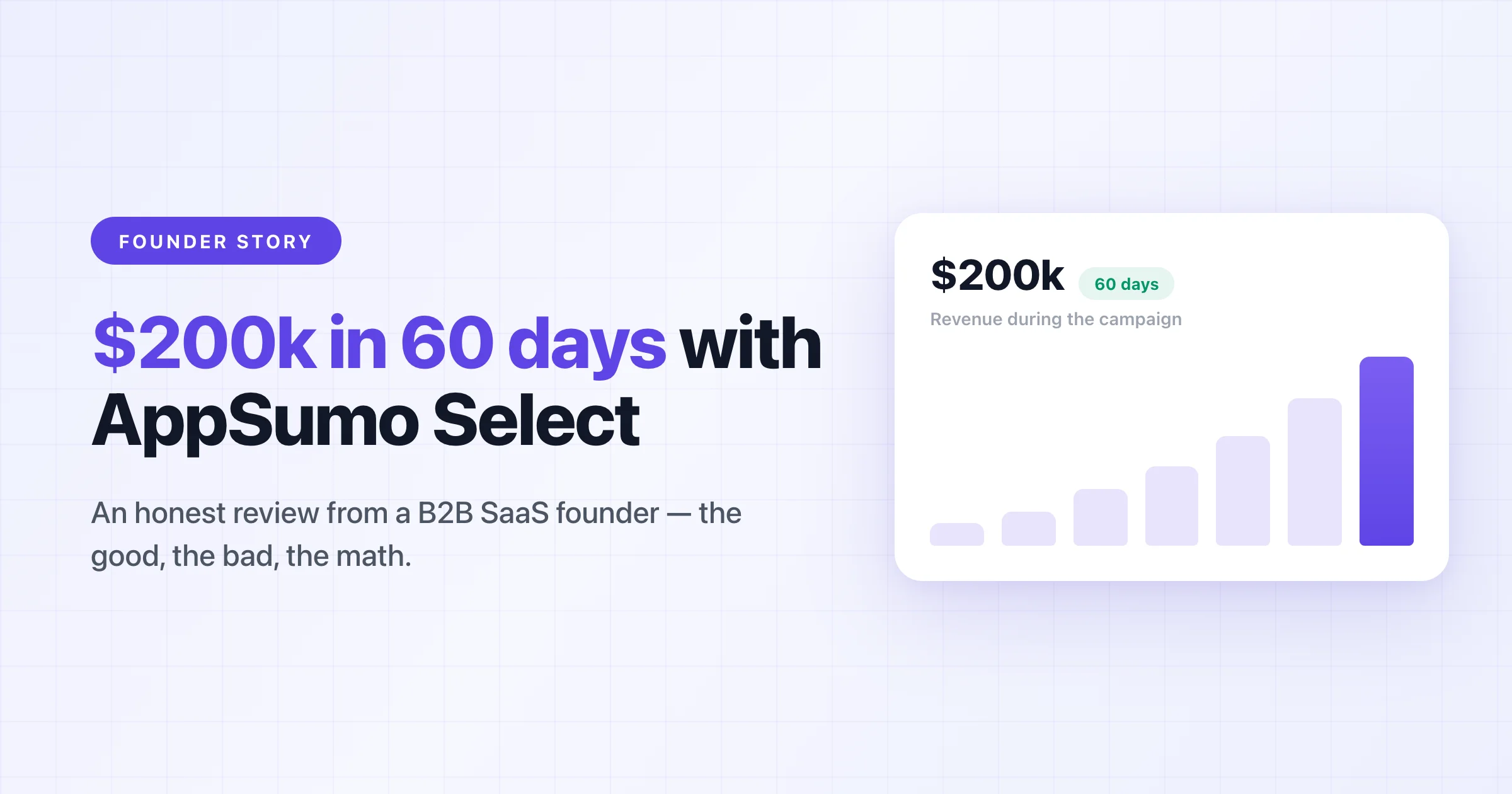
We made $200k in sales on AppSumo in 60 days. Here’s my honest review of selling my AI B2B SaaS product, Octolens , through AppSumo Select .
When I was researching AppSumo, I found some helpful reviews.
However, many were outdated, and I found little from the perspective of an AI and B2B SaaS founder.
I thought this reflection could help other founders in a similar situation inform their decision.
I first learned about AppSumo through the Tim Ferriss Podcast where Noah Kagan, AppSumo’s founder, was a guest.
He was promoting his book Million Dollar Weekend . At the time, I had just started working on Octolens and really enjoyed Noah’s pragmatic approach to founding businesses and his strong focus on distribution. This sparked my interest in AppSumo, and I looked into listing Octolens but initially decided against it.
Octolens is an AI-powered social monitoring tool for B2B SaaS.
We track keywords important to our customers across platforms like X, LinkedIn, Reddit, and others, alerting them when relevant posts pop up. Our AI assesses posts for relevance—flagging those with buy-intent or strong engagement opportunities. As a typical SaaS, we charge monthly or annually, incurring recurring costs ourselves for every workspace.
These costs include notably hosting, scraping, and AI.

- The Lifetime Deal (LTD) Approach: Customers pay once for lifetime access on AppSumo and have a 60-day money-back guarantee. For a product with recurring costs like Octolens, I was worried about long-term sustainability if pricing wasn’t right—especially given our AI costs.
- The Revenue Share Model: It’s negotiable, but AppSumo takes 65-80% of revenue from my research (even though recently I saw this comment from Noah on LinkedIn saying the average is 50%). Without knowing much about other potential benefits, this split felt high and added to my uncertainty about creating attractive yet viable pricing tiers.
- The Time Commitment Needed: Listing on AppSumo requires engineering resources to set up custom onboarding and pricing tiers. With just two of us (me and Pepe, Octolens' founding engineer), I didn’t want to halt product development. Plus, many warned about being swamped with customer support during and after the campaign.
- Brand Concerns: I worried that offering a lifetime deal would dilute Octolens' perceived value. The same goes for any other heavy discounting.
Given these concerns, and with Octolens growing steadily on its own, I decided AppSumo wasn’t a good fit.
A couple of months later, the AppSumo team approached me on LinkedIn.
After talking with them several times and doing a lot more research, I decided to give it a go.
Here’s why:
- A Great Team: One of the highlights of working with AppSumo - a really helpful and great team. In total, every interaction I had with a member of the AppSumo team was positive. They are quick to respond, structured, and informed.
- Inactivity Clause: To address my concerns about recurring costs, AppSumo allowed us to turn off accounts after six months of inactivity. Users could always reactivate, but this protected us from spending on abandoned accounts.
- A More Mature Product: By this point, we had more customers, core features, and a better understanding of user behavior and costs. This made it easier to model pricing tiers. I’ll emphasize here: If you have a recurring cost product, I would strongly recommend only going for AppSumo once you have a good grasp on your costs. This might seem obvious, but it's really not that trivial in the early stages of a SaaS.
- Decreasing AI Costs Helped Pricing: Around the same time, AI costs started to go down quite a bit, which helped in creating pricing tiers that could accommodate a LTD. The AppSumo team also gave me a better indication of how to think about lifetime pricing and lifetime averages to work with and cover.
- Letting go of the Brand Concerns: Some great companies that I value today have launched with AppSumo (e.g., Lemlist founded by Guillaume Moubeche and others like Zapier) and I think done right it can be a brand booster. If Octolens can get on a similar trajectory to a company like Lemlist - I would be happy.
- Defining Clear Goals Beyond Revenue: If your only goal is to bring in cash, as a recurring cost product, AppSumo likely won’t be sustainable. I began seeing AppSumo as less about immediate profit and more as an investment in marketing, learning, and growth.
In the end I distilled my goals for Octolens to the following:
- **Goal 1:**Gather user feedback to refine our ICP and improve our product.
- Goal 2: Drive website traffic during and after the campaign.
- Goal 3: Increase MRR with post-campaign add-ons.
- Goal 4: Turn AppSumo reviews into testimonials on platforms like G2 and Capterra.
A cash injection was of course also a goal, but I knew it would only be temporary, so it was secondary to the above.
As the title suggests, we grossed slightly over $200,000 in total sales within the 60-day period.
That’s the headline figure, but let’s break it down.
After AppSumo’s revenue share (in our case, around 70%) and the inevitable refunds (remember, it’s a very buyer-friendly marketplace with a 60-day guarantee), we will net closer to $40,000 in payouts. We ended up onboarding over 1,000 new users, which is no small number for an early-stage B2B SaaS tool.
This greatly helped us test our robustness and scalability.

We have managed to already convert some customers to partial MRR, which is exciting.
This has come through add-on packages like selling extra mentions or social media platform add ons to the lower tiers.
Making some progress on Goal 4 of creating MRR opportunities.
Quantity doesn’t automatically mean quality, and I was initially nervous that we’d bring in a crowd who didn’t fit our ideal customer profile (ICP).
To be honest, we did see a mix.
Some customers were in our ICP—B2B founders and growth teams who “got it” and started using Octolens to drive their growth.
Others clearly weren’t a perfect fit and dropped off quickly or asked for refunds.
That’s the nature of a broad marketplace.
But the upside: the engaged users gave us insights.
We saw how people interpreted our features, what they loved, and what they found confusing.
Everyone warns you that AppSumo campaigns come with a tidal wave of support requests.
They’re not kidding. The first couple of weeks were a big change to our much calmer customer support thus far, with questions pouring in from all directions.
Some queries were totally fair—basic onboarding help, clarification on tiers.
Others felt more like demanding wish lists (“Can you just give us all features, forever, for free?”).
While stressful, it was also a forcing function to improve our support docs, streamline onboarding, and clarify certain product points.
In the end, the support-heavy sprint made our product more accessible and helped us get rid of a lot of edge case bugs!
Another pleasant surprise was the spike in website traffic during and after the campaign.
There’s a halo effect: being on AppSumo’s radar brought us into new communities.
Even after the deal ended, there are more organic sign-ups and inbound interest.
We also leveraged the momentum to strengthen our overall marketing funnel—tweaking landing pages and improving messaging. A side bonus: AppSumo is a great website to have a backlink from!
Similar to Product Hunt, launching on a very reputable site like AppSumo means your own website improves in domain rating.
We went from 10 to 23 DR on Ahrefs during our AppSumo campaign

I still consider a lot of these goals as “in progress”, but here are some reflections so far.
Yes. The volume and variety of users meant we got feedback we might have taken many months to gather otherwise.
We learned that some of our original assumptions about who would use Octolens most effectively were spot-on, while others needed adjusting.
This feedback didn’t just come in the form of “I like/don’t like this feature”; it helped us understand what types of customers derive the most value, which workflows are most common, and what features are truly must-haves.
We saw a substantial traffic spike, and while some of it tailed off after the campaign ended, our baseline traffic is now higher than before.
We gained more backlinks, mentions on social media, and word-of-mouth buzz.
The long-term effect is yet to be fully measured, but the initial signs are positive.
We already have some AppSumo users upgrading with add-on packages, like additional keyword mentions or platform expansions.
It’s still early days, but this indicates that at least a portion of the AppSumo cohort sees enough value to pay more on an ongoing basis.
That’s a big win because it was one of my primary concerns—could we convert lifetime deal seekers into recurring revenue customers?
No. We got some great reviews - and even though I have approached some to also share on other platforms, I haven’t had success yet.
This is largely due to lack of follow ups - so more on me than anything else.


Yes. ✅ But I would do a few things differently. Here’s what I would tell my past self:
- Try to negotiate a little more- I’d try harder to improve the revenue split. As a first-timer, I accepted terms too readily. With hindsight, even a few percentage points improvement would have made a meaningful difference.
- Put negative feedback into perspective- it was the first time I had to deal with rude and angry customer messages, but looking at the numbers now, it was really a small small percentage. I had days where I was down because of these voices, which was unnecessary.
- Set firmer boundaries with some users - it’s a thing on AppSumo, you can see it in the comments of virtually any campaign, Sumo-Lings ask for more, and often not in the kindest of ways. We did add in some features due to some of these voices, but guess what, they’ll always ask for more! Sometimes you just have to politely ignore them. At times maybe you should edit your deal - but it should be more data driven and not due to loud voices.
- Clarify ICP better in listing description - I would even more clearly try to address our ICP in the product description and work with the AppSumo copywriters. For example, we know Octolens is not great for agencies yet, it would have been smart to explicitly write that into the product description.
- Test test test onboarding- We would definitely test our redemption flow better and avoid early missteps. We had a big bug in the beginning which was not the best start and catching that would have reduced the initial support flood.
As with all things - it depends! For Octolens, we’ve come out of the campaign stronger - with a revenue boost and powerful learnings. I hope the above summary can help some of you in making your decision.
AppSumo is not a magic bullet. As with most startup moves, it’s a big experiment that can pay off if you manage it well.
You have to go in eyes wide open—knowing the trade-offs, the time investment, and the emotional rollercoaster.
But if you play it right, it's a great catalyst for growth and a step towards a stronger, more customer-focused product.