
The Best Google Alerts Alternative in 2024
Google Alerts is a popular tool for web monitoring. Learn how it compares to Octolens, the AI-powered social listening tool for B2B.
In today's digital landscape, staying informed about online mentions of your brand is crucial. People often make buying decisions online based on what their network or wider community is saying across social platforms and more. Whether there is a rave review for your product, a complaint about you or your competitor, or a discussion of a paint point, you can help address - you’ll want to know. You can turn many online mentions into growth opportunities for your business.
Social listening tools are designed to help you do this. At their core, these tools monitor different online sites for your chosen keywords like your brand name, competitors, or other relevant terms and notify you when it happens.
Google Alerts has been a longstanding solution for monitoring online mentions. As the name suggests, it is powered and based on the Google Search Engine. It is a handy (and free) tool that sends you email alerts when a term is mentioned on an indexed site. While helpful, it comes with limitations in terms of accuracy, speed, platform coverage, and support. We will discuss its merits and drawbacks in this post below.
A new and alternative tool on the market is Octolens. Octolens is an AI-powered social listening tool tailored to B2B software companies. It is focused on covering platforms for a business audience (e.g., X/Twitter, LinkedIn, GitHub, Reddit, and more) in an accurate, fast, and relevance-sorted way to sift out the noise.
Below we compare both tools across several factors. As you’ll see, Octolens is a great option for company builders while Google Alerts is suited for individuals just getting started or as an add-on tool.
Octolens is an AI-powered social listening tool designed to monitor platforms crucial for B2B software companies. It sifts through platforms like DEV, GitHub, Hacker News, LinkedIn, Twitter, Reddit, YouTube, and Stack Overflow, providing notifications whenever a specified keyword is mentioned. These keywords can range from your company name to competitor mentions, relevant industry problems, or any other term.
Once it finds these keywords, it will sift out posts that are not relevant at all, and will then tag the posts as High, Medium or low relevance. This is done to save you time, and ensure you get high-signal information, whilst still surfacing all of the relevant information.
Google Alerts, monitors a variety of sources, including news websites, web pages, blogs, public forums, video titles, and books. However, it lacks the capability to effectively monitor social media platforms, which are increasingly vital for comprehensive online brand monitoring.
Google Alerts operates solely via email alerts, allowing users to specify the frequency, language, and geographical regions for monitoring mentions. There is often a delay in the alerts, because it takes time for Google to index new posts.
Octolens
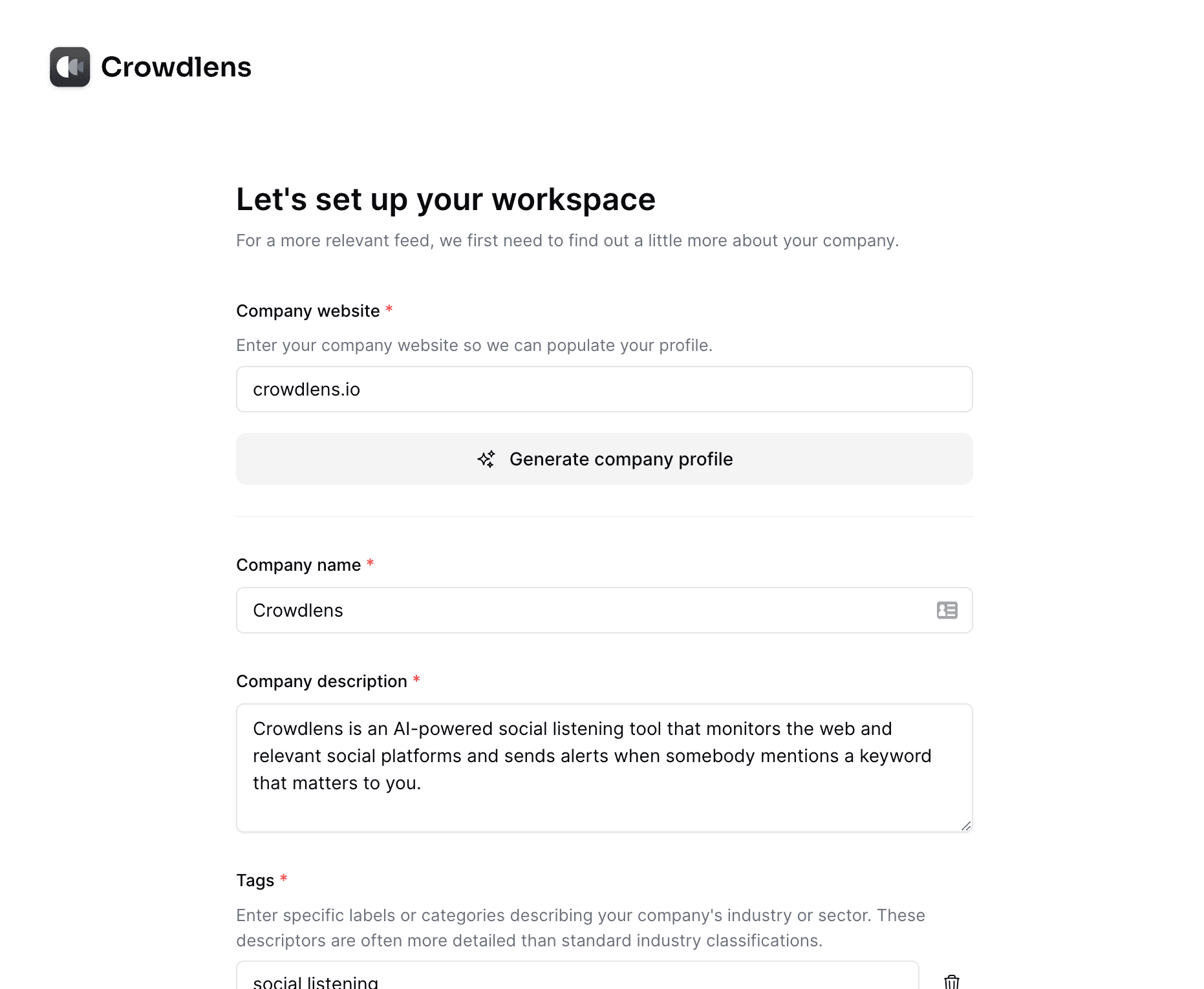
To set-up Octolens you need to follow the steps bellow:
- Signup with magic link, Google, or an email address
- Input your company website and click “Generate company profile” - with AI Octolens surfaces the needed information about your company so it can later understand what posts are more or less relevant to you.
- AI generates keyword ideas for you, which you can edit and add to based on your needs.
- Then within a few minutes you’ll have up to 100 mentions of the last 7-days across your chosen platforms to start looking into.
Google Alerts
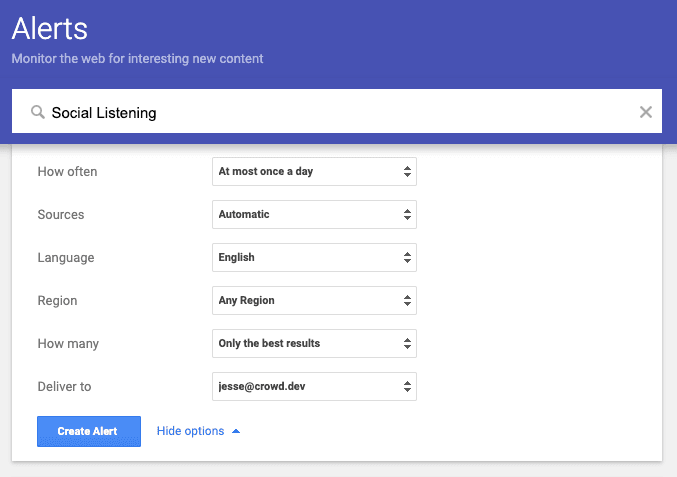
To set-up Google Alerts you need to follow the steps bellow:
- Sign into with your Google account.
- Type in your keywords for example “Social Listening”.
- Select your criteria to be notified.
Overall, the process is quite simple. However it doesn’t consider your company, or make the process more efficient for you. To setup multiple keywords, is also slightly more time consuming as you have to do each one individually.
Octolens
Octolens covers a diverse range of platforms, including social media, community forums, and industry-specific platforms crucial for B2B software companies. With more platforms on the way. In contrast, Google Alerts primarily focuses on web pages, news sites, and blogs, with limited social media monitoring capabilities.
The platforms that are monitored:
- DEV
- GitHub
- Hacker News
- X/Twitter
- YouTube
- Stack Overflow
Octolens is consistently adding more data sources and users can easily contact customer service with their requests to be added into the short term roadmap.
Google Alerts
Google Alerts is built as a more general tool, and is not aimed at solving for a specific industry. This means the platforms are less focused on B2B SaaS and more focused on broader categories like news, blogs and Google search results.
The limited monitoring capabilities are a big pain point if you’re running a B2B software company. For example, X/Twitter is where a lot of customers share complaints, and talk about software. With Google Alerts, you’re missing out on all of these conversations - a critical place to engage with users. However, it may be prudent to use Google Alerts in addition to a paid tool like Octolens to get better insight into more general mentions.
The platforms that are monitored by Google Alerts:
- News and blogs
- Google search results
- Video
- Books
- Possibly other sources, this is not made clear by Google
Octolens
From seamless onboarding, to monitoring and relevance scoring Octolens makes the most of AI. When it searches platforms, it will screen each post to ensure its a relevant post in the context of your company. Following that, it will assign a relevance score of either High, Medium or Low so you can get high signal content with as little noise as possible.

Google Alerts
With Google Alerts, users experience a lot more noise, and a lot less signal. This is easy to test, and see for yourself. Once a keyword mention is found, there is still no way to rank each post, or sift through the content efficiently. This is largely due to having no AI implementation, or filtering capabilities. With Google Alerts, the user needs to do a lot more manual work.
Octolens
Octolens is focused on serving one type of customer - B2B software companies. It’s designed with this specific target audience in mind and as a result it searches for mentions on the most relevant platforms like X/Twitter, and LinkedIn because this is where B2B software customers are. Along these lines, it is also able to find and tag the posts that are the most relevant to the B2B software company’s team.
Now that the target company is clear, we can unpack the users and use cases for Octolens below:
Marketers:
- Monitor brand mentions, track sentiment, and identify trends.
- Analyze competitor strategies and market positioning.
- Discover content topics, industry discussions, and trending hashtags.
Go-to-Market:
- Conduct market research on pain points and product feedback.
- Identify potential leads and engage in relevant conversations.
- Validate product-market fit and refine go-to-market strategies.
Sales:
- Monitor target accounts and engage with prospects in real-time.
- Gain insights into customer sentiment and objections.
- Stay updated on competitor activities and market trends.
Customer Success:
- Address customer feedback, complaints, and support inquiries promptly.
- Engage with customers on community forums and social media.
- Capture product feedback and facilitate product improvements.
Developer Relations:
- Engage with developers, address technical questions, and provide support.
- Advocate for products and establish thought leadership in the developer community.
- Stay informed about developer events, conferences, and hackathons.
Whilst this is not an exhaustive list, it’s focused on helping B2B software companies grow, and over time, the product will become increasingly more valuable for this specific target audience.
Google Alerts
Just like Google Search is for everyone, so is Google Alerts.
Businesses:
- Track mentions of your brand.
- Monitor competitors.
- Stay ahead of industry trends.
Marketers:
- Discover new content ideas.
- Measure campaign performance.
- Identify potential customers.
Anyone:
- Follow your favorite sports teams, celebrities, or hobbies.
This target audience is broad, and less focused than Octolens. Which is a key difference between the two tools. Whilst Google Alerts can be used by businesses, it won’t be able to satisfy all of their needs.
Octolens
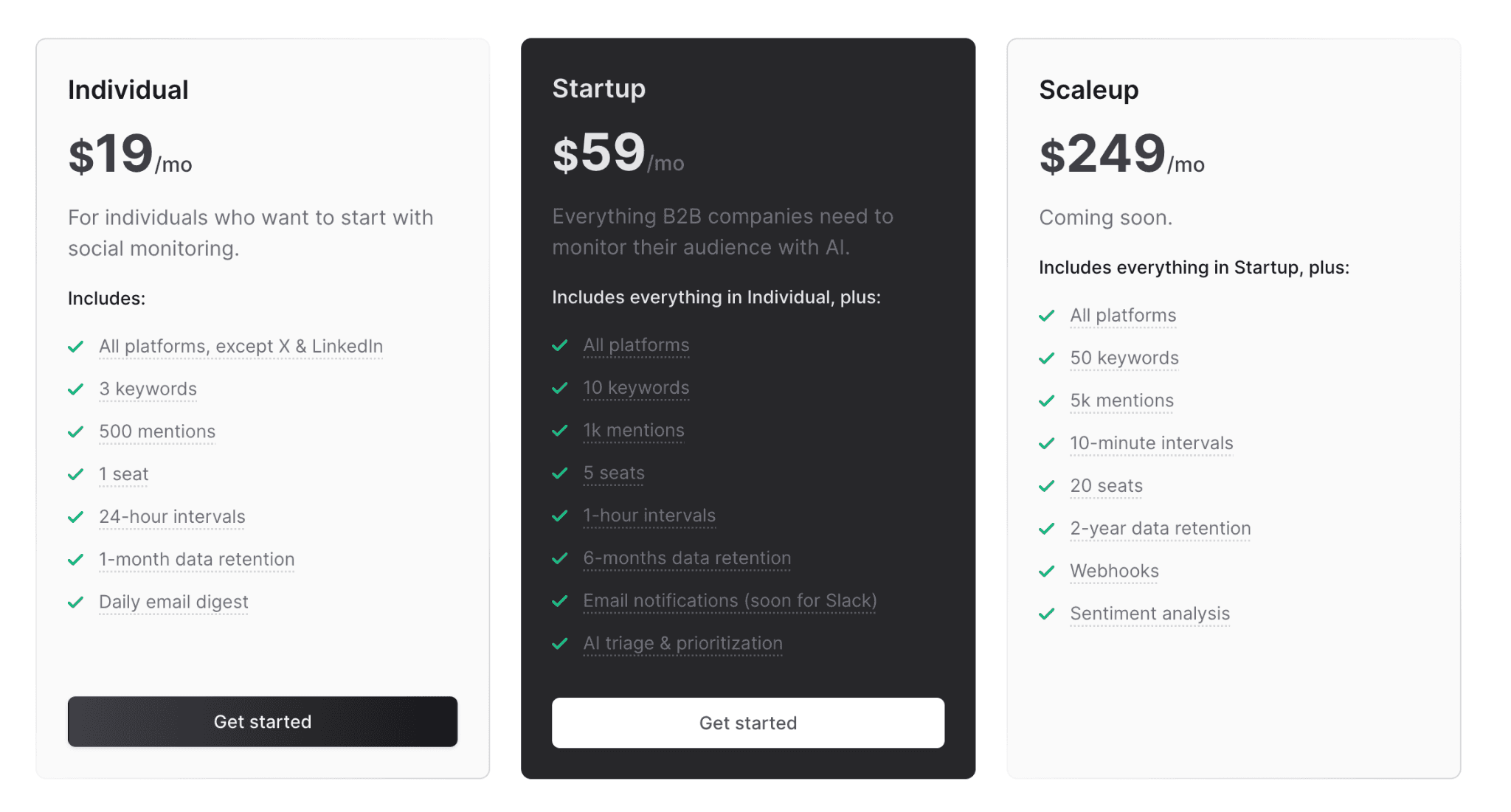
Octolens offers competitive pricing plans that cater to different company needs, providing affordable options for startups and scalable solutions for established enterprises. For social listening tools, Octolens is priced competitively, and over delivers on value. It starts at only $19 per month.
Google Alerts
Google Alerts is free to use, but its limitations in monitoring social media and accuracy may result in hidden costs associated with missed opportunities. However, because it’s free there is no reason not to use it in conjunction with a tool like Octolens. We would recommend testing both platforms, to see if you get additional value from Google Alerts.
Octolens
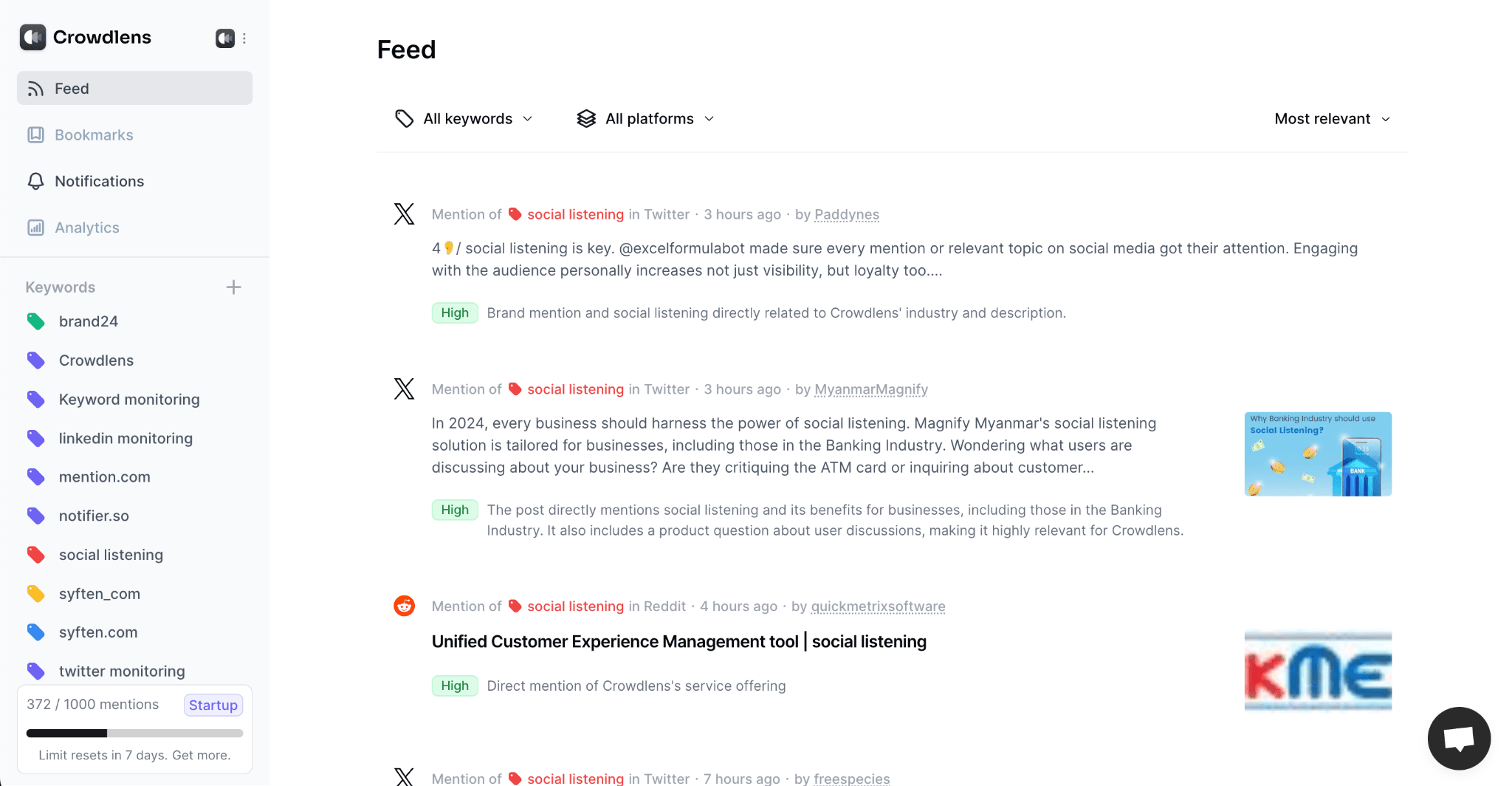
Octolens boasts an exceptional user experience with an intuitive interface, and AI-driven features to streamline setup and monitoring processes. Octolens provides flexible notification options, including email and Slack alerts with customizable frequency (hourly, daily, or weekly) and content filtering based on relevance.
Designed for companies:
- The startup plan has 5 seats, which gives teams full visibility of the Octolens dashboard.
- This also allows for multiple people to utilize one subscription, and receive notifications directly from Octolens.
Overall, Google Alerts, while functional, may feel less intuitive and lacks the advanced features offered by Octolens.
Google Alerts
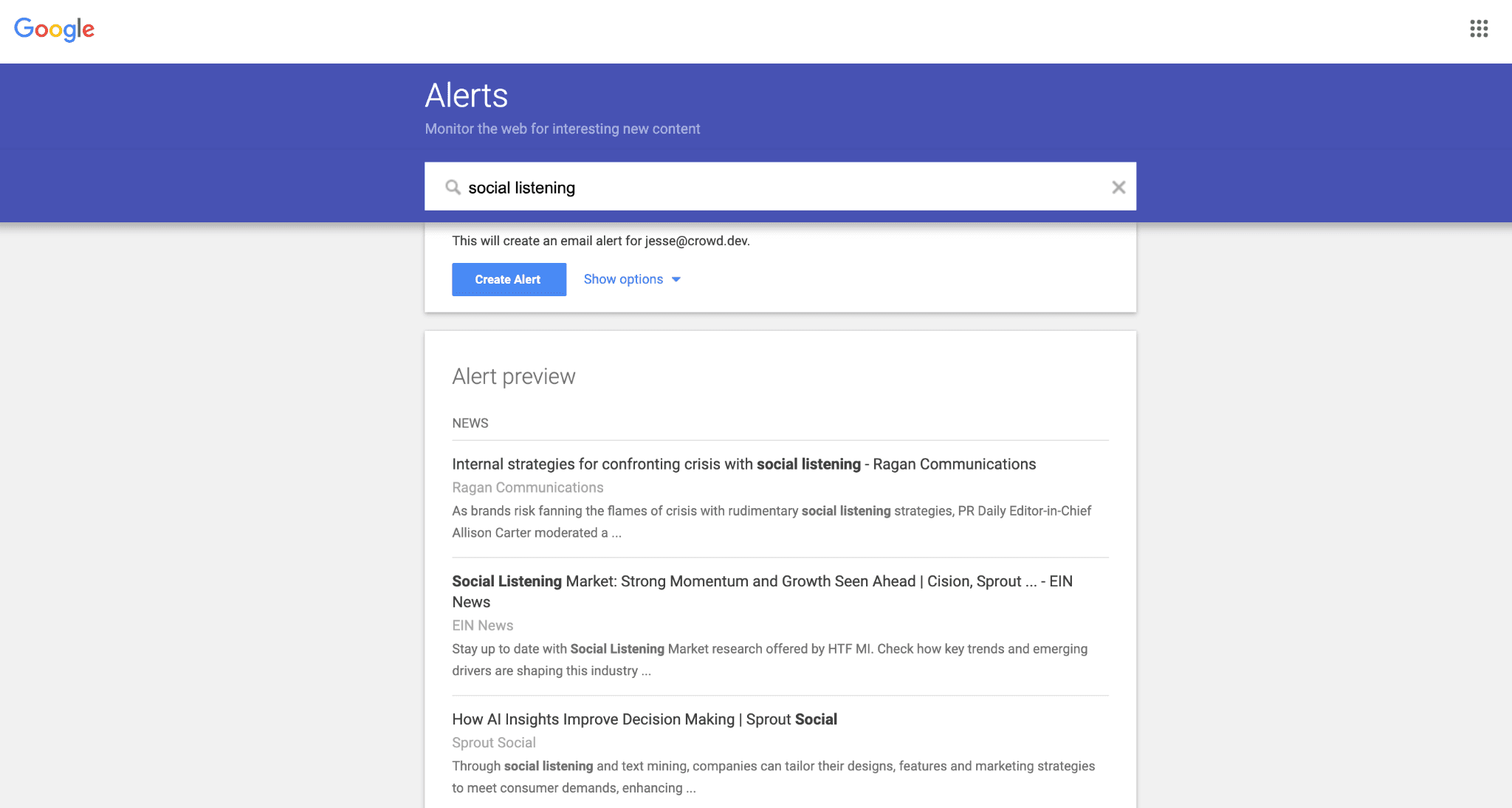
The experience is predominantly driven by user input, and leaves a lot to be desired in terms of reducing manual work. Things like finding keywords, working with multiple keywords, and viewing all of the keyword searches in one dashboard. Google Alerts solely relies on email notifications, lacking options for real-time alerts or customization beyond frequency and language.
Designed for individuals, Google Alerts makes it easy to search for one set of keywords, and to see all of the posts that it retrieves, however it’s not easy to share this with a teammate or show other members of your company what to monitor
Octolens
Octolens is built by a team of people that are passionate about solving problems for B2B software companies. We love hearing from our customers. This could be in the form of negative feedback, feature requests, or to help you get the most out of the product.
We believe that it's important to stay close to customers when building software. This is a core advantage over using a tool like Google Alerts, with Octolens you can speak to a human, and get help every step of the way.
Google Alerts
One notable limitation of Google Alerts is its lack of human support. Google Alerts relies solely on automated processes for monitoring and delivering alerts.
This means that users may encounter challenges or issues that cannot be addressed through direct human intervention. Users would have to get assistance with setup, customization, or troubleshooting by navigating online documentation or community forums.
Description Octolens Google Alerts Pricing From $19 Free Keyword monitoring ✅ ✅ Search intervals 1-hour (Startup plan) Once indexed (could lead to delays) Customer service ✅ ❌ Feed of post mentions / web app ✅ ❌ AI relevance scoring ✅ ❌ Data retention ✅ ❌ Customizable notifications ✅ ✅ Email notifications ✅ ✅ Slack notifications ✅ ❌ Analytics ✅ ❌ Twitter/X monitoring ✅ Only what's indexed by Google Reddit monitoring ✅ ❓ LinkedIn monitoring ✅ Only what's indexed by Google DEV monitoring ✅ Only what's indexed by Google GitHub monitoring ✅ Only what's indexed by Google Hacker News monitoring ✅ Only what's indexed by Google YouTube monitoring ✅ Only what's indexed by Google Stack Overflow monitoring ✅ Only what's indexed by Google News & Blogs monitoring Coming soon Only what's indexed by Google Google Search monitoring Coming soon ✅
In conclusion, social listening tools play a crucial role in monitoring online mentions, and fostering engagement. While Google Alerts has served as a go-to solution for many, its limitations in accuracy, platform coverage, and support are increasingly apparent, particularly for B2B software companies.
Octolens is an alternative designed specifically for B2B software companies. Leveraging AI technology, Octolens offers comprehensive monitoring across platforms that are relevant to this industry, ensuring fast and accurate notifications while filtering out noise.
Its seamless onboarding process, intuitive interface, and flexible notification options provide a superior user experience compared to Google Alerts. Moreover, Octolens is more than just a tool; it's backed by a team passionate about addressing the unique needs of B2B software companies. With responsive customer support and a commitment to ongoing improvement.
While Google Alerts remains a viable option, particularly for individuals and companies with broader monitoring needs, Octolens is the clear choice for companies focused on growth and engagement within the B2B software space. As companies navigate the digital landscape, investing in tools like Octolens ensures they remain not just informed, but empowered to turn online mentions into meaningful opportunities for growth. Sign up for Octolens.