
Social Media Reputation Monitoring Masterclass
A complete guide to social media reputation monitoring. Learn to track brand mentions, manage feedback, and protect your online reputation with practical steps.
Let's break it down: social media reputation monitoring is simply keeping tabs on what people are saying about you online. It’s the process of tracking conversations about your brand, products, or key people across all the social platforms that matter to your audience.
It's all about knowing what people are saying, where they're saying it, and how they feel about you. This isn’t a passive, check-it-once-a-week task. It's an active process that lets you protect your brand's image and jump into conversations when it counts.
Here's the truth: your brand isn't what you say it is. It's what your customers say it is. And these days, they're talking, sharing, and reviewing on social media more than anywhere else. These platforms have become the new town square for modern brand reputation.
Think of social media as a massive, unfiltered focus group that runs 24/7. It’s where raw, honest opinions are formed and shared in an instant. Unlike a curated survey or an official review, social media captures those immediate, emotional reactions that truly shape how the public sees you.
There are roughly 5.45 billion social media users across the globe, which is about 67.1% of the world's population. People spend an average of 2 hours and 24 minutes a day on these platforms.
It’s not just idle scrolling, either. A huge chunk of these users are there for buying inspiration (26.6%) or to actively research products (25.9%), making social media a critical touchpoint for your business.
This constant stream of conversation means your reputation is being built—or torn down—with every single post, comment, and share. A single viral complaint can easily overshadow months of positive marketing, while an authentic, glowing customer story can become your most powerful ad.
Ignoring these online conversations is like letting complete strangers define your identity for you. Proactive social media reputation monitoring is the difference between leading the narrative and being forced to clean up a mess after the damage is done.
It gives you the power to:
- Catch Issues Early: Address a customer complaint before it snowballs into a viral firestorm.
- Identify Advocates: Find and celebrate the happy customers who are organically promoting your brand.
- Gather Unfiltered Feedback: Hear what users really think about that new feature you just launched.
- Understand Market Sentiment: Get a real-time pulse on how your brand is perceived compared to your competitors.
Effective monitoring transforms social media from a potential liability into your greatest source of market intelligence. It’s not about controlling the conversation; it’s about participating in it with awareness and purpose.
The table below shows the stark difference between the two approaches. It’s easy to see how being proactive is a game-changer.
Impact Area Proactive Monitoring Reactive Monitoring Crisis Management Spot issues early, and mitigate them before they escalate. Scramble to do damage control after a crisis has gone viral. Customer Service Resolve complaints quickly, turning a negative into a positive. Address angry customers publicly, often too late to save the relationship. Brand Perception Shape a positive, responsive, and engaged brand identity. Appear defensive, out of touch, or indifferent to feedback. Opportunities Discover brand advocates, UGC, and new leads. Miss out on positive mentions and chances for engagement.
Ultimately, choosing a reactive stance means you're flying blind. The benefits of getting ahead of the conversation are just too significant to ignore.
For a deeper look at building out your own strategy, this helpful social media reputation management guide provides a comprehensive overview of how to shape and protect your online image. Your brand’s story is being told online every single day—the only question is whether you’ll be an active part of it.

Putting together a solid social media reputation strategy can feel like a huge task, but it really just boils down to listening for the right signals. Think of it as casting a wide net to catch the conversations that actually matter, then filtering out all the noise so you can focus on what’s truly important for your brand's health.
This process is way more than just tracking mentions of your brand name. A comprehensive approach means you’re actively searching for a whole range of keywords and phrases. Without this, you’re only hearing a tiny fraction of the conversation.
To get the full picture, you need to be tracking several different categories of keywords. Each one gives you a different piece of the puzzle, helping you understand not just what people are saying about your company, but the entire context around those chats.
Here are the essential signals to have on your radar:
- Brand and Product Names: This is the baseline. Track your company name, all your product names, and any common misspellings or acronyms people might use.
- Key People: Keep tabs on mentions of your CEO, founders, or other public-facing executives. Their personal reputations are often directly tied to the company's.
- Campaign Hashtags and Slogans: Running a marketing campaign? Track any unique hashtags or taglines to see how far they’re reaching and what kind of sentiment they're stirring up.
- Industry Keywords: Paying attention to broader terms in your industry helps you spot new trends, pinpoint customer pain points, and jump into relevant conversations where you can add value.
- Competitor Names: Monitoring your competitors tells you what their customers are complaining about, what they're loving, and where you might have an edge.
Setting up these trackers means you’re not just sitting around waiting for someone to tag you. You're proactively finding the conversations that define your brand. To get more specific about where to focus your energy, our guide on how to know which social networks to start with can help you zero in on the platforms that will have the biggest impact.
It’s really important to get the distinction between monitoring and listening. They sound similar, but they serve two different—and equally critical—functions. One is about immediate reaction, and the other is about long-term strategy.
Think of it like this:
Social media monitoring is the smoke detector. It’s your real-time alert system. It tells you what is happening right now by picking up specific mentions and keywords. It lets you know there’s a "fire" that needs your immediate attention, like a customer complaint or a nasty review.
Social listening is the fire marshal. This is the analysis of all the data you've gathered through monitoring. It tells you why the fire started in the first place. Listening helps you see the bigger picture, analyze sentiment over time, and make strategic moves to "fireproof" your brand down the road.
Getting this right is the key to building a mature strategy. You monitor the individual trees to handle immediate problems, but you listen to understand the health of the entire forest.
Monitoring and listening aren't an either/or situation; they create a powerful feedback loop. Monitoring gathers the raw data—all the individual mentions, comments, and posts. You then feed this data into your social listening process to analyze it and pull out the deeper insights.
Here’s a practical example. Your monitoring tool might flag 15 negative comments about a new software feature in a single day (the 'what'). That's the alert.
Your listening process then dives into these comments and discovers they all mention the user interface being confusing (the 'why'). This insight gets passed to your product team, which leads to an update that improves the user experience.
One is tactical and reactive, the other is strategic and proactive. A successful social reputation program absolutely needs both to not only protect your brand today but to build a stronger one for tomorrow.
Alright, let's move from theory to action. Building a social media monitoring system that actually works isn't about buying the most expensive software you can find. It's about piecing together a smart, scalable process. You can get started, even on a shoestring budget, by combining the right tools with a clear plan for what to do when a mention pops up.
Think of this as your blueprint for a system that catches critical feedback without drowning your team in noise. It’s all about setting up the right filters and workflows to turn a firehose of raw data into something you can actually use.
The diagram below shows how raw chatter from social platforms gets collected, analyzed for sentiment, and then used to trigger real-time alerts for your team.
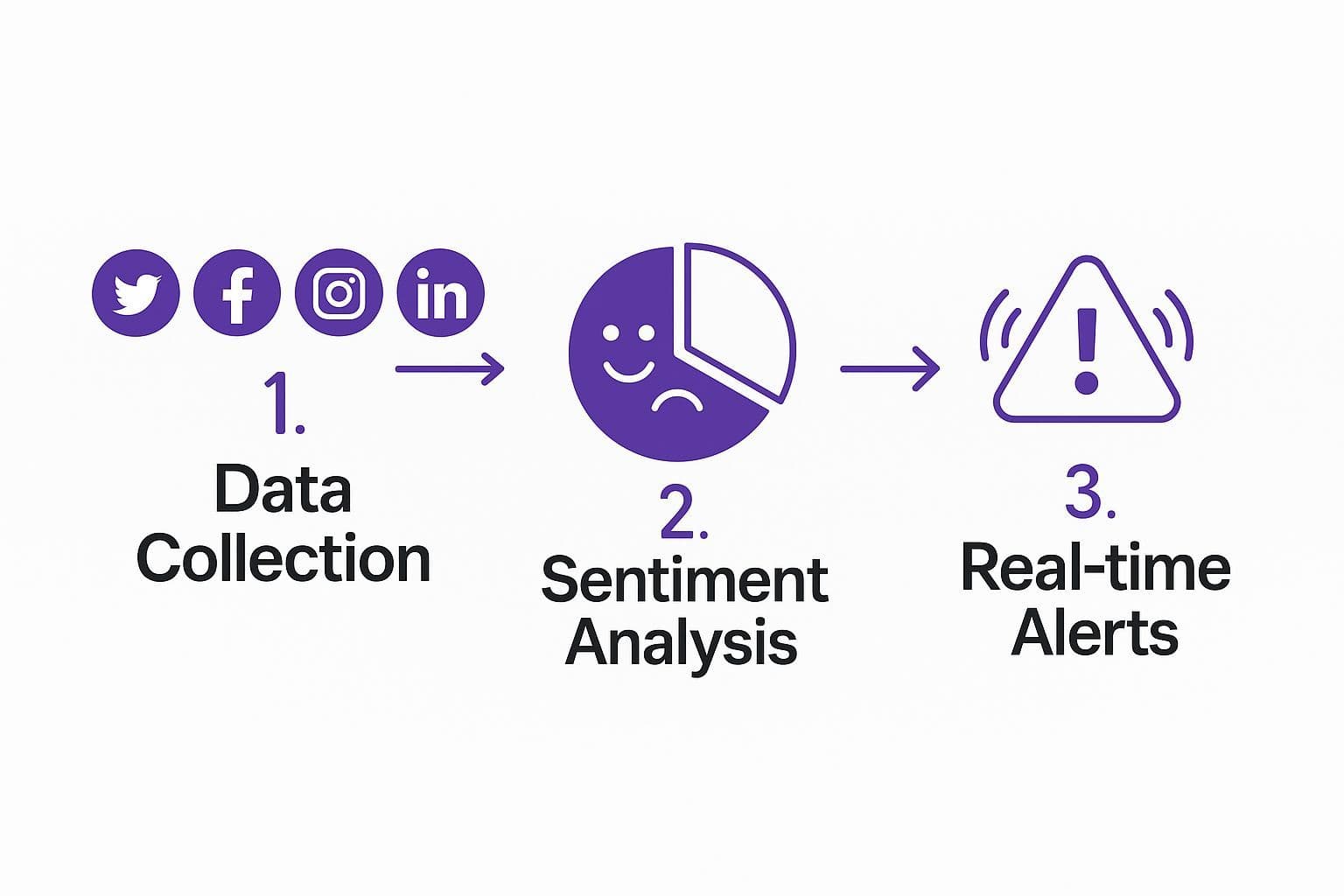
This kind of workflow makes sure nothing important slips through the cracks, letting your team focus on responding to the conversations that truly matter.
Your monitoring toolkit can range from completely free to enterprise-level, depending on your needs and budget. The key is to start with what you can realistically manage and then build from there. Don't fall into the trap of thinking you need a complex, multi-thousand-dollar dashboard from day one.
For anyone just starting out, free tools are surprisingly powerful:
- Google Alerts: This is your non-negotiable first step. Set up alerts for your brand name, product names, key executives, and even your top competitors. It’s a dead-simple way to get email notifications when new mentions appear across the web, including blogs and news sites.
- Platform-Native Search: Don't sleep on the search bars within X, LinkedIn, or Reddit. Use them to track hashtags, keywords, and mentions in real-time. A tool like TweetDeck (now X Pro) can help you create persistent columns to watch specific terms on X without having to search constantly.
As your brand grows, you'll probably hit the limits of manual methods. That's when paid tools become a necessity, offering automation, deeper analytics, and a consolidated view that manual searching just can't provide.
Picking the right tools depends entirely on your team's size, budget, and what you're trying to achieve. There's no single "best" option, only the best fit for you right now. This table breaks down the main categories to help you decide.
Tool Category Best For Example Tools Free & Manual Startups and solo entrepreneurs on a tight budget. , X Pro (TweetDeck) All-in-One Suites Larger teams needing publishing and analytics. , Focused Monitors Teams needing real-time alerts from niche platforms. , ,
Ultimately, the best tool is the one your team will actually use consistently. Start simple, prove the value, and then you'll have a much stronger case for investing in a more advanced solution down the road.
The biggest challenge in social media reputation monitoring isn't finding mentions; it's filtering out the junk. A poorly configured system will flood you with so much irrelevant noise that you'll inevitably miss the one or two comments that really matter.
Start with the basics we covered earlier (brand name, products, etc.), but get surgical with them. Use Boolean operators to narrow your focus. For example, instead of just tracking "Octolens," you might search for "Octolens" AND ("feedback" OR "bug" OR "review") to find specific types of conversations.
Your goal isn't to see every single mention. Your goal is to see every important mention. Quality over quantity is the mantra for effective monitoring.
A great free tool for this is Google Trends. It's perfect for finding related keywords and seeing how search interest changes over time, giving you clues about the language your audience is using.
This screenshot from Google Trends shows how you can compare search interest for different keywords, helping you identify what terms your audience is actually using.
Using this data helps you fine-tune your monitoring keywords to match how your customers actually talk, ensuring you don't miss crucial conversations just because you were listening for the wrong words.
Once mentions start rolling in, your team needs a clear game plan. Without a workflow, responses will be slow and inconsistent, and important feedback will get lost in the shuffle. A simple triage system ensures every mention gets seen, categorized, and handled efficiently.
Here’s a three-step process to get you started:
- Categorize: Is the mention positive, negative, or neutral? Is it a question, a complaint, or a shout-out? Tag each mention so anyone can understand its nature at a glance.
- Prioritize: Not all mentions are created equal. A bug report from a major customer or a scathing review on a popular blog needs to be handled immediately—long before a neutral brand mention with zero engagement. Create a simple priority scale (e.g., High, Medium, Low).
- Assign: Who owns the response? A technical question might go to the support team, a sales inquiry to sales, and positive feedback to the community manager. Route the mention to the right person to get a fast, accurate reply.
This doesn't need to be complex. A shared spreadsheet or a dedicated Slack channel can work wonders when you're starting out. The key is consistency. By building this simple system, you transform monitoring from a reactive chore into a proactive business intelligence function.

Let’s be honest: no matter how amazing your product or service is, negative comments are going to happen. It’s just part of doing business online. The real test isn't avoiding criticism—it's how you handle it.
An ignored complaint can fester and spiral, but a thoughtful, swift reply can transform a frustrated customer into one of your biggest fans. The trick is to see criticism not as an attack, but as a golden opportunity to show everyone you’re committed to a great customer experience. This is where your social media monitoring system really shines, giving you the heads-up to step in and make things right.
And the stakes are high. Consider that 93% of consumers say online reviews influence their buying decisions. A staggering 74% will abandon a purchase if they spot negative feedback on the first page of their search results. Even one mishandled review can have a massive impact, which makes a quick, graceful response absolutely essential.
When a negative comment pops up, the absolute worst thing you can do is get defensive or hit the delete button. That just pours fuel on the fire. Instead, you need a clear game plan that puts empathy and resolution first. This approach doesn't just fix the immediate issue; it shows every single person watching that you're a brand that listens and genuinely cares.
Here’s how to handle criticism like a pro:
- Acknowledge and Validate Publicly: Always start with a public reply. A simple, "Thanks for bringing this to our attention. We're sorry to hear you had this experience," shows you're not hiding and immediately validates their feelings.
- Move the Conversation to a Private Channel: After that first public acknowledgment, gently guide the conversation offline. Something like, "To get the details we need to sort this out, could you please send us a DM with your account info?" works perfectly. It protects their privacy and keeps a long back-and-forth out of the public feed.
- Ditch the Canned Responses: Templates can be a good starting point, but every single response needs a personal touch. Mention a specific detail from their complaint so they know a real human is reading and understanding their problem.
- Focus on the Solution, Not the Blame: Resist the urge to explain why something went wrong. Instead, pour all your energy into what you’re going to do to make it right for them.
The goal is never to win an argument. The goal is to solve the customer's problem and prove your brand's integrity to everyone else watching.
When someone is upset, what they want most is to feel heard. Your very first reply sets the tone for everything that follows. Kicking things off with empathy instantly brings the tension down and shifts the dynamic from a confrontation to a collaboration.
If you're dealing with a bigger issue that affects more than just one customer, you'll need a more structured response. We cover how to handle widespread negative attention in our guide to public relations crisis management. The core principles are the same: act fast, be transparent, and show you're on top of the solution.
But to really get the most out of feedback—especially the tough stuff—it's not enough to just listen. You have to act. This is often called "closing the feedback loop." Discover how closing the feedback loop can build customer loyalty and turn critics into your most valuable source of insight.
Ultimately, how you react to criticism reveals your brand's true character. By meeting negative feedback with a clear, empathetic, and solution-focused strategy, you can consistently turn potentially damaging moments into powerful displays of your commitment to your customers.
Monitoring your brand online isn't just about playing defense against negative comments. It's actually one of the best ways to find your happiest customers and turn their authentic praise into your most powerful marketing. This is where you flip the script from crisis management to opportunity creation.
By systematically catching positive mentions and user-generated content (UGC), you can tap into a goldmine of genuine social proof. This is how you transform a passive compliment into active, trustworthy content that builds credibility far more effectively than any ad campaign ever could.
Your monitoring system is already set up to catch mentions, but now it's time to filter for the good stuff. Look for posts where people are genuinely excited about your product, sharing success stories, or posting photos of your product in the wild. These are your brand advocates.
Engaging with them is simple, but it's absolutely crucial. A quick, personalized "thank you" can go a long way.
- Acknowledge their effort: "Wow, this is an amazing photo! We love seeing how you use our product."
- Ask a follow-up question: "This is a great tip for using the new feature. What other results have you seen?"
- Show genuine appreciation: Ditch the generic replies. Mention a specific detail from their post to show you actually read it and paid attention.
This simple act of recognition makes your customers feel seen and valued, encouraging them to keep sharing their positive experiences. For an in-depth look at what makes this type of content so effective, you can explore a complete guide to User-Generated Content (UGC) and see how creators are using it to build massive trust.
Once you've found a great piece of UGC, the next step is simple: ask for permission to share it. Never, ever repurpose a customer's content without their explicit consent. A quick DM is usually all it takes: "This is an incredible post! Would you mind if we shared it on our official channels and gave you full credit?"
Most happy customers are thrilled to be featured. Getting their permission not only respects their ownership but also strengthens your relationship with them.
Once you have the green light, you've got a versatile piece of authentic marketing content you can use across the board.
Don't just retweet a positive mention and call it a day. Get creative! Weave that authentic praise into different parts of your marketing to build trust at every single touchpoint.
Content Type Where to Use It Why It Works Customer Photos Product pages, ads, newsletters. Shows your product in a real-world context, making it far more relatable. Glowing Reviews Website homepage, case studies. Provides third-party validation that builds immediate trust with new visitors. Testimonial Videos Landing pages, social stories. A video testimonial is incredibly powerful for conveying genuine emotion.
This whole approach is a cornerstone of effective social media reputation monitoring because you're not just reacting—you're actively shaping a positive narrative around your brand. To see how this fits into a bigger picture, check out our complete guide on reputation management on social media.
By consistently amplifying the voices of your happiest users, you create a powerful cycle of positive reinforcement that attracts new customers and builds a loyal, thriving community.
The world of social media never sits still, and the tools we use to track it are evolving at breakneck speed. Looking ahead, two powerful—and sometimes competing—forces are shaping the future of reputation monitoring: artificial intelligence and the deep-seated human need for authenticity.
On one hand, AI is giving us superpowers. It can comb through millions of conversations to find patterns a human team could never spot, offering incredible insights into how people truly feel about a brand. On the other hand, this same technology is creating new headaches that your strategy needs to be ready for.
One of the biggest new threats is the explosion of AI-generated content. Between 2020 and 2024, there was a shocking 758% surge in AI-generated online reviews across major platforms. This flood of fake content got so bad that the Federal Trade Commission (FTC) stepped in to officially ban it, driving home the point that brands need to focus on genuine feedback. You can learn more about the FTC's move against AI-generated reviews on reputationx.com and what it means for businesses.
This all means that effective social media reputation monitoring isn't just about tracking mentions anymore. It's now about telling the difference between real human feedback and a wall of artificial noise. Going forward, you'll need tools and processes designed specifically to spot and verify authentic conversations.
In a world filling up with automated responses and AI-generated fluff, a real human connection is more valuable than ever. As technology takes over the heavy lifting of data collection, your team’s focus has to shift toward building genuine, transparent relationships with your audience.
In an increasingly automated world, authenticity isn't just a buzzword—it's your most critical competitive advantage. Brands that double down on genuine, transparent communication will build the lasting trust that AI can't replicate.
To get ready for this shift, you'll want to strike a balance between tech and the human touch. Here's how:
- Embrace Helpful AI: Let AI-powered monitoring tools handle the grunt work of data analysis. This frees up your team to focus on what they do best: high-value, personal engagement.
- Champion Transparency: Be open about how you gather reviews and feedback. Encourage real testimonials and user-generated content to drown out the noise of fake reviews.
- Prioritize Human Connection: Empower your team to have authentic, unscripted conversations with customers. A personalized, empathetic response will stand out more than ever.
The future isn't about choosing between AI and authenticity—it's about using one to amplify the other. By leaning on helpful technology while doubling down on genuine communication, you’ll build a resilient reputation that can weather any change that comes your way.
As you start to build out your own social media reputation monitoring, a few practical questions almost always come up. Let's get them answered so you can move forward with confidence.
This really depends on how much chatter your brand gets online. There’s no one-size-fits-all answer.
For most businesses, the sweet spot is a hybrid approach. You'll want to set up real-time alerts for your most critical keywords—think your brand name, product names, or any known issues. This way, you catch the truly urgent stuff the second it happens.
Then, layer on a manual check-in once or twice a day. This is your chance to get a feel for the overall sentiment and catch conversations that aren’t on fire but still matter. A big consumer brand might need someone watching constantly, while a smaller B2B company could be perfectly fine with a few daily check-ins. The goal is simply to be responsive enough to stop a small spark from turning into a wildfire.
I get this question all the time, and it’s a crucial distinction. Think of it like a doctor treating a patient.
Monitoring is like taking a patient's temperature. It’s reactive and focused on a specific, immediate metric—in this case, direct mentions of your brand. You're monitoring to see what's happening right now and responding to it.
Listening is like analyzing that patient's entire medical history to understand their overall health. It's proactive. You're looking at the bigger picture: industry trends, what people are saying about competitors, and broader customer feelings. You listen to inform your long-term strategy and, hopefully, prevent problems before they start.
Yes, absolutely. While paid tools offer some powerful automation and analytics, you can build a solid monitoring foundation for free. It just takes a bit more hands-on effort, but it's a fantastic way to get started and prove the value.
Here’s a simple, no-cost toolkit to get you going:
- Google Alerts: Set this up for your brand name, key executives, and product names. It'll send email notifications when you're mentioned across the web.
- Platform-Native Search: Just use the search bars within X (formerly Twitter), LinkedIn, and Reddit. You can actively track hashtags and keywords to see what people are saying in those communities.
- X Pro (TweetDeck): This is a game-changer for X. You can create columns that act as persistent, real-time searches for specific conversations, so you don't have to keep manually searching.
This manual approach is a powerful and budget-friendly way to start protecting your brand's reputation online today. You can always invest in more advanced software later as your needs grow.
Ready to catch every critical mention without the noise? Octolens helps B2B SaaS teams surface the conversations that matter on Reddit, X, Hacker News, and more, delivering them straight to your Slack. Start your free trial and see what you're missing.