Brand Reputation Monitoring in 2026: The Complete Guide
How to track what people — and AI models — actually say about your brand, measure it, and catch problems while you can still fix them.
Search Google for "brand reputation monitoring" and the first result isn't a software vendor or an analyst report. It's a Reddit thread — someone asking strangers which tools they use, with answers from a mix of real practitioners and vendors pretending not to be vendors.
That search result tells you most of what you need to know about this topic. Your reputation is being formed in public threads like that one, and they get read by your prospects and, increasingly, by the AI assistants your prospects ask for recommendations. The brands that come out of this fine are usually the ones who knew what was being said while there was still time to do something about it.
This guide covers what brand reputation monitoring actually is, how it differs from adjacent things with confusingly similar names, how to measure reputation with real metrics, and how to build a monitoring setup that catches problems early. One disclosure up front: we make Octolens, a monitoring tool, so we're a vendor in this category. We'll be explicit about where our kind of tool fits and where a different kind is the better choice.
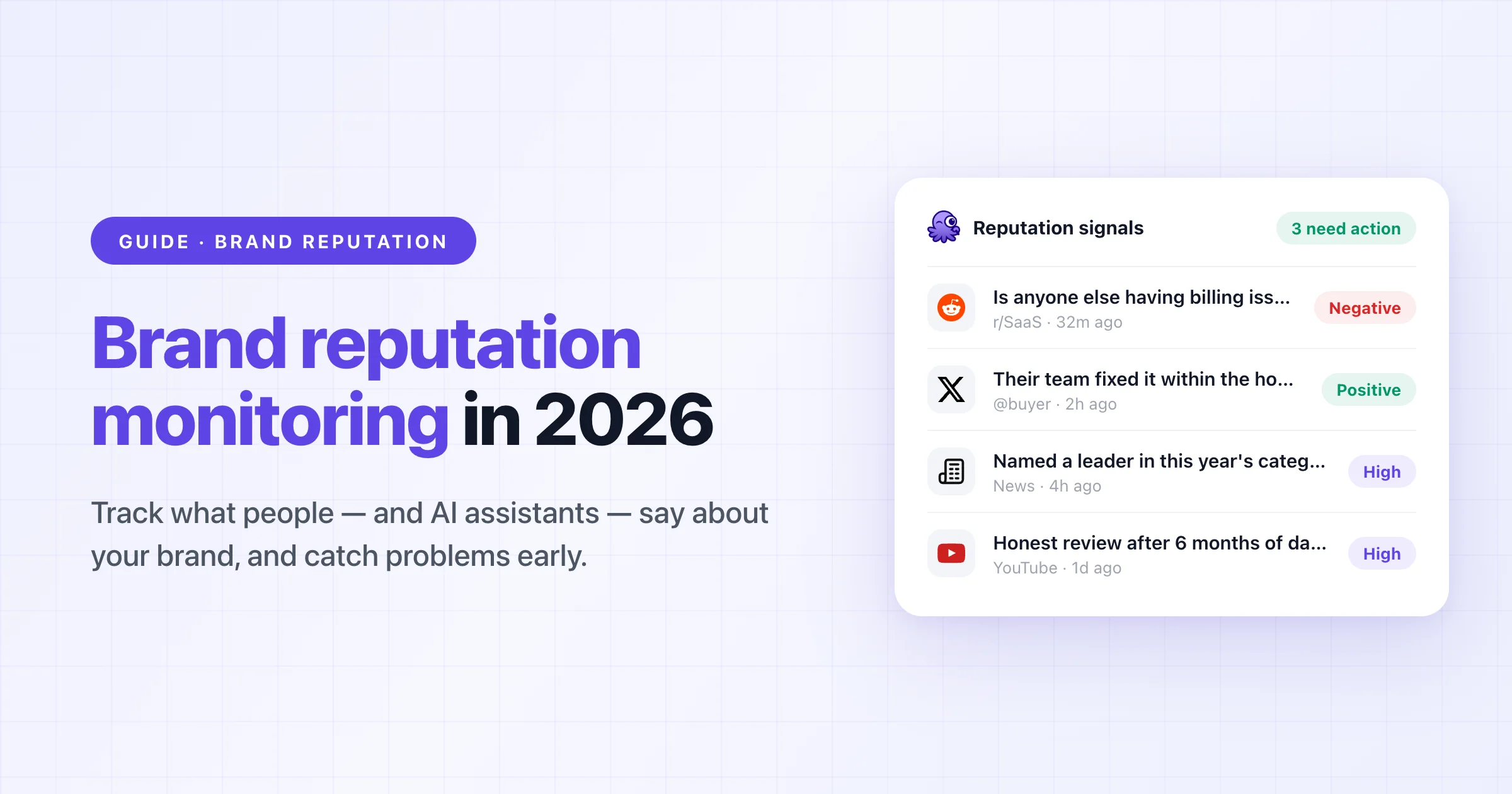
Brand reputation monitoring is the continuous tracking of what people say about your brand — across review platforms, social media, communities, news, and AI assistants — so you can measure how perception is trending and act on problems before they spread. Essentially it's the detection layer of reputation work: knowing what is being said and where, before you decide what to do about it.
That sounds simple until you try to do it. Here's how one marketer described what they were actually looking for, in that #1-ranking thread:
"I'm looking for a solution to monitor what people say about my brand (and products, team, partners, etc) across all channels … somewhat of 'sentiment analysis' over my brand as well as reporting over key events (and being able to filter out the noise)" — r/AskMarketing
Every phrase in that request is a real requirement: all channels, not just the two easy ones. Sentiment, not just mention counts. Key events surfaced, noise filtered out. Most reputation problems trace back to one of those requirements being unmet — the mention appeared on a platform nobody watched, or it appeared in a channel so noisy nobody read it.
Three overlapping terms, three different jobs:
| What it does | The question it answers | |
|---|---|---|
| Brand monitoring | Tracks all mentions of your brand for any purpose: leads, feedback, competitive intel, reputation | "Who is talking about us, and what do they need?" |
| Brand reputation monitoring | Tracks mentions specifically for sentiment, trust, and risk | "Is perception of us getting better or worse — and is anything on fire?" |
| Online reputation management (ORM) | Intervenes: responds to reviews, corrects misinformation, works to change what ranks for your brand name | "How do we fix what people find?" |
Reputation monitoring is a subset of brand monitoring with a narrower question and a lower tolerance for lag. If you miss a sales-opportunity mention, you lose one deal — however, a missed reputation signal keeps costing you, because a negative thread keeps getting read (and ranked, and cited) long after the original conversation ended.
ORM is a different discipline entirely — closer to PR and SEO than to monitoring. If your problem is "a five-year-old lawsuit ranks #2 for our brand name," you need an ORM strategy or agency, not a monitoring tool. But every ORM effort runs on detection: you can't manage what you don't know about. Monitoring comes first.
Ten years ago a reputation strategy meant watching your Google results and your review pages. Those still matter, but the map has grown — and the newest territory is the one most teams haven't started watching.
Review platforms — G2, Capterra, Trustpilot, App Store, Google reviews. Still the most structured reputation surface, and the first stop for buyers in evaluation mode. If your business is local or review-driven, this is your center of gravity.
Communities — Reddit, Hacker News, Discord, niche forums. This is where the unfiltered version of your reputation lives, and it's the hardest surface to monitor well:
"i used to just manually search for my company name every day which... yeah that didn't work well. missed so much." — r/digital_marketing
The same person landed on the real problem: "honestly the hardest part is just staying on top of it without it becoming a full-time job."
Community threads also have a second life that makes them disproportionately important: they rank. Google increasingly surfaces Reddit threads for commercial queries — including, as noted, for this article's own topic. A thread where three people complain about your pricing isn't just three unhappy people; it's a page your next hundred prospects may read.
News and media — coverage, funding announcements, incident reports. Lower volume, higher stakes, and the source AI models cite most confidently.
Social platforms — X, LinkedIn, TikTok, YouTube, Bluesky. High volume, fast decay, and where reputation incidents usually start before they get written up anywhere else.
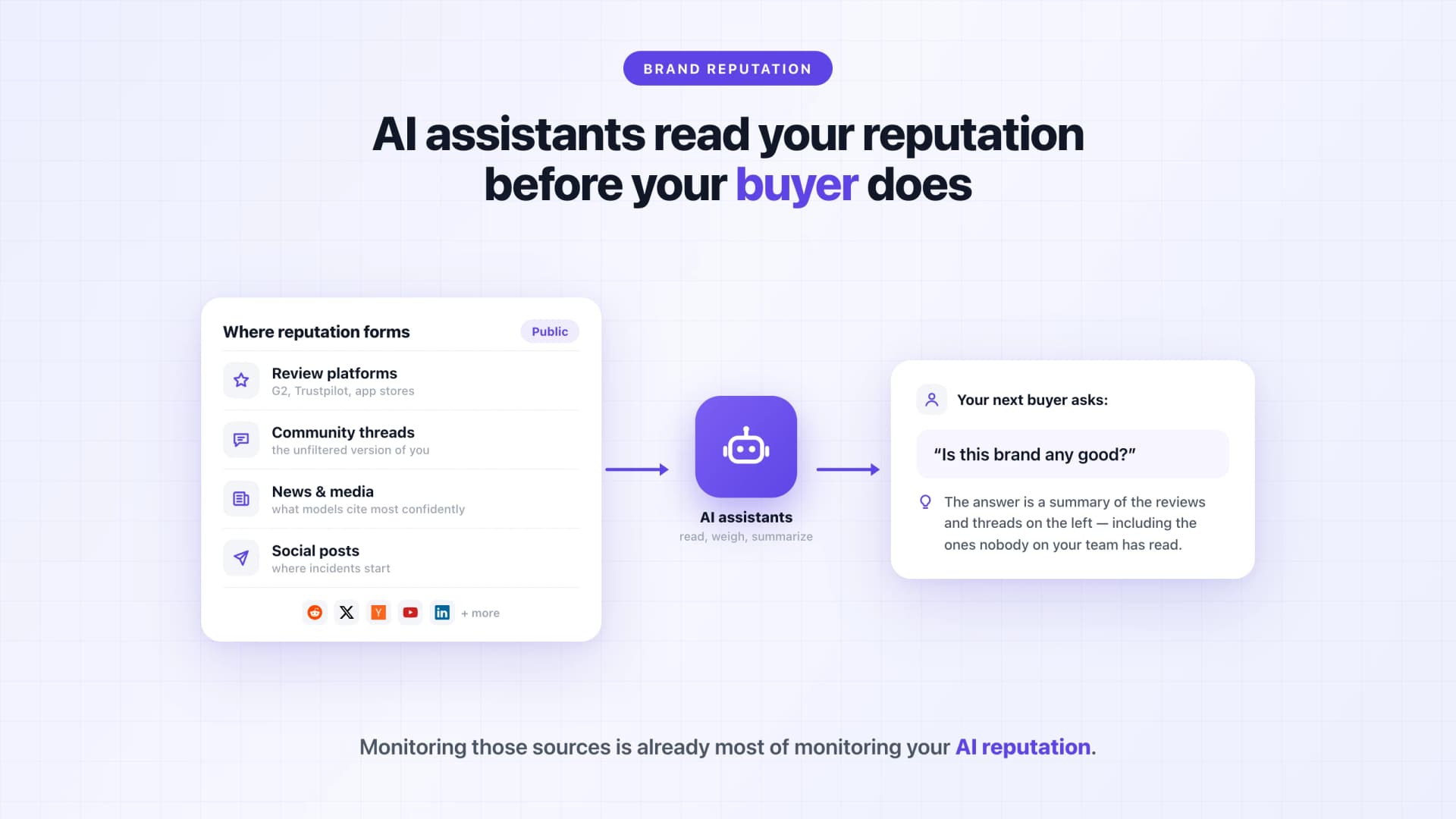
AI assistants — the new one. When someone asks ChatGPT, Perplexity, or Gemini "what's the best tool for X" or "is [your brand] any good," the answer is a synthesis of everything above — reviews, threads, articles. Marketers are noticing:
"I'm tracking it now because Google rankings stopped telling the full story." — r/seogrowth
And noticing that it's genuinely hard:
"tracking brand mentions in ai outputs is gonna become huge, but i think most teams aren't equipped for it yet … these responses are dynamic and personalized, so consistent tracking is kinda a nightmare" — r/seogrowth
This one is personal for us: 1 in 4 signups at Octolens now comes from AI assistants, so what the models say about us has direct revenue attached. The practical takeaway is that AI answers are downstream of the other four surfaces. The Reddit thread you didn't respond to and the review page you let drift are now training data and retrieval sources, which means monitoring those surfaces is already most of monitoring your AI reputation. If you want to actively influence what the models say, we've written a full guide on how to get your brand mentioned in ChatGPT.
"How do you measure brand reputation?" is one of the most-asked questions on this topic, and most answers are hand-waving. Reputation isn't one number, but it is measurable — as a set of trend lines:
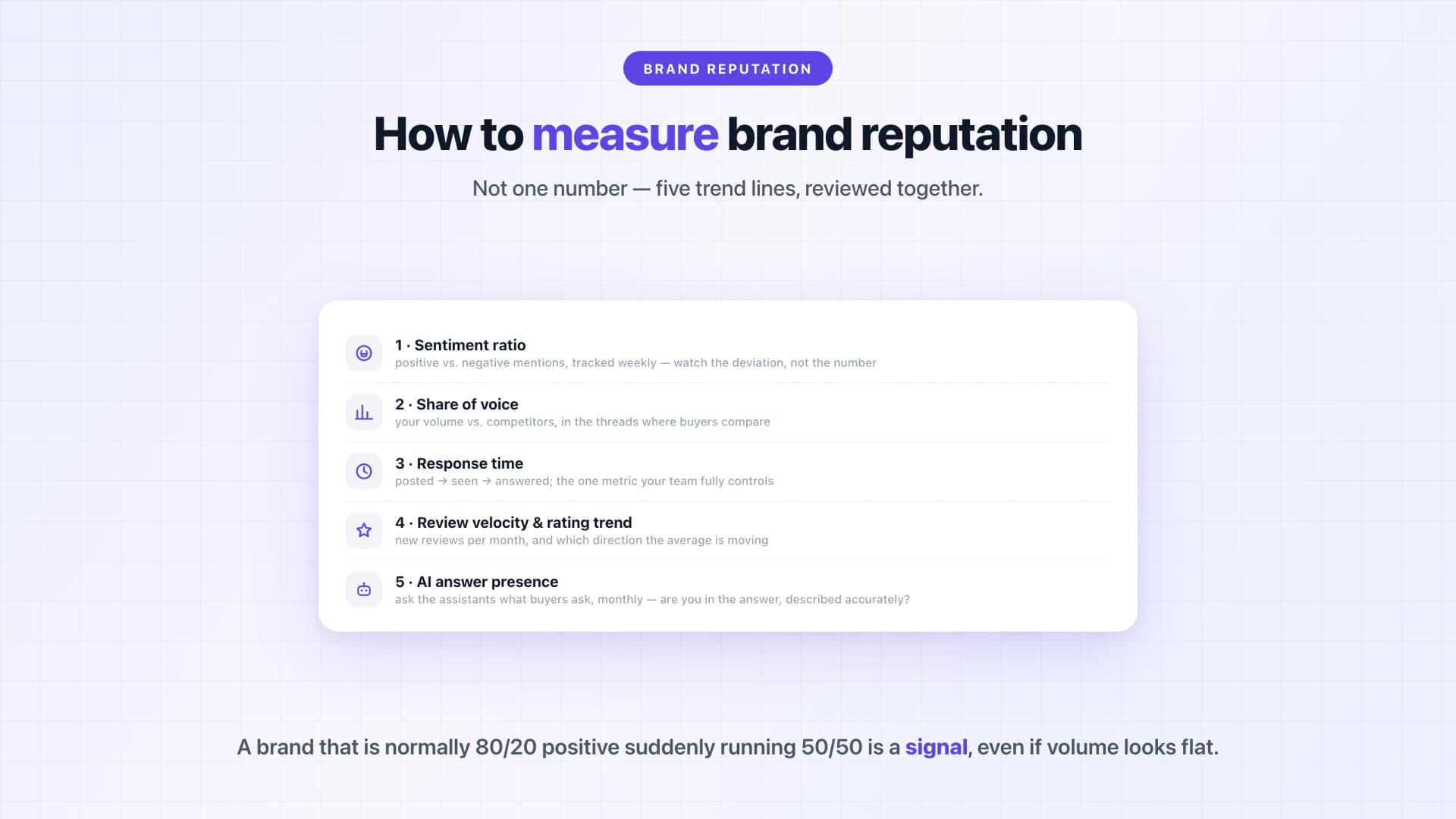
1. Sentiment ratio. The share of your mentions that are positive vs. negative, tracked weekly. The absolute number matters less than the trend and the deviation: a brand that's normally 80/20 positive suddenly running 50/50 is a signal even if total volume looks flat. Use AI-based sentiment classification as a triage layer, not a verdict — sarcasm and community in-jokes still fool it, so read the threads that matter before reacting to a score. (We compared how the major platforms handle exactly this in our guide to the best AI sentiment analysis tools.)
2. Share of voice. Your mention volume as a share of your competitive set, on the platforms where your buyers actually are. This matters because reputation is relative — if buyers compare options in threads where your main competitor shows up twice as often as you, that gap is part of your reputation whether you track it or not.
3. Response time to negative mentions. This is the metric your team controls most directly: how long between a mention being posted, someone on your team seeing it, and someone responding. A complaint that gets an honest answer within the hour often ends with the author editing their post or thanking the company. The same complaint answered four days later just becomes the thread's permanent conclusion.
4. Review velocity and rating trend. New reviews per month and the direction of your average rating on the two or three platforms that matter for your category. A slowly sinking average is one of the clearest early reputation indicators — and one of the slowest to repair.
5. AI answer presence. Ask the major assistants the questions your buyers ask ("best [category] tool," "is [brand] worth it," "[brand] vs [competitor]") on a monthly cadence and log what comes back: are you mentioned, is the description accurate, which sources are cited? Tooling here is young and results vary — as one practitioner put it, "I've tried various tools and the results they show are different lol" (r/seogrowth) — but a simple prompt log in a spreadsheet beats not looking.
Step 1: Track more than your brand name. The minimum viable keyword set is your brand, common misspellings, your product names, your founders or public execs, and "[your brand] vs [each competitor]." The comparison queries are especially important, because that's where undecided buyers hear about you from people who owe you nothing.
Step 2: Cover the platforms where opinions form, not just the easy ones. Most tools are strongest on X and news because those are the easiest to ingest. But if your buyers live on Reddit, Hacker News, YouTube, or in podcasts, a tool that misses those isn't monitoring your reputation — it's monitoring a convenient sample of it. Coverage questions beat feature questions when evaluating any tool.
Step 3: Filter before you alert. Raw mention streams are what kill monitoring programs. Alerts pile up, the channel gets muted "temporarily," and the one mention that mattered scrolls past unseen. For context on how much filtering matters: across Octolens customers, roughly 70–76% of posts matching a keyword get scored irrelevant by AI filtering — that's the noise your team would otherwise be reading. Relevance and sentiment filtering is the difference between a system your team trusts and a channel they mute:
"what actually matters to me is accurate sentiment filtering (so i don't get alerted for every neutral mention) and how fast the alerts come through. waiting 4 hours for a 'crisis' alert is useless." — r/AskMarketing
Step 4: Route mentions to the people who can act. Reputation monitoring fails quietly when mentions land in a dashboard nobody opens. Send them where work already happens: negative mentions and review alerts into a channel support and marketing actually watch, competitor comparisons to sales, recurring product complaints to the product team. Vercel routes mentions into more than 20 Slack channels so each team sees exactly the conversations it owns — nobody checks a dashboard, and nothing waits for a weekly report.
Step 5: Define response rules before the incident. Decide now what gets a reply (genuine complaints, factual errors, comparison questions), what doesn't (trolling, spam, decade-old grudges), who replies, and how fast. Ideally you reply as a named human rather than a brand account reciting policy. Also worth knowing: communities punish stealth marketing. The recommendation threads we researched for this guide were full of astroturf accusations, and they were usually correct. Showing up honestly, as yourself, stands out because so many vendors don't.
Step 6: Review trends monthly, not just incidents daily. Alerts will catch the sudden problems, but slow erosion only shows up when you look at trends. Once a month, go through the five metrics above plus the recurring themes in negative mentions. When three unrelated people describe the same onboarding confusion, that's a product finding, and it should reach the product team. PostHog runs exactly this loop, using its mention stream to keep a pulse on brand perception and route product sentiment to the teams that ship the fixes.
The point of all this infrastructure is to compress one interval: the time between "something started" and "we know about it." Because the default, without monitoring, looks like this:
"we used pretty basic monitoring before, and by the time we caught sentiment turning negative, it was already too late to fix the messaging" — r/b2bmarketing
The signals that deserve an immediate look, not a spot in the weekly review:
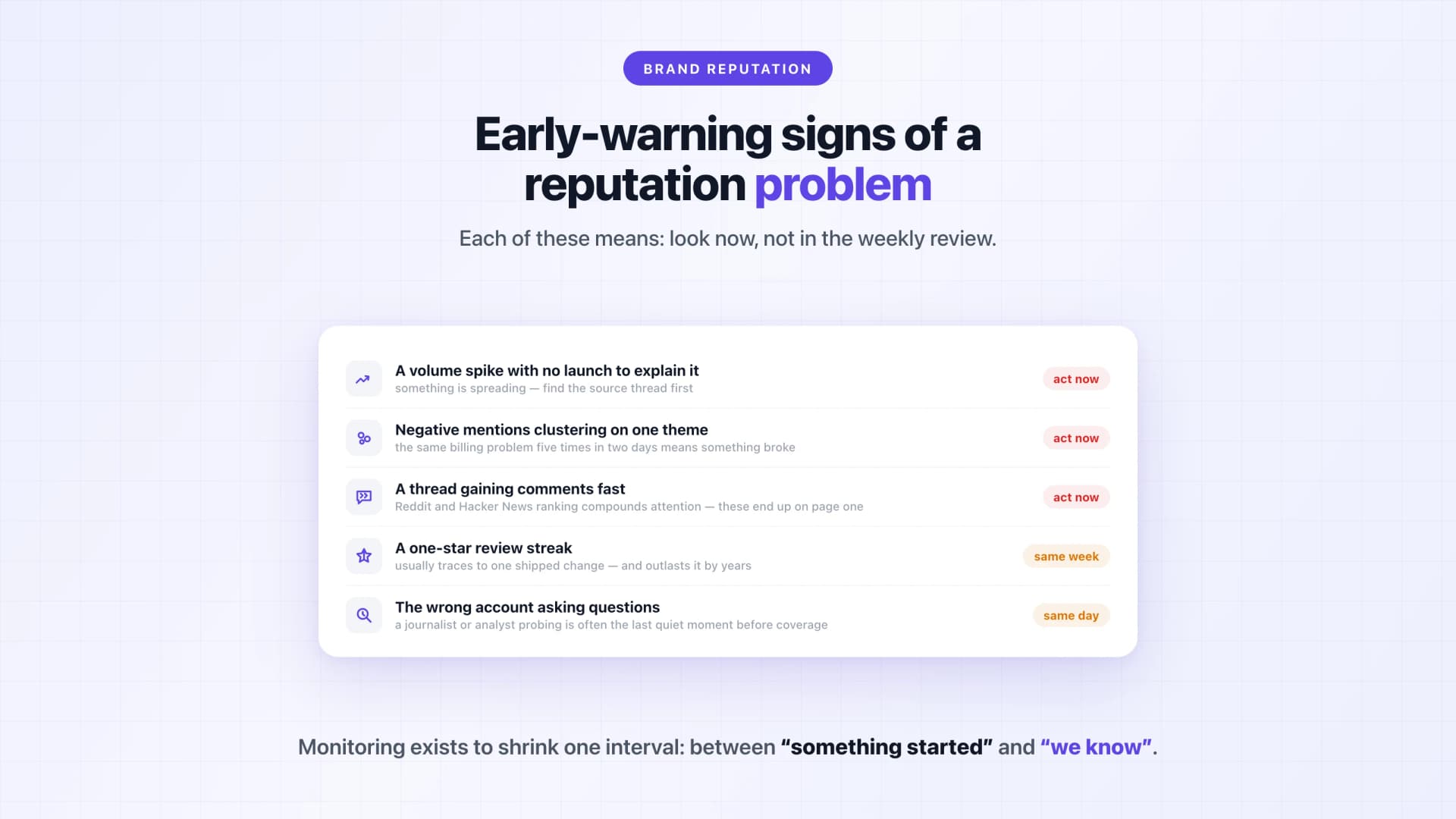
- A volume spike without a launch to explain it. Mentions running well above your baseline means something is spreading. Find the source thread before you do anything else.
- Negative sentiment clustering on one theme. Scattered unrelated complaints are normal for any brand. Five mentions of the same billing problem in two days means something specific broke, and the complaints will keep coming until it's fixed.
- A thread with velocity. One post gathering comments and shares fast, especially on Reddit or Hacker News where ranking compounds attention. These are the threads that end up on page one for your brand name.
- A one-star review streak. Several in a week usually traces to a single shipped change or incident — and review-page damage outlasts the incident by years.
- The wrong account asking questions. A journalist, analyst, or prominent voice in your space suddenly asking pointed questions about you is often the last quiet moment before coverage.
When one of these fires, the playbook is not complicated: find the origin thread, establish the facts internally, respond once where the conversation actually is (honestly, from a named human), and then keep watching the numbers instead of re-arguing the thread. A fast, honest "you're right, here's what we're doing" usually works better than a perfect statement two days later, because by then the thread has already concluded without you.
Different reputation centers of gravity need different tools, and no single product covers everything well. Honest map of the categories:
Review management platforms (Birdeye, Podium, Reputation.com) are built for local and multi-location businesses: aggregating reviews across hundreds of listings, automating review requests, managing responses at scale. If you run 40 dental clinics, this category is your answer — conversation monitoring is a sideshow for you. Pricing is typically custom, quoted per location.
Enterprise media intelligence (Meltwater, Cision, Brandwatch) is built for PR and comms teams at large brands: massive source coverage, analyst-grade reporting, crisis war-room features. The tradeoff is cost and commitment — contracts typically run $10,000 to $130,000+ per year, annual-only. Or as one practitioner warned a buyer evaluating the category: "Meltwater is going to be really expensive. Think tens of thousands per year, with annual commitments." (r/b2bmarketing)
Conversation monitoring tools (Octolens — that's us — Brand24, Mention) track mentions across social, communities, news, and forums with filtering and alerts, at self-serve prices: Brand24 starts at $249/month, Octolens at $199/month. This is the right category when your reputation forms in public conversations — the developer-tool, SaaS, and product-led pattern. Where we differ from the rest of the category: AI relevance filtering tuned for high-volume and common-word brands, coverage that includes Reddit, Hacker News, podcasts, and newsletters, and API, webhooks, and MCP access on every plan — so mentions flow into Slack, your own tools, and your AI agents instead of another dashboard. Our honest cons: no review-platform aggregation, no publishing or scheduling features, and we start at $199/month — F5Bot is the better answer for a side project.
Free tools (Google Alerts, F5Bot) cover the basics: Google Alerts for news and indexed pages, F5Bot for Reddit and Hacker News, both genuinely free. Real coverage gaps and no filtering, but infinitely better than not looking.
For a full comparison of eleven options in the monitoring category, see our best brand monitoring tools roundup.
To sum up where this leaves you: your reputation lives in more places than it used to, including inside AI answers that your prospects often trust more than your homepage. Detection needs to be continuous and filtered, because a missed signal gets more expensive the longer it sits there. And the output of monitoring should be action inside the tools where your team already works, because a dashboard nobody opens is just a slower way of not knowing.
The teams that do this well have wired the conversation about their brand directly into Slack channels, ticket queues, and agent workflows. When perception starts to shift, the right person is already reading the thread.
If your reputation forms in public conversations, try Octolens free for 7 days and see what people are saying about your brand right now.