
The B2B SaaS Playbook for a Crisis in PR
Facing a crisis in PR? This guide offers actionable strategies for B2B SaaS companies to navigate, manage, and recover from reputational threats.
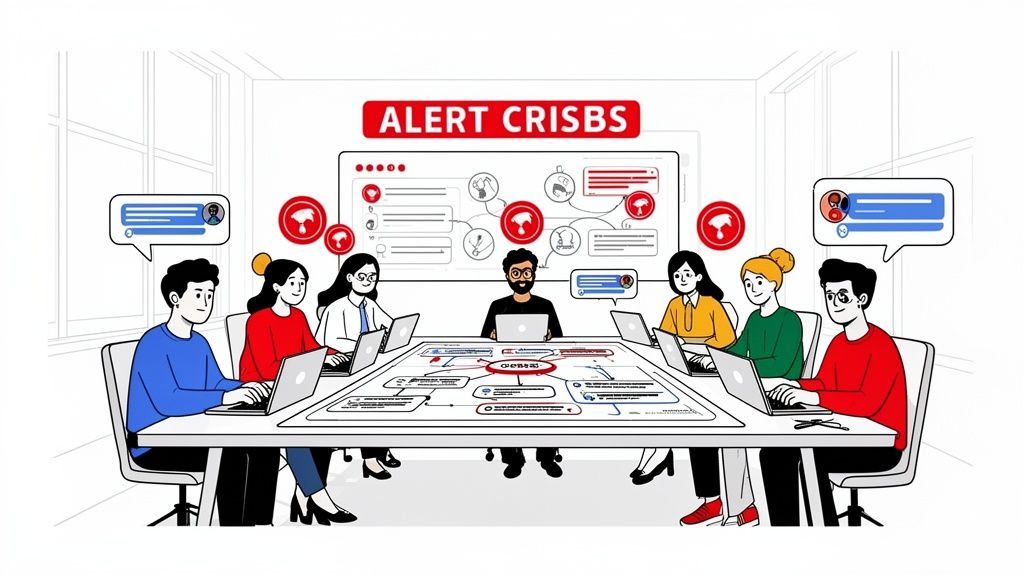
A PR crisis is any event that threatens to throw your brand’s reputation under a bus. If you don't handle it right—and fast—it can spiral out of control. The secret isn't some magic formula; it's about moving from sheer panic to a structured, deliberate response. It all starts with immediately verifying the threat, pulling together a core team, and getting your internal comms sorted before a single word goes public.
We’ve all felt that pit in our stomach. A negative mention starts blowing up on X, a product bug gets exposed in a popular forum, or an employee’s off-the-cuff comment goes viral for all the wrong reasons. In these moments, panic is your worst enemy. What you do in the first 60 minutes will almost always decide whether you contain the fire or get burned by a full-blown reputation disaster.
Your first move is not to start drafting a public statement. It’s to stop the bleeding.
Immediately pause all scheduled marketing. That means social media posts, email newsletters, ad campaigns—everything. Nothing screams "we're out of touch" louder than a cheerful, pre-scheduled tweet going live in the middle of a massive service outage. It’s a classic mistake, and it’s like pouring gasoline on the fire.
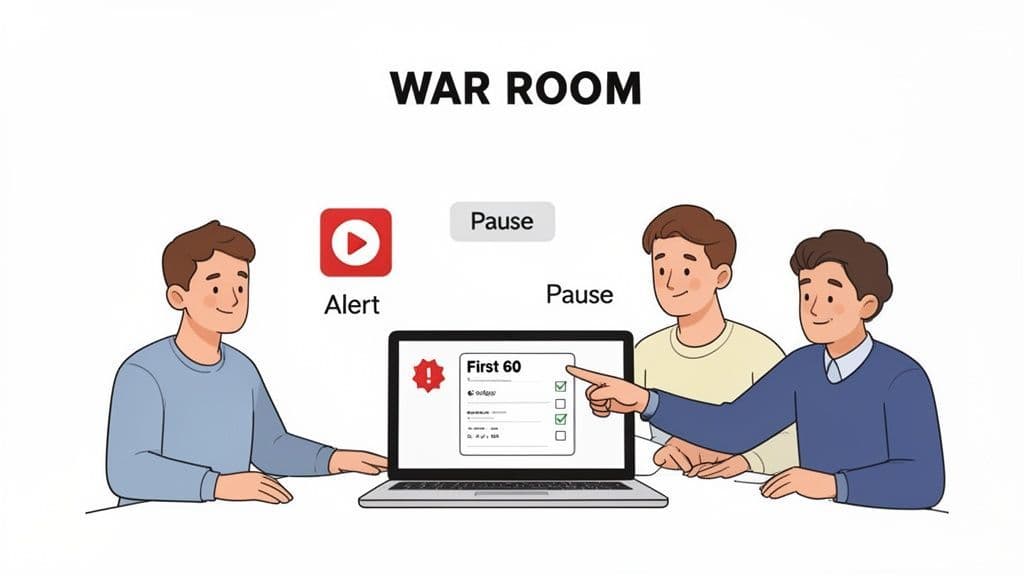
Once the marketing machine is on hold, your next move is to get the right people in a room (or, more likely, a private Slack channel). This is not the time for a company-wide all-hands meeting. You need a small, agile team with crystal-clear roles to cut through the chaos.
- The Decision-Maker: This is usually the CEO or a department head. They have the final say on every action and external message. Keep the decision circle small.
- The Comms Lead: Your Head of Marketing or PR takes this seat. They own the drafting of all internal and external messaging, making sure the tone and facts are right.
- The Subject Matter Expert: Depending on the crisis, this could be your Head of Engineering for a technical meltdown or the Head of HR for an employee-related issue. Their job is to provide the ground truth—just the facts, no spin.
This small group becomes your "war room." It's the single source of truth for the entire incident. Their first task is simple: verification. Is this threat even real? Dig into the initial reports and get to the source of the chatter. If you need a refresher on how to do this effectively, you can learn more about how to track social media mentions and separate signal from noise.
Before you say a single word to the public, you must get your internal team on the same page. One well-meaning but misinformed employee posting their own take on the situation can instantly create a second, self-inflicted crisis. The easiest way to prevent this is with a concise internal holding statement.
Internal Holding Statement Example"Team, we are aware of [brief, neutral description of the issue, e.g., 'reports of login issues on the platform']. We are actively investigating and our crisis response team is managing the situation. Please direct all external inquiries to [Comms Lead] and refrain from commenting publicly. We will provide an update via this channel within [timeframe, e.g., 'the next 60 minutes']."
This simple message pulls a ton of weight. It acknowledges the problem, creates a clear point of contact, and stops the rumor mill before it even starts.
This framework breaks down the first hour into a simple, three-part process.
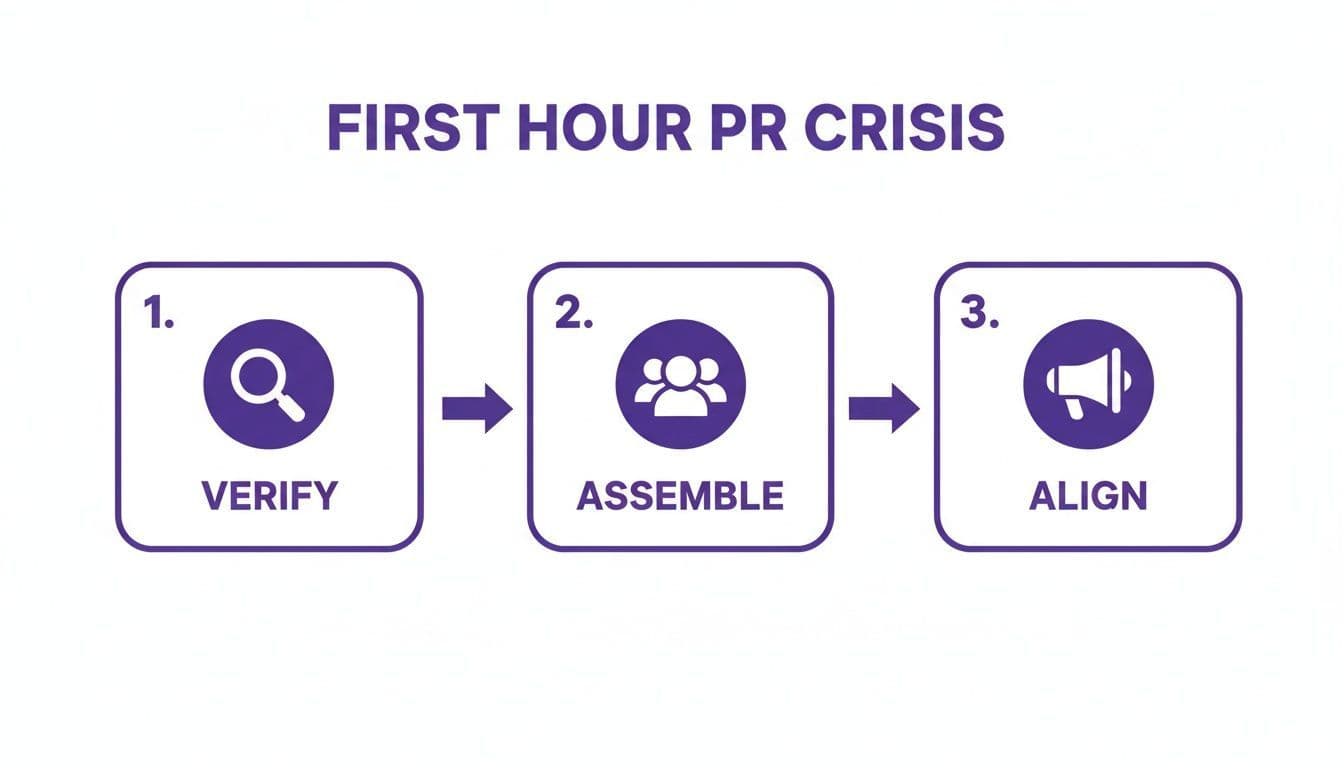
This Verify, Assemble, Align flow gives you a clear, repeatable playbook. It’s what keeps your initial response organized and intentional, not chaotic and reactive.
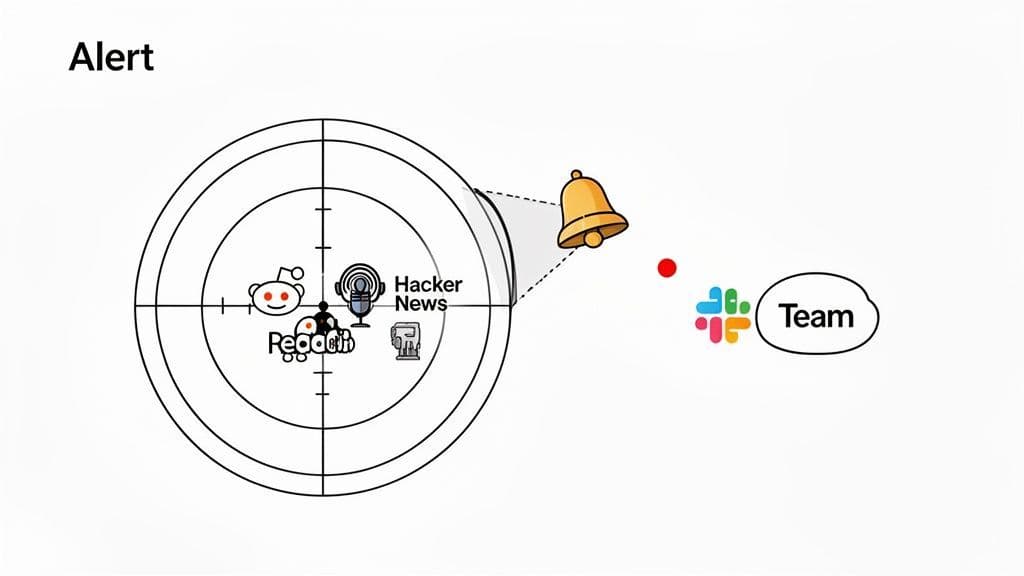
A PR crisis almost never announces itself with a formal press inquiry. It starts small. A quiet but persistent whisper on platforms like Reddit, Hacker News, or in a niche podcast where your most engaged—and most critical—users hang out.
Relying on generic brand monitoring is like having a smoke detector that only goes off once the house is engulfed in flames. By then, it's too late. You need a real early warning system.
This means homing in on what I call “high-signal” conversations—the unfiltered, often blunt feedback from developers, power users, and industry insiders. These are the conversations that can signal a much bigger problem is on the horizon.
The goal here isn't to create a noisy dashboard filled with every brand mention under the sun. It's to generate actionable alerts. Forget just tracking your brand name; that’s table stakes. Your listening engine has to be tuned to catch specific, high-intent keywords and negative sentiment that scream "trouble ahead."
For any B2B SaaS company, these are the words that should make your ears perk up immediately:
- Service-related terms: outage, downtime, slow, buggy
- Security red flags: data breach, security flaw, vulnerability, exposed
- User experience issues: terrible UX, unusable, frustrating, crashes
- Pricing and billing complaints: overcharged, hidden fees, billing error
Combine these with your brand name, product names, and key executives to cast a powerful net that catches problems while they're still small. Effective B2B social listening is less about the volume of mentions and far more about their quality and relevance.
This kind of proactive monitoring isn't just a "nice-to-have" anymore. In fact, a staggering 96% of organizations report dealing with at least one crisis in the past two years, a trend that's only accelerated with the speed of social media. You can dive deeper into this in the 2023 Global Crisis Resilience Survey.
Once you've spotted a potential threat, speed is everything. The best systems don't just dump alerts into a lonely email inbox. They pipe critical mentions directly into your team’s daily workflow—think a dedicated Slack channel.
The most effective crisis plans connect a specific trigger to an immediate, automatic action. For example: a Reddit thread about a security flaw with more than 10 upvotes should automatically ping your on-call engineering lead and head of comms.
This creates a seamless flow from detection to triage, ensuring the right people see the right information instantly. A system like this doesn't just help you manage a crisis in PR; it often stops one from ever taking root in the first place.
When a crisis hits, your biggest enemy isn't an angry Reddit thread. It’s silence. Leave an information vacuum, and I promise you, speculation and misinformation will fill it almost instantly. Your public response strategy is all about controlling the narrative by becoming the first—and most reliable—source of information.
The modern crisis in pr is almost always about trust. In a world this connected, that trust can erode in minutes. While 68% of global brands have newsrooms, many still stumble when an incident kicks off, leading to huge hits in both customer confidence and revenue. A simple tactic like including a direct quote from leadership in a press release can boost media pickup by 40%, helping you frame the story on your own terms.
Before you fire off a single tweet, you have to nail down what you’re going to say. Ditch the defensive corporate jargon. It helps no one.
Instead, build your messaging around a simple, human-centric framework called APCO. This model makes sure every statement hits the right notes:
- Acknowledge: State the problem directly and clearly. No sugarcoating.
- Process: Explain what you're doing right now to investigate and fix it.
- Commitment: Show your dedication to making sure this specific issue never happens again.
- Ownership: Take accountability. This doesn't always mean admitting legal fault, but it absolutely means owning the responsibility to make things right.
Using this structure helps you come across as empathetic and transparent, which are the two currencies that matter most when you're trying to rebuild trust.
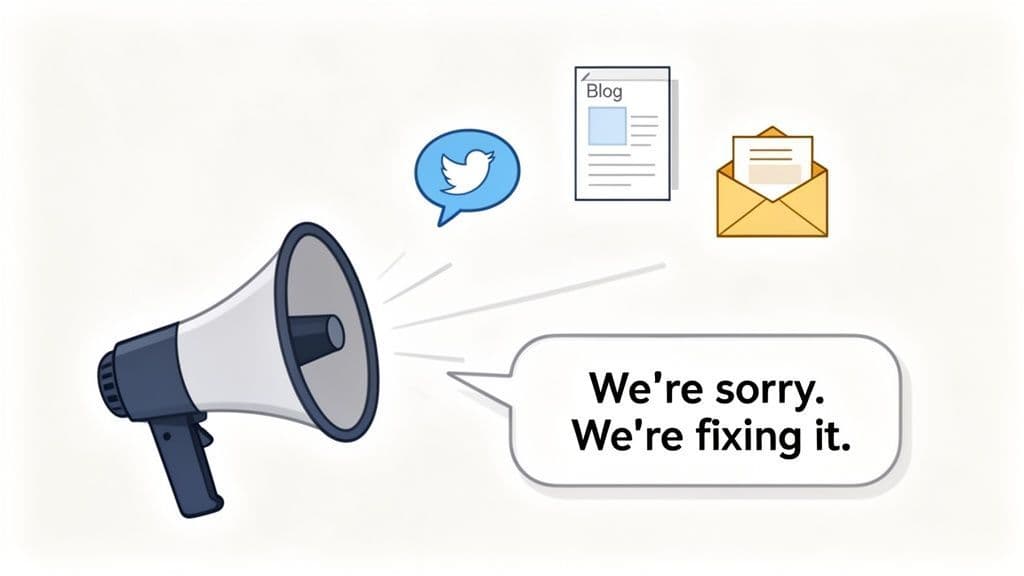
Not every crisis needs a prime-time press conference. Your response has to be proportional to the incident. Using the right channels to reach the right people is key. If you're not sure where to start, getting a handle on how to handle a negative review or incident going viral is a great first step.
To make this even easier, you can use a triage matrix to decide where to focus your efforts first.
Use this table to quickly decide the right communication channel and response speed based on the crisis's severity.
Severity Level Primary Channel Response Time Goal Low Social Media (e.g., X) Within 2-3 hours Medium Company Blog Post & Email Within 1-2 hours High Press Statement & All Channels Within 60 minutes
A low-severity issue, like a minor bug affecting a few users, can often be handled with a quick, empathetic reply on social media. But for a major outage or security breach? You need to go all-in with a multi-channel push: a detailed blog post, a direct email to all customers, and a formal press statement. You can get more specific tips in our guide on https://octolens.com/blog/crisis-management-in-social-media.
Pro Tip: Draft adaptable holding statements before you need them. Having templates ready for an initial acknowledgment, a detailed update, and a final resolution can shave precious minutes off your response time. Just fill in the blanks, get approval, and post.
The moment a crisis in PR hits, the biggest threat isn't always the external backlash. It's the internal chaos that can completely derail your response.
Without a clear plan, you get teams stepping on each other's toes, conflicting messages slipping out, and precious time wasted in endless review cycles. An external problem quickly spirals into an internal meltdown.
To sidestep this, you need a pre-defined system for how your team talks, approves, and escalates issues. This isn't about adding red tape; it's about building guardrails that let your team move fast and with confidence when the pressure is on.
The goal is to eliminate that frantic question: "Who needs to see this?" The answer should already be documented. Getting your internal house in order is what separates a smooth response from a disastrous one. For a deeper look at getting teams on the same page, check out these strategies for fixing internal alignment.
Every second is critical during a crisis. Waiting for five different people to sign off on a single tweet is a surefire way to lose control of the narrative. Your approval process has to be lean and tailored to the channel you're using.
Think about it this way: not every decision needs to go to the CEO. A simple, tiered approach works best.
- Social Media Updates: A quick acknowledgment on X (formerly Twitter) might only need a sign-off from the Comms Lead. This keeps you agile and responsive in real time.
- Blog Posts & Customer Emails: For more detailed communications explaining the issue, the Comms Lead and a relevant Subject Matter Expert (like the Head of Engineering) should review it.
- Press Statements: Any official statement going to the media needs the highest level of approval—typically the Decision-Maker (often the CEO) and a once-over from legal.
This kind of tiered system gives you the right level of oversight without creating frustrating bottlenecks.
The core principle is simple: match the approval workflow to the communication's impact. A tweet is temporary and fast-moving; a press release is a permanent record of your company's official stance. Treat them accordingly.
Just as vital as your approval workflow is a crystal-clear escalation path. This is your playbook of pre-defined triggers that automatically bump an issue up the chain, ensuring the right people get involved at precisely the right time.
An effective escalation path removes the guesswork and emotion from the decision-making process. It’s based on data, not feelings.
Here’s what that looks like in practice.
Escalation Trigger Example:
Trigger Event Initial Owner Escalation Point Negative Reddit thread with 10+ upvotes Community Manager Head of Marketing is notified. Thread hits 100+ upvotes & mentions "security" Head of Marketing Head of Engineering is looped in immediately. The issue is picked up by a tech blog Head of Marketing The entire "war room" team is activated.
This structure guarantees that your response intensity always matches the threat level. A minor issue gets a measured response, while a potentially explosive problem gets all hands on deck instantly. It's how you stop a small fire from becoming an inferno.
Okay, the immediate fire is out. The social media storm has died down, and you can finally take a breath. It’s tempting to just move on and try to forget the whole ordeal.
Don't. The most important part of crisis management starts after the crisis is "over." This is your chance to turn a painful, stressful experience into one of your biggest assets.
A blameless post-mortem isn't about pointing fingers. That's a waste of time. It's about digging into your systems and processes to find the weak spots so you never have to live through this specific nightmare again. The goal here is simple: build a concrete action plan that hardens your product, your processes, and your team against whatever comes next.
Get your core crisis team and a few key stakeholders in a room for an honest debrief. This can't be a surface-level chat; you need to be ready to dissect the entire incident, from the first spark to the final all-clear.
Come prepared to dig into the timeline with a critical eye:
- Detection: How did we first find out? Did we miss the early whispers on platforms like Reddit or X that could have bought us more time? Where did our early warning system fall short?
- Response Time: Let's be honest, how long did it take from the first real alert to our first public statement? Where were the bottlenecks? Was it legal? A slow-to-respond exec? A clunky approval workflow?
- Messaging: Was our communication actually clear? Did it sound empathetic, or did we come off like a corporate robot? A quick look at sentiment analysis data from before and after your statements will give you the unfiltered truth.
- Tools & Process: How did our internal "war room" actually function? Did everyone know their role, or was it chaos? Did the right people have the right access to the right tools when the pressure was on?
The defining feature of a PR crisis today is the blinding speed at which a reputation can unravel online. But here's the flip side: companies with solid plans and a fast, transparent response can slash their reputation recovery time by up to 50%. If you want to see how unprepared brands get torn apart by misinformation, you can learn more about the impact of response speed.
A crisis post-mortem has exactly one output: an action plan. Every insight, every "we should have...," and every painful lesson must become a specific task with an owner and a deadline.
The final, and most crucial, step is translating all those raw findings into a simple, trackable plan. This document is what separates teams that learn from teams that just repeat their mistakes. It’s the bridge between talking about what went wrong and actually getting stronger.
Your action plan shouldn't be a 20-page report. Keep it simple, direct, and leave zero room for ambiguity.
Here’s a straightforward framework for turning your post-mortem discussion into a set of concrete, trackable tasks. This isn't just about documenting what happened; it's about assigning ownership to prevent it from happening again.
Identified Weakness Action Item Owner Deadline Delayed detection of Reddit thread Set up specific keyword alerts for "security flaw" & "data breach" in our monitoring tool Head of Comms 1 week Approval for initial tweet took 90 minutes Simplify crisis social media approval to a single designated person (with a backup) Head of Marketing 3 days Customer support was overwhelmed with tickets Draft three pre-approved customer response templates for common crisis scenarios Head of Support 2 weeks Engineers lacked customer context during the fix Integrate high-priority support tickets directly into the primary engineering Slack channel Head of Engineering 1 month
This isn't just paperwork. Following through on this plan is what transforms a reactive, gut-wrenching event into a proactive opportunity for real, measurable growth. It's how you ensure the next time a spark appears, you're ready with a fire extinguisher, not a bucket of gasoline.
Even with the most detailed playbook, a real-time crisis always throws curveballs. You'll find yourself in uncharted territory, trying to make high-stakes decisions with incomplete information. It’s natural.
The goal isn't just to survive; it's to navigate the storm with confidence and emerge with your team and reputation intact. Let's tackle the questions that keep founders and marketing leads up at night.
Not every angry tweet is a catastrophe. If you treat everything like a five-alarm fire, your team will burn out, and you’ll be less effective when a real threat emerges. The key is to have an objective framework that takes the emotion out of the equation.
A true crisis usually checks several boxes:
- Significant Impact Potential: It has a clear path to hurting revenue, causing major customer churn, or damaging key partnerships.
- Legal or Regulatory Risk: The issue involves potential legal action, data privacy violations, or regulatory scrutiny.
- Rapid Amplification: The conversation is spreading like wildfire across multiple influential platforms, not just contained to one small forum.
For instance, a single user complaining about a bug on X is a support ticket. But if that same bug gets validated by dozens of developers on Hacker News with reproducible evidence of a core product flaw? That’s absolutely a crisis. Create a simple severity matrix (Low, Medium, High) with clear triggers for each level to remove the guesswork.
The moment you have to ask, "Is this a crisis?" you should act as if it is. It's far easier to de-escalate a planned response than to claw your way back from a delayed one.
The answer is a firm "it depends." Deploying your CEO is a powerful move, but it's a card you can only play a few times before it loses its impact. If the CEO weighs in on every minor hiccup, their voice won't carry the same weight when a true catastrophe strikes.
My rule of thumb is to match the spokesperson to the problem's core issue.
- When to Use the CEO: For major incidents involving a breach of fundamental trust—think data breaches, significant ethical lapses, or a widespread service failure impacting all customers. In these moments, the CEO's voice signals ultimate accountability.
- When to Use an Expert: For technical issues like a product vulnerability or a specific feature failure, your Head of Engineering or CPO is often more credible. They can speak with an authority and level of detail that a CEO simply can't.
Think of your CEO as your ace. Save it for when the stakes are highest and the issue strikes at the heart of your company's values and commitment to its customers.
Without a doubt, the most damaging and common mistake is a slow or evasive response. In the digital age, an information vacuum is toxic. It gets filled instantly by speculation, anger, and, all too often, misinformation.
So many teams fall into the trap of waiting to "get all the facts" before saying a word. This is a losing strategy. By the time you have every single detail confirmed, the public narrative has already been written for you—and you won't like the story.
The best approach is to communicate early and often, even if your first statement is just an acknowledgment:
"We are aware of the reports regarding [the issue]. Our team is investigating this as our top priority. We will provide a detailed update here by [time/date, e.g., 3 PM ET]."
This initial message accomplishes three critical things:
- It shows you're aware and taking it seriously.
- It establishes your brand as the official source for information.
- It buys you precious time to investigate without appearing negligent.
You can't predict the what, but you can absolutely prepare for the how. The best way to do this is through simulation.
Run tabletop exercises at least twice a year. In these sessions, walk your designated crisis team through a realistic, detailed scenario. For a SaaS company, this could be:
- A key feature outage during peak business hours.
- A security vulnerability discovered and posted on a public forum.
- A prominent influencer posting a viral, negative review of your product.
During the drill, practice drafting communications, debate response strategies, and walk through your approval and escalation workflows in a safe environment. These simulations build critical "muscle memory" and reveal the hidden cracks in your plan before you're in a high-stakes situation. It makes sure everyone knows their role and how to coordinate under pressure.
Navigating a crisis in PR is one of the toughest challenges a B2B SaaS company will face. Having an early warning system to catch critical conversations on platforms like Reddit, X, and Hacker News is key. Getting high-signal alerts directly to your team helps you respond faster and protect your reputation. You can learn more at https://octolens.com.