
Social Listening Strategies for Fast-Paced B2B SaaS Teams
Discover social listening strategies to track brand mentions, gather feedback, and outperform competitors in fast-moving B2B SaaS.
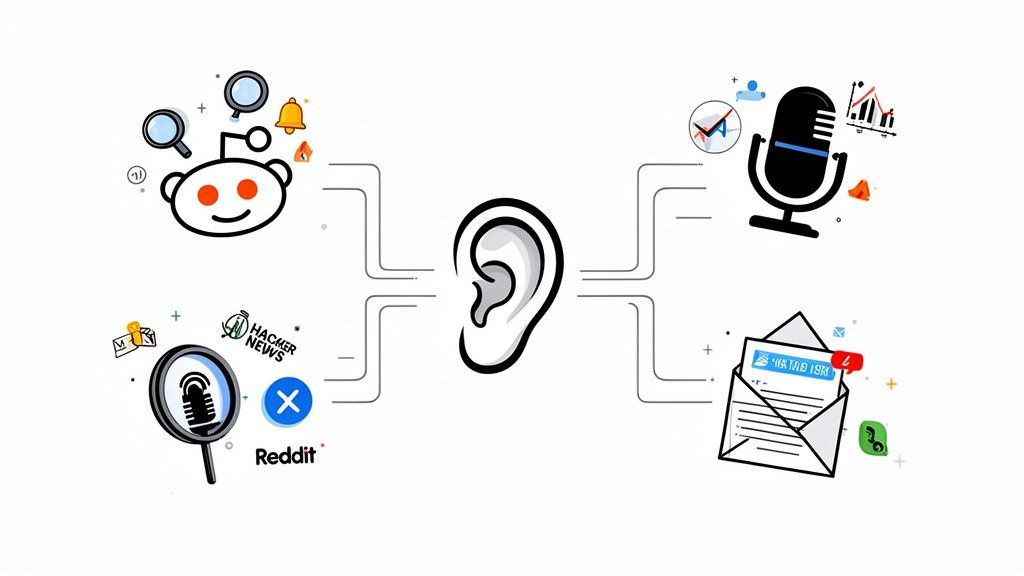
In the B2B SaaS world, your customers aren't just sending support tickets. They're talking about your product, comparing you to competitors, and sharing raw feedback every day on platforms like Reddit, X, and Hacker News. The problem? Most teams either hear this chatter too late or not at all, since it’s buried under an avalanche of digital noise.
Traditional social media tools are often too broad, too slow, and not built for the high-signal, low-volume conversations that actually shape your brand and product roadmap. This isn't about chasing vanity metrics. It's about tapping into the real-time voice of your market to build a better product, stay ahead of competitors, and protect your hard-earned reputation. The right social listening strategies give you a direct line to what your most valuable users and prospects are actually thinking.
This article breaks down 10 actionable social listening strategies designed specifically for fast-moving B2B SaaS teams. Forget generic advice. We’re giving you playbooks to find the signals that matter—from tracking feature requests on Hacker News to spotting competitive threats discussed in niche podcasts, all without spending hours digging through feeds. We'll cover everything from setting up real-time alerts for critical mentions to using social feedback for product and competitive insights. Let's get to it.
The foundation of most social listening strategies starts and ends with tracking brand mentions. But for agile B2B SaaS teams, the real value isn't just knowing when you were mentioned; it's knowing instantly and with full context. This approach shifts the focus from passively watching a feed to actively detecting signals, turning raw mentions into intelligence you can act on.
This strategy means creating a high-fidelity alert system that cuts through the noise to deliver critical conversations from places like Reddit, X (formerly Twitter), Hacker News, and even niche newsletters directly into your team's workflow. It’s the difference between finding a critical bug report after thousands have seen it and being the first to respond in the thread, showing you’re on top of things.
A modern approach treats every relevant mention as a time-sensitive signal, empowering your team to jump on product feedback, competitive threats, and important brand-building moments.
This real-time approach is a must-have for teams where speed is a competitive advantage. It's essential for:
- DevRel and Product Teams who need to address technical questions or bug reports before they blow up.
- Growth and Marketing Teams aiming to capitalize on competitor comparisons or purchase-intent conversations the moment they happen.
- Founders and Leadership who want to keep a real-time pulse on how the market feels about their brand.
- Start with Core Keywords: Begin by tracking your brand name, product names, and common misspellings.
- Expand to Adjacent Topics: Add keywords for key features, integration partners, primary use cases, and direct competitors to cast a wider net.
- Use Negative Keywords: Filter out irrelevant noise. If your product is named "Relay," add negative keywords like "-race" or "-for life" to exclude mentions related to the common noun.
- Set Up Granular Alerts: Create separate, dedicated Slack channels or email alerts for different signal types (e.g., #product-feedback, #competitive-intel, #praise). This ensures the right info gets to the right people without causing alert fatigue.
- Assign Ownership: Clearly define who is responsible for responding to different types of mentions. For example, a support engineer handles bug reports on Hacker News, while a community manager engages with praise on X.
Key Insight: The goal isn't to track every single mention; it's to instantly surface the ones that matter. By treating mentions as signals, you empower your team to act on high-impact conversations, turning social listening from a reporting chore into a strategic growth driver. For a deeper dive into setting up your initial trackers, explore these best practices to track social media mentions effectively.
Going beyond simple keyword counts, smart social listening strategies figure out the emotional tone of online conversations. Sentiment analysis sorts mentions into positive, negative, or neutral buckets, helping you understand how people feel about your brand, not just that they're talking about it. This layer of emotional context is key for prioritizing responses and getting an accurate read on brand health.
This strategy uses algorithms, often powered by natural language processing, to score the tone of each mention. It’s the difference between seeing a spike in mentions and knowing whether that spike is from a wave of happy new users or a frustrating bug going viral. For B2B SaaS teams, this means telling constructive criticism from a genuine churn risk.

A modern approach uses sentiment not just as a report card but as a way to route tasks. Frustrated user comments on Reddit can be automatically flagged and sent to support, while enthusiastic testimonials on X are routed to the community team to share.
Sentiment tracking is vital for teams that need to manage brand reputation and customer experience at scale. It’s especially helpful for:
- Customer Support and Success Teams aiming to proactively spot and help frustrated users before they submit a formal ticket or churn.
- Marketing and PR Teams who need to measure the emotional impact of campaigns and manage brand perception over time.
- Product Teams seeking to understand the emotions behind feature requests and bug reports, separating minor annoyances from major deal-breakers.
- Establish a Baseline: Before you automate everything, manually review and score a sample of 100-200 mentions. This helps you understand your audience's unique language and sets a benchmark for accuracy.
- Train Your Model: If your tool allows, create custom sentiment models. Teach it that "wicked" means "good" for your Boston-based audience or that specific technical jargon implies frustration.
- Pair with Manual Checks: Automated sentiment analysis isn't perfect; sarcasm and nuance can be tricky. Have a process for a human to quickly review high-priority negative mentions to confirm what’s really going on.
- Track Trends Over Time: The value of sentiment analysis multiplies when you track it weekly or monthly. A single negative comment is an anecdote; a 20% jump in negative sentiment over a month is a trend you need to investigate.
- Segment by Source: Analyze sentiment on a per-platform basis. You might find that feedback on Hacker News is consistently more critical (but constructive) than praise on X, which helps you set the right expectations for each channel.
Key Insight: The real power of sentiment analysis is in how it helps you prioritize. By understanding the emotion behind mentions, you can focus your team's limited time on the conversations that have the biggest impact on customer loyalty, brand love, and product improvement.
Good social listening strategies go beyond your own brand to actively monitor the competitive landscape. This approach focuses on tracking competitor mentions, product comparisons, and unsolicited feedback to see in real-time why you’re winning or losing deals. It’s about understanding not just what your competitors are doing, but why customers are choosing them—or leaving them—based on public conversations.
This strategy involves treating every competitor mention as a potential insight. For instance, discovering a Reddit thread where users consistently praise a competitor's integrations gives your product team a clear direction. Likewise, finding prospects on X comparing your pricing against three rivals helps your go-to-market team refine its positioning and sales battle cards.
By systematically capturing these signals, you turn messy social data into a powerful source of competitive intelligence, helping you spot market gaps and emerging threats before they hit your bottom line.
This strategy is crucial for B2B SaaS teams in crowded markets where standing out is everything. It's particularly valuable for:
- Product Marketing and Go-To-Market Teams needing to sharpen messaging, positioning, and sales materials based on real-world objections and competitor weaknesses.
- Product and Engineering Teams looking to prioritize their roadmap by identifying high-demand features that competitors either lack or don't do well.
- Founders and Strategy Leaders aiming to understand market dynamics, spot disruptive newcomers, and make informed strategic moves.
- Create Competitor-Specific Monitors: Set up distinct tracking projects or alerts for each primary competitor, including their brand names, product names, and key executives.
- Track "Anti-Keywords": Monitor for phrases that signal dissatisfaction with competitors, like "[Competitor Name] alternative," "[Competitor Name] down," or "[Competitor Name] slow." These are often high-intent buying signals.
- Analyze Standalone Complaints: Don't just look for direct comparisons. A customer complaining about a competitor's poor customer support on Hacker News is an opportunity to highlight your own team's responsiveness in your marketing.
- Look for Thematic Patterns: Each quarter, review the mentions you've collected to identify recurring themes. Are users consistently praising a competitor's UI? Are they complaining about a specific feature gap? Use these patterns to inform your strategy.
- Turn Gaps into Content: Find a common complaint about a competitor and create content (like a blog post or social media thread) that directly addresses how your product solves that specific pain point.
Key Insight: The most honest product feedback is often found in conversations that don't even mention your brand. By systematically listening to what people say about your competitors, you get an unfiltered view of the market's needs and can position your product to win. To build a solid framework for this, you can explore how to conduct an effective social media competitor analysis.
Effective social listening strategies often mean trading a wide net for a finely-tuned spear. Instead of monitoring the entire social web, this approach focuses intensely on the specific digital communities where your ideal customers and users gather, such as niche subreddits, Hacker News, Discord servers, and professional Slack groups. The goal is to move from broad monitoring to deep, empathetic listening in high-signal environments.
This strategy involves immersing your team in the culture, language, and norms of these communities. It’s about understanding the context behind a feature request on r/devops or a complaint in an "Ask HN" thread. For example, a DevTools company will get far more valuable insights by actively participating in r/webdev than by simply tracking brand mentions across all of X.
By focusing on these concentrated hubs, you can uncover unfiltered pain points, emerging trends, and authentic feedback that often pops up long before it hits mainstream social media. It’s a proactive way to engage with your most important audience where they feel comfortable being candid.
This deep-listening approach is crucial for companies whose products serve a specific professional or technical audience. It’s ideal for:
- Product and Engineering Teams seeking raw, context-rich feedback to inform their roadmap and prioritize features.
- Developer Relations (DevRel) and Community Managers aiming to build real relationships and establish credibility with key user groups.
- B2B Marketers looking to understand the specific language and pain points of their target audience to create more resonant messaging and content.
- Map Your Community Ecosystem: Identify and prioritize the 5-10 most important online communities where your customers and prospects spend their time.
- Assign Community Participants: Designate team members to be active participants, not just lurkers. Encourage them to genuinely engage by answering questions and offering help, long before ever mentioning your product.
- Learn the Local Language: Pay attention to community-specific terms, acronyms, and inside jokes. Add these to your keyword tracking to catch more nuanced conversations.
- Respect Community Norms: Every community has rules, both written and unwritten, about self-promotion. Breaking them can damage your brand's reputation. Always lead with value.
- Track Key Influencers: Identify the most respected and active members within these communities. Building relationships with them can provide invaluable insights and turn them into advocates.
Key Insight: The most valuable conversations about your product or problem space might not mention your brand at all. By embedding your team in key communities, you get access to the honest discussions that reveal true customer needs, competitive weaknesses, and untapped market opportunities. This is how social listening grows from a reactive task to a strategic intelligence-gathering function.
Your customers are constantly talking about your product, but their most valuable feedback is scattered across Reddit threads, X replies, and niche forums. This strategy moves beyond simple sentiment analysis to create a structured system for pulling out, gathering, and prioritizing user feedback. It turns unstructured social chatter into a powerful, organized backlog of actionable product insights.
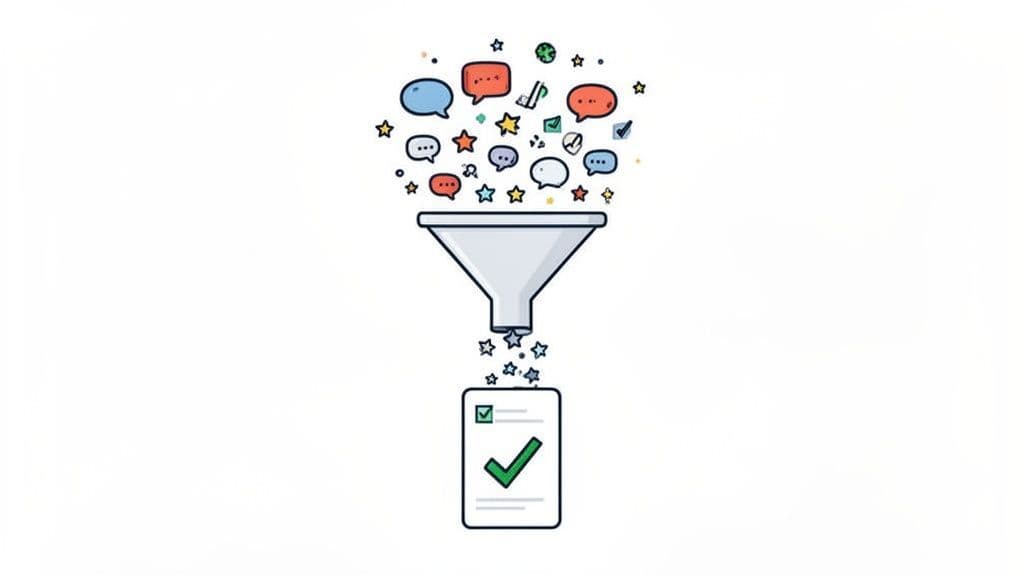
This approach involves creating a systematic process to capture feature requests, bug reports, and user frustrations the moment they appear. For example, noticing a pattern of developers on Hacker News mentioning a missing integration validates its importance far more than an internal assumption. The goal is to build a product roadmap that is directly informed by the unfiltered voice of the user.
By systematically tracking these requests, you can see which features are most in-demand, understand the needs of different customer segments, and make data-driven decisions that reduce churn and increase user happiness.
This is a critical strategy for product-led companies committed to building a user-centric roadmap. It’s essential for:
- Product and Engineering Teams looking for direct, qualitative data to prioritize features and bug fixes.
- Customer Success and Support Teams aiming to quantify common pain points and advocate for customer needs.
- Marketing and Community Teams who want to show users that their feedback is heard and valued.
- Standardize Feedback Capture: Create a dedicated Slack channel (e.g., #feedback-intake) with a workflow or pinned form. When a team member spots a request on X or Reddit, they can quickly submit it in a consistent format.
- Categorize and Aggregate: Use tags or labels to categorize feedback by feature area (e.g., "API," "UI/UX," "Integrations"). Tally these mentions monthly to identify trends and present a summary to the product team.
- Weight Feedback by Source: Not all feedback is equal. Consider giving more weight to requests from high-value enterprise customers mentioned in private communities than anonymous suggestions.
- Track Feedback ROI: Analyze which feedback sources have led to the most successful and widely adopted features. This helps you validate the quality of your listening channels.
- Close the Loop: When you ship a feature that was frequently requested on a specific platform, go back to the original threads and announce it. This builds immense goodwill and proves you are actually listening.
Key Insight: Raw social mentions are messy; a structured feedback process turns that chaos into a clear, prioritized signal for your product team. By turning scattered comments into a coherent product backlog, you ensure your roadmap reflects what users actually want, not just what you think they need.
For a B2B SaaS company, a single negative event can spiral into a major reputation crisis in hours. This social listening strategy is about getting ahead of the storm. It moves beyond standard sentiment analysis to proactively identify negative spikes, emerging threats, and coordinated criticism before they gain steam and cause real brand damage.
This approach combines real-time monitoring with pre-defined escalation plans to transform your team from reactive damage control to proactive reputation defense. It’s the difference between finding a security vulnerability discussion after it hits the front page of Hacker News and containing it while it’s still a small thread on a niche forum.

A solid crisis detection system acts as an early warning alarm, giving you the time you need to investigate, craft a response, and manage the narrative effectively.
This strategy is mission-critical for any brand where trust and reliability are core to the business. It is essential for:
- Leadership and PR Teams who are responsible for maintaining brand health and managing corporate reputation.
- Security and Engineering Teams that need to be the first to know about potential vulnerabilities or service outage complaints.
- Customer Support and Success Teams who can use early warnings to prepare for an influx of tickets and manage customer sentiment.
- Define Escalation Thresholds: Set clear rules for what triggers an alert. For example, a 100% increase in negative mentions within an hour, a single mention of "data breach" or "security vulnerability," or a high-profile influencer posting negatively.
- Establish a 24/7 On-Call Rotation: A crisis doesn't wait for business hours. Designate a clear on-call rotation so that a critical alert is never missed, even on a weekend.
- Pre-Prepare Response Templates: Don't start from scratch in a crisis. Have pre-approved holding statements and response templates for common scenarios like service outages, security issues, or major bugs.
- Monitor Broadly: Crises often start with adjacent keywords, not just your brand name. Monitor for conversations around problems your software solves, combined with negative terms like "down," "broken," or "vulnerability."
- Document Everything: After a crisis is managed, conduct a post-mortem. Document the timeline, the response, and key learnings to refine your process and improve your response time for next time.
Key Insight: Proactive crisis detection isn't about paranoia; it's about preparation. By setting up a system that spots threats early and having a clear plan for who does what, you turn a potential catastrophe into a managed event. This approach to reputation management with social media protects your brand's most valuable asset: its credibility.
Tracking mentions tells you what is being said, but one of the most powerful social listening strategies is figuring out who is saying it. This approach moves beyond simple volume metrics to identify the specific individuals, power users, and micro-influencers whose opinions carry real weight within your niche. It’s about finding the credible voices that shape community sentiment and buying decisions.
This strategy involves actively looking for and mapping the key opinion leaders in your ecosystem. It's the difference between seeing ten random mentions of your product and discovering that a single, highly respected developer on Hacker News just recommended it in a widely read comment, or that a prolific user in the r/devops subreddit is consistently helping others with your tool.
By identifying these key players, you can shift from a broadcast marketing model to a targeted, relationship-driven approach, building genuine connections with the people who truly influence your market.
This strategy is crucial for B2B SaaS companies whose products are adopted through community trust and peer recommendations. It is particularly effective for:
- DevRel and Community Teams looking to build authentic relationships with technical experts and super-users who can become powerful advocates.
- Marketing Teams aiming to run targeted co-marketing campaigns, get authentic product reviews, or amplify their message through credible voices.
- Product Teams seeking high-quality, informed feedback from the most engaged and knowledgeable users in their community.
- Go Beyond Follower Count: Prioritize relevance and engagement over raw numbers. A specialist with 5,000 highly engaged followers in your niche is often more valuable than a generalist with 50,000.
- Classify for Targeted Engagement: Segment the people you find into tiers (e.g., power users, micro-influencers, industry analysts). This lets you tailor your outreach, offering beta access to power users and co-marketing opportunities to influencers.
- Build a Relationship CRM: Use a simple spreadsheet or a dedicated tool to track key individuals, their areas of expertise, platforms of influence, and your history of interactions. This prevents generic, impersonal outreach.
- Provide Value First: Engage with their content authentically long before you ask for anything. Comment thoughtfully on their posts, share their work, and offer genuine value, like early access to new features or an introduction to someone in your network.
- Track Relationship ROI: Monitor the impact of these relationships. Track metrics like referral traffic, earned media mentions, and conversions that come from influencer collaborations to prove the investment is worth it.
Key Insight: The most powerful brand advocacy doesn't come from paid partnerships; it comes from real relationships with respected experts. By using social listening to find and nurture these key individuals, you build a durable competitive advantage rooted in authentic community trust and credibility.
Effective social listening strategies go beyond tracking what people say about your brand to understanding why they are saying it. This approach shifts from monitoring surface-level mentions to identifying the deeper patterns behind user intent, pain points, and specific use cases. It’s about uncovering the "job-to-be-done" that prospects are trying to solve when they discuss your product category.
This strategy involves systematically analyzing conversations to see how customers and prospects actually talk about their problems, what features they care about most, and who is involved in the conversation. Instead of just noting that someone mentioned your competitor, you might discover that DevOps teams are increasingly using monitoring tools for cost optimization rather than just performance—a crucial insight for your marketing and sales teams.
By spotting these patterns, you can align your product messaging, marketing campaigns, and even your roadmap with the real-world needs of your audience, moving from reactive listening to proactive, strategic insight.
This deep-dive approach is vital for teams looking to achieve product-market fit or refine their go-to-market strategy. It is especially critical for:
- Product and Marketing Teams who need to ensure their messaging, positioning, and feature development line up with actual customer problems.
- Sales and Go-To-Market Teams seeking to understand the buying committee and decision drivers, like discovering that compliance teams, not just engineers, are evaluating security tools.
- Founders and Strategists trying to identify emerging market trends or untapped customer segments based on evolving use cases.
- Create a Use Case Taxonomy: Start by listing the known and hypothetical ways customers use your product. Track which of these use cases pop up most frequently in your social listening data.
- Analyze the Questions Asked: Pay close attention to the questions people ask in communities like Reddit or Stack Overflow. These are direct clues about the problems they are trying to solve.
- Track Vocabulary Across Audiences: Note how language changes depending on who's talking. An engineer might talk about "API latency," while a manager discusses "developer productivity." This helps you tailor your messaging to different personas.
- Build Profiles from Patterns: Use the insights you gather to enrich your buyer personas. If you find procurement teams consistently care more about vendor consolidation than feature breadth, add that to their profile.
- Update Messaging Quarterly: Treat your positioning as a living document. Use the evolving patterns you identify to refresh your marketing copy, sales decks, and website content to stay relevant.
Key Insight: The real value of social listening isn't just in brand mentions; it's in decoding the underlying customer intent. By systematically identifying use case patterns, you transform scattered conversations into a strategic map that guides your product, marketing, and sales efforts with much greater clarity.
While social platforms offer a high volume of conversations, some of the most influential discussions happen in curated, high-trust places like niche newsletters and industry podcasts. This specialized social listening strategy extends beyond public feeds to catch brand mentions where editorial credibility and audience intent are super high. It's about hearing your name in the channels your ideal customers trust for expert advice and recommendations.
This approach involves systematically tracking mentions and discussions in the audio and text-based media that your industry pays attention to. A mention in a top DevOps podcast or a feature in a widely-read developer newsletter can drive more qualified traffic and sign-ups than hundreds of social media posts. It transforms listening from a reactive social media task into a proactive media intelligence function.
Monitoring these channels lets you find powerful testimonials, spot competitive threats in curated content, and identify opportunities to place your own experts in front of a highly engaged audience.
This strategy is crucial for B2B SaaS companies whose target audience relies on expert-led content for discovery and decision-making. It’s essential for:
- Marketing and Growth Teams aiming to measure the impact of PR and content partnerships, and find new sponsorship or collaboration opportunities.
- Product Teams seeking to understand how industry experts and influencers are framing problems that their solution solves.
- Founders and Leadership who want to track brand authority and identify key voices shaping the narrative in their industry.
- Identify Key Sources: Make a list of the 10-15 most influential newsletters and podcasts in your specific niche. Ask your best customers what they read and listen to.
- Set Up Monitoring Tools: Use RSS feed readers and podcast transcription services with keyword alerts to automatically flag mentions of your brand, competitors, or key topics. To gather comprehensive insights, expand your listening efforts beyond social feeds by monitoring niche newsletters.
- Track Referrals Diligently: Use UTM parameters for any links you control in newsletters to precisely measure traffic, sign-ups, and conversions. For organic mentions, monitor referral traffic from known sources.
- Build Relationships: Don't just monitor; engage. Connect with newsletter creators and podcast hosts. Offer them unique insights or expert commentary to build rapport for future collaboration.
- Pitch with Precision: When pitching a guest appearance on a podcast, reference recent episodes and suggest a specific, timely angle that provides clear value to their audience, rather than just promoting your product.
Key Insight: Mentions in newsletters and podcasts carry an implicit endorsement that is hard to replicate on social media. This social listening strategy taps into high-signal, low-noise channels, letting you connect with prospects when they are in a mindset of learning and discovery, not just scrolling.
While most social listening strategies focus on the present, a forward-looking approach can give you a huge competitive advantage. This strategy moves beyond reacting to current conversations and into proactively identifying emerging topics, technologies, and market needs before they become mainstream. It’s about spotting the seeds of the next big thing in niche communities and forums.
This method involves analyzing the velocity and spread of new concepts and conversations. Instead of just counting mentions, you track the growth rate of a topic to see if it’s gaining momentum. For a B2B SaaS company, this could mean noticing rising discussions around "observability tooling consolidation" six months before RFPs start asking for it, giving you a crucial head start in product positioning and marketing.
By spotting these early signals, you can anticipate market shifts, inform your product roadmap, and align your go-to-market strategy with what your audience will care about tomorrow, not just what they care about today.
This forward-looking strategy is critical for teams that need to stay ahead of the curve to survive and thrive. It's particularly valuable for:
- Product and Strategy Teams aiming to build features or entire products that meet future market demands.
- GTM and Marketing Leadership who need to craft messaging and campaigns that resonate with emerging pain points and trends.
- Founders and C-Suite responsible for the long-term company vision and steering the organization toward new opportunities.
- Track Topic Velocity, Not Just Volume: Set up monitors for new technical concepts or industry terms (e.g., "eBPF-based monitoring," "remote-first DevOps"). Focus on the week-over-week percentage growth in mentions, not just the raw number.
- Monitor Early Adopter Hubs: Figure out where innovators and early adopters hang out. This often includes specific subreddits (like r/devops), Hacker News, and niche technical communities.
- Look for Cross-Community Mentions: A key signal of an emerging trend is when a topic suddenly appears across multiple, previously separate communities at once.
- Validate with Customer Conversations: Use the trends you identify as hypotheses. Bring them into conversations with your most forward-thinking customers to validate if the emerging pain point is real and urgent.
- Create a Quarterly Forecast: Pull your findings into a brief internal document each quarter. Share these emerging topics with leadership to influence strategic planning and roadmap discussions.
Key Insight: The most powerful social listening strategies aren't just reactive; they're predictive. By systematically tracking the velocity and spread of new ideas, you can move from participating in the market to shaping it, making sure your product and messaging are always one step ahead.
Strategy Complexity Resources Expected Outcomes Mention Monitoring Low–Medium Low Immediate mention visibility ⚡ Sentiment Analysis Medium–High Medium Prioritized issues; brand health 📊 Competitive Intelligence Medium Medium Identifies market gaps & risks Community Listening Medium–High Medium High signal-to-noise feedback Product Feedback Medium Medium Actionable, prioritized requests Crisis Detection High High Rapid threat detection & containment ⚡ Influencer ID Medium Medium Identifies advocates for outreach Use Case Recognition High Medium–High Reveals buying intent & use cases Newsletter/Podcast Medium Low–Medium High-credibility mentions; leads Trend Forecasting High Medium–High Early market signals for strategy
We've explored a full playbook of social listening strategies, moving far beyond simple keyword tracking. From setting up real-time alerts for competitor mentions to diving deep into niche communities on Reddit and Hacker News, the goal is clear: turn raw online chatter into a strategic asset. You’ve seen how to track sentiment, pull out actionable product feedback, and even monitor podcasts and newsletters for subtle signals. The power lies not in collecting data, but in creating a system that gets the right insights to the right people at the right moment.
For a fast-moving B2B SaaS team, this isn't a "nice-to-have." It's a fundamental part of how you operate. Adopting these social listening strategies means you stop guessing what your customers and prospects think. You know. It means your product roadmap is directly influenced by real-world use cases, and your marketing messages hit home because they come from genuine user conversations. It's about making customer-centricity a practical, daily reality, not just a value on a slide deck.
The most important step is to move from passively monitoring to actively integrating. A dashboard full of charts that no one checks is useless. The real value is unlocked when high-signal conversations are piped directly into the tools your team uses every day, like Slack, email, or your CRM.
This integrated approach ensures that:
- Support teams can proactively address user friction before it escalates.
- Product managers get a constant, filtered stream of feature requests and pain points.
- Marketing teams can spot powerful testimonials and emerging trends for content creation.
- Founders and leadership can keep a pulse on brand perception and competitive threats without getting lost in the noise.
Think of it as building a central nervous system for your company's market awareness. When a key influencer praises a competitor’s new feature on X, or a developer on Reddit details a frustrating bug, that information shouldn't sit in a report. It should trigger an immediate, relevant action within your organization.
Feeling overwhelmed by the ten strategies we've covered? Don't be. The secret to success is not to implement everything at once. Instead, identify your single biggest blind spot right now.
- Is it competitive intelligence? Start by setting up alerts for your top three competitors and their key features.
- Are you struggling with product feedback? Focus on deep listening in one or two key communities where your ideal customers hang out.
- Concerned about brand reputation? Implement a crisis detection playbook and define your triage process.
Choose one area, build a solid process around it, and show its value. Once you have a win, you can expand your program, layering on more social listening strategies with purpose. The goal is to build a sustainable system that delivers compounding returns, turning the authentic voice of the customer into your most powerful competitive advantage. This disciplined approach keeps your efforts focused, actionable, and tied to business outcomes.
Ready to cut through the noise and get only the mentions that matter? Octolens is built for B2B SaaS teams who need to turn social listening into action, not another data silo. Start your free trial and see how you can pipe high-signal conversations from Reddit, X, Hacker News, and more directly into your Slack in minutes. Visit Octolens to learn more.