
Real Time Customer Feedback for SaaS Teams
Transform your SaaS with real time customer feedback. This guide provides actionable strategies to capture, analyze, and act on user insights instantly.

Real-time customer feedback is exactly what it sounds like: getting opinions and reactions from your users the moment they’re using your product. It’s all about capturing those fresh, unfiltered insights before they fade.
This way, your team can react to what's happening now, instead of waiting weeks for survey results that are already old news.

In the B2B SaaS world, speed is everything. The old way of doing things—sending a quarterly survey and hoping for the best—is like trying to drive a car by only looking in the rearview mirror. You only spot problems long after you've passed them.
By the time you get that data, your users have either figured out a clunky workaround or, worse, they've churned.
Real-time feedback completely flips the script. Think of it less like a formal performance review and more like an ongoing conversation happening right inside your app.
It’s like the difference between a chef who tastes the sauce as they cook versus one who only tries it after serving the meal. The first chef can adjust the salt, add a little more spice, and perfect the dish on the fly. The second can only apologize for a meal that wasn't quite right. For SaaS teams, real-time feedback is your chance to taste the sauce while it's still simmering.
The real magic of instant feedback is how it shifts your team from being reactive to proactive. Instead of just logging bug reports after a user is already pulling their hair out, you can spot the friction as it happens.
This proactive approach creates a ripple effect across the entire company. A product manager can quickly see if a new feature is actually intuitive. A customer success manager can jump in before a minor annoyance spirals into a cancellation notice. In fact, one study found that solving a complaint within five minutes can have a massive impact on customer loyalty.
The customer feedback that arrives too late is the feedback that costs you money. It's the difference between reading a bad review and preventing it in the first place.
A steady stream of feedback isn't just for one department; it becomes the lifeblood of a company that truly listens to its customers. Here’s a quick look at how it helps key teams:
- Product Teams: Get immediate validation on new features and UI tweaks. They stop guessing whether a new workflow makes sense and get direct input from people actively using it.
- Support Teams: Watch repetitive tickets disappear. By fixing confusing parts of the UI or smoothing out workflows, you stop common problems before they ever hit the support queue.
- Success Teams: Gain a real-time pulse on account health. A sudden burst of negative feedback from a key account is a massive red flag, giving CSMs the heads-up they need to step in and save the relationship.
This guide is a practical roadmap for building a culture of listening. It’s not about abstract theories—it's about simple, effective strategies you can use to make smarter decisions, improve your product faster, and build loyalty that lasts.

Let’s be honest, "real-time" gets thrown around a lot. It’s easy to write it off as just another buzzword. But when it comes to customer feedback, it’s a simple but powerful shift in thinking. Real-time customer feedback is about having a live conversation with your users while they’re using your product—capturing their thoughts the very moment they have them.
Think about it this way. Traditional feedback, like an email survey sent a week after someone uses your app, is like asking a friend to remember a specific joke from a movie they saw last month. They might recall the gist of it, but the punchline, the timing, the exact delivery? That’s all lost to time.
Real-time feedback, on the other hand, is like getting their reaction while the credits are still rolling. It catches the raw, unfiltered experience—the frustration with a clunky UI or the pure delight of a new feature—as it’s happening. This immediacy is what makes the insights so genuine and, more importantly, so actionable.
What really sets this approach apart from the old way of doing things? It all comes down to two things that fundamentally change the quality of the data you get.
- Immediacy: The feedback is captured on the spot, so there’s no room for memory to play tricks. When a user tells you an onboarding step is confusing while they’re stuck on that very step, you get a pure, untainted view of the problem.
- Rich Context: The feedback is directly tied to a specific action or moment. You don’t just learn a user is unhappy; you learn they got unhappy right after trying to export a report. Suddenly, you have a crystal-clear starting point for your investigation.
This gives you a huge strategic advantage. Unlike waiting for quarterly reviews, real-time feedback pulls in authentic customer feelings at the peak of their experience, which means the data is far more accurate. For instance, some companies now collect feedback across dozens of different journey touchpoints, empowering their teams to spot and fix issues before they ever blow up. You can read more about how businesses are leveraging instant feedback on supportman.io.
To really get why "now" is so powerful, you have to look at what the old methods are missing. They’re like driving using only the rearview mirror—great for seeing where you’ve been, but totally useless for navigating the road ahead.
Real-time feedback is about spotting the pothole before you hit it, not just analyzing the flat tire afterward. It transforms your team from reactive problem-solvers into proactive problem-preventers.
Here’s a quick rundown of what you get with each approach when a user hits a snag in your SaaS.
Feedback Type What You Learn Actionability Delayed (Email Survey) A user vaguely remembers being "confused last week." Low Real-Time (In-App) "The 'Save' button is hard to find on this screen." High
This simple shift from asking "how was it?" to "how is it right now?" gives you the sharp, specific insights you need to make meaningful improvements. It’s the foundation for a product development cycle that’s actually guided by the user's present experience, not a fuzzy memory of it.
Knowing what real-time customer feedback is gets us started, but the real question is: why should you care?
Shifting to an instant feedback loop isn't just a minor tweak to your process; it's a strategic move that directly impacts your bottom line. It's the difference between hearing a quiet complaint and preventing a very loud cancellation.
When you capture insights right at the moment of experience, you’re giving your teams exactly what they need to build better products faster, stop customers from leaving, and frankly, feel a lot better about their own work. This isn't just theory—it’s about connecting the dots between daily tasks and real customer wins.
In the SaaS world, the speed of innovation is what separates the winners from everyone else. A real-time feedback loop is like a shot of adrenaline for your product team. Forget waiting weeks for survey data to trickle in; your developers can get immediate validation on new features or UI changes.
Imagine your product manager just shipped a redesigned dashboard. Within hours, they see a few in-app comments mentioning that a key button is now buried. They can push a quick fix that very same day, stopping a potential flood of support tickets and user frustration before it even starts.
This rapid cycle of feedback and iteration is how you build a product that users genuinely love, faster. You can also get a serious edge by pairing these insights with a sharp understanding of what your rivals are up to. For a deeper look at this, check out our guide on how competitor monitoring can grow your SaaS.
Customer churn is the silent killer for so many SaaS companies. Most of the time, users don't leave because of one big catastrophe. They leave because of a thousand tiny friction points that slowly build up until they've had enough.
Real-time feedback is your early warning system for that growing frustration.
By flagging a confusing workflow or a minor bug the moment it happens, you can step in before a user gets annoyed enough to start looking at your competitors. This proactive approach turns potential churn events into opportunities to show you’re actually listening.
Think about it: a customer success manager notices a spike in negative comments from a high-value account right after a new integration goes live. They can immediately reach out, acknowledge the problem, and offer a fix. That one swift action could be the very thing that saves the account.
Take a look at how key metrics can improve once you have a real-time feedback system in place.
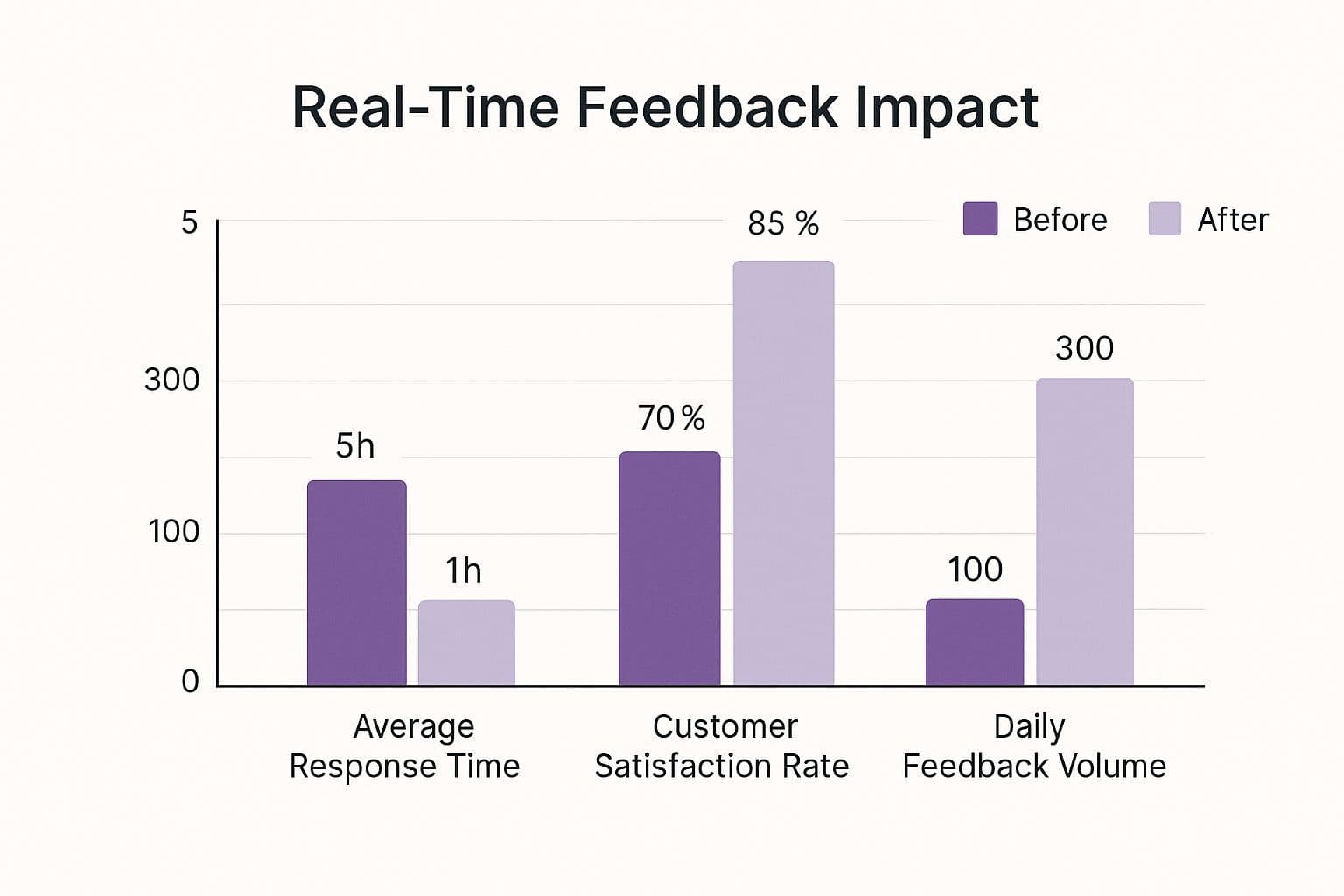
The data is pretty clear. A more responsive feedback loop leads directly to higher satisfaction, quicker resolutions, and a much higher volume of truly useful insights.
It's way too easy for product and engineering teams to feel disconnected from the people they're building for. They spend their days deep in code and roadmaps, often without seeing the direct impact of their work.
Real-time customer feedback completely changes that. It closes the gap.
When a developer sees a positive comment pop up praising a feature they just shipped, it creates a powerful sense of purpose and accomplishment. That direct line to customer wins is a massive morale booster, reminding everyone that their work genuinely matters.
Modern customer expectations have only made this speed more critical. Today, even a 24-hour response can feel painfully slow. In fact, 62% of customers say they would recommend a brand based on its quality of service alone, proving that positive, real-time engagement builds powerful advocacy.
Alright, we’ve covered the "why," so let's get into the "how." The good news? You don't need some complex, multi-layered strategy to start collecting real time customer feedback. It's really just about meeting your users where they are, in a way that feels helpful, not disruptive.
Think of this as your practical toolkit. We’ll walk through the most effective methods for gathering instant insights right inside your SaaS product, with actionable tips you can use today. My goal is to give you a range of options you can adapt to your team's size and goals.
In-app microsurveys are the gold standard for collecting contextual feedback. These are just short, targeted questions that pop up based on what a user is doing, which makes the feedback incredibly relevant.
The secret to a great microsurvey is perfect timing. Triggering a survey while a user is deep in a complex task is like tapping someone on the shoulder while they’re parallel parking—it’s annoying and totally counterproductive. Instead, time your surveys for moments of completion or resolution.
Here are a few moments that are perfect for a quick question:
- Right after a user successfully completes onboarding. A simple "How easy was that to set up?" can give you invaluable insights into your first-run experience.
- The first time a user interacts with a new feature. This is your chance to get a raw, unfiltered first impression.
- After a support ticket is marked as resolved. Ask about the quality of the support they just received.
The golden rule for microsurveys is to ask one simple, clear question. Resist the urge to ask for everything at once. A single, focused question is far more likely to get a response than a multi-page questionnaire.
While surveys are great for actively prompting users, sometimes the best feedback comes when the user initiates it themselves. This is where feedback widgets really shine. These are small, persistent buttons or tabs—often with a simple "Feedback" or "?" icon—that sit quietly on the edge of your UI.
A widget gives users a constant, low-friction outlet to share their thoughts whenever the mood strikes. They might use it to report a minor bug, suggest a feature, or even just to say thanks. It puts the user in control, making it a purely passive collection method.
This approach is fantastic for catching the kind of feedback that might otherwise get lost. It's for the user who thinks, "It would be cool if this did X," but wouldn't bother writing an email about it.
Your live chat and support tickets are more than just a way to solve problems; they are a goldmine of real-time customer feedback. Every single conversation is a direct window into your user's experience—what’s confusing them, what’s frustrating them, and what they’re trying to achieve.
Instead of just closing tickets, treat them as feedback. Train your support team to tag conversations with themes like "UI confusion," "feature request," or "bug report." This simple step turns your support queue into a structured, searchable database of user sentiment. It's one of the most organic ways to gather feedback because it comes from users who are already engaged and trying to solve a real problem. These insights are often far more detailed and specific than what you'd get from a generic survey.
While support channels are great for direct feedback, it's also smart to monitor what users are saying elsewhere. Our guide on how to start with social listening can help you broaden your reach.
To help you decide where to start, here’s a quick-reference guide to the most effective channels.
Channel Best For Pro Tip In-App Microsurveys Validating specific features or workflows. Keep it to one question and trigger it after the user completes an action, not during it. Feedback Widgets Capturing unsolicited ideas and minor issues. Make the widget visible but not distracting. A simple tab on the side of the screen works best. Live Chat & Support Uncovering deep, contextual friction points. Use tags to categorize conversations so you can spot recurring issues and trends over time.
By combining these methods, you create a comprehensive system that captures a wide range of real time customer feedback, from structured responses to spontaneous ideas. This multi-channel approach ensures you're always listening, no matter how your users choose to speak up.
Collecting real time customer feedback can feel great at first—you’re finally hearing your users in their own words. But give it a week, and you’ll be elbow‐deep in survey responses, chat transcripts, and widget comments. It’s like trying to drink from a firehose.
That’s when the real challenge hits: you need more than data; you need clarity. AI can step in like a tireless teammate, scanning every piece of feedback, spotting patterns, and delivering bite-sized insights. Suddenly, your team isn’t bogged down in manual work—they’re solving real user pain points.
With AI handling the grunt work, product managers and support reps can focus on what matters: crafting solutions and building stronger relationships.
“AI” often brings up images of complex algorithms and tech wizards. In this context, though, think of it as a language specialist with a knack for spotting trends. It translates your wall of feedback into a clear roadmap.
Here’s what it does day-to-day:
- Automated Sentiment Analysis: Instantly gauges mood—frustrated, delighted, or neutral. You can zero in on the most urgent issues, like an unhappy high-value customer, without reading every comment.
- Smart Categorization: Automatically tags feedback as a bug report, feature request, or UI confusion. This creates organized buckets for your product, engineering, and success teams.
- Trend And Anomaly Detection: Keeps watch over time. If a dozen users mention the same glitch within an hour, AI flags it as a trend—so you can fix small fires before they rage.
AI isn’t here to replace your team’s human touch. It sweeps away the repetitive tasks so you can dig into the stories behind the data.
Experts predict AI could handle up to 95% of routine customer interactions through chatbots and smart assistants. Combine that with real time feedback, and your response time drops from days to seconds. Learn more at AI’s Impact on Customer Experience at onramp.us.
Let’s make this concrete. Imagine Sarah, one of your power users, discovers the “Export” button has disappeared after an update. She vents in your in-app chat:
- User Message: “I can’t find the ‘Export’ button in my reports anymore. This is really holding up my work!”
- AI Analysis: Within moments, the system flags negative sentiment, labels it a bug report and a UI issue, and notes “Export button missing.”
- Automated Routing: In under ten seconds:
What once took hours of manual juggling now happens before your coffee break ends. This is how you scale real time customer feedback—transforming raw comments into immediate, coordinated action.
Getting real-time customer feedback isn't just about plugging in a new tool. It's a complete shift in how your company operates. Moving from those delayed quarterly surveys to an "always-on" feedback loop means you have to build a culture of responsiveness, where every single team feels a direct connection to the user's experience.
The end goal is to create a constant cycle. A customer gives you feedback, your team jumps on it quickly, and that same customer actually sees their suggestion come to life. This does more than just fix bugs; it builds real, honest-to-goodness trust. When your customers feel heard, they stop being just users and start becoming your biggest fans.
This kind of cultural change empowers your team to make decisions based on hard evidence, not just what they think is right. Instead of sitting in a conference room debating what users might want, your product managers can pull up a dozen recent comments all asking for the exact same feature.
That direct line to your user has a massive ripple effect across the company:
- Engineering teams see how their code directly impacts real people, for better or worse.
- Support teams can spot and tackle issues before they blow up into widespread problems.
- Success teams get a live pulse on account health and can step in before a customer churns.
A culture of responsiveness turns feedback from a dusty old report into a daily conversation. It makes the customer’s voice a constant, guiding presence in every decision your team makes.
I know, this all sounds like a huge project. But you don't have to boil the ocean. The journey starts with one small, manageable step.
Forget overhauling everything overnight.
Instead, just pick one critical moment in your customer's journey. Maybe it's during onboarding, or right after they use a key feature for the first time. Start collecting feedback right there. This single action is the first building block for a more agile and customer-focused company. For more ideas on where to listen, our guide on using social listening to understand customer needs has some great starting points.
That simple act of listening is the first domino to fall on the path to a much better product.
Even when you're sold on the idea, a few practical questions always pop up before diving in. Let's tackle some of the most common ones I hear from teams just getting started.
This is the big one, isn't it? No one enjoys a random pop-up derailing their workflow. The trick is to stop thinking of it as an interruption and start seeing it as part of a conversation.
The goal is to feel contextual, not intrusive. A few ground rules:
- Trigger feedback based on actions. Don't ask someone what they think of a feature while they're in the middle of using it. Wait until after they've successfully completed a task or tried something new. The context is fresh, but you're not in their way.
- Keep it short and sweet. One simple question is almost always better than a long-winded survey. You're showing them you respect their time.
- Make dismissal easy. A clear, one-click 'X' is non-negotiable. If a user feels trapped, you've already lost their goodwill.
This approach flips the script. You're no longer a nuisance; you're a team that genuinely cares about their experience right in that specific moment.
Great question. They seem similar, but they serve two very different—and equally vital—purposes. Think of it this way: a feature request board is about long-term planning, while real-time feedback is all about immediate action.
A feature request board is a suggestion box for the future. Real-time feedback is a fire alarm for the present.
A feature board is where users can drop ideas, vote on suggestions, and help you democratize your roadmap. It’s passive and forward-looking. Real-time customer feedback, on the other hand, is about capturing a raw, in-the-moment reaction. It's often more emotional and tied to a specific pain point, like, “Where on earth is the export button?!”
You need both to balance fixing today’s friction with building tomorrow’s vision.
This is where smart systems become your superpower. You don't need a huge customer support department if you have the right tools to automatically sort the signal from the noise.
Modern tools can instantly analyze sentiment, categorize comments by theme ("bug," "UI confusion," "praise"), and route them to the right person or system. A bug report could automatically create a Trello card for your engineer, while a rave review pings your team's #wins channel in Slack.
You don't have to act on every single piece of feedback at once. Start by focusing on the most critical insights—like comments from your highest-value customers or messages that signal intense frustration. With a good triage system, managing feedback becomes totally achievable, not overwhelming.
Ready to stop guessing what your users are thinking? Octolens helps you catch every critical mention across Reddit, X, Hacker News, and more, delivering unfiltered product feedback straight to your team. See how Octolens can help you stay connected to your niche.