
How to Identify Customer Pain Points That Actually Matter
Why Most Businesses Get Customer Pain Points Wrong

Let's be honest, a lot of companies are creating solutions for problems that don't actually exist. I've seen it firsthand: businesses pouring money into features no one wants, while real customer frustrations are completely ignored. It's like designing a state-of-the-art coffee machine when your customers can't even figure out how to turn it on.
One of the biggest pitfalls is the assumption trap. Companies think they know what their customers need, based on internal biases or outdated research. This often leads to wasted resources and missed opportunities. I once worked with a SaaS company that spent six months developing a complex dashboard. Turns out, their customers were actually struggling with the initial onboarding process. They assumed advanced analytics were the key, but users couldn't even get past the login screen!
Another common mistake is relying on surface-level feedback. Polite responses to generic survey questions rarely reveal the real issues. People tend to tell you what they think you want to hear. It’s like asking someone if the food is okay at a restaurant – they might say yes, even if they’re secretly wishing they’d ordered something else. For deeper insights, you might want to check out this comparison of social listening vs. social monitoring.
This brings us to another crucial point: speed of resolution. 45% of consumers want their issues resolved immediately. This highlights the need for clear communication and quick problem-solving. Companies that fail to meet this expectation pay a hefty price. U.S. companies lose an estimated $75 billion annually due to poor customer service. Here are more insights on customer service statistics. It all comes back to addressing the right pain points, not just collecting more data. The companies that truly excel are the ones that understand and address real customer needs. They're not just building products; they're building solutions that customers genuinely value.
Forget those stiff, scripted surveys. Real, actionable insights come from genuine, relaxed conversations. The best customer interviews feel like catching up with a friend, not like an interrogation. That's how you build trust and get people to really open up. In my experience, asking open-ended questions like, "What's your biggest worry about [managing your social media presence]?" gets you way more useful information than a simple, "Are you satisfied with [our reporting features]?"
You can practically feel the difference.
Think of uncovering customer pain points like detective work. You're looking for clues, not just taking statements. The really successful product teams create an environment where customers feel comfortable sharing their frustrations—not just the polite, surface-level stuff. A simple tweak to your questions can unlock a goldmine of information. For example, instead of asking about their satisfaction with a specific feature, try asking about their overall goals. This often reveals underlying issues they haven't even consciously identified yet.
It’s like peeling back the layers of an onion.
The real magic happens when you start listening between the lines. That pause before an answer, the hesitant tone of voice—those are often telltale signs that you've struck a nerve and hit on a real pain point. I've found that the most valuable insights often come from those seemingly simple follow-up questions. A gentle, "Can you tell me more about that?" or "What makes you say that?" can uncover a wealth of hidden frustrations and anxieties.
Those little nuggets are pure gold.
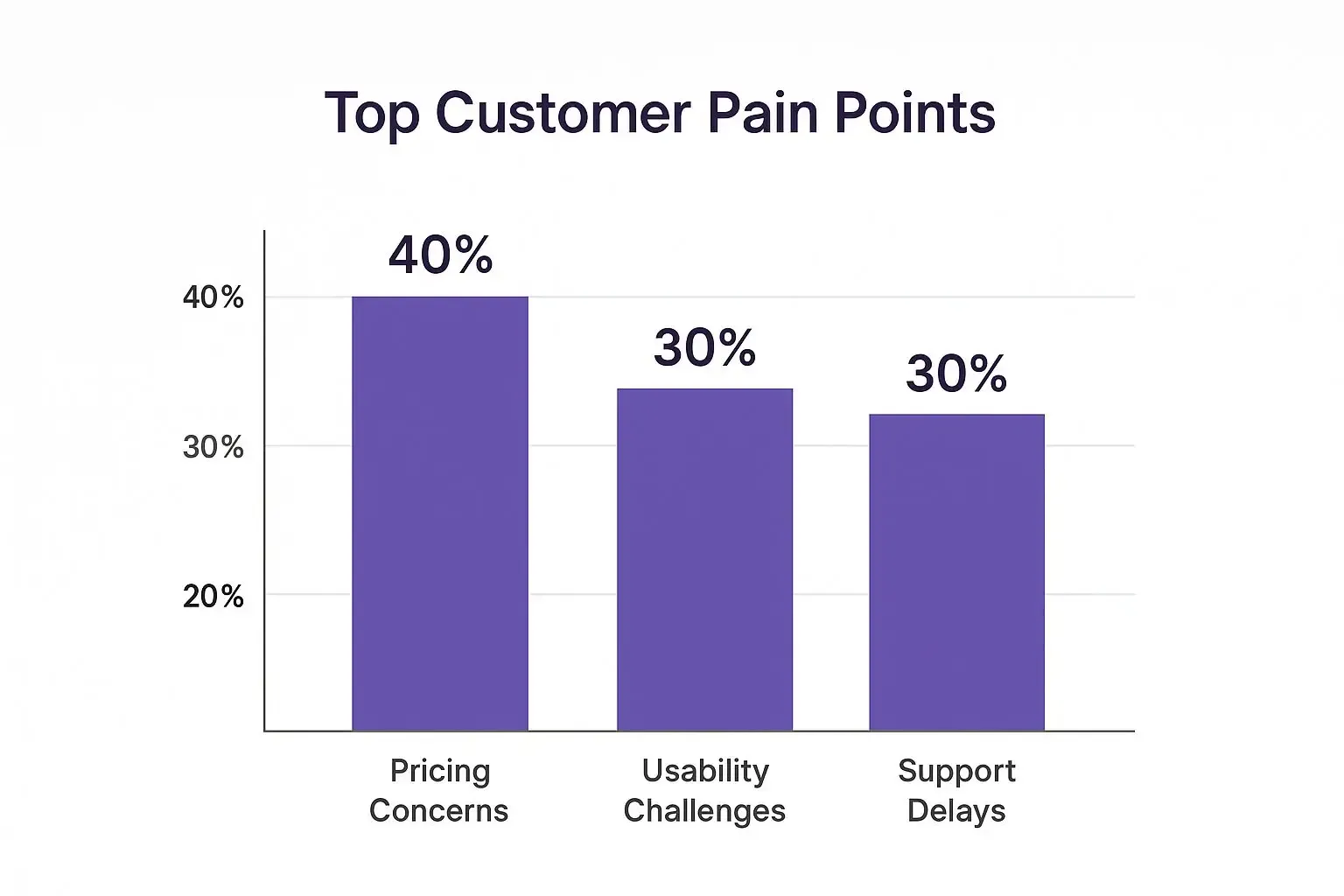
This infographic shows the top customer pain points from some recent interviews I conducted. Pricing concerns came up 40% of the time, usability challenges 30%, and support delays also at 30%. Clearly, pricing is a major concern, which suggests we might need to adjust our pricing models or do a better job communicating the value we offer. However, the significant numbers for usability and support also point to opportunities to streamline the user experience and improve our customer service responsiveness.
Data like this is invaluable.
As you conduct more interviews, start looking for recurring themes. What patterns emerge across different conversations? This helps validate your findings and prioritize the most pressing issues. But be mindful of bias. Make sure you’re talking to a diverse group of customers, not just the vocal minority or your biggest fans. This gives you a much more accurate picture of widespread pain points.
The following table summarizes various customer interview techniques, their effectiveness, and when they’re best used:
Interview Type Best For Time Required Insight Quality Cost One-on-One Interviews In-depth understanding of individual experiences High (1-2 hours per interview) High Medium Focus Groups Gathering diverse perspectives on a specific topic Medium (2-3 hours per group) Medium Medium-High Surveys Collecting quantitative data from a large sample Low (15-30 minutes per survey) Low-Medium Low Social Listening (e.g., with Octolens) Understanding public sentiment and trends Low (ongoing monitoring) Medium Low-Medium
This table clearly shows the trade-offs between different methods. One-on-one interviews offer rich insights, but require a significant time investment. Surveys are quicker and cheaper, but may not uncover the deeper "why" behind customer behaviors.
Remember, the goal is to understand the real problems your customers face, not just the ones they’re comfortable talking about. This takes time, effort, and a genuine desire to listen. But trust me, the insights you gain are worth their weight in gold.

Let's be honest, customer surveys can be a bit…fluffy. People are generally inclined to be nice, telling you what they think you want to hear, not what they really feel. This makes uncovering true customer pain points a real challenge. One of the best ways to get genuinely actionable data is to proactively collect customer feedback and design surveys that ditch the pleasantries and get to the heart of the issue. In my experience, it all boils down to how you structure those questions.
Companies like Buffer and Intercom are masters of this. They understand that frustration often simmers beneath the surface of polite responses. They go beyond simple satisfaction questions and tap into the emotional side of the user experience. Instead of a generic "Are you satisfied?", they might ask, "What's the biggest frustration you face when trying to [achieve specific outcome]?". This encourages more specific, actionable feedback.
It's not just what you ask, but when you ask it. Timing is everything. Imagine someone just spent 20 minutes on hold with customer support. That’s the perfect moment to capture their raw, unfiltered feedback. They’re far more likely to be honest right then than a week later when they’ve cooled down and received a generic survey. Capture those in-the-moment reactions for the best insights.
No one wants to spend their precious time wading through a never-ending survey. Keep it concise and laser-focused on a specific topic. A good rule of thumb? Five to seven well-crafted questions are usually more than enough to unearth some seriously valuable insights.
Think quality over quantity. Longer surveys usually lead to lower completion rates and rushed, less thoughtful responses. People just want to get it over with. This results in incomplete or inaccurate data, making it harder to address the real pain points.
Analyzing survey responses isn’t just about crunching numbers. It's about digging deeper, looking for patterns, and understanding the why behind the answers. Don't just look at the surface level; search for recurring themes and emotional cues hidden within the responses.
A few scattered negative comments might not be a red flag. However, if you see the same complaint popping up again and again, you know you’ve stumbled upon a significant pain point. For instance, if several users complain about a feature's complexity, it might be time to simplify the design or offer better tutorials. Online communities and forums can also be goldmines for identifying and addressing customer pain points. You might even be interested in: why keyword monitoring is important.
Even small tweaks in your survey design and delivery can drastically improve the quality of your insights. By asking the right questions at the right time, keeping surveys concise, and analyzing responses for emotional cues and recurring themes, you can gain a much deeper understanding of your customers' real needs and frustrations.
Survey Techniques - Watch on YouTube
Think about it: when was the last time you meticulously filled out a customer satisfaction survey? Now, when was the last time you vented online about a terrible experience? See the difference? People are way more open and honest online, sharing their raw experiences across platforms like Facebook groups, Reddit threads, Twitter, and niche forums. This is a treasure trove of unfiltered customer feedback, often revealing pain points you'd never uncover through traditional methods.
Knowing where to look and how to listen is the name of the game. You want insights, not to come across as Big Brother. Monitoring relevant hashtags, participating in industry forums, and keeping an eye on brand mentions are great starting points. They give you a consistent flow of valuable data. Tools like Octolens can supercharge this process, letting you track mentions and analyze sentiment across various platforms. I've used Octolens myself and it's been invaluable in identifying brewing customer frustrations before they blow up into PR nightmares. Imagine catching a negative trend early and addressing it proactively – talk about impactful!
One major pain point I've seen repeatedly revolves around subpar customer service. I'm talking long hold times, having to re-explain your issue to five different people – the usual suspects. In fact, nearly 60% of customers find long wait times to be the most frustrating aspect of customer service. And a whopping 72% hate having to repeat their story over and over. This highlights a massive opportunity to improve the continuity and efficiency of service delivery. Check out these customer service stats for more context. Smart companies don't just see these online complaints as negativity; they see them as a roadmap for improvement. They turn negative feedback into a competitive edge, prioritizing product changes based on what real customers are saying.
Of course, not every online comment is a sign of a widespread issue. You need to distinguish between the vocal minority and genuinely important concerns. This involves looking for patterns and recurring themes. Is the same complaint popping up everywhere? Is the overall sentiment strongly negative? Does it seem to be impacting a specific group of customers? This helps determine if the problem is limited or the norm. Thinking about which social networks you focus on is important too – check out our guide on how to choose the best social networks for your business. By analyzing the volume, frequency, and context of these online discussions, you'll start to see the bigger picture and zero in on the pain points that truly matter. The goal isn't just to gather data, but to understand the why behind it. What are your customers really trying to tell you?
.jpg&w=3840&q=75)
Numbers can be deceiving. They often present a limited perspective. Truly understanding customer pain points means connecting the dots between different data sources to get the full picture of what’s frustrating your users. Think of it like assembling a jigsaw puzzle. Each piece on its own might not tell you much, but put them together and you see the bigger picture.
So, how do you actually do this? Let’s talk about some practical ways to analyze things like support tickets, user behavior data, and direct feedback to uncover hidden patterns. I’ve seen firsthand how seemingly minor issues can mask bigger problems. I once worked with a SaaS company struggling with a high volume of support tickets for Feature A. On the surface, it seemed like a small problem.
But when we dug deeper, we found something interesting. The users contacting support about Feature A were also having trouble with Onboarding Process B, a completely separate part of the product. By connecting these two seemingly unrelated data points, we realized the real pain point wasn't Feature A itself, but the inadequate onboarding that prevented users from understanding how to use it.
Once you've identified some potential pain points, you need to figure out how big of a deal they really are. This is where quantification and prioritization come in. It’s not just about counting how many times something came up. You need to ask: How many customers are actually affected? How much does this issue impact their experience? What's the potential cost to your business if you don't fix it? Keeping an eye on your user generated content strategy can also give you a direct line into customer pain points discussed in online forums and social media. This helps you separate minor inconveniences from major roadblocks so you can focus your energy where it matters most. Some problems need immediate attention, while others can wait.
Another key piece of the puzzle is segmentation. Analyzing your data by customer type, usage patterns, or journey stage can uncover hidden nuances you’d miss if you just looked at the overall data. For example, imagine a feature that’s causing a lot of frustration for new users, but not for experienced users. By segmenting your analysis, you can zero in on pain points affecting specific groups, allowing for more targeted solutions.
To help you choose the right methods for uncovering those pain points, I've put together this table summarizing different analysis techniques:
Pain Point Analysis Methods
Overview of different data analysis techniques and their effectiveness for identifying various types of customer pain points
Analysis Method Pain Point Type Data Source Accuracy Level Implementation Effort Support Ticket Analysis Usability, Bug Reports, Feature Requests Support Tickets, CRM High Low User Behavior Analysis Usability, Navigation Issues, Feature Adoption Website Analytics, Product Usage Data Medium Medium User Interviews In-depth understanding of motivations and frustrations Direct Customer Interviews High High Surveys Quantifying pain points and gathering feedback on specific features Online Surveys, Email Surveys Medium Low Social Listening Identifying trending topics and sentiment around your brand/product Social Media, Forums, Review Sites (Octolens) Medium Low
This table provides a quick reference for choosing the most appropriate methods based on your resources and the type of pain points you're looking to uncover. User interviews, while requiring more effort, provide rich qualitative data, whereas support ticket analysis offers readily available insights into immediate usability issues.
Data analysis isn't just about number crunching; it's about storytelling. By connecting the dots between different sources, quantifying pain points, and segmenting your analysis, you can gain a much deeper understanding of your customers' needs and frustrations. And ultimately, that understanding translates into more effective product improvements that truly make a difference.
Finding pain points is exciting, but it’s easy to get carried away. I’ve seen so many companies trip up at this stage. They think they’ve nailed the problem and dive headfirst into building a solution, only to realize they completely missed the mark. I remember one team who spent months developing a complex feature that technically solved the problem, but didn’t actually address the underlying customer need. They built a high-tech mousetrap when a simple spring-loaded one would have done the trick.
Before you sink time and money into building anything, validate your findings. This means going beyond your initial research and really testing your assumptions about problem severity and solution fit. Here are a few ways to do that:
Distinguish between complaints and willingness to pay. People might grumble about minor inconveniences, but are they actually willing to pay to fix them? That’s the real question. Think about it: how many times have you complained about something but haven’t actually taken any steps to change it?
Prototype your solution. This doesn't need to be a fully functional product. A rough mockup, a storyboard, even a hand-drawn sketch can be enough to get feedback and see if you’re on the right track. I once used sticky notes and a whiteboard to prototype a complex workflow, and it was surprisingly effective!
A/B test different approaches. This is where you can really see what resonates with your target audience. Try different messaging, different layouts, different features. Let the data guide your decisions, not your gut.
Validation isn't a one-and-done activity. It's an ongoing process. Even after launch, keep checking in with your customers. Are they using the feature? Are they getting the value you promised? Are there unintended consequences you didn’t anticipate?
Ongoing validation might involve analyzing user behavior data, tracking support tickets, or conducting follow-up interviews. The goal is to build something that truly works in the real world.
Different stakeholders often have different ideas about which pain points are most critical. Sales might focus on closing deals, while Product obsesses over new features. Marketing might worry about brand perception, while Customer Support drowns in tickets. Getting everyone on the same page can be tricky.
Building consensus requires clear communication, data-driven decisions, and a shared understanding of your business goals. This might mean presenting your findings clearly and concisely, running workshops to brainstorm solutions, or creating a prioritized roadmap that everyone can agree on. It’s a collaborative effort, not a top-down mandate. By involving everyone in the process, you’re much more likely to build solutions that address the right pain points and drive meaningful results for your business.
Ready to really understand what makes your customers tick? Let's build a system for uncovering their pain points—one that fits your resources and schedule. Forget massive teams and budgets; this is about smart, consistent effort. Think of it as fine-tuning an engine for peak performance.
This isn’t about adding another item to your overflowing to-do list. Instead, we’re weaving pain point discovery into your everyday work. We'll start small and scale up as you grow—like tending a garden, nurturing it bit by bit.
What does that look like in practice?
Strategies you can use this week. Forget theory; this is about actionable advice you can put into practice immediately.
Realistic timelines. Building a customer-centric business takes time. We’ll set achievable goals and celebrate wins along the way.
Clear metrics for success. How will you know it’s working? We'll define measurable goals so you can track progress and prove the value of this work.
Hit a snag? Low survey responses? Conflicting feedback? It happens. We'll cover troubleshooting tips for common challenges, helping you navigate those tricky spots. And as your business expands, your approach should too. We'll give you the frameworks to scale your pain point discovery process, keeping it effective as your customer base grows.
This screenshot shows Octolens’s dashboard, pulling data from various sources. Notice the range of platforms, from X (formerly Twitter) and Reddit to niche communities like Hacker News and Stack Overflow. This wide reach helps you capture a complete picture of customer conversations. Having it all in one place simplifies the task of tracking online discussions.
Each part of your plan will have clear deliverables and checkpoints. You'll know exactly what success looks like at each stage. It’s like climbing a mountain—each base camp is a milestone, giving you a sense of accomplishment and keeping you motivated.
Ready to listen? Octolens is an AI social listening tool built for B2B SaaS. It surfaces hidden pain points by tracking keywords across social media, giving you insights to build products your customers truly love. Learn more about how Octolens can help you identify customer pain points and fuel your growth.