
A Guide to Using a Social Listening Tool
Learn how to use a social listening tool to monitor conversations about your brand, track competitors, and turn online chatter into actionable business insights for your B2B SaaS.

Imagine being able to tune into every important conversation about your brand, your competitors, and your industry as it happens online. That's the real power of a modern social listening tool—it cuts through the internet's overwhelming noise and hands you clear, strategic signals for your business.

Let's get straight to the point. People often throw "social listening" and "social monitoring" around as if they're the same thing, but they are fundamentally different.
Here's a simple way to think about it: social monitoring is like collecting newspaper clippings every time your name is mentioned. It tells you what people are saying. Social listening, on the other hand, is like having a team of analysts tell you what all those clippings actually mean for your business. It gets to the why behind the chatter.
That deeper level of insight is what turns raw data into a genuine competitive advantage, especially in the fast-moving B2B SaaS world.
A great social listening tool does far more than just count your brand mentions. It deciphers the context, emotion, and intent behind conversations, giving your teams the intelligence they need to make smarter, faster decisions.
For example, you can:
- Improve Customer Support: Catch customer frustrations the moment they surface on forums and respond before they snowball into bigger issues.
- Guide Product Development: Discover unfiltered feedback on Reddit or X to understand what features your users actually want, not just what they say in surveys.
- Protect Your Brand Reputation: Spot a sudden spike in negative sentiment that could signal a looming PR crisis, giving you precious time to get ahead of the story.
A social listening tool gives you a front-row seat to the real, unprompted conversations that define your brand. It's about understanding the market, not just tracking keywords.
This strategic approach helps you zero in on the conversations that truly matter. Instead of getting lost scrolling through endless feeds, you get targeted alerts on high-signal discussions. This is crucial for figuring out which social networks to start with when you're just getting going.
Ultimately, social listening helps you shift from being reactive to proactive. You're no longer just putting out fires; you're anticipating market shifts, identifying competitor weaknesses, and uncovering opportunities your rivals completely miss.
To really get what a modern social listening tool can do, you have to look under the hood. It's not just a long list of features; it's about what those capabilities actually do for your team day in and day out. Think of it less like another gadget and more like a skilled intelligence analyst working for you 24/7.
These tools are really built on a few core functions that work together to paint a complete, real-time picture of your online world. Once you understand them, the tech becomes a lot less mysterious, and you can see the practical value each one brings.
At its heart, social listening is all about speed. Real-time monitoring means the platform catches relevant conversations the moment they happen—not hours or days later when the opportunity has passed. You simply set up alerts for keywords, like your brand name, competitor products, or specific industry pain points, and the tool delivers them right to you.
This immediate awareness is a total game-changer for fast-moving teams.
- Catch customer issues instantly: When a user posts about a bug on X or Reddit, you can jump in to help before their frustration boils over.
- Join timely conversations: Spot a discussion about a problem your B2B SaaS solves and offer helpful advice, positioning your brand as an expert.
- React to competitor news: Get an alert when a rival launches a new feature or gets bad press, letting you adapt your strategy on the fly.
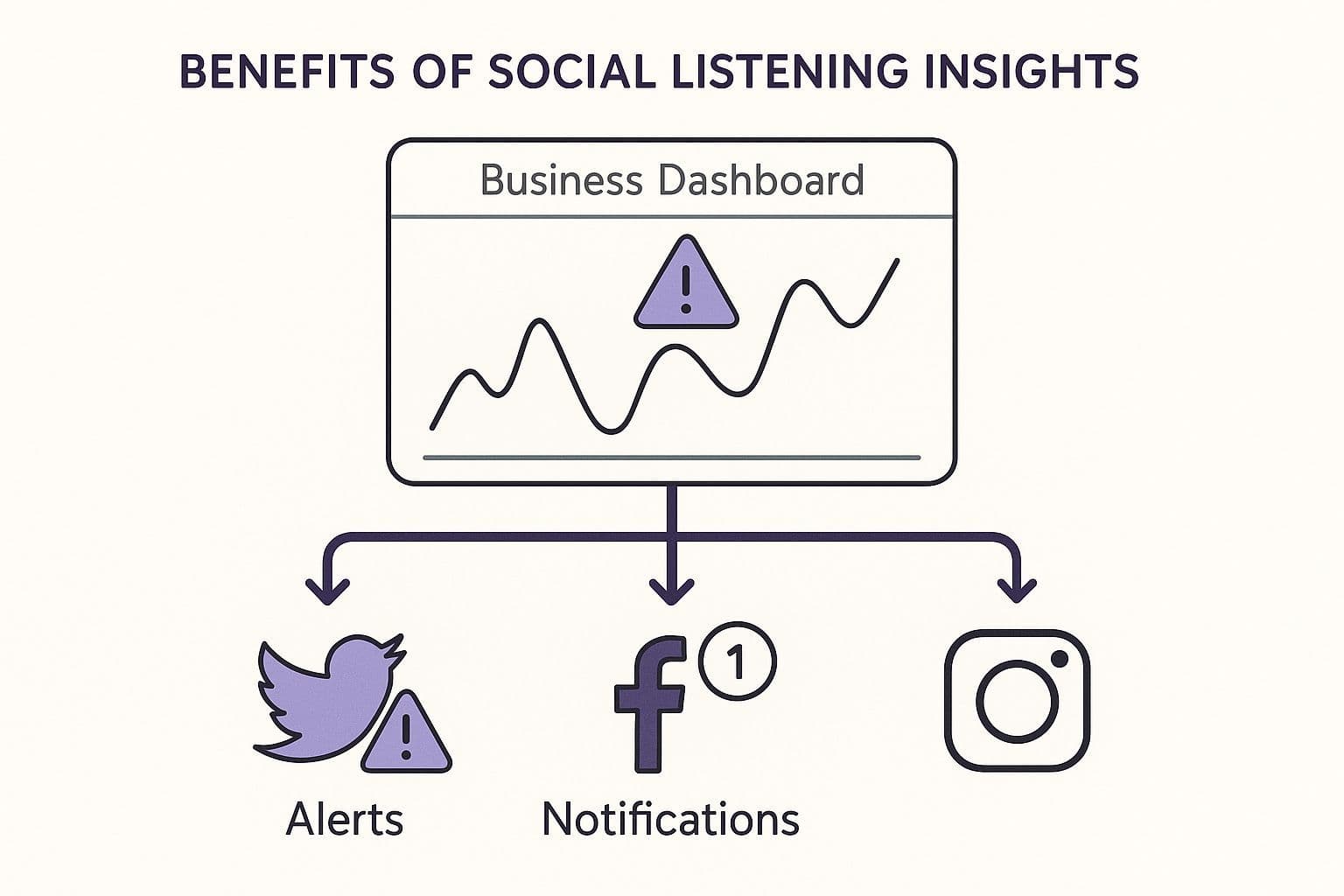
This kind of visualization shows how quickly a brand can be notified of conversation spikes, turning what looks like chaotic online chatter into organized, actionable intelligence.
Beyond just finding mentions, a powerful tool analyzes the emotion behind them. Sentiment analysis uses AI to figure out if a conversation is positive, negative, or neutral. This goes way beyond a simple keyword match, helping you understand the collective mood of your audience at a glance.
Sentiment analysis is your early warning system. A sudden dip in positive sentiment can alert you to a brewing PR crisis, while a spike can show that your latest marketing campaign is really hitting the mark.
Finally, competitive tracking gives you a clear benchmark to measure against. By monitoring your competitors' mentions, you can see how your share of voice stacks up, pinpoint their customers' biggest complaints, and spot gaps in their product that you can pounce on.
To better connect these features to actual business outcomes, let's break them down.
This table outlines what these key functions do and, more importantly, what they mean for your bottom line.
Feature What It Does for You Why It's a Game-Changer Real-Time Monitoring Catches keyword mentions across platforms as they happen. Lets you react to customer issues, sales opportunities, and PR crises in minutes, not days. Custom Alerts Sends notifications to your email or Slack when a mention is found. Keeps your team in the loop without having to live inside the tool, ensuring no opportunity is missed. Sentiment Analysis Uses AI to classify mentions as positive, negative, or neutral. Provides a high-level view of brand health and acts as an early warning for reputational threats. Competitive Tracking Monitors mentions of your competitors' brands and products. Uncovers competitor weaknesses, customer complaints, and strategic gaps you can exploit.
These capabilities are exactly why the social listening tool market has exploded. Brands increasingly rely on these platforms to manage their reputation and gather real-time feedback that feeds directly into product development.
In fact, the market was estimated at USD 9.2 billion in 2024 and is only growing. If you're curious, you can read the full research about the social media listening market to see how it's projected to hit USD 20.18 billion by 2030.
Artificial intelligence is the secret ingredient that turns a decent social listening tool into an indispensable business intelligence engine. Not too long ago, these tools were pretty basic. They were limited to simple keyword matching, which meant they often flagged a ton of irrelevant mentions while completely missing the conversations that actually mattered.
Thankfully, AI has completely changed the game.
Modern AI, especially the sophisticated language models we see today, acts as a powerful analysis layer over all that noise. It can understand the subtle nuances of human conversation in a way that older tech just couldn't touch.
This means the tool can finally tell the difference between genuine praise and biting sarcasm. It can spot a user's frustration even when they don't bother to @mention your brand. It's the difference between just collecting data and actually understanding what it means.
By sifting through enormous amounts of information, AI uncovers patterns and connections that a human analyst could easily miss. This capability is what shifts social listening from a purely reactive chore to a predictive strategy.
The real magic of an AI-powered social listening tool is its ability to deliver much more accurate and actionable intelligence. Instead of just flagging a keyword, it looks at the entire conversation for context, intent, and emotion.
This unlocks a few key advantages:
- Smarter Trend Identification: AI can spot emerging topics of conversation in your industry long before they hit the mainstream. This gives you a serious head start on creating relevant content or even developing new product ideas.
- Proactive Crisis Management: It can detect a sudden spike in negative sentiment around a specific topic, acting as an early warning system for potential PR fires.
- Deeper Sentiment Analysis: The technology goes way beyond a simple "positive/negative" rating. It can understand more complex emotions like confusion, excitement, or disappointment, giving you a much clearer picture.
This isn't just a theoretical upgrade; the integration of advanced AI has made a huge, measurable difference. Technologies like large language models have boosted sentiment analysis accuracy to 93%, leaving older methods in the dust.
This huge jump in precision is a big reason why crisis management has become such a fast-growing use case. It allows brands to build truly reliable early-warning systems for reputational risks. You can learn more about AI's impact on social listening and see the data for yourself.
Ultimately, AI turns a social listening tool from a simple notification service into a strategic partner. It helps you understand not just what people are saying, but why they're saying it—giving you the clarity you need to make much smarter business decisions.
Knowing the theory is one thing, but seeing how a social listening tool actually shapes business decisions is where the magic happens. For B2B SaaS teams, this isn't just about keeping tabs on your brand name. It's about plugging directly into the honest, unsolicited conversations happening all over the internet, every single day.
Let's get out of the abstract and into a real-world playbook. Here's how different teams can use social listening to fix specific problems and jump on opportunities they'd otherwise miss.
Your product roadmap shouldn't be a guessing game. Surveys and scheduled interviews are great, but they often lack the raw, unfiltered feedback people share when they think no one from the company is listening. This is where a social listening tool becomes a product team's secret weapon.
Forget just tracking your brand name. Start monitoring keywords tied to common user frustrations or feature wishes.
- Track "problem" keywords: Set up alerts for phrases like "so frustrated with [competitor's feature]" or "wish my CRM could just do X." This is a direct line into the pain points your product can solve.
- Monitor niche communities: Keep an eye on conversations happening in specific Reddit communities (like r/sysadmin or r/sales) or on Hacker News—wherever your ideal users are hanging out.
- Analyze competitor feedback: Listen for complaints about rival products. Those grumbles are strategic gaps you can fill in your next development cycle.
This approach turns random online chatter into a structured, continuous feedback loop, making sure your roadmap reflects what customers actually want.
Marketing teams can use social listening to stop shouting into the void with broad campaigns and start connecting with people at the exact moment they're looking for a solution. It's all about spotting the buying signals that are hiding in plain sight.
The trick is to listen for problems, not just your product name. For instance, a project management SaaS could track phrases like "our team collaboration is a mess" or "looking for a Basecamp alternative."
When someone publicly complains about a problem that your product solves, they're basically raising their hand as a high-intent lead. A social listening tool finds these conversations so you can slide in with a helpful, non-salesy comment.
This dashboard view from Octolens shows how you can organize and flag mentions, making it dead simple for teams to spot these chances and act on them fast.
This kind of focused tracking lets marketing teams engage prospects with genuinely useful advice, building trust long before a sales pitch is even on the table.
For any sales team, timing is everything. A social listening tool is like an early-warning system for buying signals, helping reps connect with prospects right when they're most open to a conversation. This is worlds away from cold outreach.
Here's how they can put it to work:
- Monitor "Switching" Language: Keep an eye on keywords like "[competitor] pricing increase" or "migrating from [rival platform]." These are flashing signs that an account is ready to make a change.
- Track Key Individuals: Follow the online conversations of key decision-makers at your target accounts. What are their priorities? What challenges are they talking about?
- Engage in Relevant Discussions: When a potential lead asks for software recommendations on LinkedIn or X, your team can be the first to jump in with an informed, helpful response.
This strategy shifts sales from a disruptive process to a helpful one. It's no surprise that 62% of marketers are now using social listening, and 55% plan to invest even more. The confidence is there because the results are, too; 76% of listeners on platforms like LinkedIn report high confidence in their ROI. You can discover more insights about social listening priorities and see why this is quickly becoming a must-have, not a nice-to-have.
Let's be honest: picking a social listening tool can feel like a chore. With so many options flashing slick dashboards and endless feature lists, it's easy to get sidetracked. The secret? Ignore the noise. Focus on a few core questions that tie what a tool can do to what your team actually needs.
The whole point is to find a platform that slots right into your existing workflow, not one that forces you to change how you operate. You want a tool that surfaces clear, actionable signals without adding more busywork to your team's plate.
Before you even glance at a pricing page, map out your non-negotiables. It's so easy to get sold on features you'll never touch. Instead, think about the fundamentals that will make a tangible difference, day in and day out.
Ask yourself these critical questions:
- What channels really matter? If your customers live on Reddit and X, a tool that only covers Facebook and Instagram is totally useless to you. Make a non-negotiable list of platforms.
- Do you need real-time data? For things like crisis management or jumping on a sales lead, getting alerts the second they happen is everything. If you just need a weekly report, a tool with a slight delay might be perfectly fine.
- Who is going to use this thing? Is your team full of data wizards, or do you need a super intuitive interface that anyone can master in five minutes? The best tool is the one people actually use.
Answering these questions first will help you build a realistic shortlist. It stops you from overpaying for a bloated, enterprise-level suite when a sharp, focused solution is all you really need. To see how different platforms compare, check out our breakdown of the 5 best social listening tools for B2B.
A good social listening tool should grow with your company and plug seamlessly into the rest of your tech stack. A platform that can't talk to your other tools is just going to create frustrating data silos and a bunch of manual copy-paste work.
Think about how well a potential tool plays with others. Does it integrate with Slack, so your team gets alerts right where they're already working? Can it connect to your CRM to help the sales team track leads from conversations? Smooth integrations are the hallmark of a tool built for efficient, modern teams.
The good news is that the rise of cloud-based platforms has made this easier than ever, offering scalability and simpler connections for businesses of all sizes. This shift is a huge reason why smaller and mid-sized businesses are adopting these tools so quickly. You can discover more insights about social listening market growth to get a sense of this trend.
Finally, think about where you'll be in a year or two. The tool that's perfect today should still be a great fit as your team expands and brand mentions multiply. Choosing a platform that can scale saves you the massive headache of having to switch vendors down the line.
Jumping into social listening can feel like learning a new language. It's a seriously powerful strategy, but it's easy to get tangled up in the terminology. Let's clear up some of the most common questions people ask when they're getting started.
Think of these as the quick-start answers to help you see exactly how a good social listening tool fits into your team's day-to-day.
This is, without a doubt, the most common point of confusion. The good news? The distinction is simple, and it's critical to understand.
Think of it this way: monitoring is the act of collecting data. It's reactive. It tells you what happened by gathering mentions, tags, and specific keywords.
Listening, on the other hand, is about analyzing that data for insights. It's proactive. It tells you why something happened and what you should do about it. A great social listening tool goes beyond just collecting mentions to analyze the sentiment, context, and trends behind them. To really get into the weeds, you can explore the full breakdown of social listening vs monitoring in our guide.
This is where the strategy moves from defense to offense. Instead of just tracking your own brand, you start tracking keywords and phrases related to the problems your product solves. Suddenly, your listening efforts become a lead-generation machine.
You can set up alerts for buying-intent phrases like:
- "Need an alternative to [competitor's name]"
- "How can I automate [specific task]?"
- "Does anyone know a tool for [solving a problem]?"
This proactive approach lets you find people actively searching for a solution. You can join the conversation at the perfect moment—offering genuine help, not a cold sales pitch.
By doing this, you're not just waiting for customers to stumble upon you. You're meeting them exactly where they are, right when they need you.
They definitely used to be. The first generation of tools was often clunky, complicated, and required a data scientist to make any sense of them. But modern tools are a completely different story.
Most are now built with intuitive dashboards that make getting started incredibly simple. At its core, the setup is just telling the tool what keywords you want it to track. While mastering advanced features—like building complex Boolean queries for ultra-specific searches—might take a bit of practice, you can start pulling valuable insights almost immediately. The best platforms deliver value right out of the box.
Absolutely. In fact, it's one of its most valuable functions. A PR fire doesn't just appear out of nowhere; it usually starts as a small but growing wave of negative conversation online. By the time it hits the mainstream news, you're already in damage control mode.
A real-time social listening tool acts as an early warning system. It can detect a sudden, unusual spike in negative sentiment around your brand long before it spirals out of control. This gives your team a critical heads-up, allowing you to investigate and address the issue before it explodes into a full-blown crisis that tarnishes your reputation.
Ready to cut through the noise and catch every conversation that matters? Octolens surfaces the high-signal mentions your B2B SaaS team needs to see across Reddit, X, Hacker News, and more—delivered right to your Slack. Start your free trial today.