
Your Guide to Brand Monitoring Software
Discover how brand monitoring software gives you the power to protect your reputation and understand your customers. Learn how to choose the right tool.
Let's cut through the jargon. Imagine you could hear every single time someone mentioned your brand, your product, or even your competitors online—the second it happens. That's pretty much what brand monitoring software does. It’s like having a dedicated scout for your company, constantly scanning social media, news sites, forums, and review platforms to keep you in the loop.
Think of brand monitoring software as a supercharged news feed, custom-built for everything related to your brand online. Its job is to automatically track down mentions of specific keywords—like your company name, products, or key people—from all corners of the internet.
This goes way beyond setting up a simple Google Alert. A basic alert might tell you when a major news outlet publishes an article, but a dedicated tool digs much deeper, surfacing conversations you'd almost certainly miss otherwise.
The real magic of a good brand monitoring platform is its reach. It’s constantly scanning a huge range of sources to give you the full picture. These platforms typically cover:
- Social Media: Catching mentions on places like X (formerly Twitter), Reddit, and Bluesky where people share raw, unfiltered opinions.
- News and Blogs: Tracking coverage from major publications and the niche industry blogs that your audience actually reads.
- Forums and Communities: Tapping into specialized communities like Hacker News or industry forums where detailed product feedback is worth its weight in gold.
- Podcasts and Newsletters: Monitoring spoken-word content and curated newsletters, which are often hotspots for influential commentary.
- Review Sites: Keeping an eye on what customers are saying on platforms that directly impact buying decisions.
We live in a world where a single Reddit thread can change a product roadmap and one tweet can ignite a PR crisis. Just being reactive isn't good enough anymore; you have to be proactive. This is where the right tool helps you listen to the digital conversation, not just broadcast into it. It’s a crucial difference, which you can read more about in our guide on social listening vs. monitoring.
The goal isn't just to see that you were mentioned. It's to understand the context, the sentiment, and the potential impact of that mention. It lets you protect your reputation, get brutally honest feedback, and spot opportunities before your competitors even know they exist.
The growing need for this kind of insight is why the market is booming. The global brand monitoring tools market hit a value of around $0.68 billion in 2024 and is projected to climb to $1.51 billion by 2033. This surge is all about the increasing weight of online reputation and big leaps in what we can do with data analytics.
A long list of features doesn't automatically make a brand monitoring tool useful. To find software that delivers real value, you have to cut through the noise and focus on the functionalities that directly solve problems. These are the core features that turn raw data into something you can act on.
This breakdown covers the essential features that form the backbone of any effective brand monitoring strategy.
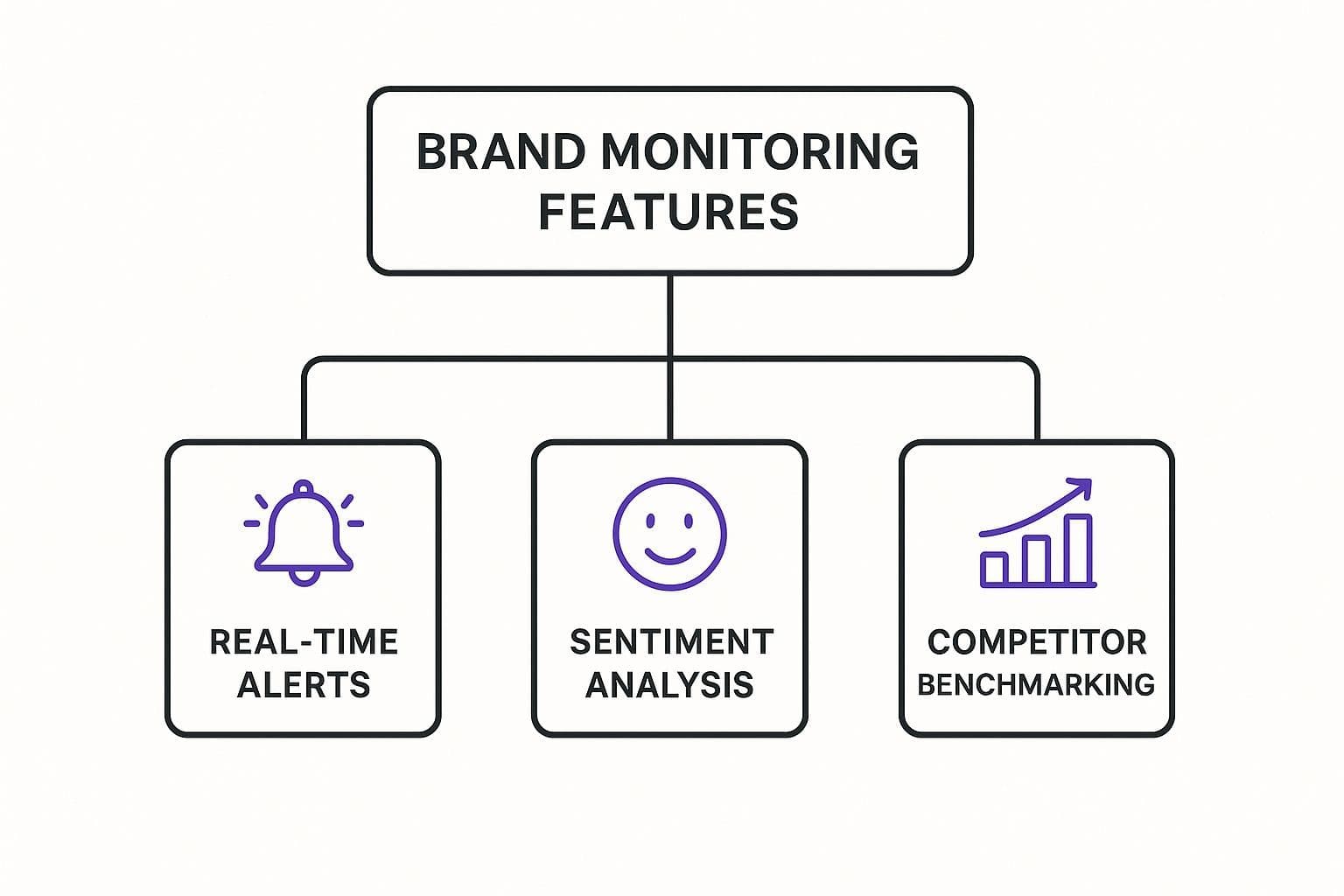
As you can see, a complete monitoring approach relies on these three pillars working together to give you a full picture of your brand's health.
Imagine finding out about a customer complaint on Reddit hours after it has spiraled into a massive thread. By then, it’s damage control. Real-time alerts are your first line of defense, sending instant notifications to your team—via Slack, email, or webhooks—the moment a critical mention happens.
This isn’t about getting a daily summary. It’s about speed. When a key influencer praises your new feature or a frustrated user reports a bug, you need to know now so you can join the conversation, not tomorrow.
Going beyond just counting mentions, sentiment analysis uses AI to figure out the emotion behind the words. It buckets mentions as positive, negative, or neutral, giving you a quick pulse check on how people feel about your brand. But its real power is in the details.
For instance, a sudden spike in negative sentiment isn't just a bad sign; it’s a diagnostic tool. It can help you spot a brewing customer service storm, identify a confusing part of your new UI, or catch a wave of bad reviews before they tank your ratings.
The goal of sentiment analysis is to move from what people are saying to why they're saying it. It helps you find your most passionate fans and address the core issues that frustrate your customers.
You don't operate in a vacuum. A solid brand monitoring tool lets you keep an eye on your rivals by tracking their mentions, product launches, and customer feedback. Think of it as gathering competitive intelligence, done ethically and efficiently.
By setting up alerts for your competitors' names, you can:
- Pinpoint their weaknesses: See what their customers are complaining about and find gaps in the market you can fill.
- Learn from their wins: Analyze what they’re doing right, from a killer marketing campaign to a beloved product feature.
- Spot emerging threats: Notice when a new competitor starts gaining traction in conversations where you used to dominate.
This turns monitoring from a purely defensive play into a proactive strategy for gaining an edge.
The conversations that matter most are often happening in niche communities, not just on mainstream social media. A top-tier tool scans a wide array of platforms to make sure you're getting the complete story. You need to know what sources and keywords you can monitor to make an informed choice.
The best tools cover a diverse range of sources, and some are more important than others depending on your industry.
A feature set is just a list until you understand what each component does and, more importantly, why it helps your business. Here’s a quick breakdown of the essentials.
Feature What It Is Why It Matters Real-Time Alerts Instant notifications (Slack, email) when your keywords are mentioned. Lets you engage immediately, handle damage control, and capitalize on positive buzz. Sentiment Analysis AI-driven classification of mentions as positive, negative, or neutral. Moves beyond simple mention counts to give you a true read on brand perception. Competitor Tracking The ability to monitor keywords and mentions related to your rivals. Uncovers market gaps, reveals competitor strategies, and helps you learn from their moves. Source Coverage The range of platforms the tool monitors, from social media to niche forums. Ensures you're not missing crucial conversations where your most vocal customers hang out.
Ultimately, these features work together. Without broad source coverage, your alerts are incomplete. Without sentiment analysis, you don't know which mentions to prioritize. And without competitor tracking, you're only seeing half the playing field.

Let's be clear: investing in brand monitoring isn't just about playing defense. It's one of the most proactive, strategic moves you can make. You shift from passively managing your brand to actively shaping where it goes next, all based on what people are saying right now.
Think of it as having a direct line to your market, giving you the unfiltered truth about how people really see you. When you have a constant stream of this feedback, you can move faster and make smarter decisions than competitors who are still guessing.
The market is catching on to this, big time. The brand tracking software market was valued at around $2.64 billion in 2024 and is expected to rocket to $6.73 billion by 2035. This boom is happening for one simple reason: more businesses are realizing they need this data to steer the ship.
Your brand's reputation is your most valuable asset, and in today's world, it's incredibly fragile. A single negative review tucked away on a niche forum or one misleading tweet can spiral out of control if you're not paying attention. Brand monitoring software is your early warning system.
Imagine a small but influential industry blog posts a critical review of your latest feature. Without monitoring, you might not hear about it for days. With real-time alerts, you're notified instantly. This gives you the chance to jump into the comments, offer a solution, and show everyone watching that you listen and care.
This is modern reputation management in a nutshell. It’s not about preventing criticism. It's about responding to it with speed and grace, turning a potential crisis into a masterclass in customer service.
Surveys and focus groups have their place, but they often lack the raw honesty of a spontaneous online conversation. The real gold is found where people share their true feelings—on platforms like Reddit, X, and specialized forums.
Brand monitoring software lets you tap directly into these conversations. You might discover users are creatively using a feature in a way you never intended, sparking an idea for a whole new marketing angle. Or, you could spot a recurring complaint about a minor bug that, once fixed, makes a world of difference to your users. This is feedback you can't buy.
How do you know if your latest marketing campaign is actually hitting the mark? Sure, you can track clicks and conversions, but brand monitoring tools measure something just as important: the conversation. You get to see how people are reacting to your messaging in real time.
By tracking campaign-specific hashtags and keywords, you get a clear picture of the sentiment out there. This helps you answer the big questions:
- Are people talking positively about our campaign?
- Is our message landing, or is it causing confusion?
- Which channels are driving the most meaningful chatter?
- How does our campaign's buzz stack up against our competitors?
This feedback loop allows you to adjust your strategy on the fly, doubling down on what works and cutting what doesn't. A key metric here is your share of voice in marketing, which tells you how much of the conversation you actually own.
Finally, don't forget that your brand monitoring software is also a powerful competitive intelligence tool. By keeping tabs on mentions of your rivals, you can see their strategies unfold as they happen.
You'll spot which new features their customers are raving about, what they're complaining about, and how they handle their own PR wins and fumbles. This isn't about copying them; it's about learning from their playbook. If you see a competitor getting praised for a new integration, it might just validate a similar idea on your roadmap. If their customers are fuming over a lack of support, it highlights a perfect opportunity for you to shine.
Knowing the features of brand monitoring software is one thing. Seeing how it actually gets put to work is where the magic happens. Smart companies aren't just collecting data; they're using these tools to solve real problems, improve their products, and connect with their customers.
Let’s move past the theory and dive into a few real-world scenarios. This is how a single online mention can become the spark for a major business win.
Picture a popular restaurant chain with locations scattered across the country. Sales look good on paper, but online reviews are all over the place. A high-level sentiment score just says "mixed," which is about as helpful as a fork in a soup bowl.
This is where brand monitoring shifts from a blunt instrument to a surgical tool.
The management team sets up alerts that track mentions of each restaurant alongside keywords like "slow service," "cold food," or "dirty." Suddenly, the fuzzy picture becomes crystal clear. They discover that just two of their locations are responsible for 80% of the negative feedback.
Armed with this specific insight, the operations team can swoop in exactly where they're needed. They can retrain staff, fix faulty equipment, and personally follow up with the unhappy customers from those branches. What started as a vague, company-wide problem is now a solved one.
For a B2B tech startup, honest user feedback is worth its weight in gold. They need to know what developers really think of their new API, but formal surveys often feel sterile and rarely capture raw, passionate opinions.
So instead of waiting for feedback to trickle in, the product team uses brand monitoring to listen in on the places where developers actually hang out—niche subreddits, Discord channels, and forums like Hacker News. They're not just tracking their product name, but also specific features and common problems their tool solves.
This approach delivers a constant stream of unfiltered gold:
- Discovering Hidden Use Cases: They find a developer on a small forum using their tool in a way they never even considered, potentially opening up a whole new market.
- Identifying Critical Bugs: A Reddit thread uncovers a nagging bug that early users were hitting but hadn't bothered to formally report.
- Learning Competitor Weaknesses: Users in these communities openly complain about why they switched from a rival product, highlighting specific pain points the startup can solve.
This firehose of feedback helps them iterate faster and build a product people actually want to use, all by tuning into conversations that were already happening. And it's not just about their own product; smart teams also monitor website changes for competitive intelligence to keep a close eye on the competition.
A trendy fashion brand knows that real people wearing their clothes sell more than any glossy ad campaign. The challenge? Finding a steady supply of high-quality, authentic user-generated content (UGC) without spending all day scrolling through Instagram.
By using brand monitoring software, the marketing team can automatically surface high-quality photos and videos from customers who have tagged the brand or mentioned specific products without using the official hashtag.
The software helps them filter these posts by engagement, instantly showing them the content that’s already getting traction. From there, they can easily reach out to these customers for permission to feature their content on the brand's own channels.
This simple strategy hits multiple goals at once. It gives them a never-ending stream of relatable content, builds a stronger community by celebrating their fans, and drives sales by showing real people loving their products. It’s a powerful, self-sustaining cycle fueled entirely by listening.
Feeling swamped by the sheer number of options for brand monitoring software? It's easy to get lost in a sea of feature lists and pricing tiers. The key is to step back from the sales pitches and start with a clear understanding of what you actually need.
Choosing the right tool isn’t about finding the one with the most bells and whistles. It's about finding the one that solves your specific problems, fits your workflow, and can grow with your business.
Before you even book a demo, grab a notepad and define your "why." What specific outcome are you trying to achieve? Your answer will dramatically narrow the field and point you toward the right solution.
Are you primarily focused on:
- Crisis Management? Your top priority is real-time alerts. You need a tool that can instantly ping your team on Slack or email the moment a high-stakes conversation starts brewing.
- Product Feedback? You'll want software with excellent source coverage, especially for niche communities like Reddit, Hacker News, or specific industry forums where unfiltered opinions live.
- Lead Generation? Look for features that help you identify buying signals—keywords like "can anyone recommend a tool for X?"—so your sales team can jump in at the perfect moment.
- Competitor Tracking? Your ideal tool will have robust dashboards that make it easy to benchmark your share of voice and analyze sentiment against your key rivals.
Knowing your primary goal stops you from overpaying for features you’ll never touch.
Brand monitoring software can range from free, basic tools to enterprise solutions costing thousands per month. Be realistic about what you can invest, not just in terms of money but also time. A complex platform might be powerful, but it's useless if your team doesn't have the bandwidth to learn it.
A simple, focused tool that gets used every day is infinitely more valuable than a complex suite that gathers dust. Prioritize usability over a laundry list of advanced features you may not need yet.
As your business grows, so will your monitoring needs. Ask potential vendors about their different pricing tiers and how easy it is to upgrade (or downgrade) your plan. You want a partner that can scale with you, not lock you into a rigid contract that no longer fits six months down the line.
The market is certainly growing to accommodate this. In fact, the brand intelligence software market was estimated at $1.2 billion in 2024 and is projected to hit $3.5 billion by 2033. This growth is fueled by the demand for scalable, data-driven brand management, with more insights on this trend available from Verified Market Reports.
Not all data is created equal. Where your audience talks is where you need to be listening. A tool that excels at monitoring X (formerly Twitter) is useless if your customers are all on niche subreddits or industry-specific blogs.
Before committing, create a checklist of your must-have sources. Then, during demos, ask vendors to show you real examples of mentions from those specific platforms. This simple test quickly separates the tools that truly deliver from those that just have a logo on their homepage. While you're at it, it's useful to compare platforms with existing lists of the best social media analytics tools to see how they stack up.
Finally, consider the user experience. A great tool should feel intuitive.
Questions to Ask Yourself During a Demo
- How long does it take to set up a new alert?
- Is the dashboard clean and easy to understand at a glance?
- Can I easily share a critical mention with my team in Slack?
- Does the interface feel fast and responsive, or clunky and slow?
Your brand monitoring software should make your job easier, not add another complicated task to your plate. By focusing on your goals, budget, and data sources, you can confidently choose a solution that delivers real, measurable value from day one.
Even after digging into all the features and benefits, you might still have a few questions rattling around. That’s completely normal. Let's tackle some of the most common ones I hear to clear up any final confusion.
Think of this as your quick-reference guide for the finer points. We'll get straight to the things people usually wonder about.
This is a classic question. While people often use the terms interchangeably, they’re really two sides of the same coin. The simplest way I explain it is this: brand monitoring is about the past and present, while social listening is about the future.
- Brand Monitoring is the act of collecting specific mentions—your brand name, your product, key people. It’s reactive and focused on what’s happening right now. For instance, "A customer just tweeted that their checkout failed." The goal is to see that tweet and respond.
- Social Listening is what you do with all that data. It’s the proactive process of analyzing the conversations to spot the bigger picture. It’s about trends, sentiment, and making smarter moves. For example, "We've seen a 15% spike in negative chatter about our checkout this month. We need to figure out what's broken."
In short, you monitor to find individual trees; you listen to understand the whole forest. You really can't have an effective strategy without doing both.
Discovering negative feedback can feel like a punch to the gut, but finding it is actually a massive opportunity. How you respond says far more about your brand than the original complaint ever could. The key is to have a game plan.
Here’s a simple, actionable framework to follow:
- Acknowledge Publicly, Resolve Privately: Jump on the public comment quickly. Something as simple as, "We're so sorry to hear this, and we want to make it right. I'm sending you a private message right now to get the details," shows everyone you’re paying attention.
- Move the Conversation Offline: Shift to DMs, email, or a phone call. This stops a public back-and-forth and respects the customer's privacy.
- Listen and Empathize: Seriously, just listen. Let them vent without interrupting. Show them you get why they're frustrated before you start offering solutions.
- Actually Solve the Problem: Whether it’s a refund, a bug fix, or a sincere apology, take real action to fix their specific issue. And always follow up to make sure they're happy with the outcome.
Ignoring negative feedback is the absolute worst thing you can do. One study found that 45% of consumers are more likely to visit a business if it responds well to negative reviews. A good response can turn a critic into a fan.
Absolutely. The old idea that brand monitoring is only for giant corporations with bottomless budgets is completely outdated. The market is now full of fantastic tools built specifically for startups and smaller teams.
Many modern brand monitoring software solutions offer flexible, tiered pricing that grows with you. You don't have to get locked into some bloated, enterprise-level suite with a million features you’ll never touch.
Feature Why It Matters for Small Businesses Scalable Pricing Plans are often based on mention volume, so you only pay for what you actually use. Focused Feature Sets Newer tools prioritize the core stuff, like real-time alerts, making them much easier to learn. Simple Integrations Getting alerts sent right to your Slack or email means you don’t need someone glued to another dashboard.
Instead of asking, "Can we afford it?" the better question is, "Can we afford not to know what people are saying about us?" For most small businesses, the cost of a basic monitoring tool is a tiny fraction of the cost of a single PR fire that could have been easily put out.
Octolens helps fast-moving B2B SaaS teams catch every critical mention—without the noise. It surfaces high-signal conversations across Reddit, X, Podcasts, Hacker News & more so you can protect your reputation and gather unfiltered feedback. Find out how it works at https://octolens.com.